Translate the Ask
The business asked for better analytics. Or attribution. Or a dashboard. Or pipeline visibility. Those are not the same ask. This lower-friction sprint turns vague stakeholder language into a concrete build plan your team can execute without guessing, rebuilding the wrong thing, or skipping the definition work a governed semantic layer eventually needs.
Give your team a build plan, not another ambiguous request
- Business questions translated into metric definitions, data models, and delivery priorities
- A clearer 90-day plan for what to build first and what can wait
- Less rework from building the wrong thing for the wrong stakeholder
- A cleaner handoff into Data Foundation, metric certification, or scoped implementation support
- A practical read on whether the ask should become a governed definition, dashboard fix, workflow build, or deferred request
This is for you if...
- The business keeps asking for better analytics but the real request is still fuzzy
- Your team is technically strong but stretched thin on business translation
- You want outside validation before committing engineering time
- You need a fixed-fee sprint that reduces rework and political confusion
This isn't the right fit if...
- You already have signed-off requirements and only need implementation labor
- You want a long requirements-gathering process with no hard prioritization
- The business stakeholders are unwilling to answer basic questions about the decision they are trying to improve
What you get
Translation document
Business questions mapped to metric definitions, models, source systems, and dashboard or workflow outputs.
90-day roadmap
A realistic sequence of what to build first, what depends on foundation work, and what should be deferred.
Stakeholder alignment
A concrete artifact you can use to confirm the business and data team are talking about the same thing.
Implementation path
A next step into Data Foundation, metric certification, Predictive GTM Models with Lift Proof, or scoped build support if the plan is solid. If the sprint rolls into build work, the translation artifact becomes the starting brief rather than a separate discovery tax.
Semantic-layer readiness
A clear call on which terms, grains, owners, and source systems must be certified before the request can safely become a dashboard, workflow, model, or AI-assisted answer.
How It Works
Interview
We talk to the business stakeholders asking for the work, not just the team being asked to deliver it.
Decode
We separate the literal ask from the decision, workflow, and metric they are actually trying to improve.
Map
We convert that into specific models, source dependencies, definitions, and outputs your team can build.
Prioritize
You leave with a tighter roadmap, clearer political cover for what should happen next, and a ladder path into build work only when the request is ready for it.
Not ready to book yet?
Get the framework we use to translate business asks into build plans
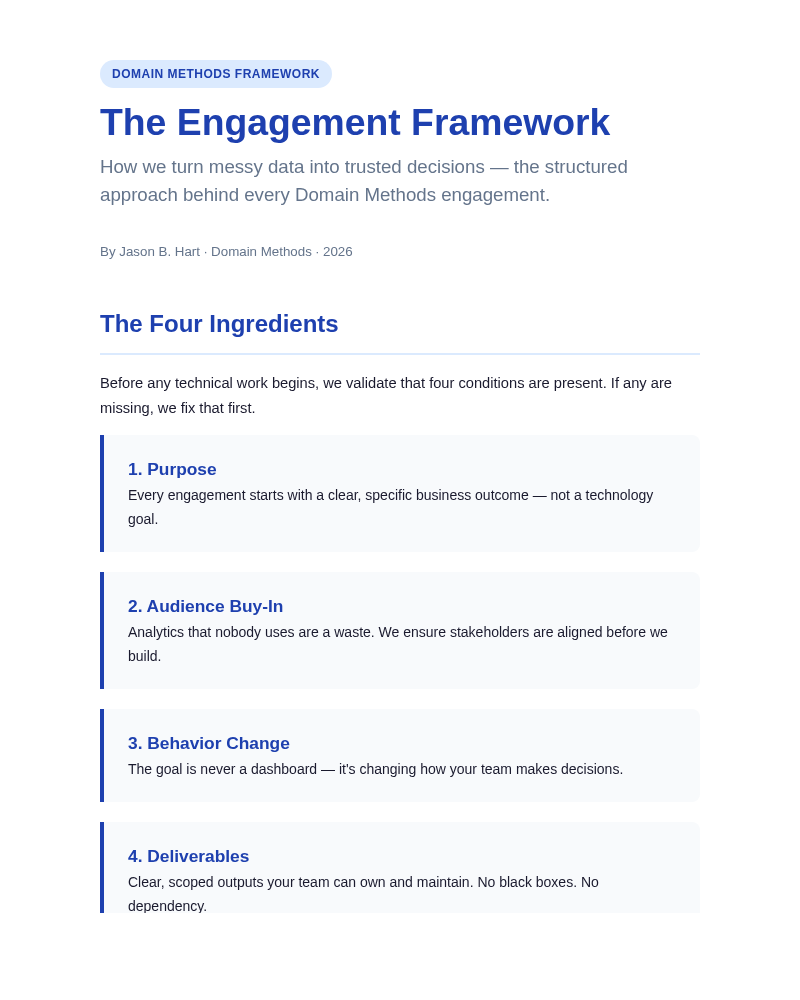
When stakeholders ask for better analytics, they usually mean three different things. This framework shows how we turn vague requests into concrete metric definitions and delivery priorities so your team stops building the wrong thing.
- How we separate the real question from the stated request
- The operating questions we ask before recommending a warehouse rebuild versus a quick reporting fix
- A practical way to align data, product, and leadership on what gets built first
Instant download. No email required.
Want future posts like this in your inbox?
This form signs you up for the newsletter. It does not unlock the download above.
Where this usually leads
Venture-Funded B2B Platform
Legacy ETL migration landed in 8 weeks without losing business logic
The migration worked because we translated the business logic before touching any infrastructure. Eight weeks from legacy ETL to BigQuery/dbt with nothing lost in translation.
Read case studyMid-Market SaaS Data Team
Pipeline reliability moved from constant firefighting to 99%+ uptime
The team knew the pipelines were fragile but couldn’t get alignment on what to fix first. We translated the business requirements into an executable plan — uptime went from firefighting to 99%+.
Read case studyReady to move up the ladder?
Need the full build, not just the translation?
If the sprint reveals that the underlying data infrastructure needs real work — source gaps, missing governance, brittle models, or uncertified metric definitions — Data Foundation turns the build plan into a production system.
Explore Data FoundationNot ready to book yet?
Start with the translation and partner-fit tools
If the ask is still fuzzy, use the worksheet group that turns vague requests and outside-help decisions into a clearer first move.
Go deeper on the build path
If the sprint shows the real issue is shared language, source ownership, or metric certification, the next move is Data Foundation or a scoped build — not more requirements theater.
See Data FoundationRelated Reading
- Data Audit vs Translation Sprint vs Full Warehouse Rebuild
- How to Translate Business Questions Into Data Requirements
- Request-to-Decision Translation Ladder
- Decision Surface Discussion Aid
- The Inherited Reporting Debt Triage Playbook
- Executive Answerability Benchmark
- Why Your Data Team and Your Marketing Team Don't Speak the Same Language
- Analytics Staffing Decision Worksheet
- dbt Core vs dbt Cloud Decision Worksheet
- dbt Project Health Scorecard
- dbt Consultant vs In-House Engineer Decision Guide
Common questions before booking this sprint
Is this just requirements gathering?
Who needs to be involved?
Can this still help if the internal data team will do the build?
What happens after the sprint?
If the ask keeps changing, translate it before you build it
This is the right starting point when the business wants answers fast, the data team wants clarity, and nobody wants another quarter of rework.
Book a Discovery Call