Build a data foundation your reporting, workflows, and decisions can rely on
Salesforce or HubSpot says one thing. GA4, ad platforms, product events, billing, and the warehouse say something else. Domain Methods reconciles those sources and builds the pipelines, transformations, definitions, ownership, and QA your marketing, finance, product, RevOps, and leadership teams need to rely on. The result is a governed source and semantic layer for consistent dashboards, board reports, and workflows; AI can consume it later when the inputs and decision rules are ready.
Get the Data Foundation AssessmentFocused diagnostic and architecture work starts at $5,000. Full semantic-layer certification and governance sprints are scoped separately when the business needs decision-grade metric ownership across teams. See details

Certify the metrics your team and leadership rely on
- CRM, billing, product, ads, and web data reconciled into reporting your team can inspect instead of arguing over screenshots
- Warehouse and dbt pipelines with freshness checks, ownership, and failure paths that do not depend on one analyst remembering the workaround
- Certified definitions for the marketing, ad, product, pipeline, customer, and revenue metrics leadership actually uses
- Source precedence, QA checks, and governance reviews that keep dashboards, board reports, workflows, and downstream AI from drifting apart
- Clean, well-defined inputs that make dashboards, board reports, scoring, routing, and automation safer to roll out — and give downstream copilots and AI agents a source they can trust
This is for you if...
- Your team spends more time fixing pipelines than delivering insights
- You need a partner who understands metric governance and operating context — not just SQL
- Nobody trusts the numbers because every tool shows something different
- You’re scaling fast and your data infrastructure can’t keep up
- Leadership wants AI answers or predictive workflows, but the underlying marketing, ad, product, and revenue metrics are inconsistent, undocumented, or unreliable
This isn't the right service if...
- You need ongoing database administration or managed services
- You’re looking for full business system design and integration (ERP, CRM buildouts)
- You need a large embedded team for 6+ months
How We Help
Analytics Engineering and Warehouse Architecture
Design the right approach for your stage, stack, reporting and workflow goals, and possible downstream AI use — including BigQuery, Snowflake, Databricks, dbt, and the source-system contracts around them.
Pipeline and Source-System Repair
Build reliable data flows from CRM, billing, product, ads, and web analytics sources into reporting your team can inspect and maintain.
dbt Consulting, Implementation, and Cleanup
Turn raw tables into tested, documented dbt models with ownership, freshness expectations, and business definitions attached — or rescue a dbt project that grew faster than its tests, naming, and review process.
Source-of-Truth and Data Governance
Establish source precedence, metric definitions, QA checks, and operating reviews so dashboards, executive reports, workflows, and downstream AI do not drift apart.
GTM Metric-Certification and Governance Sprint
Certify the CAC, pipeline, NRR, product-qualified account, attribution, and growth metrics that dashboards, board reports, workflows, copilots, and AI agents need to answer from — with owners, caveats, and evaluation rules attached.
Governed semantic layer
One certified metric definition, reused everywhere decisions happen
A governed semantic layer for marketing and product data is a certified definition layer for the metrics your dashboards, RevOps reports, board materials, workflows, copilots, and AI agents are allowed to answer from. The useful version is not a giant glossary; it is a short list of decision-grade definitions with source precedence, owners, tests, and caveats attached.
Example metric set
CAC, NRR, pipeline, and product-qualified account definitions
Before certification
Marketing calculates blended CAC from ad spend and self-reported source. Finance uses invoiced spend. RevOps excludes partner-sourced pipeline. Product defines activation from events the warehouse only partially trusts. Every dashboard is defensible in isolation, but none of them can safely answer the company question.
After certification
Domain Methods defines the metric once: source precedence, inclusion/exclusion rules, entity matching, freshness expectations, owning team, QA tests, caveat language, and the threshold for when the answer is directional versus decision-grade. The same certified definition then feeds dashboards, board reporting, CRM workflows, and AI/copilot answers.
dbt may be where the certified logic ships, but the offer is the judgment layer — the decisions about which sources the business is allowed to trust, which definitions are stable enough for a board answer, and which caveats need to travel with the number.
How governed semantic-layer and foundation work actually happen
Assessment
We audit sources, pipelines, models, metric definitions, ownership, and governance to see which business answers are safe, directional, or actively misleading.
Architecture
We design the certified metric layer: source precedence, data models, transformation logic, QA tests, caveats, and ownership rules.
Implementation
We build and deploy inside your warehouse, dbt project, and reporting/activation stack while keeping the business definition visible.
Handoff
We document the definitions, tests, caveats, and operating reviews so your team can maintain the foundation without turning every metric question into a new debate.
Focused cleanup starts at $5,000; certification sprints are scoped by decision risk
Scoped and priced upfront based on complexity, governance burden, source-system risk, and business impact. No hourly billing. A full GTM Metric-Certification & Governance Sprint typically lands between $40,000-$150,000.
Talk Through the Foundation GapsIf the business ask is still fuzzy
Start with Translate the Ask
When the real problem is ambiguity between business needs and data-team execution, the translation sprint is often the smartest way into the broader foundation work.
See the translation sprint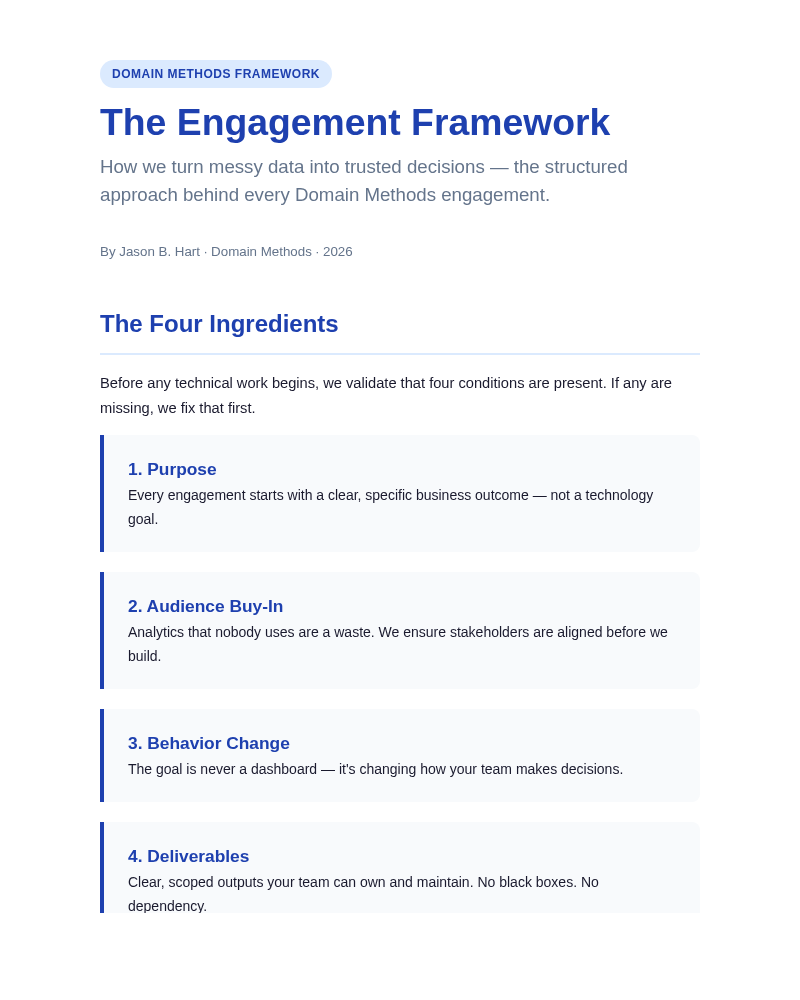
Need a lower-commitment starting point?
Get the framework we use before we certify a metric or touch dbt
Most foundation problems are not just technical debt. They are mismatched ownership, weak definitions, and rushed architecture decisions. This framework shows how we sort that out before a semantic-layer, warehouse, or dbt rebuild turns into another expensive cleanup project.
- How we separate tooling problems from trust and governance problems
- The operating questions we ask before recommending warehouse or dbt work
- A simple way to align data, RevOps, and leadership on what has to be fixed first
Instant download. No email required.
Want future posts like this in your inbox?
This form signs you up for the newsletter. It does not unlock the download above.
Client Outcomes
Fast-Growing Fintech Startup
Unified 12 data sources into a single trusted warehouse in 6 weeks
A Series A fintech had data in 12 different tools and every team maintained their own spreadsheets. We built a BigQuery warehouse with dbt — tested models, clear documentation — and the CEO went from reconciling spreadsheets to opening one dashboard.
Read case studyVenture-Funded B2B Platform
Migrated from legacy ETL to modern cloud warehouse in 8 weeks
A B2B platform had outgrown their legacy stack. We moved them to BigQuery with dbt in 8 weeks, preserving all business logic and adding proper testing. Their team owns the whole thing now.
Read case studyNot ready to book yet?
Start with the foundation-repair tools
Use the source-of-truth and dbt worksheets when the team needs to decide what to fix before a larger foundation engagement.
Go Deeper
Read our practical guide to building a modern data foundation with dbt — architecture decisions, migration strategies, governance that actually works, and the groundwork for trustworthy AI.
Download the dbt Foundation GuideRelated Reading
- Data Audit vs Translation Sprint vs Full Warehouse Rebuild
- How to Scope a Data Foundation Cleanup Before You Hire Anyone
- How to Audit Your SaaS Tech Stack for AI Readiness
- The Data Stack Teardown
- What Should We Fix First in dbt?
- dbt Project Health Scorecard
- dbt Core vs dbt Cloud Decision Worksheet
- dbt Consultant vs In-House Engineer Decision
- dbt Investment Trust Checklist
- Source-of-Truth Maturity Benchmark
- Source-of-Truth Audit Worksheet
- Campaign Taxonomy and UTM Governance Checklist
- First-Party Measurement Readiness Worksheet