Ship the first reverse ETL or data activation workflow that actually matters
Data activation turns trusted warehouse, CRM, product, and model outputs into governed actions inside the tools where sales, marketing, success, and lifecycle teams work. If you’re asking whether you need a data activation platform, reverse ETL tool, or simpler custom sync, the real question is whether one workflow is clear enough to deserve implementation. We help SaaS teams move from activation ambiguity to one reliable workflow the business will actually use.
Launch the Activation SprintActivation sprints start at $5,000. Most hands-on implementation work lands between $7,500-$30,000 depending on how many destinations and workflow owners are involved. If the work includes lead, churn, expansion, or spend models plus holdout/lift proof, use the Predictive GTM Models with Lift Proof path. See details

Platform decision
What is Reverse ETL, and when should a SaaS team use data activation?
A data activation platform moves trusted warehouse or product data into the tools where sales, marketing, success, and lifecycle teams work. The platform matters when the same fields, audiences, scores, and sync failures affect real customer conversations. Before that, the better first move may be a narrower reverse ETL workflow, a warehouse-native sync, or fixing the workflow definition itself.
| Path | When it fits | Next move |
|---|---|---|
| Use a data activation platform | Several teams depend on fresh CRM, lifecycle, or success signals; retries and monitoring matter; and field ownership cannot live in one analyst’s notebook. | Define the first workflow, sync contract, owner, freshness rule, and failure path before comparing vendors. |
| Use reverse ETL or warehouse-native activation | The data already lives in the warehouse and the main need is pushing modeled fields, audiences, or scores into Salesforce, HubSpot, Braze, or similar tools. | Start with the smallest high-value sync and use the reverse ETL buyer guide to decide how much platform support is justified. |
| Use a CDP | Identity resolution, event collection, consent, or cross-channel profile assembly is the real gap — not just moving trusted warehouse fields downstream. | Compare the architecture choices in CDP vs reverse ETL vs warehouse-native activation before treating every customer-data problem as reverse ETL. |
| Use a custom sync | The workflow is narrow, engineering already owns the integration surface, and vendor overhead would be larger than the operational value. | Keep the blast radius small: one destination, one owner, one rollback path, and a clear point where the build becomes a maintenance burden. |
| Pause and fix the workflow first | The team cannot name the decision, owner, target system, field definitions, or what should happen when the activated signal looks wrong. | Use The $500K Question to decide whether this workflow is valuable enough to automate at all. |
Turn trusted warehouse data into operational decisions
- Get governed warehouse data into the CRM, marketing automation, and customer-success tools your team actually uses
- Choose when Hightouch, Census, Polytomic, a warehouse-native pattern, or a simple custom sync is worth the operational overhead
- Define freshness, ownership, field mapping, and failure handling before a score or audience changes customer-facing work
- Use your warehouse as the control point for activation without pretending a platform can fix unclear workflows
- Embed analytics into daily decisions and handoffs without creating another black-box automation layer
- Route predictive-model buyers into a proof plan before scores get treated as revenue lift
This is for you if...
- You have rich data in your warehouse but no way to act on it
- You want to prove that a score, audience, churn signal, or expansion model can change a live workflow this quarter
- You’re deciding whether a CDP is still the right fit or whether a narrower warehouse-native activation path would solve the real workflow
- Your product team needs an MVP approach — ship fast, prove value, then expand
This isn't the right service if...
- You need a custom-built CDP from scratch — we activate your existing warehouse
- You want someone to manage data syncs and workflows long-term as part of the initial build — if ongoing governance is useful after launch, that’s an optional Run + Measure path: month-to-month, cancel anytime
- You don’t have a data warehouse yet — start with a data foundation
How We Help
Reverse ETL Consulting and Implementation
Push trusted warehouse fields, scores, and audiences into Salesforce, HubSpot, Braze, lifecycle tools, or ad platforms with clear sync ownership, monitoring, and rollback paths.
Predictive Workflow Handoffs
Lead, churn, expansion, and lifecycle models that include reason codes, freshness rules, rep-facing context, escalation paths, and a clear proof plan before they change customer work.
Warehouse-as-CDP and Platform Decisions
Decide when a CDP, reverse ETL platform, or warehouse-native activation pattern fits the actual workflow rather than the vendor category chart.
Operational Analytics
Embed data into daily sales, marketing, success, and product workflows with enough documentation that the business knows what to do when the signal looks wrong.
How reverse ETL consulting turns one workflow into production
Map
We identify which data needs to flow where — from your warehouse to the operational tools your teams use daily.
Design
We architect activation workflows, audience definitions, and sync schedules that match your business logic.
Connect
We implement reverse ETL pipelines, configure destinations, and validate data accuracy end-to-end.
Optimize
We monitor, tune, and hand off — ensuring your team can manage and expand activation workflows on their own. The win isn't the pipeline; it's your team making faster, data-driven decisions every day.
Engagements start at $5,000
Scoped with clear deliverables and fixed pricing. No hourly billing. Most activation projects range from $7,500-$30,000. Predictive model-and-proof engagements use the dedicated Predictive GTM Models path because model scope, destination handoffs, and lift-readout design change the work.
See Where Activation Pays FirstNot sure whether you need a data activation platform yet?
Start with The $500K Question
When leadership is still arguing about which workflow deserves a platform purchase, scoring model, or automation work, settle that before paying for implementation.
See the growth diagnostic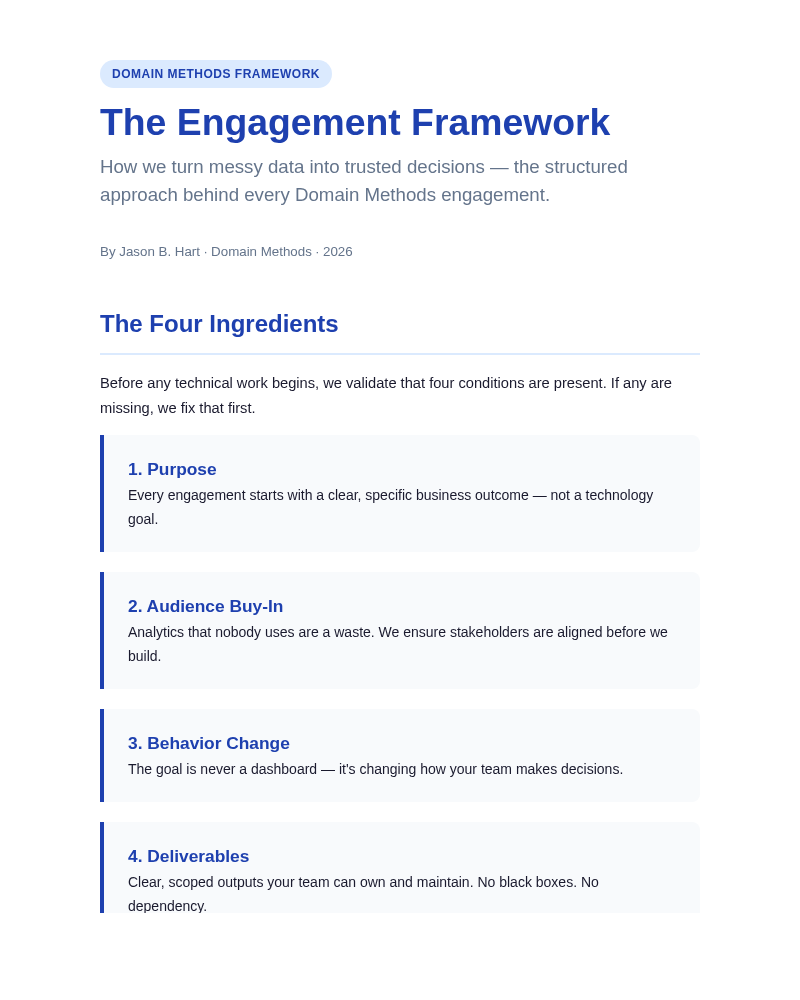
Want to pressure-test the idea first?
Download the framework we use before we automate anything
Good activation work starts with one decision the business actually needs to make, not a pile of syncs. This framework shows how we choose the first workflow, pressure-test the economics, and avoid shipping automation nobody will trust or use.
- How we choose the first activation workflow worth shipping
- The checks we use before recommending reverse ETL, scoring, or warehouse-as-CDP work
- A practical way to prove value before expanding the automation surface area
Instant download. No email required.
Want future posts like this in your inbox?
This form signs you up for the newsletter. It does not unlock the download above.
Client Outcomes
PLG SaaS Product Team
First reverse ETL workflow shipped in 3 weeks, reduced churn by 18%
Rich behavioral data was sitting in the warehouse doing nothing. We built an MVP reverse ETL workflow that synced churn-risk scores to the CRM — 18% churn reduction in three weeks, and they expanded to three more workflows that quarter.
Read case studyB2B SaaS Sales Team
AI lead scoring increased sales efficiency 40% by surfacing product-qualified leads
Sales reps were manually reviewing every trial account. We built a scoring model from warehouse behavioral data — feature adoption, usage patterns, activation milestones — and synced it to the CRM via reverse ETL. Qualified pipeline from inbound trials jumped 40%.
Read case studyNot ready to book yet?
Start with the activation and handoff tools
Use these worksheets when warehouse data is trusted enough to act on, but the team still needs to pick the right first workflow.
Still deciding whether you need a data activation platform?
Read the practical buyer guide on when reverse ETL is enough, when a dedicated activation platform is worth it, and when the real bottleneck is workflow clarity.
Read the buyer guideRelated Reading
- Data Activation Playbook: From Warehouse to Revenue
- Data Activation QA Checklist
- Data Activation Suppression Logic Checklist
- Activation Data Contract Template
- AI Activation Contract for Revenue Workflows
- CRM Field Ownership Checklist
- Reverse ETL vs Workflow Automation Ownership Guide
- Census vs Hightouch: Which Reverse ETL Fit Is Better?
- CDP vs Reverse ETL vs Warehouse-Native Activation
- Salesforce Data Cloud vs Reverse ETL