Marketing analytics audit services and quick diagnostics
Something is broken and you know it, but you do not want a six-month engagement just to find out where the truth lives. These analytics audit services are the lower-friction diagnostic rung for SaaS marketing and revenue teams: find the reporting trust break, spreadsheet dependency, attribution gap, CRM hygiene issue, AI-readiness risk, or warehouse problem before the next planning decision gets made on weak numbers.
Book a Discovery Call
Choose the right first move
Analytics audit vs flagship diagnostic vs build engagement
Most teams already know which report hurts. The audit decides whether the right first move is a small diagnostic, the flagship AI-Ready Data Diagnostic, a named build engagement, or no outside build at all. A dashboard rebuild cannot fix a definition fight, and a warehouse rebuild will not fix a meeting that asks the wrong question.
| Path | When it fits | Next move |
|---|---|---|
| Analytics audit | The team can name the broken decision, but not whether the cause is tracking, definitions, CRM hygiene, source trust, dashboard design, or ownership. | Run the diagnostic, name the trust break, and choose the repair lane before committing budget. |
| Dashboard rebuild | The sources and definitions are trusted, but the current report does not answer the meeting question or makes the workflow harder than it needs to be. | Rewrite the report around the decision and preserve the source logic that already works. |
| Flagship AI-Ready Data Diagnostic | The question is broader than one report: CRM hygiene, source reliability, workflow ownership, and executive metric trust all affect whether AI-assisted reporting or automation can be trusted. | Move up to the AI-Ready Data Diagnostic before committing to agents, copilots, or automated handoffs. |
| Warehouse / data foundation rebuild | Several reports fail for the same upstream reason: source precedence, dbt logic, missing tests, broken lineage, or no clear metric owner. | Move into Data Foundation or a GTM metric-certification sprint before polishing more dashboards. |
| Attribution / revenue analytics service | The immediate argument is about spend, pipeline, budget pacing, or whether marketing’s revenue story survives finance scrutiny. | Use Revenue Analytics or Where Did the Money Go? after the audit isolates the break. |
What the client receives from an analytics audit
- Findings that separate symptoms from root causes: source trust, definition conflict, CRM hygiene, campaign tracking, dashboard design, spreadsheet dependency, or warehouse logic
- A decision-risk register showing which leadership, budget, AI, or planning decisions are unsafe until the data issue is fixed
- A prioritized fix roadmap that names what to repair first, what to stop doing, and which reports or workflows should not be trusted yet
- A clear branch into the flagship AI-Ready Data Diagnostic, Data Foundation, Revenue Analytics, Predictive GTM Models with Lift Proof, attribution diagnostics, or no-build internal cleanup
- An honest answer even if the right move is not to hire us
When a SaaS marketing audit is the right first move
- Marketing, RevOps, finance, and leadership are all citing different numbers and nobody trusts the report that is supposed to settle it
- You need a SaaS marketing audit that inspects data, reporting, attribution, CRM fields, campaign tracking, and operating logic — not just campaign performance
- The team is debating whether to rebuild a dashboard, fix attribution, clean the warehouse, or retire spreadsheet reporting, and each option has a different owner
- Shadow spreadsheets or quarterly reporting workarounds keep carrying the real decision after the dashboard stops helping
- Leadership wants a diagnosis and repair order in weeks, not another exploratory committee process
This isn't the right service if...
- You need a generic paid-media or campaign-performance audit with no revenue-data review
- You want dashboard beautification while the source logic underneath remains disputed
- You want a generic strategy deck with no hard conclusions
- You want to start an AI automation project without auditing whether the underlying data is clean enough to automate
What analytics audit services should include
Marketing Analytics Audit
Checks campaign tracking, channel definitions, source-to-pipeline handoffs, CAC logic, dashboard assumptions, and the meetings those numbers are supposed to support. This is the right starting point when the symptom is a messy SaaS marketing audit or a quarterly report nobody fully trusts. Book a Discovery Call.
Revenue Reporting Audit
Looks for the reason marketing, sales, RevOps, finance, and leadership cannot agree on pipeline, bookings, expansion, churn, or attribution. When the conflict is definitions and ownership, Three Teams, Three Numbers may be the sharper next step.
AI-Ready Data Diagnostic
The flagship diagnostic above the quick-audit rung. It tests whether CRM hygiene, source reliability, exception handling, metric definitions, and workflow ownership are strong enough for AI-assisted scoring, routing, reporting, or automation. See the diagnostic.
Attribution Audit
Inspects whether spend, campaign taxonomy, CRM capture, lifecycle timing, and revenue logic can support budget decisions. If the immediate pressure is channel credit or budget pacing, start with Where Did the Money Go?.
Data Foundation / Source-of-Truth Audit
Finds whether the trust break lives in source precedence, warehouse models, dbt tests, ownership, lineage, or metric definitions. If several reports fail for the same upstream reason, Data Foundation is usually the repair lane.
Shadow Spreadsheet and Reporting Trust Audit
Maps the spreadsheet, deck, or manual export that still carries the real decision and names what the official workflow has to answer before the workaround can be retired. Book a Discovery Call.
How It Works
Choose
We align on the decision, meeting, buyer, and diagnostic path. The audit starts with the operating question, not a generic data inventory.
Inspect
We review the systems, reports, CRM fields, campaign tracking, spreadsheet dependencies, dashboards, definitions, and workflow handoffs behind the problem.
Conclude
We show what is true, what is noise, which decision risks matter, what to stop doing, and which fixes should happen first.
Act
You leave with a clear recommendation: fix it internally, move up to the flagship AI-Ready Data Diagnostic, enter the right build lane, add an optional Run + Measure handoff, or stop wasting time on the wrong project.
Diagnostics typically run $2,500-$7,500
Fixed fee. Clear scope. Most finish in 1-2 weeks. The point is not to drag out discovery. The point is to make the next decision obvious before more budget or team time gets wasted. If the diagnostic moves into a scoped build, the fee can be credited into that next engagement.
Book a Discovery Call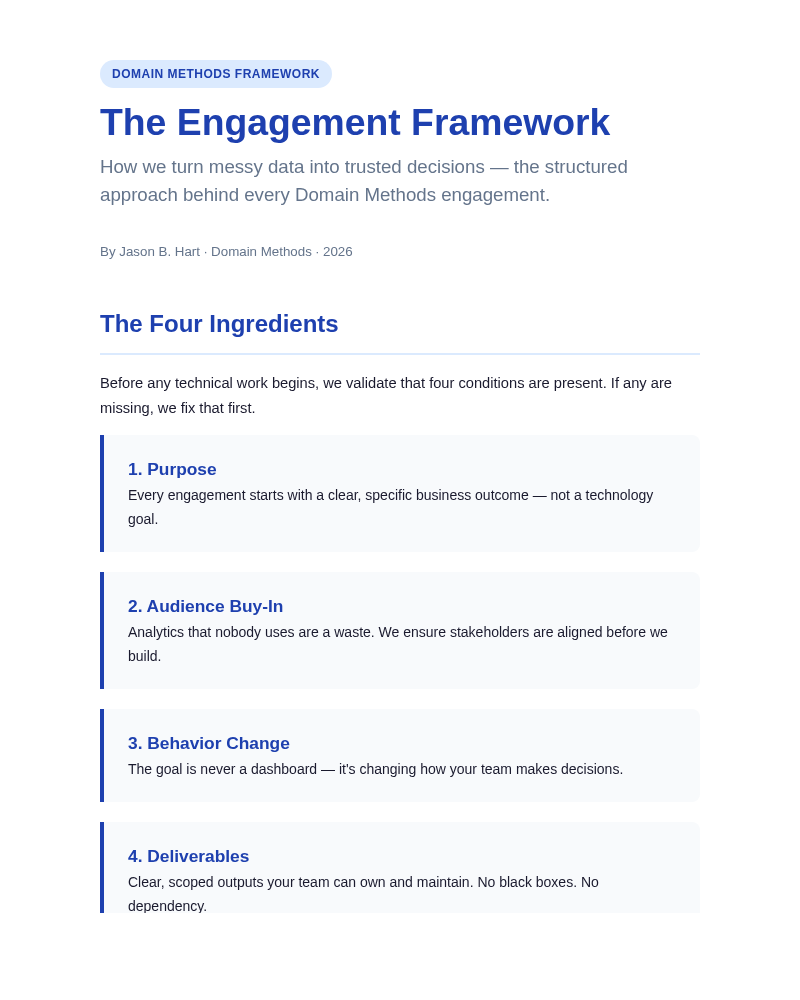
Not sure which diagnostic fits?
Get the framework we use to figure out where the real problem lives
Before we recommend a diagnostic, we need to understand whether the pain is a spend problem, a metric-definition problem, a data trust problem, or something else entirely. This framework shows how we sort that out quickly so you do not book the wrong engagement.
- How we separate reporting problems from data foundation problems from governance problems
- The decision tree we use to match operator pain to the right diagnostic
- A practical way to frame the engagement conversation for your buyer or leadership team
Instant download. No email required.
Want future posts like this in your inbox?
This form signs you up for the newsletter. It does not unlock the download above.
Proof that diagnostics should lead to decisions, not more discovery
B2B SaaS Growth Team
Conflicting attribution reports became one spend-to-revenue view leadership could use
Useful if the audit question is whether paid growth reporting can survive finance scrutiny before the next budget call.
Read case studyMid-Market SaaS Growth Team
Messy campaign and revenue data became a defensible budget story
Useful when the audit needs to show whether attribution, pipeline definitions, or campaign capture is the first trust break.
Read case studyFast-Growing Fintech Startup
Twelve scattered sources became a trusted warehouse in six weeks
Useful if the diagnostic finds that dashboard mistrust is really a source-of-truth and ownership problem upstream.
Read case studyMid-Market SaaS Data Team
Pipeline firefighting turned into 99%+ reporting uptime
Useful if the audit points to brittle pipelines, missing tests, or reporting operations that break whenever leadership needs speed.
Read case studyNeed a triage artifact first?
Start with the source-of-truth repair tools
If the audit question is really about which source, definition, owner, or pipeline has to be fixed first, use the Operator Tools group before booking a broader diagnostic.
Go deeper before moving up the ladder
Read the two-day marketing data audit guide if you need the practical inspection sequence behind this diagnostic. If the first pass shows the risk is broader — AI readiness, governed metrics, or predictive GTM decisions — move up the ladder instead of stretching a quick audit past its useful shape.
Read the two-day audit guideRelated Reading
- Data Audit vs. Translation Sprint vs. Full Warehouse Rebuild
- The Attribution Health Check
- The Revenue Data Trust Score
- How to Stop Your Marketing Team from Building Shadow Spreadsheets
- How to Build a Quarterly Marketing Report Leaders Can Trust
- How to Tell Whether You Have a Tools Problem or a Foundation Problem
- Build or Buy Data Decision Matrix
Common Questions About Analytics Audits and Diagnostics
What is included in a SaaS marketing analytics audit?
How do we get rid of spreadsheets in marketing reporting?
Is this an attribution audit, dashboard audit, data foundation audit, or AI-readiness diagnostic?
Can an audit cover CRM, GA4, ad platforms, and warehouse data together?
What is the difference between a data audit and a source-of-truth audit?
When should we use this instead of Where Did the Money Go?
How long does an analytics audit take?
What is the difference between an audit and a full engagement?
How do I know which diagnostic is right for my situation?
What happens after the audit?
Can we use the diagnostic to build an internal business case for a larger project?
Not sure which diagnostic fits?
Tell us where trust is breaking down — attribution, revenue metrics, roadmap bets, analytics requests, AI readiness, or profitability — and we will point you to the right rung: a quick diagnostic, the flagship AI-Ready Data Diagnostic, a build engagement, or a Run + Measure handoff.
Talk Through the Situation