Your KPI Review Is Performing Certainty, Not Creating Alignment
- Jason B. Hart
- Revenue Operations
- April 26, 2026
Table of Contents
What is certainty theater in a KPI review?
Certainty theater in a KPI review is what happens when a meeting presents metrics as settled truth before the team has agreed on confidence, ownership, caveats, or decision consequences. The deck looks disciplined. The conversation sounds mature. The operating agreement is still missing.
That is the trap.
A KPI review can have clean slides, consistent colors, a recurring agenda, and a room full of senior people nodding along. It can still avoid the one question that matters: what can we safely do with this number right now?
In mid-size SaaS companies, this usually does not look chaotic from the outside. It looks like normal operating cadence. The team reviews pipeline, CAC, conversion rate, expansion, retention, and campaign efficiency. Someone adds a verbal caveat. Someone else says the number is directionally right. The meeting moves on because nobody wants to derail the agenda.
Then the same metric comes back next month with the same caveat, the same debate, and a little more political weight attached to it.
That is not alignment. That is reporting theater with better formatting.
The deck can be clean while the agreement is weak
The dangerous part is that certainty theater often shows up after a company has improved its reporting hygiene.
The warehouse is better. The dashboard is less embarrassing. The KPI deck arrives on time. The RevOps, finance, marketing, and data teams have learned enough of each other’s language to get through the meeting without obvious conflict.
But the meeting still rewards the appearance of certainty more than the work of alignment.
You can hear it in phrases like:
- “This is directionally right.”
- “We know attribution is imperfect, but the trend is useful.”
- “Finance has a slightly different number, but this is the operating view.”
- “The caveat is the same as last month.”
- “Let’s not go too deep on methodology in this meeting.”
None of those phrases is automatically bad. Operators need imperfect numbers all the time. The problem starts when those phrases become permission to skip the decision rule.
If a metric is directional, say what it is allowed to influence. If it is decision-grade, say what caveat still travels with it. If it is board-grade, say who has signed off on the definition and source path. If nobody can say that cleanly, the KPI review is performing confidence the team has not earned yet.
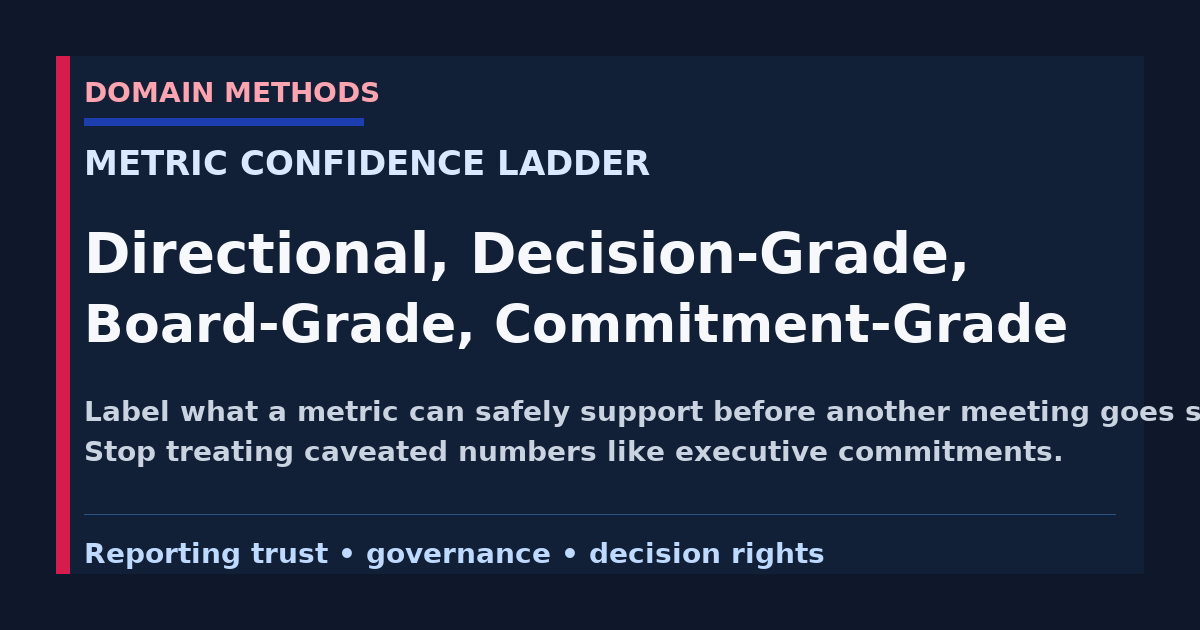
That is the behavior behind The Metric Confidence Ladder: the same number can be useful for one decision and dangerous for another.
Signs your KPI review is performing certainty
Most teams do not need a philosophy lesson to spot this. They need a few sharper tells.
| Performing certainty | Creating alignment |
|---|---|
| The deck shows the metric without a confidence label. | The metric is marked directional, decision-grade, or board-grade. |
| Caveats are explained verbally and then disappear. | The caveat is written into the metric record or meeting notes. |
| The same definition debate reappears every month. | The definition owner and next proof step are assigned. |
| A directional number quietly drives budget, hiring, or forecast posture. | The meeting states what the number is allowed to support right now. |
| The room agrees to “keep watching it” without a cleanup owner. | The room decides what would make the metric stronger next time. |
The most common operator-level tell is not a shouting match. It is a meeting where everyone is polite because the caveat has become familiar.
Familiar caveats are dangerous. Once a caveat becomes part of the wallpaper, the business starts treating the number as safer than it is.
That is how a directional paid-channel efficiency view becomes a budget argument. It is how a shaky pipeline conversion rate becomes a hiring plan. It is how a dashboard that still depends on manual edits becomes the source for a board narrative.
This is close to the problem in The Dangerous Comfort of False Precision, but the failure mode is different. False precision is about the number looking more exact than it is. Certainty theater is about the meeting making the number feel more agreed than it is.
The missing artifact is not another chart
When a KPI review keeps failing, teams often reach for the wrong fix.
They add a dashboard tab. They ask for a cleaner executive summary. They standardize the slide template. They request one more source-of-truth reconciliation before the next review.
Sometimes that work matters. But if the meeting itself does not force a confidence and ownership decision, a cleaner chart just makes the avoidance easier to miss.
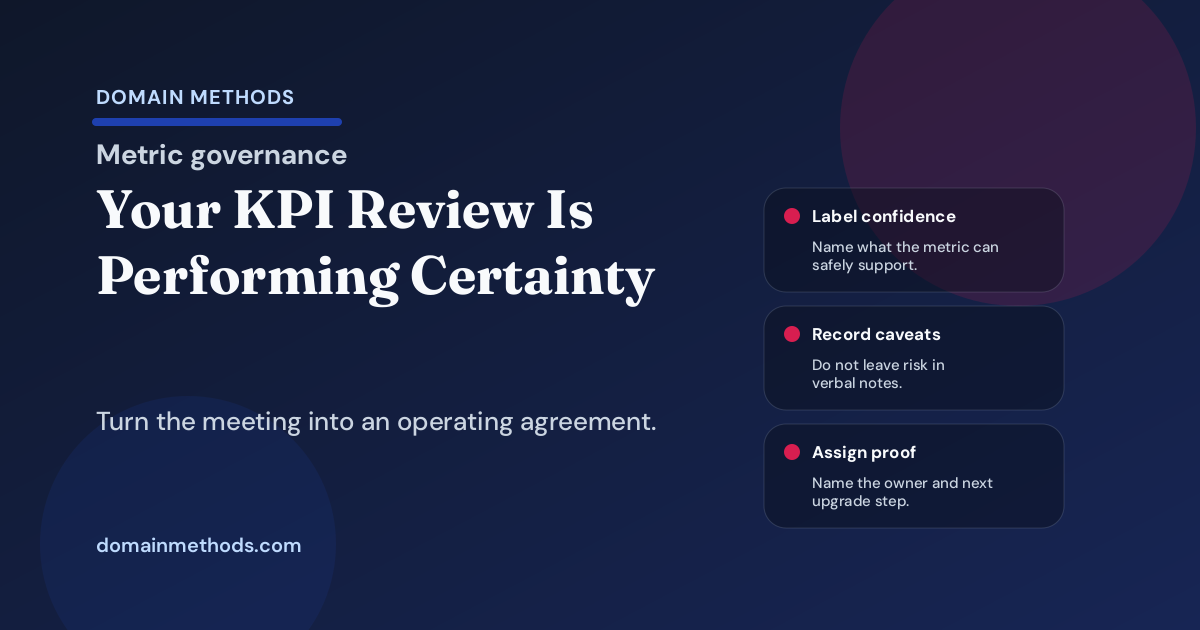
A useful KPI review needs a small operating record for each metric that matters:
| Question | What the room should record |
|---|---|
| What is the metric being used for? | Triage, weekly operating choice, budget movement, forecast posture, board narrative, or compensation-sensitive decision. |
| How confident are we? | Directional, decision-grade, board-grade, or not yet usable for this decision. |
| What caveat changes behavior? | The one source, definition, lag, exclusion, or manual step leadership must know before acting. |
| Who owns the next proof? | A named owner for definition, source cleanup, reconciliation, or stakeholder sign-off. |
| What changes before next review? | The specific condition that would upgrade, downgrade, or retire the metric. |
This is not bureaucracy. It is the difference between a metric review and a metric governance ritual.
The room does not need a dissertation on every number. It needs enough written structure that nobody can leave with a different interpretation of what the metric permits.
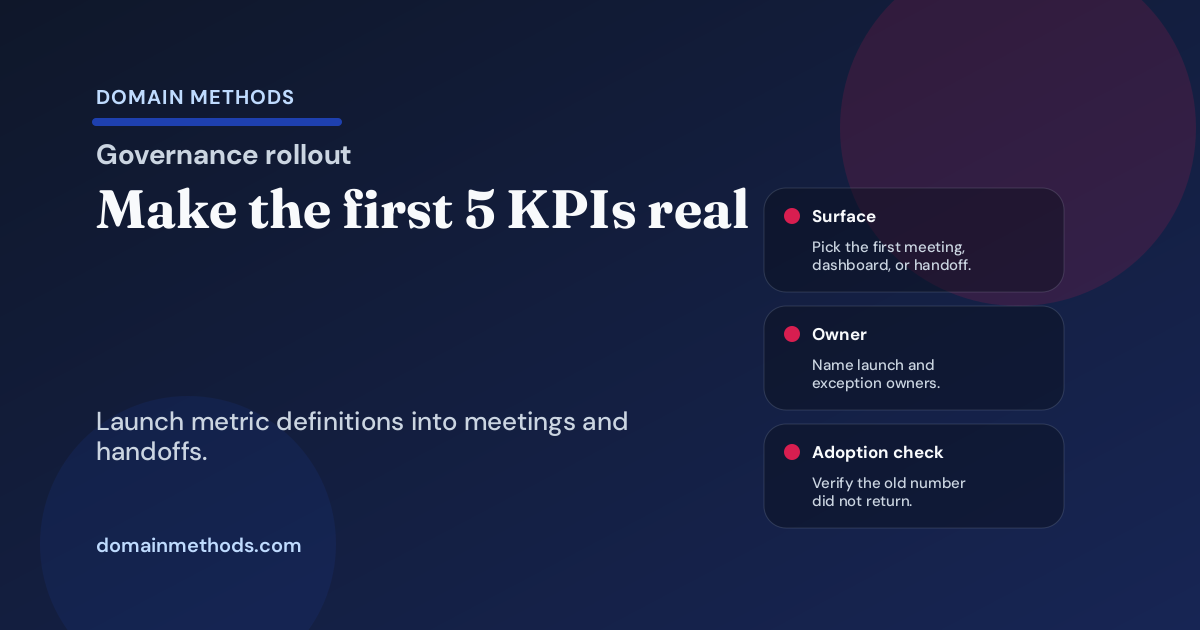
If the organization is trying to govern a small first wave of important KPIs, The Metric Governance Rollout Playbook for the First 5 KPIs is the broader rollout pattern. This article is the meeting-level behavior inside that pattern.
What better KPI reviews sound like
A better KPI review does not become slower by default. In practice, it often gets faster because the room stops relitigating the same ambiguity.
Instead of:
“Pipeline quality is down, but source attribution is still a little messy.”
The room says:
“This pipeline-quality view is decision-grade for segment triage, not board-grade for forecast narrative. RevOps owns the stage-definition cleanup. We will not use this number for hiring posture until finance signs off on the expansion exclusion next month.”
That sentence is not prettier. It is more useful.
It tells the room what the metric can do, what it cannot do, who owns the next proof, and where the business should not overreach.
You see the same pattern with marketing spend. A paid-efficiency chart might be strong enough to pause a bad campaign this week, but not strong enough to defend quarterly budget allocation in front of the board. Those are different jobs. Treating them as the same job is how a reporting meeting turns into an argument about trust.
For board-facing conversations, How to Present Marketing Data to Your Board covers the executive narrative side. The KPI review should do the earlier work so the board deck is not the first place the caveat becomes visible.
What this does not mean
This does not mean leaders should turn every KPI review into a caveat festival.
The goal is not to lower standards. It is to stop hiding standards.
A good recurring review should still be crisp. It should still focus on the numbers that matter. It should still create pressure for better performance. The difference is that the pressure lands in the right place.
If the metric is weak, the owner and proof step get named. If the metric is strong, the business can lean on it harder. If the metric is useful but limited, the room says exactly where the limit is.
That is healthier than pretending every number is equally trustworthy because admitting uncertainty feels politically inconvenient.
The practical tradeoff is this: a KPI review that names confidence may feel less tidy for a month or two. It will expose definition gaps and source-system debt that were previously hidden behind the deck. But that discomfort is cheaper than making budget, hiring, or forecast decisions from metrics nobody can defend under pressure.
A simple before-the-meeting checklist
Before the next KPI review, pick the five metrics most likely to affect money, commitments, or executive narrative. For each one, answer these prompts before the deck goes out:
- Decision use: What decision might this metric influence in the meeting?
- Confidence label: Is it directional, decision-grade, board-grade, or not safe for this use yet?
- Known caveat: What single caveat would change how leadership should act?
- Definition owner: Who can approve or change the metric definition?
- Next proof: What must improve before this number carries more weight?
If that feels like too much work, the meeting is probably already asking the metric to carry more than the team has written down.
Download the KPI Review Alignment Checklist (PDF)
Use this lightweight checklist before the next KPI review to label confidence, write down the caveat, assign the next proof owner, and prevent directional metrics from quietly becoming commitments.
Instant download. No email required.
Want future posts like this in your inbox?
This form signs you up for the newsletter. It does not unlock the download above.
The real output of a KPI review
The real output of a KPI review is not a deck that everyone saw.
It is a shared operating agreement:
- what changed
- what the team trusts
- what the team does not trust yet
- what decision the number can support
- who owns the next proof
- what gets revisited before the next commitment
Without that agreement, the meeting may still look productive. The calendar invite happened. The slides were reviewed. The dashboard was opened. The caveats were mentioned.
But the business leaves with unresolved risk disguised as alignment.
That is why KPI reviews deserve more discipline than a nicer chart. They sit at the point where weak data becomes operating behavior. If the meeting rewards certainty before the metric has earned it, the company will keep turning unresolved reporting debt into decisions.
If your KPI review keeps producing a clean deck and a messy interpretation, start with the operating agreement. Domain Methods’ Three Teams, Three Numbers diagnostic is built for the cross-functional metric fights behind that problem. If the deeper issue is that the business question keeps getting translated into the wrong reporting request, Translate the Ask is the better starting point.
Download the KPI Review Alignment Checklist (PDF)
A lightweight pre-meeting checklist for naming confidence, owner, caveat, decision use, and next proof before a directional metric becomes an operating commitment.
DownloadIf every team leaves the KPI review with a different truth
Three Teams, Three Numbers
Use the diagnostic when recurring reporting meetings look polished but marketing, sales, finance, and data still do not agree which number leadership can trust.
See the metric-alignment diagnosticIf the meeting is exposing translation debt
Translate the Ask
Use the sprint when the business keeps asking for reporting, but the real need is a clearer decision, owner, confidence label, and next-action rule.
See the translation sprintSee It in Action
Common questions about KPI review alignment
What is certainty theater in a KPI review?
Does this mean every KPI review needs more caveats?
Which metrics need confidence labels in a KPI review?
What should change after a better KPI review?

About the author
Jason B. Hart
Founder & Principal Consultant
Helps mid-size SaaS companies turn messy marketing and revenue data into decisions leaders trust.