Your Attribution Problem Probably Is Not an Attribution Problem
- Jason B. Hart
- Marketing Analytics
- April 19, 2026
- Updated June 10, 2026
Table of Contents
What does it mean when an attribution problem is really a CRM workflow problem?
It means the team is arguing about credit when the real break is context getting lost between marketing activity, CRM process, and revenue reporting.
That is a different problem.
A true attribution problem is about how credit gets assigned across touches. A CRM workflow problem is about whether the right source, lifecycle, ownership, and revenue context survives long enough to make attribution possible in the first place.
A lot of mid-size SaaS teams skip that distinction because the visible symptom shows up later:
- paid media looks expensive but hard to defend
- campaign influence numbers keep changing
- sales says the attribution report misses what actually moved the deal
- finance does not trust the pipeline story anyway
So the team assumes the model is wrong. Sometimes it is. But often the model is just the last place the damage becomes visible. When the next step needs outside help instead of another internal debate, the SaaS Marketing Attribution Services path separates model work from CRM, lifecycle, and revenue-linkage repairs.
HubSpot’s 2026 State of Marketing reporting found that 33% of marketing leaders say measuring ROI is their top challenge.1 In B2B, that challenge gets harder fast because the buying path itself is messy: Forrester says an average of 13 people are involved in a purchase decision.2
If that much human mess already exists in the journey, a weak CRM handoff process can do more damage than one more debate about first-touch versus multi-touch ever will.
Why marketing attribution breaks before the model does
When a SaaS team asks, “why is my marketing attribution broken?” the first honest answer is usually: because the facts needed for attribution stopped surviving the workflow.
A model can only assign credit to the context it can still see. If original source gets overwritten during lead conversion, if opportunity contact roles are partial, if lifecycle stages drift, or if finance changes the revenue date logic without a reporting reset, the attribution layer inherits a broken chain of custody.
That is why the useful diagnostic is not “which attribution model should we buy?” It is “where did the commercial story stop being traceable?” A team that can answer that question often finds the first fix belongs in CRM handoffs, source governance, or revenue definitions before it belongs in attribution software.
Use this alongside the Marketing Attribution Playbook when you need the broader operating model behind the measurement decision, not just this narrower tactic.
The tell: the same attribution fight keeps coming back
When the same attribution argument keeps reappearing every quarter, I stop assuming the problem lives in the attribution layer.
That repetition usually means one of four operating failures is still underneath the conversation:
- campaign source survives on the lead but disappears on the opportunity
- lifecycle stages changed, but reporting logic did not
- account, contact, or ownership rules drifted without anyone resetting downstream joins
- revenue definitions changed in practice faster than the dashboards changed in code
Those are workflow failures.
They are also exactly the kind of failures that make an attribution model look dishonest even when the math itself is not the main problem.
I have seen teams “fix attribution” three times in a year while keeping the same messy lead conversion logic the whole time. Each refresh produces a few weeks of optimism, then the same executive question lands again: why does this report still not match the deals we remember actually winning?
That is not a modeling failure first. That is an operating-system failure with attribution symptoms.
What a real attribution problem looks like
To keep this honest, some problems really do belong in attribution.
You probably have a true attribution problem when:
- source data is mostly intact across the path
- CRM lifecycle and ownership rules are stable enough to trust
- lead-to-opportunity linkage is good enough to reconcile real pipeline
- the disagreement is about weighting, model choice, touch windows, or channel credit rules
Examples:
- deciding whether branded search should absorb as much credit as it currently does
- comparing first-touch, last-touch, and position-based models for budget planning
- choosing whether a platform’s multi-touch logic is good enough for your buying cycle
- determining how to treat self-reported attribution alongside system-captured touches
Those are real attribution questions.
They matter.
But if your source fields disappear halfway through the CRM, you are not there yet.
What a fake attribution problem looks like
The fake version usually sounds more technical than it is.
It shows up like this:
- paid reports say one thing, the CRM says another, and nobody can explain where the divergence starts
- opportunities exist, but the original campaign context is missing or stale
- sales manually reassigns records in ways the reporting layer never sees
- lifecycle stages mean different things to different teams, even though the field name stayed the same
- the finance-facing revenue view is anchored to rules that marketing never knew changed
In those cases, attribution is not failing alone. The business is asking a broken workflow to produce a clean causal story.
That is why I like asking a blunter question:
Did the attribution logic fail, or did the workflow lose the facts the logic needed?
That one question usually improves the room faster than another tour through vendor feature lists.
Attribution problem or CRM workflow problem? Use this table first
Before you touch the model, sort the problem into the right bucket.
| Symptom | More likely attribution / tracking problem | More likely CRM workflow / handoff problem | More likely definition / revenue-linkage problem |
|---|---|---|---|
| Paid platform claims conversions the CRM cannot support | Click and session tracking may be incomplete or inflated inside the platform | Source context did not survive from lead to opportunity, or ownership changed the story midstream | Revenue is reconciled on different dates, entities, or rules than the marketing report assumes |
| Campaign influence report changes every quarter | Lookback windows or model rules changed | Lifecycle stages, conversion rules, or contact-role behavior changed without reporting updates | Pipeline and revenue logic were redefined downstream without aligning historical reporting |
| Sales says the report misses what actually moved the deal | The attribution layer cannot see dark social, referrals, or assisted influence well | Hand-raisers, follow-up motion, and account ownership are logged inconsistently in the CRM | The business lacks one accepted rule for what counts as sourced, influenced, or revenue-linked |
| One channel always looks like the hero | Last-touch or platform-native reporting is overweighting late-path capture | Retargeting, lead routing, or campaign membership rules are making one workflow look cleaner than it is | Revenue joins, cohort logic, or cost treatment are creating false certainty about efficiency |
| Attribution tool implementation did not improve trust | Tool configuration may still be weak | The tool is sitting on top of unstable CRM process, lifecycle governance, or source hygiene | Teams still disagree on the commercial truth the tool was supposed to report |
That middle column is where a lot of teams are actually living.
Four CRM workflow failures that wear an attribution costume
1. Source capture survives the form, then dies in the handoff
This is one of the most common problems.
The lead record looks fine at capture. UTMs are there. Campaign membership is there. Maybe self-reported attribution is there too.
Then the record converts. A new contact or account gets created. An opportunity opens later. Some combination of overwrite rules, duplicate logic, sales edits, or sync timing strips away the original context.
Now attribution looks broken because the later-stage report cannot tell a believable story. But the issue is not that the platform chose the wrong model. The issue is that the workflow failed to preserve the story.
2. Lifecycle stages drift quietly
Teams think lifecycle drift is a governance problem. It is. It is also an attribution problem once reporting depends on those stages.
If marketing means one thing by MQL, sales means something else by SAL, and RevOps quietly changes conversion logic during a routing cleanup, the attribution layer starts inheriting unstable milestones.
The result is predictable:
- campaign efficiency looks better or worse for reasons nobody can explain
- quarter-over-quarter comparisons stop being apples to apples
- leadership thinks attribution got worse when stage logic really moved underneath it
A lot of attribution reporting pain is really uncontrolled stage semantics with nicer charts.
3. Opportunity creation and contact-role behavior are inconsistent
Multi-person buying journeys are hard enough before the CRM starts improvising.
In a clean world, the right people are tied to the right account, opportunity, and timing. In the real world, contact roles are partial, late, or missing. Opportunities get opened by different reps with different habits. Some deals live on the account early, others on the lead, others nowhere useful until the pipeline meeting.
That creates a false attribution argument because the path to revenue looks incomplete.
If the workflow that binds people to opportunity context is weak, attribution will always look more controversial than it actually is.
4. Revenue linkage rules change without a shared reset
Sometimes the tracking is not the problem. The CRM is not even the main problem. The actual break is in the rule that says how opportunity, revenue, or customer value should be linked back to marketing activity.
Examples:
- finance changes when revenue is recognized for reporting purposes
- closed-won dates versus booking dates start getting used differently
- one team reports on sourced pipeline while another reports on influenced revenue
- a warehouse model gets updated, but the business meaning of the field is never re-explained
At that point, attribution gets blamed because it is the visible surface. But the operating truth underneath it already split.
If this is the kind of disagreement you are dealing with, the next step is usually less about tooling and more about getting marketing, sales, and finance back onto the same handful of definitions. That is exactly the kind of problem Three Teams, Three Numbers is built for.
The practical diagnostic I would run in one working session
If a team asked me whether the problem was attribution or workflow, I would not start by rebuilding the model.
I would start by tracing one disputed path from touch to revenue.
Step 1: pick one report the business does not trust
Do not debug attribution in the abstract. Choose one report that has already created real disagreement.
Good candidates:
- paid search pipeline contribution
- campaign influence on closed-won deals
- sourced pipeline by channel
- attribution on a recent quarter or planning cycle
Step 2: follow one real deal backward
Pick a handful of recent opportunities and inspect:
- original source fields
- campaign membership
- lead conversion details
- account association
- contact roles
- opportunity owner history
- lifecycle stage timestamps
- the fields the final attribution report depends on
You are not looking for theoretical flaws first. You are looking for where the factual chain stops being believable.
Step 3: mark which layer actually lost the story
This is the turning point.
Ask:
- did the source disappear?
- did the lifecycle meaning change?
- did the account/opportunity join get fuzzy?
- did revenue linkage stop matching the business rule?
- or did all of that stay stable, leaving only a true attribution-model dispute?
Step 4: classify the break before prescribing the fix
If the break is mostly workflow:
- fix source preservation rules
- tighten lifecycle governance
- repair handoff logic
- clarify ownership around opportunity and revenue linkage
If the break is mostly attribution:
- revisit model choice
- adjust touch windows
- compare platform-native views against the minimum useful blended view
- decide what confidence level the business actually needs
Step 5: only then decide whether tooling is the answer
A lot of teams buy attribution software at Step 0. That is usually too early.
If the workflow is still unstable, the tool just makes the disagreement easier to distribute.
What changes first when the diagnosis is workflow, not tooling?
If the problem is really CRM workflow, I usually prioritize fixes in this order:
- source preservation - make sure campaign and source context survive conversion and handoff
- lifecycle governance - lock plain-English stage definitions and downstream reporting dependencies
- account and opportunity linkage - tighten the path from person-level activity to account and revenue context
- owner visibility - make it clear who can change the fields that shape the revenue story
- reporting caveats - label what is directional versus decision-grade until the workflow becomes stable
That order matters.
Teams often want to start with better dashboards because that feels faster. But if source preservation is weak, a cleaner dashboard just turns a broken process into a more polished story.
If you want the broader operator context for this problem, The Attribution Gap Map shows where each layer of the stack sees the journey clearly and where it starts bluffing.
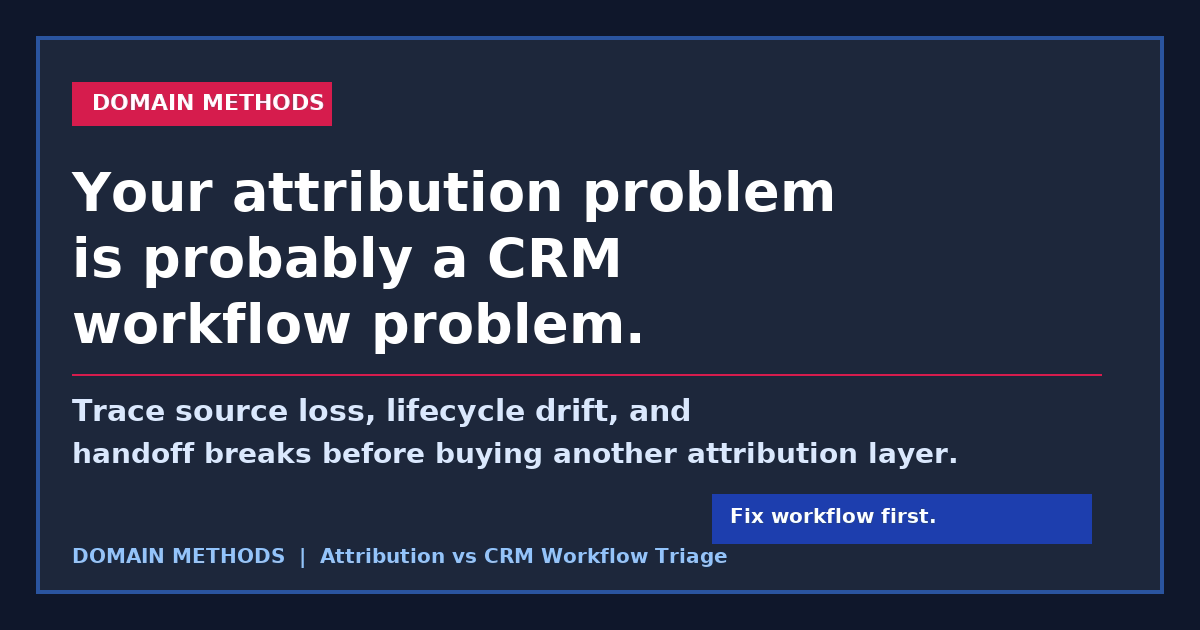
Download the Attribution vs CRM Workflow Triage Worksheet
Use this worksheet before the next attribution debate, vendor conversation, or budget review when the room keeps jumping to model fixes before tracing where the CRM workflow actually loses the story.
Download the Attribution vs CRM Workflow Triage Worksheet (PDF)
A practical worksheet for deciding whether the next fix belongs in tracking, CRM handoffs, lifecycle governance, or revenue linkage.
Instant download. No email required.
Want future posts like this in your inbox?
This form signs you up for the newsletter. It does not unlock the download above.
It is especially useful when marketing thinks the platforms are lying, sales thinks the report misses reality, and finance is not willing to bless either story. If you need a broader diagnostic after the worksheet, start with Where Did the Money Go?. If the worksheet shows the fight is really about cross-team definitions and workflow ownership, move into Three Teams, Three Numbers.
Bottom line
A lot of attribution problems are not attribution problems. They are CRM workflow problems that only become visible once someone asks the revenue question with more precision.
That is actually good news.
A workflow problem is usually more fixable than an endless model debate because it gives you something concrete to repair: a handoff, a stage rule, an ownership boundary, or a revenue link that stopped being trustworthy.
If your team keeps revisiting the same attribution argument, stop asking only how credit is assigned. Ask where the workflow lost the facts the credit model depends on.
That is usually where the real work starts.
See the Spend DiagnosticSources
- HubSpot, The top challenges marketing leaders expect to face in 2026, citing its 2026 State of Marketing report.
- Forrester, The Verdict Is In: It's Buying Groups For The Win, citing Forrester's Buyers' Journey Survey, 2024.
Download the Attribution vs CRM Workflow Triage Worksheet
A practical worksheet for deciding whether the next fix belongs in tracking, CRM handoffs, lifecycle governance, or revenue linkage.
DownloadIf channel reporting and revenue reality keep falling apart
Where Did the Money Go?
Use the diagnostic when platform reports, CRM views, and revenue numbers all sound plausible on their own but collapse the moment leadership asks what really drove pipeline and closed-won revenue.
See the spend diagnosticIf the real break is cross-team definitions and handoffs
Three Teams, Three Numbers
When the attribution fight is really a workflow and ownership fight, use the workshop to align the few numbers that marketing, sales, and finance all need to trust.
See the alignment workshopSee It in Action
Common questions about attribution versus CRM workflow problems
Why is my marketing attribution broken?
When is this a real attribution problem?
What is the most common fake attribution problem?
Should we buy an attribution tool if the CRM workflow is weak?
What should we fix first if attribution reports keep changing every quarter?

About the author
Jason B. Hart
Founder & Principal Consultant
Helps mid-size SaaS companies turn messy marketing and revenue data into decisions leaders trust.