The Workflow Exception Ownership Model
- Jason B. Hart
- Data Engineering
- April 19, 2026
- Updated June 17, 2026
Table of Contents
What is the workflow exception ownership model?
The workflow exception ownership model is a practical way to name who reviews, who overrides, who pauses, and who escalates the messy cases after a workflow already looks worth piloting.
That sounds like a narrow point. It is actually where a lot of promising workflow ideas go sideways.
Teams usually do the exciting part first. They map the happy path. They talk about the use case. They compare rules-based automation to AI. They get the demo to look plausible.
Then the workflow touches real operating mess.
A lead lands with two possible owners. A lifecycle record comes through with one key field late. The model output is plausible, but thin. A customer-facing action suddenly depends on a judgment call nobody explicitly owns.
That is the moment the conversation stops being about model quality and starts being about operating ownership.
Gartner predicted that at least 30% of generative AI projects will be abandoned after proof of concept by the end of 2025 because of poor data quality, inadequate risk controls, escalating costs, or unclear business value.1 In practice, a lot of that failure shows up in a less glamorous form: the workflow worked in demo conditions, but nobody had named what should happen once it left the happy path.
If you want the earlier screens, start with Should This Workflow Stay Manual, Go Rules-Based, or Use AI?, How to Evaluate AI Workflow Readiness When CRM Data Hygiene Is Weak, and The AI Pilot Exception-Handling Playbook. This article assumes you already did that work. The workflow is promising. The missing piece is a reusable ownership model the team can use in a real working session.
Why teams get stuck after the workflow looks viable
Most operators do not struggle to imagine the happy path.
They struggle to make the ugly cases governable.
That is an important distinction.
A workflow can be ready enough to test and still be unsafe to scale if the team cannot answer four basic questions quickly:
- who reviews a weird case
- who can change the output
- who can pause the workflow without a political fight
- who decides that rules-based handling is still the better answer than AI for this branch
Salesforce found that 76% of business leaders say the rise of AI increases their need to be data-driven, while fewer than half feel sure they can use data to drive action and decision-making effectively.2 That gap is exactly where exception ownership matters. The workflow pressure goes up, but the team’s confidence in using the output does not rise at the same speed.
You can feel this in real operator conversations.
The room is not debating whether the workflow is interesting. The room is debating whether anyone wants to be the person who catches the weird cases once the workflow starts touching routing, customer communication, or revenue decisions.
If nobody wants that job, the workflow is not ready.
The framework at a glance
Use the model to separate exception classes and assign authority before the workflow expands.
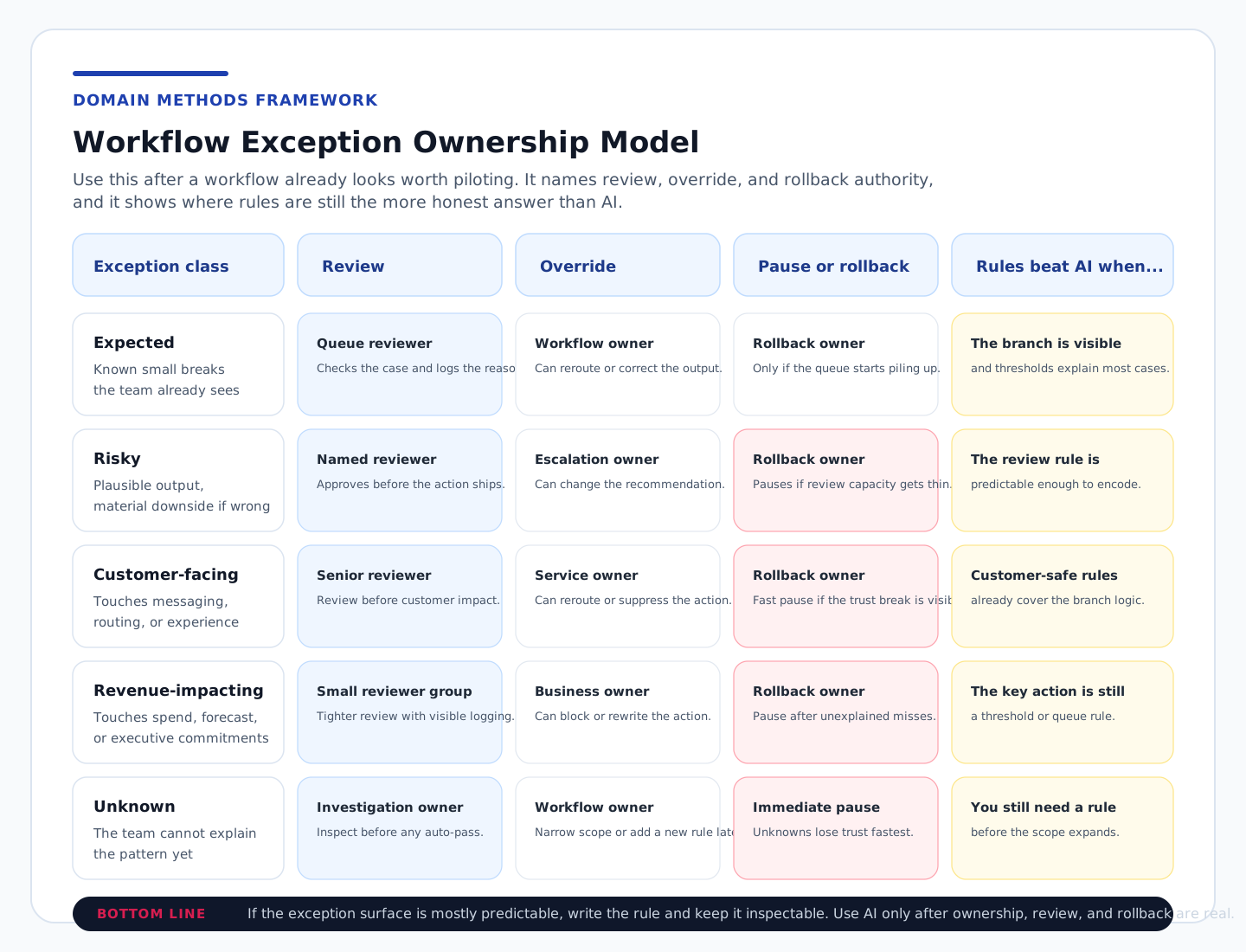
The goal is not to make the workflow feel more complex. It is to make authority clearer than the mess.
A good framework visual should answer the operator question in one glance: what kind of exception is this, who owns it, and what is the default posture?
The five exception classes that matter most
Do not treat everything outside the happy path as one blob called “edge cases.”
That is how teams end up with vague promises about human review and no real operating discipline.
A more honest model is to sort the exception surface into five classes.
1. Expected
These are the small breaks the team already knows are part of normal operation.
Think missing enrichment, thin context, a record that needs a quick human look, or a known branch where someone just confirms the output before the action ships.
The operator tell here is simple: the case is annoying, but not surprising.
Expected exceptions do not need executive theater. They need a visible queue, a named reviewer, and a short log of what happened. If the team cannot handle those cleanly, the problem is not an advanced AI governance problem. It is a basic workflow hygiene problem.
2. Risky
A risky exception is not obviously catastrophic, but the business consequence of a wrong action is material enough that a named reviewer should look before the workflow moves forward.
This is where many teams get sloppy.
They say the workflow is “mostly right” and quietly let that phrase carry more weight than it should. In practice, risky exceptions are often where trust erodes because the room has not agreed how much confidence is enough for the actual downstream action.
If the wrong output can change who gets routed, what gets prioritized, or what a manager thinks is true this week, the workflow should not glide through on vibes.
3. Customer-facing
Customer-facing exceptions need a different posture because the blast radius is social before it is technical.
A queue assignment error might create internal cleanup work. A workflow that sends the wrong message or routes the wrong customer into the wrong experience makes the workflow feel reckless fast.
When a team says, “We can probably fix it if it goes wrong,” that is usually a sign the branch should be slower, narrower, or rules-based.
The lived-in detail here is that customer-facing exceptions often look harmless in the spreadsheet and expensive in the inbox. That is why they deserve senior review and a cleaner default stop state.
4. Revenue-impacting
This is the class where a workflow starts influencing spend, forecast posture, pipeline logic, or executive narrative.
At that point, the question is no longer whether the workflow is clever. The question is whether the business is comfortable having that workflow change a consequential action without a clear owner trail.
Revenue-impacting exceptions need a smaller approved reviewer group, visible logging, and explicit authority to block or rewrite the output. Otherwise the workflow turns into a polished way to spread uncertainty faster.
5. Unknown
Unknown exceptions are the cases the team cannot explain yet.
This is the most dangerous category because it tempts teams to keep going under the banner of “we’ll learn from the data.” Sometimes they do. More often, they teach the organization that the workflow creates unexplained behavior no one can defend.
Unknown cases should not auto-pass.
They should stop the action, trigger inspection, and force the team to decide whether the workflow needs a narrower scope, a new rule, a different input path, or a stronger manual fallback.
The authority stack: review, override, pause, and rules boundary
Once the exception classes are named, the next question is authority.
This is the part teams often collapse into one fuzzy statement like “We’ll keep a human in the loop.”
That is not enough.
You need four distinct authority lanes.
| Authority lane | What this owner actually does | What usually breaks when it is missing |
|---|---|---|
| Review | Looks at the case and decides whether the output is usable | Weird cases pile up or get rubber-stamped because nobody owns the judgment step |
| Override | Changes the workflow output, queue, or recommendation when the result is wrong | People work around the workflow privately because no one is clearly allowed to correct it |
| Pause or rollback | Turns the workflow down when the trust break gets bigger than the benefit | The workflow keeps running past the point where the room still trusts it |
| Rules boundary | Decides when a branch should stay deterministic instead of escalating to AI | The workflow becomes more sophisticated than the decision actually requires |
That fourth lane matters more than many teams expect.
A lot of “AI workflow” conversations are really boundary-setting conversations. The workflow does not fail because the model is impossible. It fails because nobody says, out loud, that a threshold, queue rule, suppression rule, or deterministic branch is already the more honest answer.
When rules-based handling is still the better answer
This is where the framework keeps the team from overreaching.
If the exception surface is still mostly predictable, write the rule.
Do not use AI to disguise a workflow whose main problem is that the branch logic was never made explicit.
Rules-based handling is usually the stronger answer when:
- most exceptions follow visible thresholds
- the receiving team cares more about inspectability than sophistication
- the workflow touches routing or customer communication
- the important disagreement is over ownership or policy, not fuzzy judgment
- the same weird cases keep repeating in recognizable forms
A lot of operators know this instinctively but hesitate to say it because rules-based automation sounds less ambitious.
It is often more mature.
A workflow does not become strategically important because it contains a model. It becomes strategically useful when the business can explain why the action happened and what to do when it fails.
A working-session sequence I would actually use
If I had 45 minutes with RevOps, a data lead, and the business owner of one workflow, this is the sequence I would use.
1. Name the workflow and the action
Write down one workflow only.
Not “AI for lead routing.” Not “automation for RevOps.” Not “smarter triage.”
Name the workflow, the downstream action it changes, and what breaks if the output is wrong for two weeks.
That last question matters because it exposes consequence faster than abstract risk scoring ever does.
2. Sort the exception surface honestly
Use the five classes above.
Do not overcomplicate it. The point is not to invent categories. The point is to stop pretending every weird case deserves the same handling rule.
In a real room, this step usually surfaces something important fast: half the cases the team thought were “AI problems” are actually duplicate ownership, stale fields, missing context, or branch logic nobody bothered to name.
That is good news. It means the workflow may need less AI and more honesty.
3. Assign owners before discussing scale
Name:
- the reviewer
- the override owner
- the rollback owner
- the data owner watching freshness and drift
- the workflow owner accountable for the business outcome
If one person owns all of that forever, the workflow is usually too fragile.
If nobody wants one of those jobs, the workflow is not ready.
4. Draw the rules-based boundary
Force the room to say which branches should stay deterministic.
A useful prompt is: If we had to explain the right action to a new operator in three sentences, what would the rule be?
If the team can answer that cleanly, the branch probably belongs in rules, not AI.
This is often the moment when the conversation gets more practical. You stop talking about automation maturity in the abstract and start talking about what the workflow actually deserves.
5. Leave with one tighter next move
The answer should be one of three things:
- ready for a narrow pilot with named owners
- keep it rules-based for now
- keep it manual until trust or ownership improves
What you should not leave with is a vague plan to “monitor closely” while the workflow keeps expanding.
That is how teams create automation debt they later call a strategy problem.
One example that shows the difference
Take inbound lead routing.
A team might say the workflow is a great AI candidate because reps want better prioritization and the current queue is messy.
That sounds reasonable until you map the exception surface.
The messy cases are not mainly about probabilistic judgment. They are about duplicate ownership, stale territories, incomplete fields, and two adjacent teams using slightly different account rules.
That is not a sign the model should get smarter.
It is a sign the workflow should stay rules-based until the ownership and branch logic stop moving underfoot.
The operator-level lesson is easy to miss if you stay too high-level: a workflow can look advanced in a roadmap deck and still be held together by one RevOps manager who quietly fixes the weird cases every Friday.
That is exactly the kind of workflow this model is meant to expose.
Download the worksheet
Use this in the next working session where the team needs to name owners and default posture before widening the workflow.
Download the Workflow Exception Ownership Worksheet (PDF)
A lightweight worksheet for naming exception classes, review owners, override authority, rollback triggers, and the rules-based boundary before an AI-assisted workflow expands. Download it instantly below. If you want future posts like this in your inbox, you can optionally subscribe below.
Instant download. No email required.
Want future posts like this in your inbox?
This form signs you up for the newsletter. It does not unlock the download above.
Bottom line
A workflow does not become production-worthy because the happy path looks smart.
It becomes production-worthy when the ugly cases stop being ownerless.
If the team can name the exception classes, assign review and override authority, define a real rollback owner, and say clearly where rules still beat AI, the workflow may be ready for a narrow pilot.
If those answers are still fuzzy, believe that signal.
That is where AI-Ready Data Diagnostic helps the team decide what the workflow can safely automate now, and where Data Foundation becomes the right path if the exception surface keeps revealing weak source systems, unclear ownership, or brittle workflow logic upstream.
The useful version of automation is not the one that sounds most ambitious.
It is the one the business can still defend on a messy Tuesday.
Sources
- Gartner, “Gartner Predicts 30% of Generative AI Projects Will Be Abandoned After Proof of Concept by End of 2025”, July 29, 2024.
- Salesforce, “State of Data and Analytics (2nd Edition)”, accessed April 19, 2026.
Download the Workflow Exception Ownership Worksheet (PDF)
A lightweight worksheet for naming exception classes, review owners, override authority, rollback triggers, and the rules-based boundary before an AI-assisted workflow expands.
DownloadIf leadership wants a hard answer on what this workflow can safely automate
AI-Ready Data Diagnostic
Use the audit when the workflow looks promising, but the team still needs a grounded answer on scope, operating risk, review thresholds, and whether AI actually belongs in the loop.
See the AI-Ready Data DiagnosticIf the ownership model keeps exposing brittle records or weak systems of record
Data Foundation
When the exception surface is really a source-data and ownership problem, fix the foundation before you widen the workflow or add more automation pressure.
See Data FoundationSee It in Action
Common questions about workflow exception ownership
What is the workflow exception ownership model?
How is this different from an AI pilot playbook?
When should a workflow stay rules-based instead of moving to AI?
What should force a workflow to pause immediately?

About the author
Jason B. Hart
Founder & Principal Consultant
Helps mid-size SaaS companies turn messy marketing and revenue data into decisions leaders trust.