The Win-Rate Confidence Check: Is This Funnel Metric Safe Enough to Guide Hiring, Spend, or Forecast Calls?
- Jason B. Hart
- Revenue Operations
- April 27, 2026
Table of Contents
What is the win-rate confidence check?
The Win-Rate Confidence Check is a practical way to decide whether win rate or stage conversion is safe for the decision leaders want to make with it.
Win rate looks like one of the cleanest numbers in the revenue meeting. Count the opportunities that closed-won, compare them to the opportunities that closed, and move on.
That simplicity is why the metric gets overused.
A VP sees win rate drop and asks whether the team needs better reps. Marketing sees stage conversion soften and asks whether lead quality is being blamed unfairly. Finance sees lower close rates and adjusts forecast confidence. RevOps knows the sales team changed stage definitions halfway through the quarter and that self-serve upgrades are still mixed into the enterprise view.
None of those reactions are irrational. The problem is that they assume the funnel metric is stable enough to carry the decision.
The useful question is not, “What is our win rate?”
The better question is: is this win-rate number trustworthy enough for the job the room is giving it?
If the answer is no, the metric can still be useful. It just needs the right confidence label before it starts driving hiring plans, channel spend, forecast calls, or board narrative.
Why win rate becomes a leadership argument
Win rate sits where sales process, marketing quality, finance expectations, and CRM hygiene all meet.
Sales may define a real opportunity as something an AE accepted. Marketing may want to evaluate conversion from qualified demand. Finance may care about closed-won bookings within a period. Product-led growth teams may have self-serve upgrades that never behave like enterprise opportunities. The data team may see all of those motions in the same denominator because nobody split them cleanly upstream.
The pressure shows up in ordinary operating details:
- SDR-created opportunities are mixed with AE-sourced opportunities.
- Enterprise, mid-market, self-serve, expansion, and partner deals sit in one blended win-rate view.
- Stage entry depends on rep behavior instead of a stable rule.
- Closed-lost reasons are optional, stale, or backfilled after the quarter ends.
- Opportunities created before a process change are compared with opportunities created after it.
- Finance recognizes revenue differently than the CRM closed-won date implies.
The lived-in detail is stage behavior. Many companies do not have a mysterious win-rate problem. They have three managers using the same stage names differently, plus one board slide treating the result as one operating fact.
If the stage rule is not stable, the confidence level is lower than the chart implies.
Start with the decision, not the percentage
Do not begin by arguing whether the win-rate percentage is “right.”
Start by naming what the number is being asked to decide.
| Use case | What leaders usually want from win rate | Minimum confidence bar |
|---|---|---|
| Weekly pipeline review | Spot whether conversion is moving in a worrying direction | Directional may be enough if caveats are visible |
| Segment or channel diagnosis | Decide where performance is actually breaking | Diagnostic-grade |
| Sales hiring or capacity plan | Decide whether more headcount will turn into more revenue | Leadership-grade |
| Demand-spend shift | Decide whether to increase, pause, or redirect spend | Diagnostic-grade with segment clarity |
| Forecast adjustment | Decide whether bookings confidence should move | Leadership-grade or explicitly caveated |
| Data-foundation escalation | Decide whether the metric itself needs repair before use | Directional evidence is enough to justify cleanup |
This keeps the conversation honest. A win-rate view can be good enough to trigger investigation and still be unsafe for a hiring plan. It can be useful for comparing two channels and still too fragile for a board statement about sales productivity.
The mistake is letting a familiar metric name carry the confidence level by default.
The seven checks that matter most
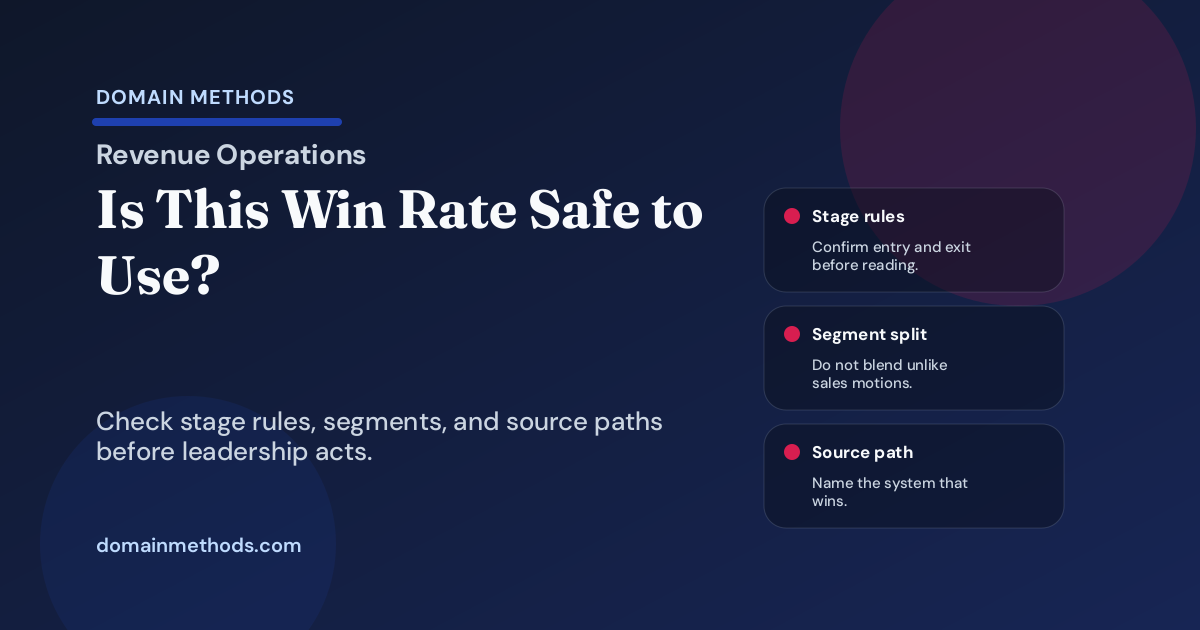
I would score win rate or stage conversion across seven checks before letting it drive a high-stakes decision.
| Check | What to inspect | What weak confidence looks like |
|---|---|---|
| Opportunity definition | What counts as an opportunity and who can create one | The denominator changes when SDR, AE, partner, or self-serve rules change |
| Stage rules | What stage entry, exit, and progression mean in plain English | Managers coach stages differently, so conversion reflects behavior as much as buyer movement |
| Segment split | Which motions belong together and which need separate views | Enterprise, expansion, partner, and self-serve deals are blended into one average |
| Time window | Which creation, stage-entry, close, or cohort window controls the metric | The team compares periods before and after a process change as if they are equivalent |
| Loss hygiene | Whether closed-lost, no-decision, disqualified, and recycled opportunities are handled consistently | Win rate improves because old opportunities were cleaned up or relabeled late |
| Source path | Which CRM report, warehouse model, finance table, or dashboard wins | The number changes depending on who exported the chart |
| Usage rule | What the metric is allowed and not allowed to decide yet | A caveated conversion signal becomes a hiring, spend, or forecast commitment |
The operator tradeoff is speed versus purity. You do not need a perfect funnel model to learn something this week. But you do need to know whether the current model is strong enough for the decision being attached to it.
A directional metric can help a team move. An unlabeled directional metric can help a team make an expensive mistake.
Directional, diagnostic-grade, leadership-grade, or not safe yet
Use the confidence band that matches the weakest important check.
| Confidence band | What it means for win rate or stage conversion | Safe uses | Not safe yet |
|---|---|---|---|
| Directional | The metric can show broad trend, risk, or movement, but funnel rules are still unstable or contested | Weekly discussion, problem spotting, prioritizing cleanup | Hiring plans, budget shifts, forecast commitments, board claims |
| Diagnostic-grade | The definition, segment, period, and source path are stable enough to diagnose one named operating question | Segment review, channel diagnosis, manager coaching, focused pipeline repair | Broad leadership claims outside the documented slice |
| Leadership-grade | The metric has stable funnel rules, owner authority, source precedence, and clean comparison periods for the decision | Hiring/capacity planning, spend allocation, forecast confidence, executive narrative | Uses outside the documented motion, segment, or period |
| Not safe yet | The metric is materially disputed, blended, manually rescued, or distorted by process changes | Evidence for repair work and leadership escalation | Any decision that changes staffing, budget, forecast, or formal accountability |
A practical standard: if the team cannot explain what changed in opportunity creation rules, the metric is not leadership-grade. If self-serve upgrades and enterprise new business are blended without a label, it is not leadership-grade. If closed-lost cleanup after the quarter can materially move the answer, the chart needs a caveat before it supports a forecast call.
That does not make the metric useless.
It means the operating rule needs to be visible.
What win rate should not decide yet
The most useful output from this check is often the limit it creates.
Write down what win rate is not allowed to decide yet.
Examples:
- Do not approve sales headcount from a blended win-rate view that mixes enterprise new business with expansion and self-serve upgrades.
- Do not cut paid spend because opportunity-to-close conversion fell if opportunity creation rules changed in the same period.
- Do not blame sales execution from a stage-conversion view where managers use discovery, qualified, and proposal stages differently.
- Do not tell the board sales productivity is improving if the improvement mostly came from late closed-lost cleanup.
- Do not compare this quarter to last quarter as a clean performance trend if the CRM process changed mid-period.
- Do not let a spreadsheet-fixed conversion number become the executive source of truth without documenting the repair.
This is not caution for its own sake. It is how you keep a useful funnel signal from turning into a false operating fact.
Mid-size SaaS teams often need to act before every CRM field is perfect. That is fine. The caveat just cannot live in one person’s head when the decision affects people, budget, or forecast confidence.
A lightweight repair path
When win rate is not ready for the decision, do not turn the fix into a six-month data program.
Fix the layer that is actually lowering confidence.
| Confidence gap | First useful repair | Who should own it |
|---|---|---|
| Opportunity definition is unstable | Write what counts as an opportunity, which motions are included, and when records are created | RevOps with sales leadership sign-off |
| Stage rules vary by team | Publish stage-entry and stage-exit rules with two or three examples per stage | Sales leadership plus RevOps |
| Motions are blended | Split enterprise, mid-market, self-serve, expansion, partner, or renewal views before comparing rates | RevOps with finance and GTM leadership |
| Time window is misleading | Decide whether the metric is cohort-based, close-period-based, or stage-entry-based | RevOps plus forecast owner |
| Closed-lost hygiene is weak | Define loss reasons, stale-opportunity cleanup, and recycle rules before the reporting cutoff | Sales ops and frontline managers |
| Source path is brittle | Name which CRM report, warehouse model, or finance view wins when numbers differ | Data/analytics with RevOps and finance authority |
| Usage is overreaching | Add a confidence label and a “not for” line to the dashboard, forecast note, or board-prep packet | Executive sponsor plus metric owner |
The sequencing matters. If the team cannot agree what an opportunity is, do not start by tuning the dashboard. If the definition is settled but enterprise and self-serve are blended, do not solve it with another meeting note. If the source path breaks every month, do not keep asking leaders to remember which slide is caveated.
Repair the specific control that is making the metric unsafe.
Use the worksheet before the next funnel review
The worksheet below is intentionally lightweight. Use it for one funnel metric and one decision: hiring, spend, forecast, segment diagnosis, or leadership narrative.
Download the Win-Rate Confidence Worksheet
Use this worksheet to classify one win-rate or stage-conversion metric, identify the weakest rule, and decide whether it is safe for hiring, spend, forecast, or only diagnosis.
Instant download. No email required.
Want future posts like this in your inbox?
This form signs you up for the newsletter. It does not unlock the download above.
Do not use it to audit every funnel report at once. The point is to leave the review with a confidence band, one unsafe use to avoid, a named owner, and the first repair needed before the number gets promoted.
When to bring in outside help
If the conflict is mainly about which team definition should win, start with Three Teams, Three Numbers. Win-rate fights often expose a broader metric-alignment problem: sales, marketing, finance, RevOps, and data can each be locally right while the business still lacks one executive rule.
If the definition is clear but the source path cannot hold, the next move is Data Foundation. Funnel-conversion reporting cannot support hiring, spend, or forecast decisions if it depends on unstable CRM stages, undocumented warehouse logic, or manual reconciliation that changes by meeting.
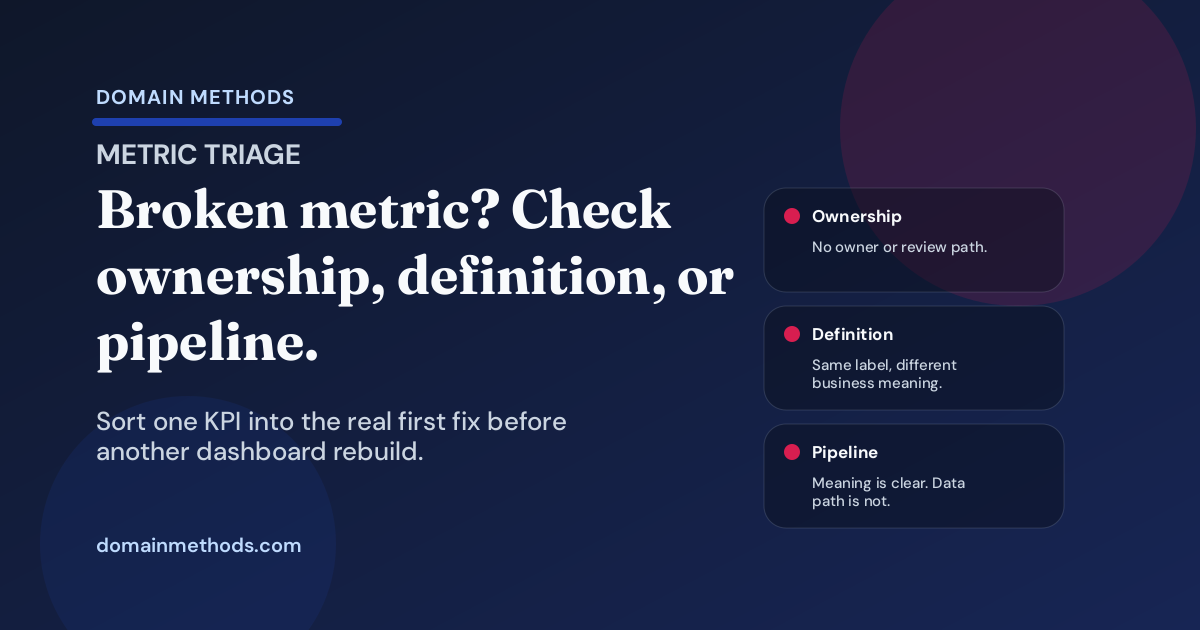
For broader context, this confidence check pairs well with The Pipeline Coverage Confidence Check, The Quota-Crediting Confidence Checklist, The Metric Confidence Ladder, The GTM Handshake Benchmark, and How to Tell Whether a Broken Metric Is an Ownership, Definition, or Pipeline Problem.
The standard is simple: use win rate when it helps the business see conversion risk sooner, but do not let it claim more certainty than the opportunity definition, stage rules, segment split, time window, source path, and usage rule can actually support.
Download the Win-Rate Confidence Worksheet
A lightweight worksheet for classifying whether win rate or stage conversion is directional, diagnostic-grade, leadership-grade, or not safe yet.
DownloadIf win rate means different things in every meeting
Three Teams, Three Numbers
Use the diagnostic when sales, marketing, finance, RevOps, and data can each defend a funnel-conversion number but the business lacks one decision rule for which version wins.
Start with the metric-alignment diagnosticIf the confidence check exposes brittle source logic
Data Foundation
Use Data Foundation when win-rate reporting depends on unstable CRM stages, warehouse logic, source precedence, or reconciliation paths that cannot support leadership decisions yet.
See Data FoundationSee It in Action
Common questions about win-rate confidence
What is win-rate confidence?
When is win rate only directional?
What makes win rate leadership-grade?
Should win rate drive hiring or spend decisions?

About the author
Jason B. Hart
Founder & Principal Consultant
Helps mid-size SaaS companies turn messy marketing and revenue data into decisions leaders trust.