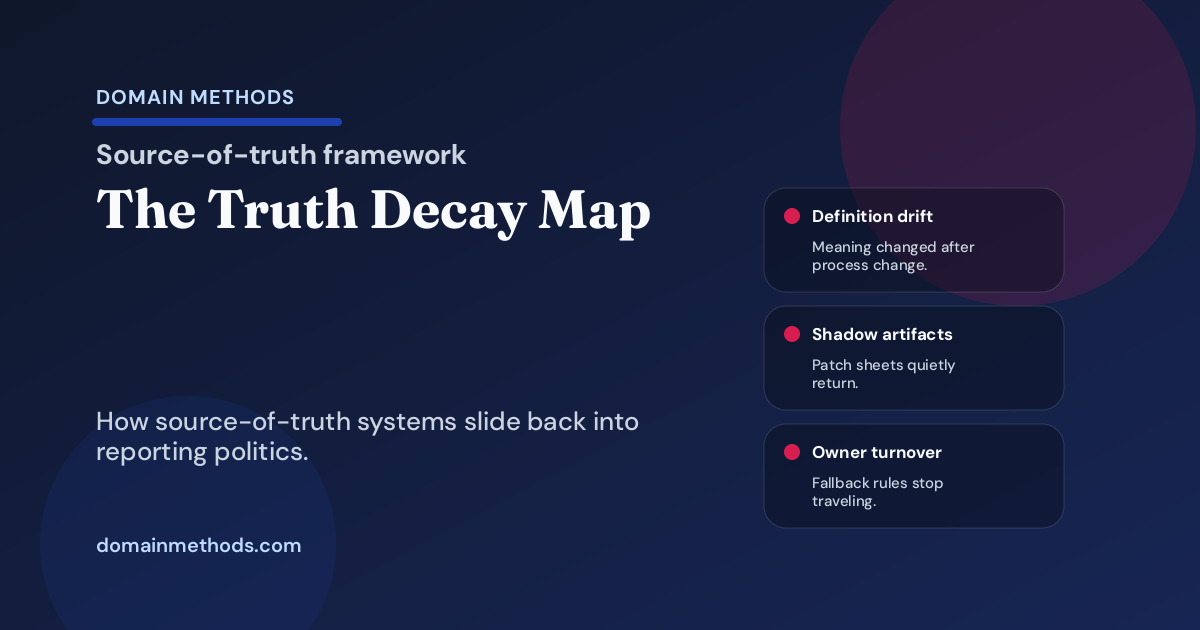
The Truth Decay Map: How Source-of-Truth Systems Slide Back Into Reporting Politics
- Jason B. Hart
- Revenue Operations
- April 20, 2026
- Updated April 25, 2026
Table of Contents
What is the Truth Decay Map?
The Truth Decay Map is a practical way to see how a source-of-truth system slides from fresh agreement back into caveats, spreadsheets, and reporting politics after the launch celebration ends.
That matters because a lot of source-of-truth work does not fail on day one.
It fails six months later.
The workshop happened. Definitions got written down. A warehouse model shipped. The board pack looked cleaner for a quarter. Then the business changed. A field stopped behaving the same way. A team added a manual caveat. Someone important left. A spreadsheet came back because it was faster than fixing the real issue before the meeting.
Nobody calls that a relaunch.
They call it a minor exception, or a temporary workaround, or just what had to happen this month.
That is how a source of truth decays.
If you want the bigger build path, start with The Single Source of Truth Blueprint. If you need the live working-session version, use How to Run a Source-of-Truth Audit Without Turning It Into a Tooling Debate. If you want the scoring lens, use The Source-of-Truth Maturity Benchmark. This article is about what happens after those things supposedly worked.
Why truth decay shows up after the project, not before it
A healthy launch phase hides a lot of fragility.
In the first weeks after cleanup, everybody is paying attention. The metric is fresh in memory. The owner still remembers why a rule was written. The dashboard has not yet been stress-tested by a messy quarter-close, a territory change, a lifecycle rewrite, or the one executive request that falls outside the original model.
Then operating reality returns.
The business adds a new exception without updating the definition record. Marketing keeps a side workbook because the dashboard is one nuance short. Finance adds a board-safe adjustment but the operating team still references the old label. RevOps changes stage rules and assumes the warehouse team will notice. A trusted operator leaves, and suddenly the room loses the person who knew where the caveats lived.
Salesforce reported that 80% of leaders say governance practices vary across different data environments.1 That is exactly the kind of condition truth decay feeds on. The source-of-truth project may have centralized reporting, but the operating rules around that reporting stayed uneven.
The map at a glance
What are the stages of source-of-truth decay?
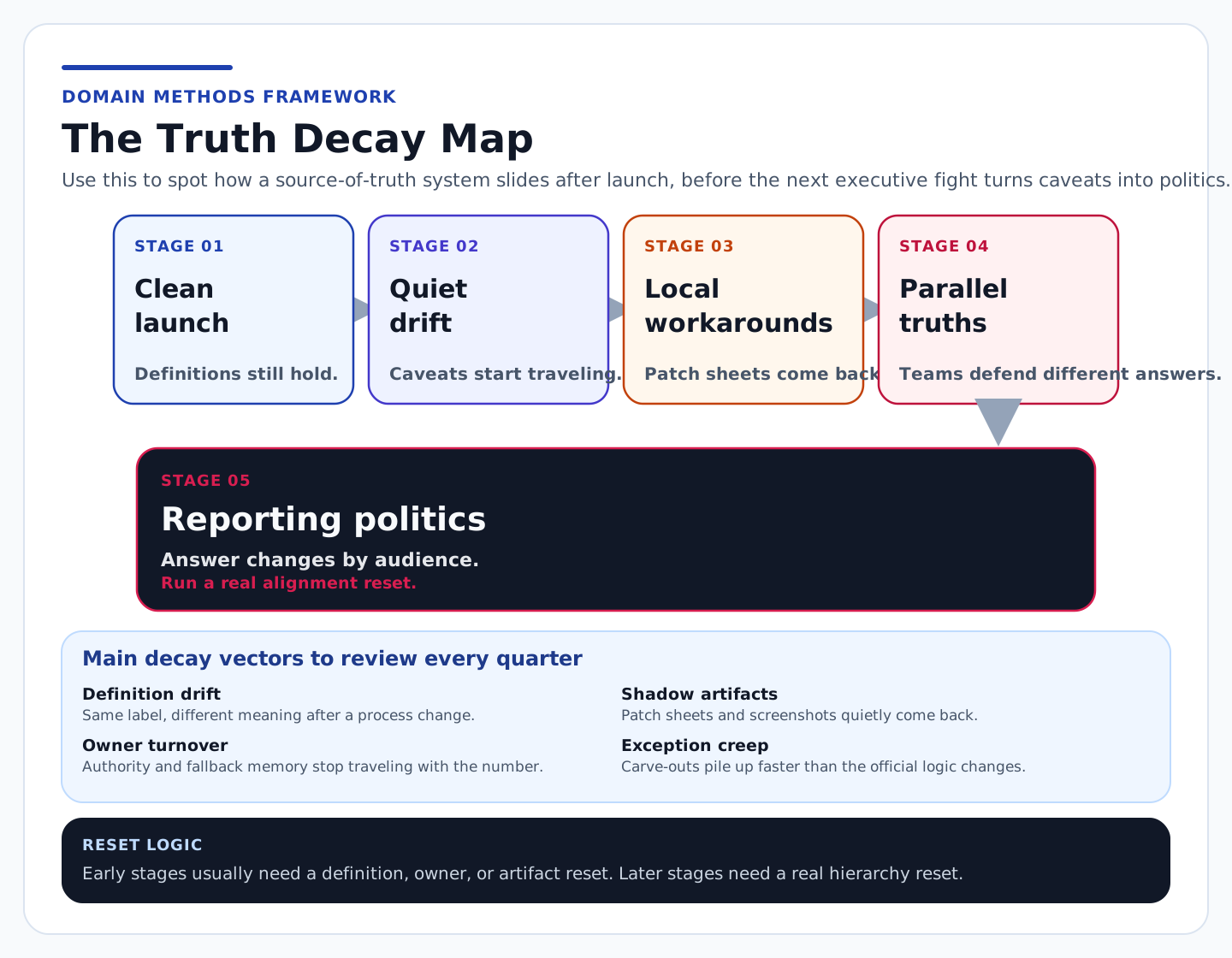
The useful question is not whether your company has a warehouse, a dbt layer, or one official dashboard.
The useful question is this:
Where is this reporting path sitting on the map right now, and what is pushing it downhill?
The map has five stages.
| Stage | What it feels like in the room | What usually changed underneath |
|---|---|---|
| Clean launch | the answer is clear and people still trust the operating model | definitions, owners, and fallback rules are still aligned with current reality |
| Quiet drift | small caveats start traveling with the number | a source, process, or approval path changed without a full review |
| Local workarounds | one team keeps a patch sheet, side export, or manual note | the official artifact is close, but not close enough for the real meeting |
| Parallel truths | multiple defensible versions of the number reappear | owner authority, exclusions, or system hierarchy are no longer shared |
| Reporting politics | the number becomes a power argument again | the operating model no longer governs the answer under pressure |
That progression matters because the fix is different at each stage.
If you are in quiet drift, a quarterly review and definition reset may be enough. If you are already back in parallel truths, the problem is bigger. Now you are not fixing one report. You are restoring a governance path the room no longer trusts.
Stage 1: Clean launch
This is the moment right after the hard work finally starts paying off.
The business can explain what the number is for. The dashboard does not need a paragraph of verbal caveats. The owner is named. The board pack is not being rebuilt in a side spreadsheet five minutes before the meeting.
The common mistake here is treating that moment as permanent.
A clean launch is not the end state. It is the moment when the operating model is most likely to survive if the team keeps reviewing it.
The operator-level detail to watch is simple: can someone new step into the workflow and still explain the logic cleanly without grabbing the one person who built it? If the answer is no, the system is cleaner than before, but not yet resilient.
Stage 2: Quiet drift
Quiet drift is where the truth still looks official, but the caveat layer is growing.
This is the quarter where someone says things like:
- “The number is right, just remember we changed how we treat recycled opportunities.”
- “Use the dashboard, but finance is still adjusting one bucket manually.”
- “The official definition still stands, but the lifecycle rules changed last month.”
Nothing has exploded yet.
That is why this stage is dangerous.
The number still carries the visual authority of a source of truth, even though the operating assumptions under it are already moving.
Early signals of quiet drift
- one or two caveats start showing up in recurring meetings
- the definition record exists, but no one updated it after the latest process change
- the source hierarchy is still technically true, but the room keeps adding spoken exceptions
- one team starts double-checking the answer offline before using it publicly
If you catch the system here, the fix is usually still small.
Stage 3: Local workarounds
Now the room no longer fully trusts the official path on its own.
This is where source-of-truth systems start leaning on artifacts they were supposed to retire.
A spreadsheet comes back because it is the fastest way to patch the edge cases. A screenshot gets reused because everyone knows it is safer than the live dashboard for this conversation. A RevOps export becomes part of the pre-meeting ritual because the warehouse answer is almost right, but not enough.
This stage matters because it tells you something important: the operating model has not fully collapsed, but the business already built an informal backup system.
That backup system is not harmless. It is where truth starts decentralizing again.
What local workarounds usually mean
| Workaround | What it usually reveals |
|---|---|
| finance workbook before the board deck | the board-grade answer still depends on a separate authority path |
| RevOps patch sheet before forecast review | stage, owner, or exclusion logic is not stable enough in the official layer |
| marketing spreadsheet before spend review | the room still does not trust the source associations or lifecycle handling |
| annotated screenshot instead of live dashboard | the official artifact cannot carry the explanation by itself |
If the workaround keeps showing up, it is not temporary anymore. It is now part of the production reporting system whether anyone admits it or not.
Stage 4: Parallel truths
This is the point where multiple versions of the same number are back in circulation and each one can be defended.
That is what makes it dangerous.
Nobody in the room is obviously inventing data. They are just using different operating assumptions.
Finance has one answer. Marketing has one answer. Sales has one answer. Data has a version that can be explained technically but no longer ends the argument.
At this stage, the room has not lost intelligence. It has lost hierarchy.
That distinction matters. The fix is not to tell everyone to stop using spreadsheets. The fix is to reassert which answer is for which decision, which system wins for that use case, and who is allowed to settle exceptions when they matter.
If you skip that and only patch the dashboard, you usually create a cleaner-looking version of the same fight.
Stage 5: Reporting politics
This is what source-of-truth decay looks like when it fully matures.
The number is no longer just contested. It becomes political.
People start arguing for the version that helps their case. Definitions become flexible depending on audience. The “official” answer only stays official until the meeting gets expensive.
The tell here is not a technical symptom. It is behavioral.
You hear things like:
- “Let’s use the old number for this deck because we know how to explain it.”
- “That dashboard is technically right, but it is not the number we should put in front of the board.”
- “We will clean up the logic later. For now, use the version the CRO expects.”
At this point, the source-of-truth problem is no longer a reporting bug. It is a decision-rights problem wearing a reporting costume.
The four decay vectors worth reviewing every quarter
The map tells you where the system is on the slide. The decay vectors tell you what pushed it there.
Which decay vectors matter most?
| Decay vector | What it looks like in practice | What to review quarterly |
|---|---|---|
| Definition drift | same label, different meaning after process changes | compare the current definition record against this quarter’s real use and exclusions |
| Shadow artifacts | spreadsheets, screenshots, side exports, and caveat docs quietly return | list which unofficial artifacts still win arguments and why |
| Owner turnover | the logic survives only in one person’s memory, then that person changes role or leaves | confirm the owner, approver, and fallback path are still explicit and current |
| Exception creep | new carve-outs keep accumulating faster than the official logic updates | review which exceptions are still justified, which should become rules, and which now deserve a reset |
Those four vectors show up constantly because they are downstream of real business motion.
The company grows. Territories change. Lifecycle stages evolve. Finance tightens definitions. Leadership asks for a different cut. New channels appear. Someone tries to preserve momentum with a local fix.
None of that is abnormal.
The abnormal move is pretending the source-of-truth system should survive those changes without review.
The difference between “the warehouse still exists” and “the operating model is still holding”
This is the sentence I wish more teams used earlier:
The warehouse still exists is not the same thing as the reporting operating model is still holding.
A warehouse can still centralize the data while the trust layer has already degraded.
You can have:
- a modern warehouse
- clean dbt models
- one official BI layer
- a recent implementation project
…and still be back in reporting politics because the operating model around those assets is no longer current.
That is why this piece is different from Your Warehouse Is Not a Source of Truth. That article is the warning label before centralization gets mistaken for trust. This article assumes you already crossed that bridge once and are trying to keep the trust from eroding after launch.
A quarterly truth-hold review I would actually run
If a leadership team says, “The source-of-truth work is done, but the room still keeps slipping,” I would not start by rebuilding architecture.
I would start with one quarterly review table.
| Review question | Why it matters | If the answer is bad |
|---|---|---|
| What changed in source systems, stages, or business rules this quarter? | truth usually decays after business change, not before it | update the definition record or source hierarchy before the next meeting |
| Which unofficial artifacts still won arguments this quarter? | shadow systems are early proof the official path is slipping | decide whether to absorb, retire, or explicitly authorize the artifact |
| Who approved the latest exceptions, and are they still valid? | exception creep becomes policy when nobody revisits it | convert the rule, remove the carve-out, or escalate it into a true owner decision |
| Can the current owner still explain the logic and fallback path? | owner turnover quietly breaks continuity | refresh ownership, approval rights, and documentation now, not after the next surprise |
| What confidence label does the metric deserve today? | teams overuse old labels after the operating conditions change | relabel the metric honestly before the next board or forecast cycle |
That review is not glamorous.
It is also much cheaper than another quarter of pretending the official answer is fine while every function keeps carrying a private caveat list.
How to reset truth without rerunning the whole project
The right reset depends on where the system is on the map.
- Quiet drift usually needs a definition review and owner confirmation.
- Local workarounds usually need one artifact cleanup plus a decision on whether the workaround should be absorbed or retired.
- Parallel truths usually need a hierarchy reset: which system wins, which use case each number supports, and who settles conflicts.
- Reporting politics usually means you need a real cross-functional alignment move again, not another hidden patch.
That is why the best next move is often smaller than people fear and more specific than they expect.
Do not say, “Our source of truth is broken.”
Say, “Our source-of-truth system is sitting in local workarounds because marketing still needs a patch sheet before spend reviews,” or “We are back in parallel truths because the finance-safe answer and operating answer still share one label.”
Now the next move is visible.
Now the work is grounded.
Now you can choose whether the answer is Three Teams, Three Numbers, Data Foundation, or a tighter quarterly governance reset before the next fight hardens.
Download the Truth Decay Quarterly Review Worksheet
Use this lightweight worksheet to mark the current decay stage, name the vectors behind it, and decide what to reset before the next executive reporting fight.
Instant download. No email required.
Want future posts like this in your inbox?
This form signs you up for the newsletter. It does not unlock the download above.
The real point of the Truth Decay Map
A source of truth does not fail because the original project was pointless.
It fails because the business keeps moving and the operating model does not get reviewed with the same seriousness as the implementation.
The Truth Decay Map gives you a simpler way to say what is happening before the room starts treating the latest workaround as normal.
That is the real win.
Not perfect purity. Not one magical dashboard.
Just a clearer answer to three practical questions:
- where is trust slipping
- what is causing it
- what is the smallest reset that gets the room back onto one defendable operating answer
Sources
- Salesforce, State of Data and Analytics (2nd Edition). Reported that 80% of leaders say governance practices vary across different data environments, which is exactly the kind of uneven operating context that lets source-of-truth systems decay after launch.
Download the Truth Decay Quarterly Review Worksheet (PDF)
A lightweight worksheet for scoring where trust is slipping, naming the decay vectors behind it, and deciding what to reset before the next executive reporting fight.
DownloadIf the room still ends with three defensible versions of the same number
Three Teams, Three Numbers
Use the diagnostic when marketing, sales, finance, and data are quietly drifting back into local truths and need one operating answer before the next reporting cycle hardens the conflict again.
See the metric-alignment diagnosticIf the decay path keeps exposing brittle lineage, dbt logic, or source-system debt
Data Foundation
Use the broader engagement when the operating model is conceptually clear, but the warehouse, source syncs, reporting logic, or governance plumbing still cannot hold the answer cleanly.
See Data FoundationSee It in Action
Common questions about source-of-truth decay
What is the Truth Decay Map?
How is this different from a source-of-truth blueprint or audit?
What is the clearest sign a source of truth is decaying even if the warehouse still exists?
What should we reset first when truth starts decaying?

About the author
Jason B. Hart
Founder & Principal Consultant
Helps mid-size SaaS companies turn messy marketing and revenue data into decisions leaders trust.