The Source-of-Truth Rollout Playbook
- Jason B. Hart
- Revenue Operations
- April 20, 2026
Table of Contents
What is a source-of-truth rollout?
A source-of-truth rollout is the ugly middle between agreeing on the right metric logic and getting the business to actually use it everywhere that matters.
That middle is where a lot of otherwise good source-of-truth work quietly fails.
The workshop goes well. The warehouse logic gets updated. Someone says the metric is finally settled.
Then the next month looks familiar anyway:
- the board deck still uses the old table because nobody wanted to change the packet three days before the meeting
- finance keeps one workbook column on the old logic because the handoff downstream is still brittle
- RevOps updates one dashboard but not the weekly operating pack
- one team says the new number is official while another team says it is still “directional for now”
At that point the business does not have a source of truth. It has a source-of-truth announcement.
That gap matters because the trust damage is operational, not theoretical. Salesforce’s State of Data and Analytics research found leaders estimate 26% of their organization’s data is untrustworthy.1 The rollout phase is where teams either shrink that trust gap or reopen it in public.
If you need the broader architecture and governance path, start with The Single Source of Truth Blueprint. If you still need to settle what should count before rollout starts, use How to Run a Source-of-Truth Audit Without Turning It Into a Tooling Debate. This playbook starts one step later: the answer is directionally chosen, and now the organization has to make the answer real.
When this playbook matters most
Use this when the room is saying some version of these:
- “We agreed on the new definition, but the deck still uses the old one.”
- “The dashboard changed, but finance has not switched the board pack yet.”
- “We have the new metric in the warehouse, but the weekly business review still runs on the legacy spreadsheet.”
- “Leadership keeps asking whether the number is final, and nobody knows how to answer without a caveat speech.”
The operator-level tell is simple: the definition fight is mostly over, but the adoption fight just started.
That is a different problem from diagnosis. It is a different problem from architecture. It is also different from governance in the abstract.
Rollout work is about choreography:
- which surfaces change first
- who owns each cutover
- what fallback is allowed during transition
- how confidence is communicated while parallel logic still exists
- when the old logic loses permission to keep shipping
The real goal of rollout is not instant purity
The wrong rollout goal is “switch everything at once so nobody sees the mess.”
That goal creates its own mess:
- stealth exceptions
- undocumented side workbooks
- leaders hearing two answers without any rule for which one wins
- operators hiding confidence problems because they feel pressure to declare the rollout complete
The right goal is more practical:
make the new answer win in the highest-stakes places first, while making the transition rules visible enough that the business knows how to lean on the number.
That is less glamorous than a big-launch story. It is also how teams avoid turning one metric cleanup into a second trust break.
A good rollout does five things well:
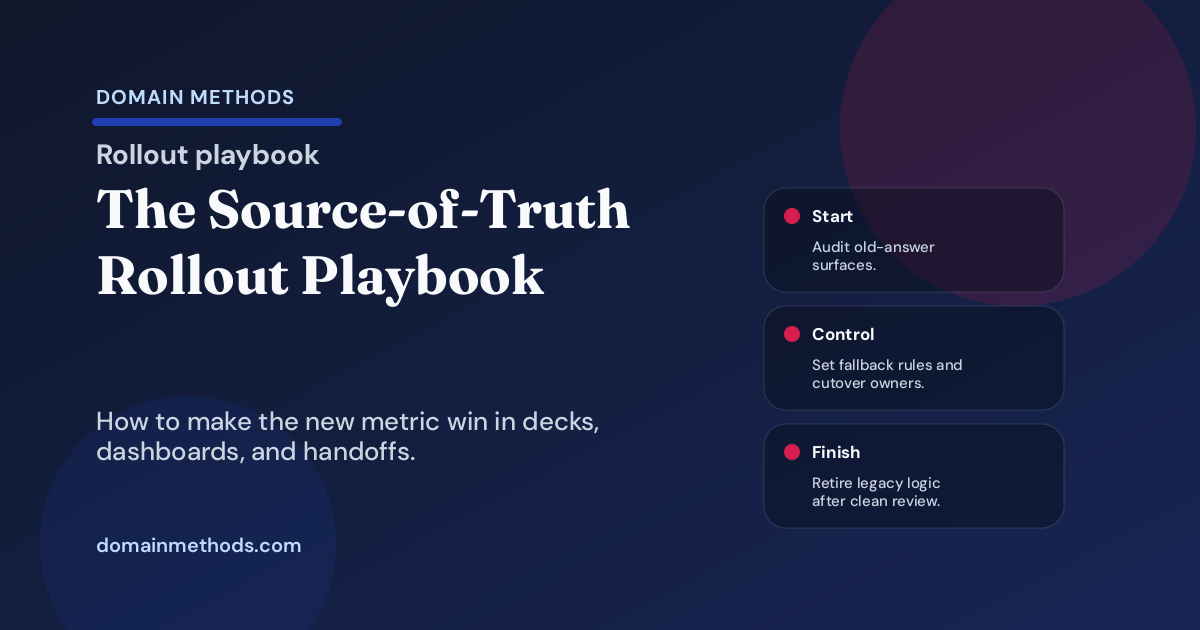
- maps every place the old logic still ships
- names one canonical answer plus one temporary fallback rule
- assigns a visible owner and cutover date for each reporting surface
- communicates confidence honestly during the transition
- removes the legacy answer on purpose instead of letting it linger forever
If those five things happen, the rollout gets boring fast. That is the win.
Step 1: inventory every place the old logic still ships
Most source-of-truth rollouts break because the team only updates the obvious artifact.
They change the warehouse model. Maybe they update the dashboard. Then they assume the organization will absorb the rest.
It will not.
You need a surface inventory first. That means listing every place the old answer still appears, especially the places nobody wants to call “production” even though they absolutely shape decisions.
A practical first-pass table looks like this:
| Reporting surface | Why it matters | Typical hidden risk if you skip it |
|---|---|---|
| Executive or board deck | sets the formal leadership story | the old logic survives because nobody wants late deck churn |
| Finance handoff workbook | settles the number in tense conversations | the workbook quietly outranks the new dashboard |
| Weekly operating review pack | drives recurring behavior and accountability | teams keep learning the old answer every Monday |
| Team-owned spreadsheet or export | patches edge cases the official path does not handle yet | the workaround becomes the de facto truth again |
| Alerts, scorecards, and planning docs | shapes action between meetings | operators keep acting on legacy thresholds |
One operator detail matters here: do not ask which surfaces are supposed to matter. Ask which artifact still wins the argument when people are under pressure.
If the real answer is “the finance workbook” or “the spreadsheet version in the packet owner’s folder,” put that on the rollout list immediately. A rollout plan that ignores the artifact that still wins the room is only documenting hope.
Step 2: freeze the canonical answer and the temporary fallback
Once the inventory exists, freeze the rollout rules.
For each metric family being rolled out, write down:
- the approved definition
- the official source path or system hierarchy
- the owner who can approve exceptions
- the first date the new answer is expected to be used
- the fallback rule if a surface cannot switch cleanly on time
That fallback rule is where teams usually get sloppy.
They say things like “we will just use the old deck for one more cycle” or “finance will sanity-check the number if needed.” Those are not fallback rules. They are vague permission slips for the rollout to drift.
A real fallback rule sounds more like this:
| Surface | Official answer during rollout | Temporary fallback | Expiration rule |
|---|---|---|---|
| Weekly exec KPI pack | new warehouse-backed metric | legacy sheet allowed only as an appendix cross-check | fallback removed after two clean cycles |
| Board deck table | finance-approved new metric | prior board table allowed one cycle with explicit note in prep doc | legacy table banned after next packet cutoff |
| Team dashboard tile | new metric immediately | no fallback; tile hidden until the new logic is live | tile republished only on new logic |
| Planning spreadsheet | new metric plus confidence label | old field allowed for reference only, not decision support | old field archived after budget review |
The point is not to sound bureaucratic. The point is to stop the business from improvising a new exception every time one surface lags behind the model.
Step 3: open one visible rollout log
If rollout status lives in Slack fragments, comments on Looker tiles, and one operator’s memory, the organization will think the change is further along than it is.
Use one visible rollout log instead.
It can be simple. It just needs to force the same fields every time:
| Surface | New owner | Cutover date | Confidence during rollout | Current blocker | Sunset rule |
|---|---|---|---|---|---|
| Weekly operating pack | RevOps lead | May 6 | decision-grade | finance still validating one edge-case adjustment | remove old workbook tab after two clean reviews |
| Board packet summary table | finance owner | May 20 | board-grade once reconciliation signoff is complete | packet template still references legacy column labels | old table removed after next board cycle |
| Marketing dashboard tile | growth ops | May 3 | directional for one week | source sync lag not fully stabilized | legacy tile hidden at republish |
| Planning model inputs | FP&A manager | May 15 | decision-grade | planning file uses old field names | old inputs archived after budget checkpoint |
This log does more than track progress. It keeps the work honest.
A lot of rollout confusion comes from one surface being board-grade while another is still directional. That is normal for a transition. What breaks trust is pretending every surface moved at the same time when everyone in the room knows they did not.
Step 4: sequence the highest-blast-radius surfaces first
Not every reporting surface deserves the same urgency.
The order matters because some artifacts shape the company’s story while others mostly trail behind it.
A clean sequence usually looks like this:
- surfaces that influence executive or board decisions
- recurring leadership review packs and operating cadences
- finance handoffs and cross-functional planning files
- team dashboards, scorecards, and local working docs
- lower-stakes historical views and edge-case cleanup
That order feels backwards to some teams because the dashboard is more visible than the board prep notes. But visibility is not the same as blast radius.
If the board table, weekly exec pack, and finance handoff are still on the old logic, the rollout is politically fragile even if the dashboard looks modern.
This is also where teams need to avoid a classic mistake: trying to solve every downstream edge case before the first high-stakes surface can move.
You do not need perfect purity before the operating rhythm improves. You do need a clear statement of where the new answer already wins, where it is still transitional, and what has to happen next.
Step 5: communicate confidence during the parallel-run window
A rollout often includes a short period where the organization is comparing old and new logic side by side.
That is not automatically bad. It is often healthy.
What is dangerous is leaving that parallel-run window unlabeled.
Use the same confidence language everywhere the rollout is discussed:
| Confidence level | What it means during rollout | Safe use |
|---|---|---|
| Directional | the new answer is informative, but one or more surfaces or edge cases are still stabilizing | early working reviews, investigation, internal comparisons |
| Decision-grade | the new answer is strong enough for operating choices, with known caveats documented in the rollout log | weekly leadership decisions, prioritization, spend or staffing tradeoffs |
| Board-grade | the new answer, owner, and reconciliation path are stable enough for formal executive or board narrative | board packs, formal monthly summaries, compensation-sensitive reporting |
This is where The Metric Confidence Ladder becomes useful in practice.
The label is not there to soften the message. It is there to stop a transitional number from getting oversold before the rollout can actually support it.
An operator-level rule that helps: if a number still depends on one person’s memory of the caveat, it is not board-grade yet no matter how polished the slide looks.
Step 6: sunset the old logic on purpose
A rollout is not done when the new metric exists. It is done when the old metric loses permission to keep shipping.
That needs an explicit sunset rule.
Otherwise the legacy logic hangs around in one safe-seeming corner forever:
- one workbook tab nobody wanted to break
- one board appendix table everyone kept “just in case”
- one dashboard tile somebody still trusts because it matches the number from last quarter
- one planning model field that nobody had time to rename
The sunset criteria should be written before the cutover, not improvised after the team is tired.
A useful checklist is:
- has the replacement surface survived the agreed number of clean cycles?
- is the owner comfortable defending the new answer without a private reconciliation ritual?
- are the remaining caveats documented in the rollout log instead of hidden in the legacy file?
- has the business been told that the old answer is now reference-only or fully retired?
If those conditions are true, archive the old logic. Do not leave it discoverable and half-legitimate.
The old answer does not need to be deleted from history. It does need to stop competing in the present.
Common rollout mistakes after the definition is settled
Mistake 1: treating the warehouse update as the rollout
The model change is necessary. It is not the whole adoption plan.
Mistake 2: switching low-risk dashboards before high-risk executive surfaces
That feels productive, but it leaves the real trust path untouched.
Mistake 3: letting every lagging artifact invent its own fallback
That is how one rollout quietly becomes five local truths.
Mistake 4: hiding confidence problems because the team wants to declare victory
If the business cannot tell whether the number is directional, decision-grade, or board-grade, the rollout is not more trustworthy. It is just more polished.
Mistake 5: never setting a sunset date for the old answer
If the legacy artifact still wins the argument in a hard meeting, the rollout is still incomplete.
The source-of-truth rollout checklist
Use this sequence when the metric logic is directionally agreed and the adoption work still feels messy:
- inventory every place the old answer still ships
- freeze the canonical answer, owner, first-use date, and fallback rule
- open one visible rollout log with cutover dates and sunset criteria
- move the highest-blast-radius surfaces first
- label confidence during the parallel-run window
- archive the old logic once the replacement survives the agreed checks
That sequence is intentionally boring.
Boring is good here.
A source-of-truth rollout should feel more like an orderly cutover and less like a monthly argument about whose caveat is currently winning.
Download the rollout checklist + change log
Use the worksheet below as a live operating tool, not a ceremonial PDF.
The point is to leave the session with a list of surfaces, owners, cutover dates, fallback rules, confidence labels, and sunset criteria the business can actually run.
Download the Source-of-Truth Rollout Checklist + Change Log (PDF)
A lightweight rollout worksheet for tracking cutover owners, parallel-run rules, confidence labels, blockers, and sunset criteria across dashboards, finance handoffs, and operating docs.
Instant download. No email required.
Want future posts like this in your inbox?
This form signs you up for the newsletter. It does not unlock the download above.
If the rollout keeps stalling because every function still has a different definition or owner story, move into Three Teams, Three Numbers. If the rollout plan is sound but the warehouse, source-sync, or reporting plumbing still cannot carry the change cleanly, Data Foundation is the stronger next move.
Sources
- Salesforce, State of Data and Analytics (2nd Edition), 2023.
Download the Source-of-Truth Rollout Checklist + Change Log (PDF)
A lightweight rollout worksheet for tracking cutover owners, parallel-run rules, confidence labels, and sunset criteria across dashboards, finance handoffs, and operating docs.
DownloadIf rollout is stuck because teams still defend different versions of the metric
Three Teams, Three Numbers
Use the diagnostic when marketing, sales, finance, and data still need explicit owner authority, metric boundaries, and one operating answer before the rollout can stick.
Start with the metric-alignment diagnosticIf the rollout plan is clear but the systems-of-record and warehouse logic still cannot carry it
Data Foundation
Use the broader engagement when the business has chosen the right answer but source syncs, model logic, lineage, or reporting plumbing still make the rollout fragile.
See Data FoundationSee It in Action
Common questions about rolling out a new source of truth
What is a source-of-truth rollout?
Why do source-of-truth projects still fail after the definition workshop?
Should every surface switch on the same day?
What is the clearest sign the rollout is not done?

About the author
Jason B. Hart
Founder & Principal Consultant
Helps mid-size SaaS companies turn messy marketing and revenue data into decisions leaders trust.