The Revenue Handshake Framework
- Jason B. Hart
- Revenue Operations
- April 21, 2026
Table of Contents
What is the Revenue Handshake Framework?
The Revenue Handshake Framework is a practical way to answer one expensive question: where does revenue truth stop surviving the handoff from one team and system to the next?
That is the question most teams should ask before they ask for another dashboard, another warehouse model, or another finance reconciliation pass.
When revenue numbers stop lining up, the room usually describes the problem from the surface where it hurts most.
Marketing says attribution is broken. Sales says the CRM history is messy. Finance says the number does not tie out. Data says the board metric keeps changing after the SQL is already written.
All of those complaints can be real. They are just usually downstream versions of the same operating problem.
Salesforce’s State of Data and Analytics (2nd Edition) reports that leaders estimate 26% of their organization’s data is untrustworthy.1 That number matters here because revenue fights are rarely caused by one obvious bad chart. They come from a chain of locally reasonable handoffs that no longer preserve one trustworthy story by the time leadership sees the metric.
That is what this framework is for.
It gives the room a way to ask:
- where did the meaning first drift?
- which handoff rule bent the story?
- who owns the next repair?
That is a much better starting point than arguing about whose dashboard is more correct.
Why teams misdiagnose this problem
A lot of revenue-trust work gets framed as a reporting problem because reporting is where the pain becomes visible.
That is late.
By the time the board deck needs caveats, the handshake has usually been degrading for a while. A capture rule was loose. A stage label changed meaning without being reset downstream. An owner handoff stayed half policy and half tribal memory. The warehouse inherited a translation layer nobody revisited. Finance normalized the story one way while go-to-market kept using another.
Now everybody in the room has evidence. Nobody has the same story.
That is why this framework should sit next to The GTM Handshake Benchmark, The ‘What Does Revenue Even Mean Here?’ Workshop Guide, and The Revenue Data Trust Score, not replace them.
- The benchmark helps you score one handoff.
- The workshop guide helps you facilitate the definition fight directly.
- The trust score helps you grade confidence across revenue reporting.
- This framework helps you see where the story first forks so the next fix lands in the right layer.
That distinction matters because many teams keep assigning the cleanup to the last person touching the metric rather than the first place the metric stopped surviving the transfer.
The framework at a glance
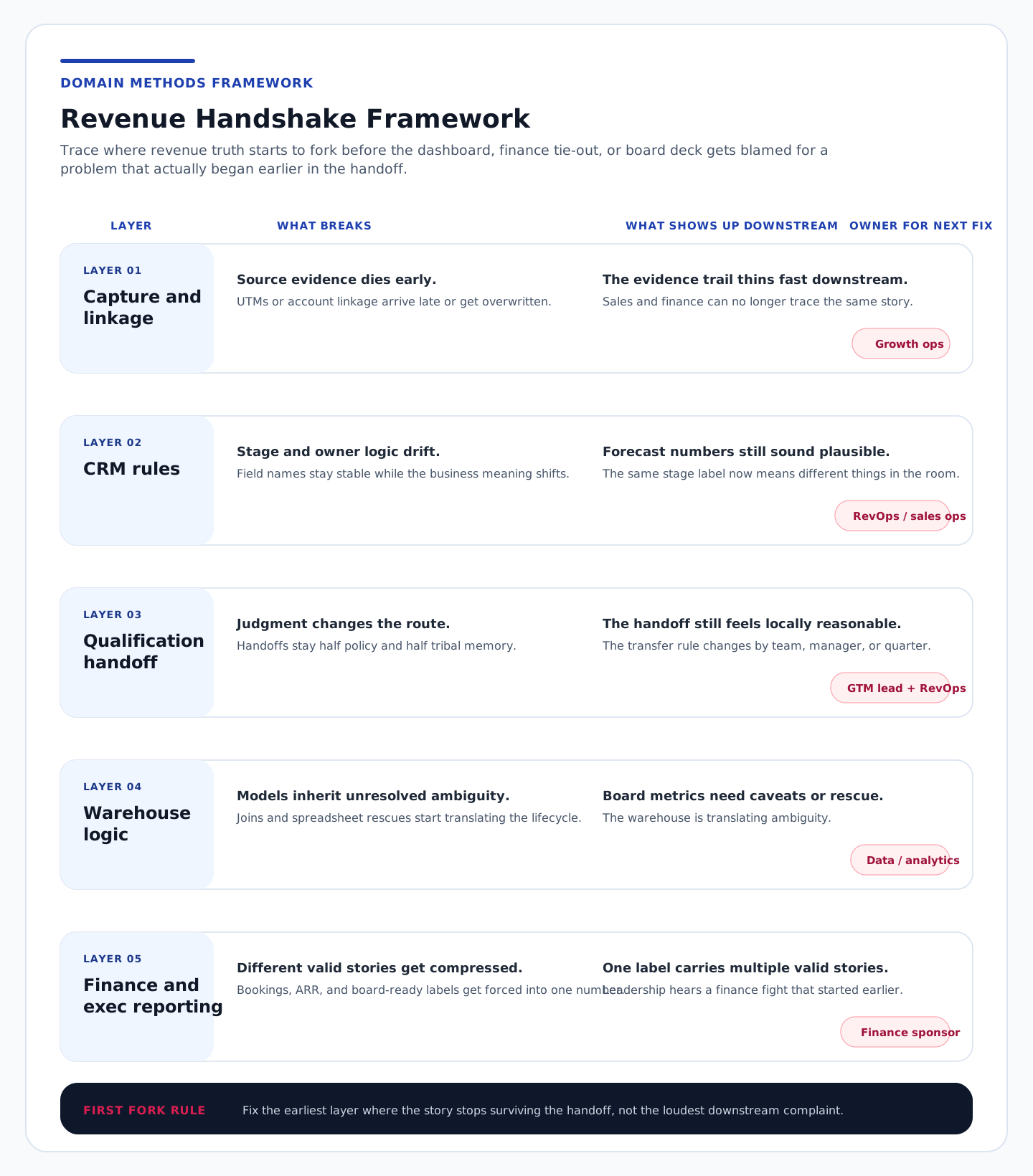
Use the framework to trace the revenue story from capture to executive reporting and mark the first layer where truth stops surviving the handoff.
The point is not to create a prettier diagram of your data stack.
The point is to answer the operator question in one glance: which layer broke the handshake first, what symptom showed up downstream, and who should own the next repair?
The five layers of the revenue handshake
You do not need a twenty-box architecture map to do this well.
You need the five layers where the story usually starts bending.
| Handshake layer | What usually breaks here | What shows up downstream | Owner for the next fix |
|---|---|---|---|
| Capture and campaign linkage | source evidence is thin, late, or overwritten before opportunity creation | marketing can defend the lead story but sales and finance cannot trace it later | growth ops or RevOps |
| CRM stage and ownership rules | stage names, owner transitions, and qualification logic drift without explicit reset | pipeline, conversion, and forecast numbers all sound plausible but do not match | RevOps or sales ops |
| Qualification and handoff decisions | SDR, AE, and manager judgment changes the route without one shared operating rule | sourced, accepted, and forecast-ready numbers stay locally rational but diverge fast | GTM leadership plus RevOps |
| Warehouse logic and joins | models, joins, and spreadsheet patches translate the same lifecycle differently for different consumers | the board metric requires caveats, private reconciliation, or one heroic operator | data or analytics engineering |
| Finance normalization and executive reporting | bookings, ARR, recognized revenue, and board-ready labels get compressed into one story | leadership hears one number label with three different meanings behind it | finance plus an executive sponsor |
The key practical point is simple: the first broken layer matters more than the loudest later symptom.
If the story was already compromised at capture or CRM stage logic, spending all your energy on the board pack or the finance tie-out will make the output calmer without making it more true.
1. Capture and campaign linkage
This is where the revenue story can get bent before sales ever has a chance to touch it.
The operator version is familiar. A paid campaign generates a real conversation. The form captures something. The CRM gets a source field. The dashboard shows a channel row. Everybody assumes the evidence survived.
Then the real path turns out to be thinner than it looked. The first-touch detail arrived late. The account association happened outside the expected route. A manual opportunity got created without the same source context. The campaign history was technically present, but not durable enough to survive the sales process.
Now marketing still has a story. It just is not the same story the rest of the business can reliably inherit.
If the first fork happens here, the next move is rarely another finance clean-up pass. It is capture and linkage discipline. That is also the moment where Where Did the Money Go? becomes the sharper secondary route.
2. CRM stage and ownership rules
This is where the same lifecycle label starts doing different jobs for different people.
Marketing hears “qualified” and thinks intent threshold. Sales hears it and thinks rep acceptance. Leadership hears it and assumes forecast relevance. RevOps tries to keep the label usable for all three conversations and ends up carrying the translation burden by hand.
This is one of the easiest places for revenue truth to fork quietly because the field names stay stable while the business meaning drifts underneath them.
A real operator tell here is when the team says the stage logic is “mostly the same as last quarter” while also carrying a list of exceptions everybody has learned to memorize. That is not a clean handoff. That is an undocumented branch structure.
If the first break is here, call it what it is: a rule and ownership problem. Do not hand it to analytics as if another model layer will settle the argument for you.
3. Qualification and handoff decisions
This is the layer people often under-document because the handoff feels operational rather than technical.
It still changes the number.
SDR to AE. Marketing-sourced to sales-accepted. Open opportunity to commit-worthy pipeline. Customer expansion signal to finance-visible revenue expectation.
In each transfer, one team thinks it is passing a clean object. The receiving team thinks it is inheriting a judgment call.
That is why this layer creates so many locally defensible disagreements. Each team is using a rule that makes sense inside its own operating context. The handshake breaks because nobody wrote down the transfer condition in a way the next team can actually inherit.
This is also where a lot of meetings get emotionally weird. Nobody is lying. Nobody is necessarily incompetent. The business just has a hidden policy problem living inside a supposedly shared number.
If this is the first fork, the next fix usually belongs with GTM leadership and RevOps together. The business rule has to be settled before the reporting rule can become trustworthy.
4. Warehouse logic and joins
This is where a lot of teams discover that the warehouse is not a source of truth so much as a translation machine for unresolved upstream ambiguity.
That is not a knock on the warehouse. It is just reality.
When capture is imperfect, CRM rules are soft, and owner handoffs still depend on judgment, the warehouse inherits the job of deciding which story becomes official enough for reporting.
That can be the right move. It can also hide the real problem for another quarter.
I have seen teams with very competent modeling work still end up with two revenue stories:
- the finance-safe version used for formal reporting
- the GTM-usable version used for planning and channel decisions
Sometimes both are reasonable. The trust problem appears when the business keeps calling them the same thing.
If the first durable fork happens in warehouse logic, the next move is not to argue harder about the dashboard output. It is to inspect the translation layer directly: which joins, caveats, override rules, or spreadsheet adjustments are preserving one audience’s story while bending another audience’s meaning.
5. Finance normalization and executive reporting
This is the layer people notice first because it is where the disagreement finally becomes expensive enough to slow a real decision.
Bookings, ARR, recognized revenue, sourced pipeline, expansion, and board-ready labels all have valid uses. The trouble starts when one executive summary compresses them into one term like “revenue” and assumes the room shares the same operating meaning.
That is when the handshake becomes political. Not because politics suddenly appeared in the board meeting, but because the earlier layers were already handing leadership different definitions with the same label attached.
If the first genuine fork is here, the real issue may be definition authority rather than system integration. Finance may have a clean rule. Go-to-market may have a clean but different rule. The warehouse may be faithfully supporting both.
That is not a tooling problem. That is a leadership decision problem.
A concrete example of an upstream fork that looks like a downstream reporting problem
Say marketing walks into the weekly revenue review claiming a paid program sourced $1.2M in pipeline. Sales says only $700K should count because several opportunities were re-owned, re-staged, or reopened after the original handoff. Finance says the booked-revenue line tied to those opportunities is lower still and that the board view will not recognize part of the story anyway.
A lot of teams treat that as three separate debates:
- attribution logic
- CRM hygiene
- finance reconciliation timing
Sometimes it is all three. But the strongest next question is still: where did the handshake first stop preserving one story?
Maybe the answer is capture. Maybe the campaign evidence did not survive the transfer to opportunity creation. Maybe the answer is ownership and stage logic. Maybe the opportunity changed hands under rules nobody ever translated into reporting logic. Maybe the answer is finance normalization. Maybe the board-ready number is intentionally different and the real failure is that nobody labeled the difference clearly.
The framework is useful because it stops the room from fixing the last visible argument first. It makes you locate the first durable fork.
That is usually where the cheapest honest fix lives.
Handshake failure vs. generic tooling complaint
This distinction matters.
A generic tooling complaint sounds like this:
- the dashboard is slow
- the BI layer is ugly
- the CRM report is hard to filter
- the warehouse query is brittle
A handshake failure sounds like this:
- the source evidence does not survive the handoff
- the lifecycle label means different things to different teams
- the owner transition is real in practice but invisible in reporting logic
- the modeled metric and the finance-safe metric are both defensible but not labeled as different stories
- the board number requires a private reconciliation pass before anyone will stand behind it
One is product friction. The other is a broken operating transfer.
You can have both. If you misclassify the second one as the first, you will keep improving the interface around a story that still does not survive contact with the next layer.
When the real issue is definition authority, not integration
Some revenue fights do not need another sync. They need an explicit answer to who gets to define the term for the decision at hand.
That is why this framework should not become a lazy excuse to say every disagreement is a systems problem.
A useful test is this:
- If the underlying event path is intact but teams disagree on what should count, you have a definition-authority problem.
- If the business meaning is agreed but the evidence dies or mutates in transfer, you have a handshake-path problem.
- If both are true, settle the decision-right first, then fix the path that is supposed to carry that decision cleanly.
This is exactly where Three Teams, Three Numbers becomes the right primary route. The room needs a visible decision on which number is fit for which use, not just another technical patch on top of unresolved authority.
The 30-minute working session I would actually run
If I had one cross-functional working session to use this framework, I would keep it brutally simple.
1. Pick one revenue question
Not “fix revenue reporting.”
Pick one real question leadership already needs answered:
- What is the sourced pipeline number we will use this quarter?
- Which number belongs in the board update?
- Why does finance not accept the same bookings story sales is using?
If you cannot name the question cleanly, the session will sprawl.
2. Trace the five handshake layers quickly
Walk capture, CRM rules, qualification handoff, warehouse logic, and finance/executive reporting.
For each layer ask:
- what is this layer handing forward?
- what business meaning is assumed here?
- what owner rule is carrying the handoff?
- what evidence would the next team expect to survive?
Keep the room honest. If someone says “it depends,” make them name what it depends on.
3. Mark the first fork
Do not let the room jump straight to the loudest downstream symptom.
The board deck may be where the argument becomes expensive. That does not mean the board deck is where the story first bent.
4. Assign the next repair owner
This is the step most teams skip.
The analyst carrying the last-mile reconciliation is not automatically the owner of the real fix. If the first fork lives in capture, stage logic, owner transitions, or definition authority, name that owner explicitly.
5. Leave with one tighter next move
A good working session ends with one of these decisions:
- tighten capture and campaign-linkage rules
- reset CRM stage and ownership definitions
- settle the qualification handoff policy
- patch the warehouse translation layer and label the caveats honestly
- choose the canonical executive definition and document what it excludes
That is enough. You do not need a giant remediation program before the next meeting. You need the next honest fix.
The review sheet to use in the room
The fastest way to make this framework practical is to write down four things while the room is still talking:
- the number in dispute
- the first handshake layer where the story forks
- the downstream symptom everyone is currently arguing about
- the owner of the next repair
The review sheet below is built for exactly that.
Download the Revenue Handshake Review Sheet (PDF)
Use this lightweight review sheet to mark the first broken handoff layer, capture the downstream symptom, and assign the next repair owner before another exec review turns into a caveat recital. Download it instantly below. If you want future posts like this in your inbox, you can optionally subscribe below.
Instant download. No email required.
Want future posts like this in your inbox?
This form signs you up for the newsletter. It does not unlock the download above.
Bottom line
Revenue fights are usually described at the layer where they become embarrassing.
That is not always the layer that broke first.
The Revenue Handshake Framework is useful because it makes the room stop asking who has the most persuasive dashboard and start asking where the story stopped surviving the transfer.
That question is less glamorous. It is also the one that leads to a real fix.
If marketing, sales, finance, and data all have defensible evidence but no shared rule for which version of the number should drive the decision, start with Three Teams, Three Numbers. If the handshake is already breaking before revenue ever reaches a clean CRM-to-warehouse-to-finance path, start with Where Did the Money Go?. And if you want the scoring view after you identify the structural fork, use The GTM Handshake Benchmark.
Start with Three Teams, Three NumbersSources
- Salesforce, State of Data and Analytics (2nd Edition), 2025. https://www.salesforce.com/en-us/wp-content/uploads/sites/4/documents/research/salesforce-state-of-data-and-analytics-2nd-edition.pdf
Download the Revenue Handshake Review Sheet (PDF)
A lightweight working sheet for marking the first fork in the revenue handshake, documenting the downstream symptom, and assigning the next repair owner before the next executive review.
DownloadIf every team still has a locally defensible version of revenue
Three Teams, Three Numbers
Use the diagnostic when marketing, sales, finance, and data all have evidence, but nobody can settle which version of the number should drive the decision in the room.
See the metric-alignment diagnosticIf the handshake starts breaking before revenue ever reaches the CRM or warehouse cleanly
Where Did the Money Go?
Use the diagnostic when campaign linkage, routing, stage movement, and spend-to-revenue visibility are already bending the story before finance gets involved.
See the attribution diagnosticSee It in Action
Common questions about the revenue handshake
What is the revenue handshake?
How is this different from the GTM Handshake Benchmark?
How do I know whether this is a tooling problem or a definition-authority problem?
Who should own the fix when the numbers disagree?

About the author
Jason B. Hart
Founder & Principal Consultant
Helps mid-size SaaS companies turn messy marketing and revenue data into decisions leaders trust.