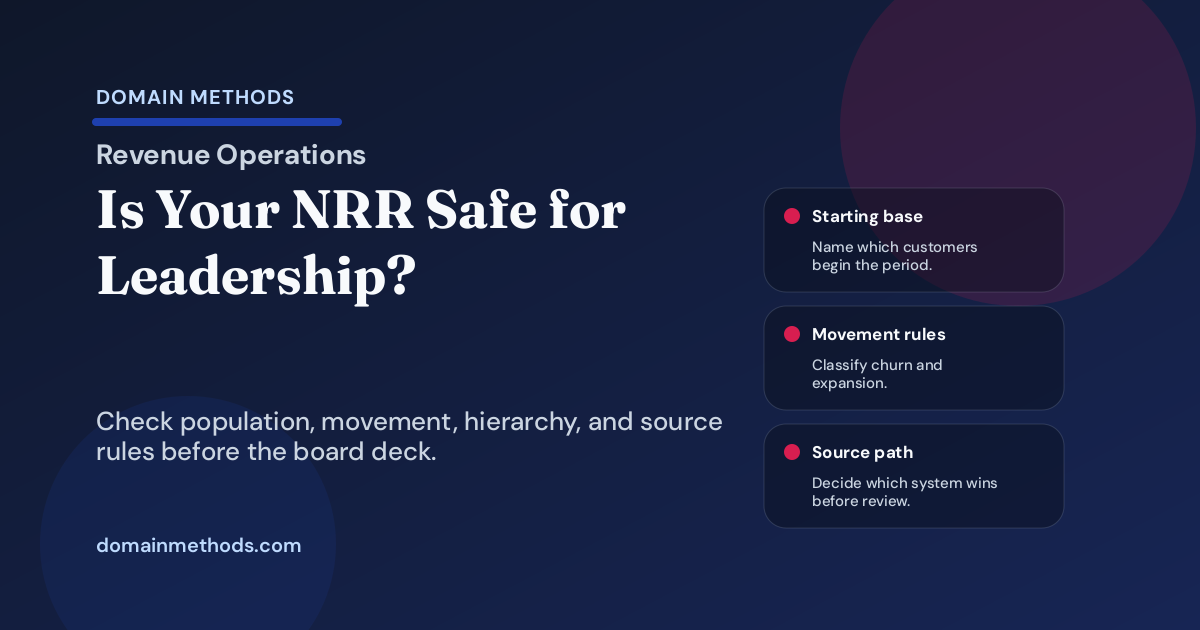
The Retention Confidence Check: Is Your NRR Number Safe Enough for Board, Forecast, or Expansion Decisions?
- Jason B. Hart
- Revenue Operations
- April 27, 2026
- Updated April 30, 2026
Table of Contents
What is the retention confidence check?
The Retention Confidence Check is a practical way to decide whether a retention metric is trustworthy enough for the leadership decision attached to it.
Retention looks simple when it shows up as one tidy number in a board deck. NRR is 108%. Gross retention is 91%. Logo churn is down. Expansion is up.
Then somebody asks what happened to paused customers, mid-period contract resets, account consolidations, annual true-ups, downgrades that booked after renewal, or expansion that finance recognizes in a different month. The tidy number starts to depend on which system exported the file.
That is the risk. Retention is not one number until the team agrees on the starting population, movement categories, account hierarchy, revenue timing, and source of truth.
A retention metric can be directionally useful before it is leadership-grade. It can show that something is getting worse. It can point customer success toward a segment that needs attention. It can justify a repair conversation.
But it should not drive board narrative, hiring plans, renewal-risk staffing, expansion investment, or forecast confidence until the controls behind it match the consequence of the decision.
Why retention numbers get slippery
Retention metrics sit at the intersection of billing, CRM, finance, customer success, product usage, and executive storytelling.
Each team has a reasonable view:
- Finance wants recognized revenue, contract policy, refunds, credits, and period close to hold up.
- Customer Success wants active account status, renewal risk, health score, and ownership to reflect reality.
- Sales wants expansion and renewal movement tied to the right account motion.
- Product wants usage and workspace behavior to explain what is changing before revenue follows.
- RevOps wants the CRM, billing platform, and warehouse to stop disagreeing every time a leader asks for a slice.
The messy part is not that one team is careless. It is that retention combines several different operating events into one executive signal.
A downgrade can be a churn signal, a packaging migration, a customer-success risk, or a finance timing issue. An expansion can be a sales motion, a product-led upgrade, a contract consolidation, or a delayed recognition event. A “customer” can mean a billing account, parent account, workspace, legal entity, product tenant, or CRM account family.
If those distinctions are not explicit, the metric may still be interesting. It is not safe enough for high-stakes decisions.
Start with the decision, not the dashboard
Do not begin by arguing whether the NRR dashboard is right. Start by naming the decision the number will support.
| Decision | What leaders usually need | Minimum confidence bar |
|---|---|---|
| Weekly customer-health review | A directional view of risk, contraction, or expansion signals | Directional may be enough if caveats are visible |
| Renewal-risk prioritization | A stable list of accounts needing action | Diagnostic-grade |
| CS staffing or segmentation | A dependable view of workload, renewal risk, and expansion motion | Leadership-grade |
| Board retention narrative | A number that can survive questions about definition, source, and period | Leadership-grade |
| Forecast or ARR bridge | Reconciled movement categories tied to finance and operating owners | Leadership-grade |
| Data-foundation escalation | Evidence that the number cannot safely support the decision yet | Directional evidence is enough to justify repair |
If the question has moved from retention quality to the full movement story, use the Revenue Bridge Confidence Check to test whether new, expansion, contraction, churn, reactivation, and adjustment categories can support the board or forecast narrative.
This prevents a familiar failure mode: a metric built for investigation gets promoted into a board claim because it looked polished.
The question is not, “Do we have a retention number?”
The better question is: what is this retention number allowed to decide right now?
The seven checks that matter most
I would check seven controls before treating a retention metric as leadership-grade.
| Check | What to inspect | What weak confidence looks like |
|---|---|---|
| Starting population | Which customers, subscriptions, accounts, products, or segments start the period | The denominator changes depending on whether billing, CRM, or finance exports it |
| Revenue movement taxonomy | How churn, contraction, expansion, reactivation, credits, refunds, and migrations are classified | Expansion rescues churn in one view but not another |
| Account hierarchy | How parent accounts, subsidiaries, workspaces, tenants, and billing entities roll up | Customer count and revenue movement disagree by account family |
| Period cutoff | Which date locks the movement: contract date, invoice date, renewal date, CRM close date, or finance close | A late update changes last month’s retention story |
| Source precedence | Which system wins when billing, CRM, finance, CS, and warehouse logic disagree | The answer changes when the CFO, CRO, or CS leader asks for the number |
| Ownership rules | Which team owns renewal, expansion, downgrade, and churn classification | CS, sales, and RevOps each have a different explanation for the same movement |
| QA cadence | How the metric is checked before leadership or board use | Errors are found only after the deck is already circulating |
The operator-level detail that usually exposes the problem is the account rollup. A workspace churns, a parent account expands, finance sees the contract as net positive, and CS still has a real relationship problem. None of those views are fake. They are just answering different questions.
A leadership-grade retention metric makes that distinction visible before the meeting starts.
Directional, diagnostic-grade, leadership-grade, or not safe yet
Use the confidence band that matches the weakest critical control.
| Confidence band | What it means | Safe uses | Not safe yet |
|---|---|---|---|
| Directional | The metric is useful for trend spotting or surfacing investigation areas, but material controls are missing | Early risk scan, rough segment comparison, cleanup prioritization | Board narrative, forecast confidence, staffing, compensation, public investor claims |
| Diagnostic-grade | The metric is stable enough to investigate causes with visible caveats and accountable owners | Renewal-risk review, customer-health triage, segment diagnosis, CS workflow prioritization | Formal board story or major investment decision without tighter reconciliation |
| Leadership-grade | Definitions, source precedence, account hierarchy, movement categories, period cutoffs, and QA are documented and owned | Board reporting, ARR bridge, forecast discussion, CS staffing, expansion investment | Uses outside the documented scope or segment |
| Not safe yet | The number is disputed, manually rescued, or materially inconsistent across systems | Evidence for repair work and leadership escalation | Any decision that changes strategy, staffing, forecast, or accountability |
A practical standard: if the team cannot explain whether a downgrade followed by a later expansion is contraction, churn rescue, migration, or normal account movement, the metric is not leadership-grade yet.
That does not mean the team should ignore it.
It means the metric needs a label before leaders act as if the label is unnecessary.
Common retention traps to settle explicitly
Some questions recur often enough that they deserve written rules before the next leadership review.
| Trap | Question to settle | Owner pattern |
|---|---|---|
| Customer vs account vs workspace | What counts as the unit of retention? | Finance, RevOps, CS, and analytics agree on the rollup |
| Gross retention vs NRR | Which number is diagnosing customer loss, and which one includes expansion rescue? | Finance owns policy; RevOps owns operating translation |
| Expansion timing | Does expansion count when sold, contracted, provisioned, invoiced, or recognized? | Sales, finance, and RevOps |
| Paused or suspended customers | Are pauses churn, excluded, or a separate status? | CS plus finance policy owner |
| Credits and refunds | Do one-time credits reduce retention, adjust billing, or stay outside the operating metric? | Finance with executive sponsor |
| Product migrations | Does a SKU migration count as churn/contraction, or as a mapping event? | Product, finance, and analytics |
| Reactivation | Does a returning account reset the base, count as expansion, or count as new business? | RevOps plus finance and sales leadership |
The tradeoff is precision versus usability. A retention model with every possible nuance can become unusable in the weekly meeting. A simple model can become misleading if it hides movement that leaders need to see.
The right answer is usually a main leadership metric plus a few named companion views. Gross retention can show customer loss pressure. NRR can show whether expansion is offsetting that pressure. Segment-level movement can show where the blended number is hiding a problem.
What cannot work is one blended number pretending to answer all three questions.
What the metric should not decide yet
The useful discipline is writing down what the retention metric is not allowed to decide yet.
Examples:
- Do not use blended NRR to justify expansion investment if enterprise expansion is masking SMB churn.
- Do not use gross retention for board narrative if paused accounts, credits, and contract resets are handled manually.
- Do not use churn rate to staff customer success if the customer unit changes between billing accounts and CRM accounts.
- Do not use expansion movement to judge sales or CS performance if product-led upgrades, sales-led expansions, and contract true-ups are not separated.
- Do not compare quarter-over-quarter retention if the renewal timing rule changed mid-period.
- Do not let a finance reconciliation spreadsheet become the only place where retention rules are understood.
This is not a call to wait for perfect data. Most teams need to make operating decisions before every warehouse model is beautiful.
The discipline is matching the decision to the confidence level. A directional metric can trigger investigation. A diagnostic-grade metric can guide workflow prioritization. A leadership-grade metric can carry the board story.
A lightweight repair path
When the retention number is not leadership-grade, avoid turning the fix into a six-month governance program.
Repair the control that is actually lowering confidence.
| Confidence gap | First useful repair | Who should own it |
|---|---|---|
| Starting population shifts | Freeze the base definition for the decision and document exclusions | Finance and RevOps |
| Movement categories blur | Separate churn, contraction, expansion, reactivation, refund, credit, and migration logic | RevOps with finance review |
| Account hierarchy breaks | Define the parent-account, workspace, and subscription rollup before reporting movement | Analytics/data with CS and finance input |
| Period cutoff moves | Publish the renewal, invoice, contract, and finance-close cutoff rules | Finance plus RevOps |
| Source precedence is unclear | Name the winning system and fallback path when billing, CRM, and warehouse disagree | Data/analytics plus RevOps |
| Ownership rules conflict | Decide who owns renewal, expansion, downgrade, and churn explanations | CS, sales, and revenue leadership |
| QA happens too late | Add a pre-review check before board, forecast, or staffing meetings | RevOps with finance sign-off |
The sequencing matters. If account hierarchy is broken, do not start by redesigning the executive dashboard. If movement categories are mixed, do not solve it with a prettier NRR chart. If finance and CS intentionally need different views, document the difference instead of forcing one metric to pretend both teams use the same definition.
Fix the layer that makes the number unsafe for the decision in front of you.
Use the worksheet before the next retention review
The worksheet below is intentionally lightweight. Use it for one metric and one decision: NRR board narrative, gross retention trend, churn-risk prioritization, expansion investment, CS staffing, or forecast confidence.
Download the Retention Confidence Worksheet
Use this worksheet to classify one retention metric, identify the weakest control, and decide whether it is safe for leadership use or only safe for diagnosis.
Instant download. No email required.
Want future posts like this in your inbox?
This form signs you up for the newsletter. It does not unlock the download above.
Do not use it to audit every retention metric in one sitting. The point is to leave the review with a confidence band, a clear unsafe use, a named owner, and the first repair needed before leadership depends on the number.
When to bring in outside help
If the conflict is mainly about which team definition should win, start with Three Teams, Three Numbers. Retention disputes often expose a broader metric-alignment problem: Sales, CS, RevOps, Finance, and data can each be locally right while the business still lacks one executive rule.
If the definition is clear but the source path cannot hold, the next move is Data Foundation. Retention reporting cannot depend on undocumented billing joins, brittle account hierarchy, private finance reconciliation, or source precedence that changes by meeting.
For broader context, this check pairs well with The Revenue Definition Cleanup Sprint, The Source-of-Truth Rollout Playbook, How to Evaluate AI Workflow Readiness When CRM Data Hygiene Is Weak, Hightouch vs. Polytomic for PLG Data Activation, and The Pipeline Coverage Confidence Check.
The standard is simple: use retention data when it helps leaders see operating truth earlier, but do not let the number carry board, forecast, staffing, or expansion decisions until the definition, source precedence, account hierarchy, period cutoff, and QA path can survive scrutiny.
Download the Retention Confidence Worksheet
A lightweight worksheet for classifying whether one retention, churn, or expansion metric is directional, diagnostic-grade, leadership-grade, or not safe yet.
DownloadIf Sales, CS, RevOps, and finance each defend a different retention answer
Three Teams, Three Numbers
Use the diagnostic when churn, expansion, renewal, or NRR definitions are technically explainable but operationally expensive because no shared decision rule exists.
Start with the metric-alignment diagnosticIf retention math breaks in the source systems
Data Foundation
Use Data Foundation when retention reporting depends on brittle billing joins, unclear account hierarchy, weak warehouse models, or manual finance reconciliation.
See Data FoundationSee It in Action
Common questions about retention confidence
What is retention confidence?
When is an NRR number not safe for board reporting?
What is the difference between diagnostic-grade and leadership-grade retention reporting?
Who should own retention metric definitions?

About the author
Jason B. Hart
Founder & Principal Consultant
Helps mid-size SaaS companies turn messy marketing and revenue data into decisions leaders trust.