The Request-to-Decision Translation Ladder
- Jason B. Hart
- Revenue Operations
- April 23, 2026
Table of Contents
What is the request-to-decision translation ladder?
The request-to-decision translation ladder is a practical way to turn a fuzzy analytics ask into a decision-ready brief before another dashboard, model, or cleanup project gets scoped wrong.
That sounds simple until you sit in the meeting where someone says one of these things:
- “We need a dashboard before next week’s forecast review.”
- “Can you pull this for the board?”
- “We need better attribution.”
- “The data team is blocked again.”
Those sentences sound like requests.
Most of the time, they are really compressed pressure statements.
They carry urgency. They carry frustration. They sometimes carry a preferred artifact. They usually do not yet carry a clean decision, a confidence bar, or an owner path.
That is why good teams still end up building the wrong thing well. They start from the noun instead of from the decision.
If you want the earlier argument for why that happens, read How to Translate Business Questions Into Data Requirements. If you want the later branch point once the room is already debating format, read Should This Dashboard Request Become a Dashboard, a Decision Brief, or a Workflow Change? and The Reporting Artifact Hierarchy.
This article sits one step earlier than both of those.
It is about the intake move that should happen before the room debates artifact type, delivery lane, or implementation scope.
Why this gap keeps costing teams time
A lot of analytics work gets scoped under social pressure, not under decision clarity.
The stakeholder is under deadline pressure. The ops or data team wants something concrete enough to estimate. Someone reaches for the closest familiar noun: dashboard, model, board pack, attribution, cleanup.
That shortcut feels productive because the conversation now has a shape.
The problem is that the shape is often wrong.
Salesforce’s State of Data and Analytics research found that 63% of data and analytics leaders say their companies struggle to drive business priorities with data.1 That is exactly the environment where intake discipline matters. When the room is already struggling to connect data work to a real business priority, the fastest way to burn trust is to treat the first artifact noun as the requirement.
The operator-level failure mode usually looks like this:
- leadership wants clarity for one planning call, but the team starts a recurring dashboard build
- RevOps needs one owner rule, but the room asks for reporting cleanup instead
- marketing wants a tighter budget decision, but the request lands as “fix attribution”
- a board request gets handled like an operator workflow because nobody named the confidence bar
The work is not wrong because the team was lazy.
The work is wrong because the intake skipped too many rungs.
The ladder at a glance
Use the ladder to slow the request down just enough that the room has to say what job it is actually trying to do.
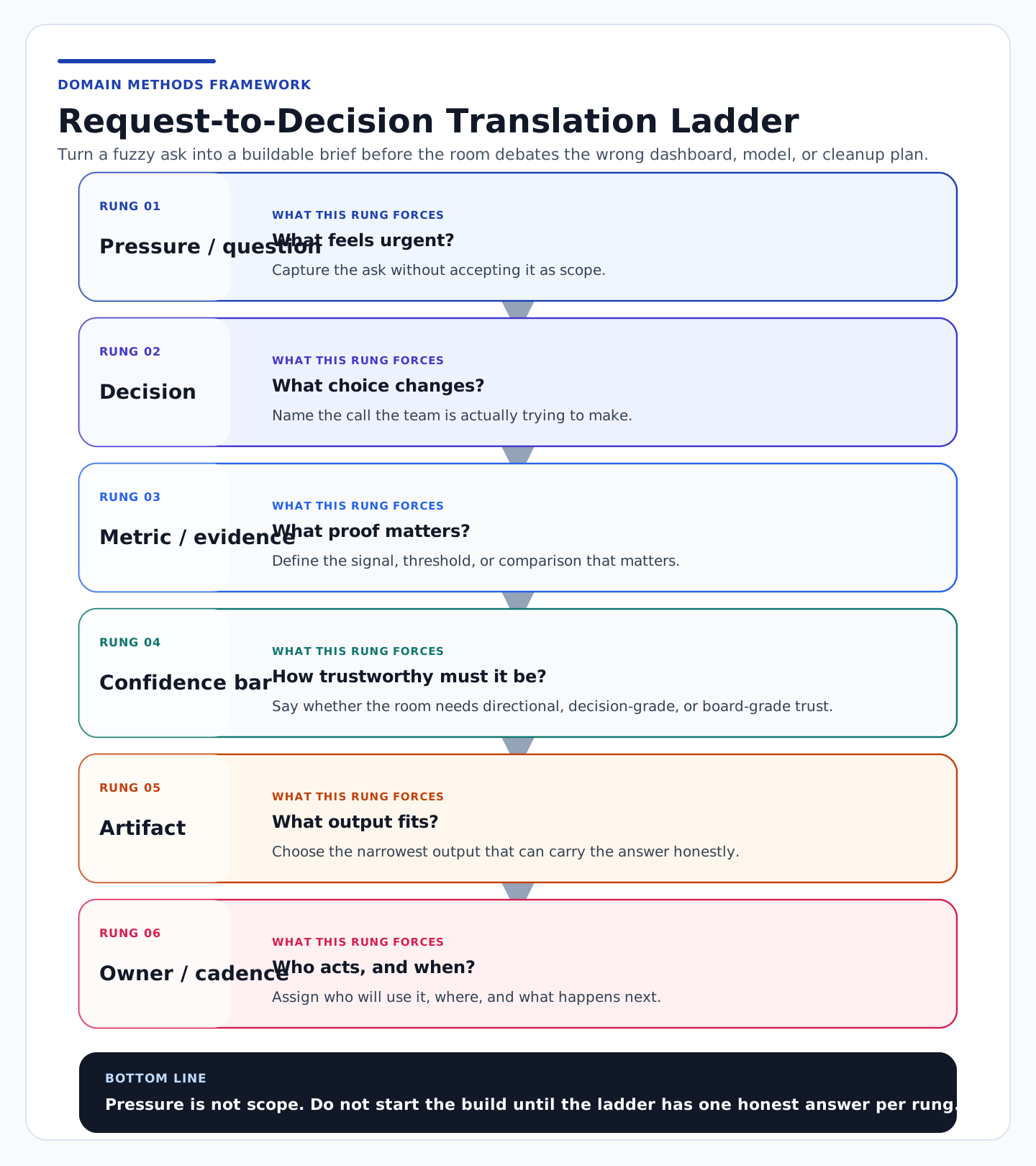
The ladder is intentionally strict.
It is supposed to stop the team from turning pressure into scope too early.
If the room cannot answer one rung honestly, that is not a failure of the ladder. That is the signal that the request still needs translation.
Rung 1: capture the pressure without treating it as scope
Start by writing down what the stakeholder actually said. Do not “clean it up” too fast.
That raw sentence tells you what the room is feeling. It does not automatically tell you what should be built.
Examples:
- “We need a dashboard for pipeline quality before the forecast review.”
- “Can someone pull the real number for the board?”
- “We need better attribution before budget planning.”
- “This handoff keeps breaking and nobody trusts the report.”
The practical move here is to separate three things:
- what feels urgent
- what artifact somebody is assuming
- what decision is probably hiding underneath the request
If you skip this rung, the room starts treating urgency language like a spec. That is how teams inherit sentences like “we need a dashboard” and discover six weeks later that the actual need was one bounded recommendation plus a cleaner owner rule.
Rung 2: name the decision
This is the rung that matters most.
If the team cannot say what choice should become faster, clearer, or less political, the request is still too fuzzy to scope honestly.
Not this:
- we need better reporting
- we need more visibility
- we need cleaner attribution
But this:
- we need to decide whether this channel loses budget next month
- we need to decide which number leadership will defend in the board pack
- we need to decide whether this pipeline drop is real or definitional
- we need to decide whether the next move is workflow cleanup or a reporting build
That difference is not semantics. It changes everything downstream.
A team that names the decision early can often avoid unnecessary build work because the right next move becomes narrower. Sometimes the answer is not “build the dashboard.” Sometimes the answer is “write the decision brief for one meeting” or “fix the owner rule before you touch reporting.”
Rung 3: define the metric or evidence
Once the decision is clear, the next job is to say what evidence would actually support it.
This is where vague language has to become buildable.
“Better visibility” is not buildable. A number, threshold, comparison, or confidence claim is buildable.
Pressure-test the request with questions like:
- which number needs to move, compare, or trigger action?
- what threshold matters?
- what comparison makes the decision easier?
- what evidence would make the skeptical person in the room trust the answer?
A good operator tell here is whether the request survives contact with a real meeting. If someone says they need “better attribution,” ask what exact budget or planning call is blocked and what evidence would let that call move. The answer is usually much narrower than the original request.
This is also where Why Your Data Team and Your Marketing Team Don’t Speak the Same Language becomes useful. A lot of cross-functional conflict is not really about communication style. It is about the fact that one side is speaking in decisions while the other still needs operational evidence.
Rung 4: set the confidence bar
The same metric can support very different decisions.
That is why the room has to say how trustworthy the answer needs to be.
In practice, most requests fall into one of three bars:
- directional: good enough to spot a pattern or make a short-term call
- decision-grade: strong enough to change spend, prioritization, or workflow behavior
- board-grade: strong enough to survive executive or board scrutiny without hand-waving
This rung prevents two common mistakes.
The first mistake is overbuilding. The room only needs a directional answer for next Tuesday’s working session, but the team starts acting like the output has to be CFO-safe forever.
The second mistake is underbuilding. The request is actually heading into a board or executive setting, but no one names the confidence bar, so the team ships something that looks polished without being defensible.
If you want the later-stage artifact choice once the confidence bar is clearer, The Reporting Artifact Hierarchy is the right follow-on. The point here is that confidence comes before artifact choice, not after.
Rung 5: choose the narrowest honest artifact
Only now should the room talk about output shape.
This is where a lot of teams reverse the order. They start with the artifact because it sounds concrete.
That shortcut is expensive.
Once the ladder has the decision, evidence, and confidence bar, the artifact question gets easier:
- recurring exploration with one audience and stable definitions may justify a dashboard
- one bounded recommendation may justify a decision brief
- a higher-confidence leadership readout may justify a board pack
- an explicit threshold with a named downstream action may justify a workflow alert or workflow rule
The important word here is narrowest.
Teams get into trouble when they choose the most socially acceptable artifact instead of the smallest one that can honestly carry the decision. A dashboard often wins because it sounds reusable. A board pack wins because it sounds executive. Both can be wrong.
If the room is still specifically stuck on the dashboard noun, Should This Dashboard Request Become a Dashboard, a Decision Brief, or a Workflow Change? is the next tool to use after this ladder.
Rung 6: assign owner, cadence, and next action
This is the rung teams forget when they are in a hurry.
They agree on the metric. They agree on the output. They even agree on the confidence bar. Then nobody writes down:
- who uses the answer first
- which meeting or workflow it belongs in
- what action should change when the output exists
- who owns the answer after delivery
That omission is why work that looked clear on paper still fails in practice.
A dashboard without a real owner turns into shelfware. A brief without a meeting home becomes one more document in a folder. A workflow alert without a response owner becomes noise.
Operator reality is simple here: if nobody can say what happens next, the request is still under-translated.
What goes wrong when you skip a rung
The ladder is useful because each rung catches a different failure mode.
| If you skip… | What gets scoped wrong | What it usually turns into |
|---|---|---|
| Pressure / question | Urgency becomes the spec | The team builds against a complaint instead of against a need |
| Decision | Nobody knows what call should improve | The room keeps arguing about output while avoiding the real tradeoff |
| Metric / evidence | “Visibility” replaces proof | Stakeholders leave with different interpretations of success |
| Confidence bar | The answer is overbuilt or under-defended | A working-session answer gets held to board standards or vice versa |
| Artifact | The room defaults to the most familiar noun | Another dashboard gets built for a job that needed a brief or workflow rule |
| Owner / cadence | Delivery happens with no operating home | The output exists, but nobody changes behavior because of it |
That table is not theory. It is the usual anatomy of “we shipped something, but the trust problem is still here.”
A worked example: “We need a dashboard before the board review”
This is a good example because it sounds specific and is still usually mixed together.
What the room says
“We need a dashboard before the board review.”
What the ladder forces the room to clarify
Pressure / question The board review is close, and leadership does not trust the current explanation.
Decision Leadership needs to decide what revenue or pipeline story is defensible enough to carry into the board conversation.
Metric / evidence The real evidence might be pipeline coverage by segment, one definition of qualified pipeline, and the caveats around what changed.
Confidence bar This is not just directional. It is at least decision-grade, and may be board-grade depending on how exposed the number is.
Artifact A dashboard might help the operator team inspect the trend, but the board-facing output is more likely a tight brief or board-ready scorecard than an exploratory interface.
Owner / cadence The first user is the leadership team in one pre-board sequence, not every operator in the company every week.
Once you walk through that ladder, the original request usually stops sounding like a dashboard project.
It starts sounding like a board-readiness decision problem. That is a much cleaner thing to scope.
How to use this ladder in a real intake meeting
If I were using this in a live working session, I would keep the process short.
1. Write the raw request on the page
Do not translate it in your head. Make the room look at the original language.
2. Force one answer per rung
If the room gives two or three answers at a rung, that is useful data. It means the request is still mixed.
3. Stop when a rung is still blurry
Do not pretend the intake is complete just because the room is tired of the conversation. If the confidence bar or owner path is still fuzzy, the request is not ready for clean scoping.
4. End with one explicit next move
A good intake outcome is not always “start building.” Sometimes the honest next move is:
- a translation sprint
- a metric-alignment working session
- one scoped cleanup pass
- one decision brief for the next meeting
That is still progress. It is usually better progress than shipping the wrong artifact quickly.
When this ladder should hand off to another tool
This framework is not supposed to do every job.
Use it early, then hand off based on what the ladder reveals.
- If the ask is still mostly fuzzy pressure, route to Translate the Ask.
- If the request is really a cross-team trust fight, route to Three Teams, Three Numbers.
- If the ladder reveals brittle source logic or warehouse debt, route to Data Foundation.
- If the room is specifically stuck on dashboard vs brief vs workflow output, move into Should This Dashboard Request Become a Dashboard, a Decision Brief, or a Workflow Change?.
- If the artifact debate is broader than dashboards, use The Reporting Artifact Hierarchy.
That handoff logic matters because the ladder is an intake tool, not a whole operating system.
Bottom line
A fuzzy request is not a harmless starting point.
It is often where the wrong project gets permission to start.
The cleaner move is to make the room climb the ladder:
- capture the pressure
- name the decision
- define the evidence
- set the confidence bar
- choose the narrowest honest artifact
- assign owner, cadence, and next action
Once those answers exist, the next move usually becomes obvious.
Until they exist, the request is still under-translated.
Download the Request-to-Decision Intake Worksheet (PDF)
Use this worksheet to turn one fuzzy analytics ask into the decision, evidence bar, artifact, owner, and next move before the wrong dashboard or cleanup project starts.
Instant download. No email required.
Want future posts like this in your inbox?
This form signs you up for the newsletter. It does not unlock the download above.
Sources
- Salesforce, State of Data and Analytics, 2nd Edition (PDF), accessed April 2026. https://www.salesforce.com/en-us/wp-content/uploads/sites/4/documents/research/salesforce-state-of-data-and-analytics-2nd-edition.pdf
Download the Request-to-Decision Intake Worksheet (PDF)
A live-meeting worksheet for turning a fuzzy analytics ask into the decision, evidence bar, artifact, owner, and next move before the wrong build starts.
DownloadIf the ask is still a mixed-up pressure statement
Translate the Ask
Use Translate the Ask when the business need is real but the room is still mixing together urgency, artifact preference, confidence level, and scope.
See the translation sprintIf the intake reveals a cross-team definition fight
Three Teams, Three Numbers
Use the diagnostic when the ladder shows the request is really a trust and ownership conflict between teams, not just a reporting build.
See the metric-alignment diagnosticSee It in Action
Common questions about the request-to-decision translation ladder
What is the request-to-decision translation ladder?
How is this different from the dashboard request triage decision tree?
When should this escalate into a broader data project?
Who should own the ladder in a real intake meeting?

About the author
Jason B. Hart
Founder & Principal Consultant
Helps mid-size SaaS companies turn messy marketing and revenue data into decisions leaders trust.