The Reporting-to-Activation Readiness Stack
- Jason B. Hart
- Data Engineering
- April 22, 2026
Table of Contents
What is the reporting-to-activation readiness stack?
The reporting-to-activation readiness stack is a practical way to check whether a trusted report is actually ready to become a workflow.
That sounds obvious until you watch how most teams make the jump.
A dashboard gets cleaner. A warehouse model finally looks stable. A score starts feeling directionally useful. Somebody says, “Great, now let’s push this into Salesforce, trigger an alert, or sync it into the campaign flow.”
That is usually the moment where the trouble starts.
The reporting layer may be good enough to explain a meeting. That does not automatically mean it is safe to run an operating action.
A report can survive caveats that a workflow cannot. A metric can be useful in a board pack before it is trustworthy enough for a routing rule. A score can be helpful for human review before it is safe to write directly into a CRM field that changes how the business behaves.
That middle layer is where a lot of teams get burned. They are not choosing between reporting and activation. They are skipping the readiness checks in between.
If you want the adjacent reads, start with The Marketing Data Stack Anatomy, Do You Need a Data Activation Tool?, and Should This Workflow Stay Manual, Go Rules-Based, or Use AI?. This article is narrower on purpose. It is about what has to be true before a trusted reporting output becomes a safe operational one.
Why teams skip the middle layers
Most teams do not skip the middle layers because they are careless.
They skip them because the reporting win creates pressure.
Leadership finally trusts a number. Marketing finally has a segment that feels better than the old spreadsheet. RevOps finally has a model the warehouse team can defend. Product or lifecycle teams finally have a score they want to use.
Once that happens, the room naturally starts asking the next question: how do we make this live?
That is a fair question. It is just not the same as asking whether the thing is ready.
The operator-level tell is simple: the conversation moves from “Can we explain this output?” to “Where should we wire it next?” before anyone has written down the threshold, owner, destination behavior, failure mode, or review path.
That is how a reporting win becomes a workflow cleanup project.
A lot of mid-size SaaS teams are living exactly in that gap. The warehouse is better than it was six months ago. The dashboard is cleaner than last quarter. The model is not the embarrassing part anymore. But the moment the business tries to operationalize the output, the old problems come back in a new costume:
- someone still does not trust the definition enough for direct action
- the destination field means something different to the receiving team
- the threshold sounds clear until the first weird account appears
- the workflow works in demo conditions and creates manual cleanup in live conditions
- nobody owns what happens when the output is wrong, late, or contested
That is not a tooling problem first. It is a readiness problem.
The stack at a glance
Use the stack to check the five layers between trusted reporting and operational action.
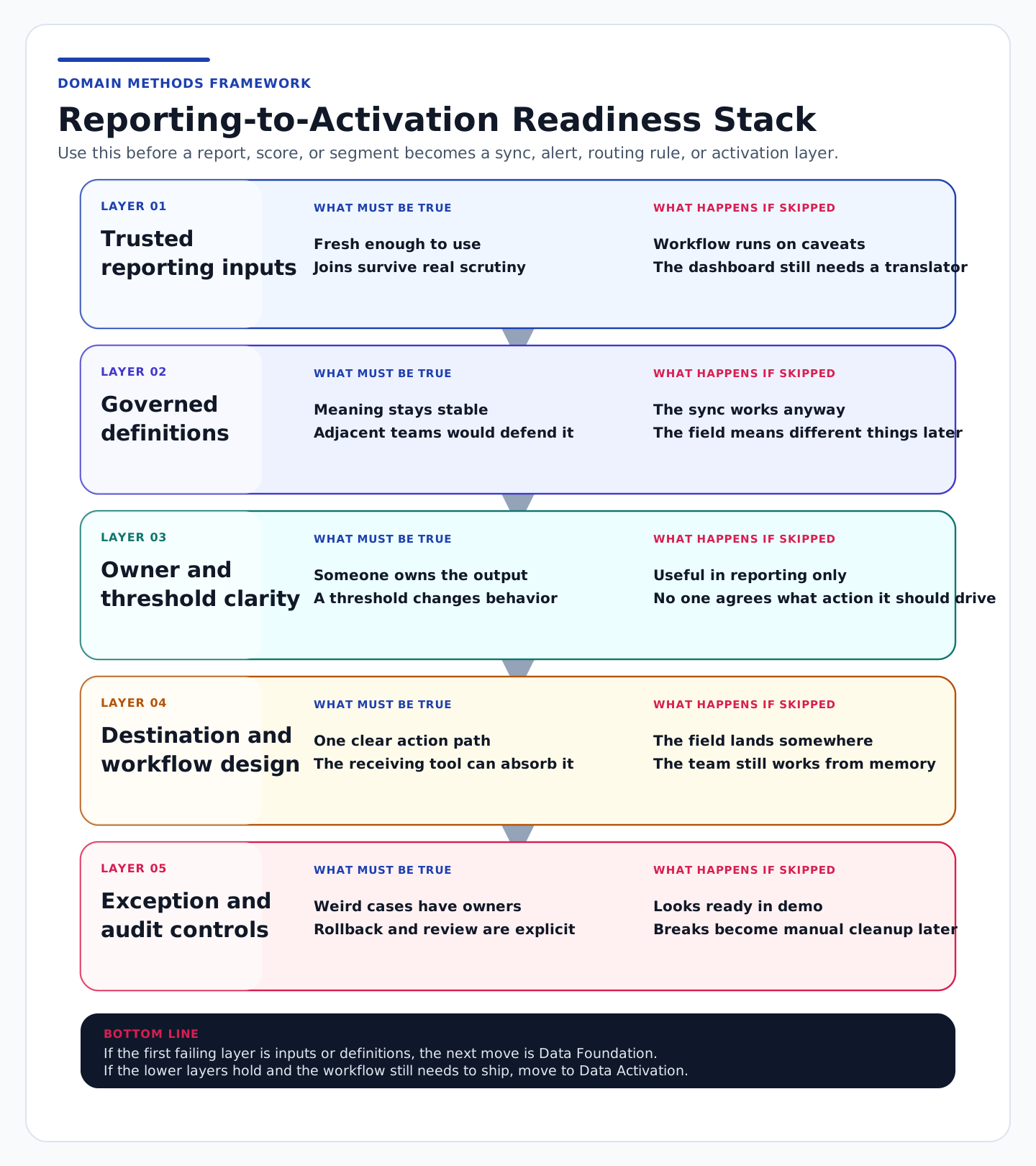
The point is not to create a fancy maturity model.
The point is to answer one practical question fast: what still has to be true before this number can leave the dashboard and start changing behavior somewhere else?
Layer 1: trusted reporting inputs
The bottom of the stack is not “the warehouse exists.”
It is narrower than that.
It is whether the specific reporting path behind the metric, score, or segment is trusted enough for the action you want to attach to it.
That means pressure-testing things like:
- source freshness
- join stability
- identity quality
- field completeness
- whether the number still depends on side caveats in the real meeting
A lot of teams misread this layer because the dashboard looks polished. The chart loads. The model passed tests. The headline number looks close enough. But when someone asks one step deeper where the caveat lives, the answer still comes out as a Slack message, a spreadsheet note, or a verbal warning from the one operator who knows how the sausage gets made.
That can still be usable for reporting.
It is usually not good enough for activation.
If the receiving workflow is going to route a lead, suppress an audience, trigger a customer action, or push a score into a system other people treat as authoritative, the trust bar has to go up.
This is where How to Tell Whether You Have a Tools Problem or a Foundation Problem becomes a useful companion. If the reporting path still needs caveats to survive normal scrutiny, you are probably still in foundation territory even if the business is already shopping for activation outcomes.
Layer 2: governed definitions
The next layer is definition stability.
This is where teams get trapped by a dangerous half-truth: “The model is technically right.”
That may be true.
It still does not tell you whether the business will use the output consistently once it is operationalized.
A workflow cannot absorb quiet definition drift the same way a report can. In a meeting, somebody can stop and ask, “Wait, what exactly counts here?” In a live workflow, the field just lands. The score just writes. The alert just fires. The segment just syncs.
That means the definition has to survive outside the room.
A useful operator test is this: if a new manager, RevOps lead, or data engineer inherited this output next quarter, could they explain what the number means without finding the one person who remembers why the rule was written that way?
If the answer is no, the output may still be too fragile for activation.
This is also where teams often confuse stability with popularity. Everyone may agree the metric is useful. That is not the same as agreeing on what it should do when it lands in a workflow.
For example:
- a lifecycle score can be helpful in a dashboard before sales agrees how it should affect routing
- a propensity segment can be interesting in reporting before marketing agrees what suppression or spend changes it should drive
- a health metric can be informative in a review deck before CS agrees which threshold justifies outreach or escalation
The activation mistake is assuming shared interest means shared operating definition.
It does not.
Layer 3: owner and threshold clarity
This is the layer many teams do not realize they skipped until the first live argument.
A report can get away with broad ownership. A workflow usually cannot.
Once the output changes behavior, the business needs answers to questions like:
- who owns the metric or score itself
- who owns the threshold that changes action
- who receives the output in practice
- who is allowed to override it
- who is accountable when the workflow creates noise, misses, or side effects
Threshold clarity matters more than teams expect.
A lot of activation conversations stall because everyone likes the idea of the score, but nobody wants to make the threshold explicit. The room wants the output to be “helpful” without deciding what score actually changes queue order, triggers a nurture branch, or qualifies a record for human review.
That is still reporting comfort, not workflow readiness.
You can feel this when the business says things like:
- “Let’s send the score over and let reps use it how they want.”
- “We’ll know the right threshold when we see it.”
- “Let’s just put it in the field first and learn.”
Sometimes that is fine for a narrow directional aid.
It is not fine if the output is going to become a real part of operating logic.
If the threshold is fuzzy, the workflow is still fuzzy.
If the owner is fuzzy, the workflow is still political.
And if both are fuzzy, the cleanest-looking sync in the world will still create downstream confusion.
Layer 4: destination and workflow design
This is where the activation layer itself becomes real.
A lot of teams assume that once the reporting output is good and the destination system exists, the rest is implementation detail.
It is not.
Destination fit is its own layer because the receiving system has to support the action honestly.
That means asking things like:
- does the destination have the right field structure
- will the user actually see the output where the decision happens
- is the timing aligned with the workflow cadence
- does the output create one clear action or just more context clutter
- is the destination turning a directional signal into fake certainty
This is exactly why Do You Need a Data Activation Tool? is adjacent but not identical to this framework. Tool choice matters after the workflow is real. But the workflow has to be designed well enough that the destination does not turn a promising output into another source of manual cleanup.
One of the most common operator failures here is sending too much.
A team finally trusts one score or one segment, then turns the sync into a field dump. The receiving team gets five new fields, three half-clear labels, and one vague promise that this should improve prioritization. Nobody adopts it because the workflow changed from “one clearer decision” to “one more thing to interpret.”
The more mature move is usually smaller.
Send the minimum signal that changes the decision.
If you cannot describe the action in one sentence, the workflow is probably not ready yet.
Layer 5: exception and audit controls
The top of the stack is where readiness becomes durable instead of performative.
This is the layer teams often wave away with language like “We’ll monitor it” or “We’ll keep a human in the loop.”
That is not enough.
If a report is becoming a workflow, the business needs to know:
- what qualifies as a weird case
- who reviews exceptions
- what should pause the workflow
- what should stay rules-based instead of becoming more automated
- how the team will know the workflow is still behaving honestly a month later
This is where The Workflow Exception Ownership Model matters. A workflow does not become safer because it has an exception queue on a slide. It becomes safer when exception ownership, override rights, and rollback behavior are named before the workflow expands.
Auditability matters too.
A reporting artifact can survive some ambiguity because the room can interrogate it. A workflow needs a trail. If someone asks why a lead got routed, why an account got suppressed, or why a health score triggered action, the team needs to be able to explain that answer without reconstructing the logic from memory.
If the workflow cannot explain itself, it has not actually matured beyond dashboard theater.
What teams mistake for readiness
This is the list I see most often.
“The model exists”
Good. That means one important part of the job is done.
It does not tell you whether the receiving team trusts the definition, the threshold, the destination behavior, or the failure path.
“The sync works”
Also good.
A successful sync demo proves almost nothing about operating fit.
It proves the pipe moved data. It does not prove the workflow should exist in its current form.
“The dashboard looks clean”
A clean dashboard can still depend on caveats, contested ownership, or thresholds no one wants to formalize. That is still useful progress. It is just not the same thing as workflow readiness.
“The business wants speed”
Of course it does.
But speed is not a substitute for action design. A workflow that moves faster than the team’s ability to explain and defend it will usually destroy trust faster than it creates efficiency.
“We can always tighten it later”
Sometimes you can.
More often, once the output starts changing behavior, the bad version becomes politically harder to unwind because too many people are now depending on it. That is why the readiness check belongs before rollout, not after the workflow has already become somebody’s weekly workaround.
What should stay manual even when the upper layers look promising
This is the question teams usually do not ask until too late.
Not everything that becomes more explainable should become more automated.
Some things should stay manual longer because the last mile still depends on judgment, local context, or a cost of error the workflow cannot carry honestly yet.
Good candidates for staying manual or rules-based longer include:
- customer-facing actions where tone, timing, or account history still need human judgment
- edge-case routing where the threshold is not yet defendable in plain English
- executive-facing outputs where the confidence level still changes materially with context
- workflows that still depend on one operator recognizing exceptions faster than the system can
- any use case where the receiving team says, quietly, “We’ll still review this before acting”
That last line matters.
If the business is already telling you the output still needs human interpretation every time, that may be a sign the workflow should remain a decision-support layer rather than a live activation one.
Manual is not failure.
Sometimes manual is the honest holding pattern while the stack finishes maturing.
The working session I would actually run
If I had 45 minutes with a data lead, RevOps, and the business owner of one workflow, this is the sequence I would use.
1. Name one reporting output
Not a category. Not a long roadmap. One output.
A score, segment, thresholded report, audience, or alert candidate.
2. Name the exact action the business wants
Who would receive it? What would they do differently? What would happen if it was wrong for two weeks?
3. Walk the stack from bottom to top
Pressure-test each layer quickly:
- are the inputs trusted enough
- is the definition stable enough
- are the owner and threshold written down
- does the destination support a real action cleanly
- are exception and audit controls explicit enough
4. Mark the first failing layer
This is the important move.
Do not keep talking about the top of the stack if the first real failure is lower down.
If the definition is still unstable, you are not in activation work yet. If the threshold is still political, you are not in activation work yet. If the destination turns the output into clutter, you are not in activation work yet. If the exception path is still hand-wavy, you are not in activation work yet.
5. Choose the narrowest honest next move
That next move might be:
- a Data Foundation fix
- a clearer threshold workshop
- a smaller rules-based workflow
- a destination redesign
- a limited manual-review activation pilot
The win is not saying yes to activation fastest.
The win is choosing the next move the business can still defend a month later.
When to route this to Data Foundation vs Data Activation
The cleanest split is this.
Route to Data Foundation when the stack keeps breaking in the lower layers:
- source trust is still shaky
- joins or identity are still contested
- definitions drift every time the room gets uncomfortable
- the warehouse model still depends on workaround logic the business would not defend publicly
Route to Data Activation when the lower layers are solid enough and the real problem is now the workflow itself:
- the metric or segment is trusted
- the threshold and owner are explicit
- the destination and user action are clear
- the business needs help shipping the workflow cleanly across systems
If the stack says “foundation first,” believe it.
A lot of expensive activation work is really a nicer interface on top of unresolved trust debt.
Download the worksheet and run one real workflow through it
Use the worksheet below with one score, one segment, one alert, or one reporting output that the business keeps trying to operationalize.
Do not do it in the abstract.
Pick the output the room actually wants to wire next. Mark which layer fails first. That will usually tell you more in 20 minutes than another month of generic activation debate.
Download the Reporting-to-Activation Readiness Worksheet (PDF)
A lightweight worksheet for checking whether one report, score, or segment is actually ready to become a live workflow. Download it instantly below. If you want future posts like this in your inbox, you can optionally subscribe below.
Instant download. No email required.
Want future posts like this in your inbox?
This form signs you up for the newsletter. It does not unlock the download above.
A clean report is a good milestone.
It is not the same thing as a ready workflow.
The middle layers matter because that is where trust either survives operationalization or falls apart the minute the output starts changing behavior.
If your team already has a promising reporting layer but keeps stalling at the point where it needs to become a live operating workflow, start with Data Foundation when the lower layers still break under pressure. If the stack is genuinely ready and the next challenge is execution, move into Data Activation.
Download the Reporting-to-Activation Readiness Worksheet (PDF)
A lightweight worksheet for checking whether one report, score, or segment is actually ready to become a live workflow.
DownloadIf the stack reveals trust debt before the workflow is safe
Data Foundation
Use Data Foundation when the real blocker is upstream reporting trust, weak joins, unstable definitions, or warehouse logic that still needs to hold up under pressure.
See Data FoundationIf the stack is genuinely ready and the next move is operationalization
Data Activation
Use Data Activation when the business already trusts the logic and now needs clean workflow design, destination wiring, and implementation that can survive outside the dashboard.
See Data ActivationSee It in Action
Common questions about reporting-to-activation readiness
What is the reporting-to-activation readiness stack?
How is this different from choosing a data activation tool?
What do teams usually mistake for activation readiness?
What should stay manual even if the upper layers look promising?

About the author
Jason B. Hart
Founder & Principal Consultant
Helps mid-size SaaS companies turn messy marketing and revenue data into decisions leaders trust.