The Real RevOps Problem Is Not Dirty CRM Data. It Is Unowned Operating Rules.
- Jason B. Hart
- Revenue Operations
- April 21, 2026
- Updated June 17, 2026
Table of Contents
What does it mean when dirty CRM data is really an operating-rules problem?
It means the visible mess in the fields is not the root cause. The root cause is that nobody has settled the rule behind the field.
That is why the same cleanup work keeps coming back.
A blank field can be fixed once. A duplicated account can be merged. A bad owner value can be corrected.
But if the team still cannot answer basic operating questions, the CRM will drift right back into the same shape:
- when should this stage change?
- who is allowed to override ownership?
- what happens when the record does not fit the normal route?
- which downstream workflow breaks if we guess wrong?
That is not a hygiene problem anymore. That is an operating-model problem wearing a data-quality costume.
I see this most often in mid-size SaaS teams that are moving fast enough to create edge cases but not disciplined enough yet to give those edge cases a real rule. The CRM becomes the place where unresolved policy arguments pile up. Then the business calls the pile-up dirty data.
Why this distinction matters
If you misdiagnose the problem, you keep funding the wrong fix.
A team that thinks it has a hygiene problem usually responds with one of four moves:
- run another cleanup sprint
- add validation rules everywhere
- buy another RevOps or routing tool
- ask one very tired operator to keep policing the edge cases by hand
All four can create short-term relief. None of them settles the underlying rule question.
So three weeks later the same problems show up again, just with fresher field values.
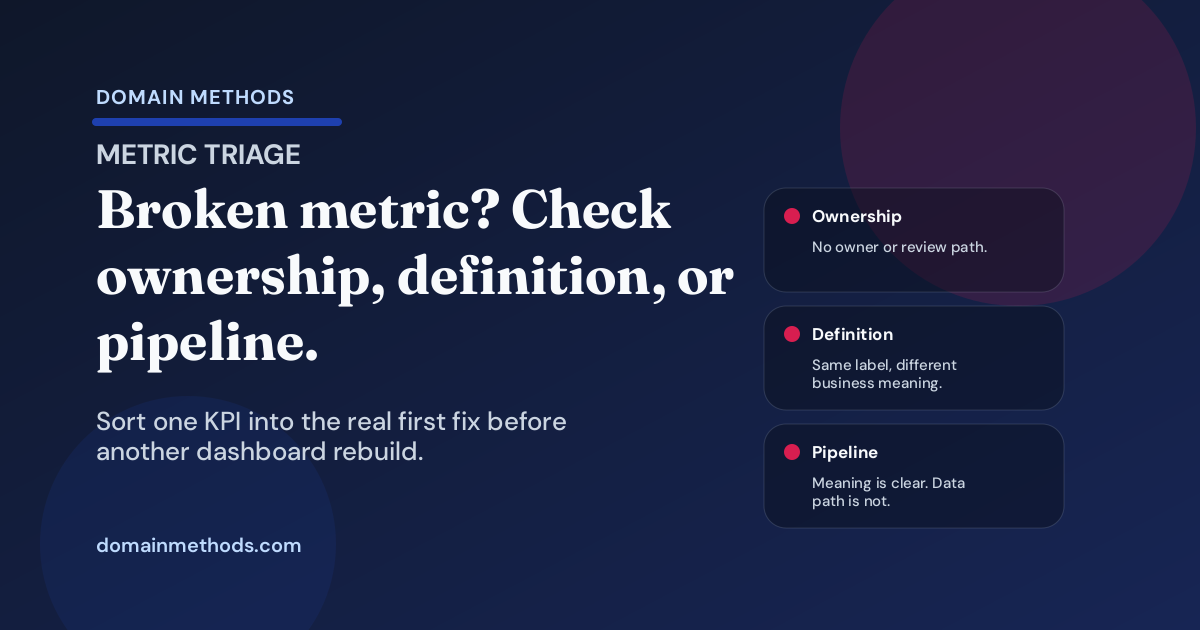
The rep still does not know when a record should move stages. Marketing and sales still mean different things by the same lifecycle label. Territory exceptions still depend on memory instead of policy. The downstream workflow still assumes one clean owner even though two teams can quietly reassign the record.
That is why some CRM cleanup projects feel productive and still change nothing important. They improve the surface without deciding how the system is supposed to behave under pressure.
The tell: the same workflow keeps needing rescue
A true field-quality problem usually has a narrow fix.
A rules problem is different. It shows up as recurring operator rescue around one workflow that never really stabilizes.
Common examples:
- inbound leads route correctly until one segment or geography exception appears
- lifecycle stages look fine until a rep or manager needs to force a late-stage shortcut
- account ownership logic works until a house account, partner account, or expansion motion collides with it
- opportunity creation looks standardized until the team hits one deal shape that does not match the template
- enrichment or scoring logic works until the missing values require a human judgment nobody wrote down
Notice the pattern.
The failure is not random. The failure shows up when the workflow reaches a judgment call that the system was never authorized to make on its own.
That is the moment I stop asking, “How do we clean the fields?” and start asking, “What rule is missing, and who owns it?”
Dirty-data symptom versus missing rule underneath
Before you launch another CRM cleanup sprint, sort the problem into the right bucket.
| Dirty-data symptom | Missing operating rule underneath | What breaks downstream |
|---|---|---|
| lifecycle stage keeps getting edited backward | stage-entry and stage-exit criteria are not explicit enough to survive edge cases | alerts, SLAs, and pipeline reports stop meaning the same thing |
| owner field changes repeatedly on the same record | override rights and reassignment authority are unclear | routing, follow-up accountability, and territory reporting drift |
| duplicates keep reappearing in the same segment | merge authority and duplicate-handling policy are inconsistent | scoring, attribution, and account-level workflow logic split in two |
| required field is filled late or with junk values | nobody agreed which event should populate the field and when it becomes actionable | routing fires too early, too late, or with fake confidence |
| ops team keeps fixing exceptions in Slack | the exception path exists in memory, not in the workflow design | the business mistakes heroics for stability |
That table is where most CRM arguments get clearer.
The field-level symptom matters. But the field-level symptom is usually just the place where a missing rule becomes visible.
The rules layer most teams leave fuzzy
When people say “the CRM is messy,” they usually mean one of a small handful of operating-rule gaps.
1. Stage-entry criteria
This is the classic one.
A stage exists, but the business has not settled what evidence earns the move.
Marketing thinks a hand-raiser belongs in one stage. Sales thinks it belongs in another. RevOps tries to split the difference with automation, then ends up babysitting exceptions because the room never agreed on the actual threshold.
Operator clue: if two smart people can look at the same record and both feel justified about different stage values, the field is not the core problem. The rule is.
2. Override rights
A lot of CRM pain is just ungoverned override culture.
Someone can change ownership, reopen a stage, bypass a queue, or rewrite a source field because they are trying to save a live opportunity or keep the customer moving.
Sometimes that is reasonable. The problem starts when nobody has decided:
- who is allowed to do it
- under what conditions
- what evidence they need
- whether the override should be logged or reviewed later
Without that, the CRM starts recording urgency instead of policy.
3. Exception handling
Every real workflow has exceptions. The question is whether the exception path is designed or improvised.
A workflow with no explicit exception path usually creates one in Slack, in side spreadsheets, or in the head of the most reliable operator on the team.
That arrangement can look efficient from the outside because the problem still gets solved. It is not efficient. It is a hidden tax.
The hidden tax shows up later when another team trusts the CRM as if the exception handling were actually encoded there. That is exactly why The Workflow Exception Ownership Model matters: it gives teams a way to make the exception path explicit instead of leaving it trapped in memory and Slack.
4. Downstream consequence awareness
A weak rule can survive longer than it should because the person editing the CRM does not feel the full downstream cost.
They are trying to unblock one rep, one campaign, or one account. They do not immediately see that the same action just changed:
- the routing queue
- the SDR SLA
- the attribution story
- the forecast rollup
- the handoff to finance or customer success
That is why a good RevOps rule is not just a field instruction. It includes the downstream consequence of getting the rule wrong.
How to tell whether you have a rule problem or a pure cleanup problem
Use one workflow and ask five blunt questions.
1. Can the team explain the rule in one sentence?
If the rule needs a ten-minute debate, it is not settled enough to automate confidently.
A useful rule sounds like this:
Move a record into this stage only after the AE confirms budget, authority, and a live next step inside the active quarter.
A weak rule sounds like this:
We usually move it when it feels sales-ready, unless it came from a partner, or unless the SDR already worked it, or unless the rep knows the account is real.
That second version is not a rule. It is a collection of exceptions pretending to be one policy.
2. Is there a named owner with decision rights?
Shared visibility is not ownership.
If nobody can approve the rule, deny an exception, or absorb the consequence of the wrong call, the workflow is still politically open.
That does not just create debate. It creates recurring dirty-data symptoms because the CRM becomes the battlefield where unresolved authority keeps getting reenacted.
3. Do people know when an override is legitimate?
Healthy workflows leave room for overrides. But they make the override legible.
A good override standard names:
- what conditions justify the override
- who can do it
- what note or evidence has to travel with it
- whether the record should be reviewed afterward
If the workflow cannot answer those questions, the override is not a safety valve. It is a second unofficial process.
4. Is there an explicit exception path?
Every operating workflow has a weird-case bucket. The question is whether the weird-case bucket is designed or social.
If the exception path depends on remembering who to DM, what spreadsheet to edit, or which ops person understands the backstory, you do not have a stable workflow yet. You have a dependency on informal labor.
5. Can the team name the downstream cost of a bad rule?
This is the question that usually changes the room.
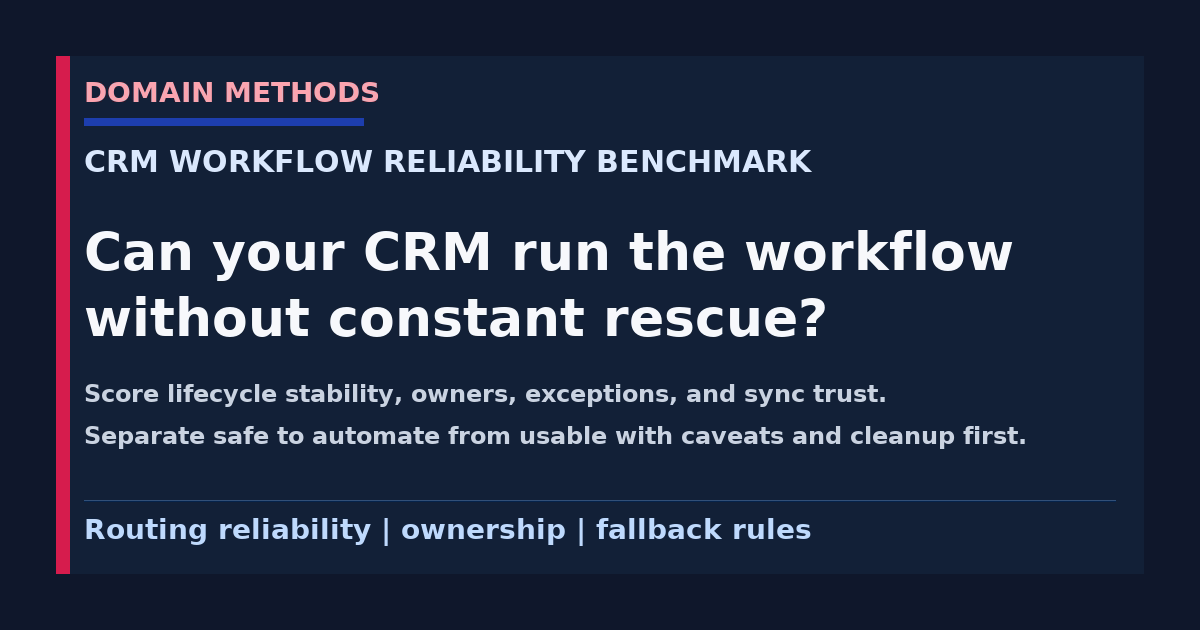
If the answer is just “the data gets messy,” people shrug. If the answer is “lead routing gets slower, forecast confidence drops, and attribution reports start telling the wrong story,” the rule suddenly feels like an operating decision instead of a hygiene chore. That is the same jump the CRM Workflow Reliability Benchmark is trying to force: stop grading CRM work by field neatness alone and grade it by whether the workflow still holds under real operating pressure.
That is where better rule ownership starts. And once the rule failure starts forking the commercial story across teams, The Revenue Handshake Framework is a useful next read for tracing where the trust break spreads beyond the CRM itself.
A practical working-session version
If I had one hour with a RevOps lead, sales leader, and the person who keeps rescuing the workflow by hand, I would not start by auditing every field.
I would start with one workflow that keeps getting called messy and walk through this sequence:
- name the workflow in scope
- write the actual rule underneath it
- identify who owns the rule
- decide who can approve an override
- define the exception path
- list what breaks downstream when the rule is ignored
- decide whether the system is still the blocker after the rule is clear
That sequence matters because it separates the policy layer from the tooling layer.
Sometimes the conclusion really is that the CRM or sync architecture needs work. But the team should earn that conclusion after the rule is clear, not use technology as a substitute for finally making the rule explicit.
Use the worksheet in the next live repair session
If this pattern sounds familiar, use the worksheet below to turn one recurring CRM pain point into a real rule audit instead of another cleanup ritual.
Download the RevOps Operating Rules Audit (PDF)
A lightweight worksheet for naming the operating rule under recurring CRM mess, setting owner and override authority, and tracing what breaks downstream when the rule stays fuzzy.
Instant download. No email required.
Want future posts like this in your inbox?
This form signs you up for the newsletter. It does not unlock the download above.
When the next move is Data Foundation versus AI readiness
This is where teams often get stuck.
If the room can now define the rule clearly but the CRM, syncs, or reporting layer still cannot carry it reliably, that is a Data Foundation problem. The business answer is finally clear, but the systems still cannot enforce or expose it cleanly.
If the bigger pressure is an automation push, copilot rollout, or AI workflow plan that assumes the CRM is already trustworthy enough to act on, that points to the AI-Ready Data Diagnostic. You are about to give more authority to a workflow that still depends on human guesswork.
The important point is that both routes start with the same truth:
dirty CRM data is often just the trail of evidence left behind by unowned operating rules.
Fix the rule first. Then decide how much cleanup, system work, or automation should follow.
Download the RevOps Operating Rules Audit (PDF)
A lightweight worksheet for identifying the rule behind recurring CRM mess, naming the owner, setting override rights, and tracing the downstream workflow damage.
DownloadIf the rule is clear but the systems still cannot carry it
Data Foundation
Use Data Foundation when the team can finally name the right workflow rules but the CRM, syncs, warehouse logic, or reporting layer are still too brittle to support them cleanly.
See Data FoundationIf automation pressure is exposing weak workflow logic
AI-Ready Data Diagnostic
Use the audit when the business wants copilots, automation, or AI-assisted decisions before the ownership rules and exception paths underneath the CRM are stable enough to trust.
See the AI-Ready Data DiagnosticSee It in Action
Common questions about dirty CRM data and operating rules
Isn't dirty CRM data still a real problem?
How do I know this is a rules problem instead of a tooling problem?
Who should own a RevOps operating rule?
What should we fix first when the CRM keeps getting manually patched?

About the author
Jason B. Hart
Founder & Principal Consultant
Helps mid-size SaaS companies turn messy marketing and revenue data into decisions leaders trust.