The Metric Governance Rollout Playbook for the First 5 KPIs
- Jason B. Hart
- Revenue Operations
- April 26, 2026
- Updated May 15, 2026
Table of Contents
What does KPI governance rollout actually mean?
KPI governance rollout is the work of moving agreed metric definitions into the places where the business actually uses numbers: dashboards, recurring meetings, finance handoffs, forecast packs, compensation rules, and operating reviews.
It is the step after selection.
You have already decided which handful of metrics deserve governance first. Maybe it is qualified pipeline, bookings, ARR, CAC, and marketing-sourced pipeline. Maybe it is the five metrics that keep derailing the same executive meeting.
The dangerous assumption is that agreement equals adoption.
It does not.
A team can choose the right five metrics, write a decent definition record, and still drift back to spreadsheet fallbacks two weeks later because nobody changed the meeting deck, forecast handoff, dashboard label, or exception path. That is why this article is not another selection guide. How to Choose the First 5 Metrics to Govern covers the priority call. This playbook covers the launch sequence.
The goal is smaller and more useful: make the first governed KPI set real in the business before anyone tries to govern the next fifty.
The rollout problem starts after everyone says yes
Most metric governance efforts look cleanest at the moment they are most fragile.
The workshop ends. The group agrees that “qualified pipeline” will mean one thing. Finance gets the caveats it needs. RevOps has the source path. Data knows which model is official. Marketing and sales have both given enough ground to keep the definition usable.
Then Monday arrives.
The old dashboard is still bookmarked. The board-prep spreadsheet still has last quarter’s adjustment tab. The sales forecast still has a slightly different stage rule. The marketing review still uses sourced pipeline because the new definition has not been added to the channel table yet.
That is not a strategy failure. It is a rollout failure.
Governance becomes real when the old number becomes harder to use than the governed number. Until then, the official definition is just a well-written suggestion.
Start by choosing the first live surface
Do not roll every governed KPI everywhere at once.
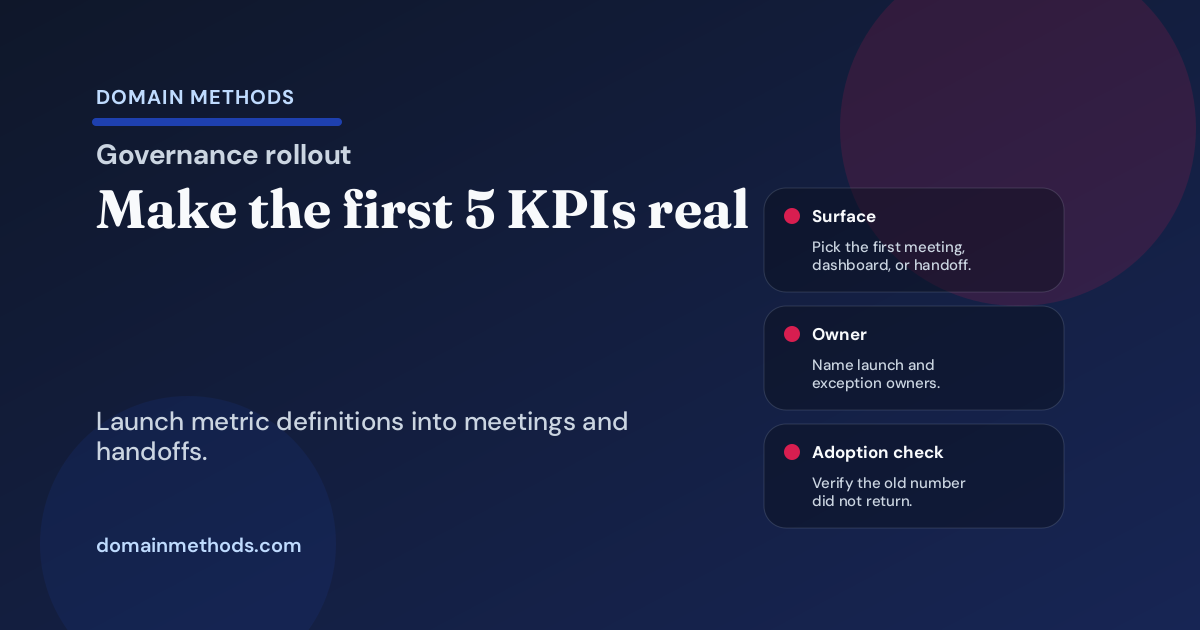
Pick the first surface where the definition needs to hold. A live surface is the place where the KPI will be used in an actual operating motion, not merely documented.
Common first surfaces include:
| Live surface | Why it matters | Example rollout move |
|---|---|---|
| Executive dashboard | Makes the governed definition visible to leadership | Replace the old KPI card and add the approved caveat label |
| Weekly revenue meeting | Changes the conversation where disagreement usually happens | Use the new definition for two cycles and record exceptions |
| Forecast pack | Forces sales, RevOps, and finance to reconcile one number | Update the handoff tab and owner sign-off rule |
| Board-prep worksheet | Tests whether the metric can survive external scrutiny | Add the canonical source path and caveat language |
| Compensation or routing rule | Prevents local exceptions from becoming political | Publish the effective date and change-request path |
The practical tradeoff: the most visible surface is not always the safest first surface.
If the metric is still fragile, you may launch it first in the weekly revenue meeting with a visible caveat before it graduates into the board deck. If it is already stable but politically contested, you may need the executive dashboard first so everyone sees the same official label.
The rollout order should match the risk, not the org chart.
Give every KPI two owners, not one vague committee
A governed KPI needs a launch owner and an exception owner.
Those are not always the same person.
The launch owner makes sure the KPI appears in the right live surface, with the right definition, label, caveat, and source path. This is often RevOps, finance, analytics, or the operator closest to the recurring report.
The exception owner decides what happens when the old number still appears, the source path breaks, or a stakeholder asks for a local adjustment. This owner needs enough authority to prevent quiet forks.
Here is the lightweight ownership record I would use for a first wave:
| KPI | First live surface | Launch owner | Exception owner | Old-number risk | First adoption check |
|---|---|---|---|---|---|
| Qualified pipeline | Weekly revenue meeting | RevOps | CRO / finance partner | Sales forecast uses older stage logic | After two meetings |
| Marketing-sourced pipeline | Channel performance dashboard | Marketing ops | RevOps | Campaign spreadsheet still used for budget defense | End of month |
| Bookings | Forecast pack | Finance | Finance | Sales uses committed bookings in a separate tab | Next forecast cycle |
| CAC | Quarterly planning model | Finance / analytics | CFO delegate | Paid media team uses blended CAC without sales cost | Planning prep review |
This table is not bureaucracy. It is how you stop the first exception from becoming the new shadow definition.
Publish the minimum definition record before the first leadership use
Do not wait for a perfect wiki page.
Before a KPI enters a leadership meeting, publish the minimum record someone can use to defend the number without calling the analyst who built it.
At minimum, include:
| Field | What it needs to answer |
|---|---|
| Official KPI label | What exact name should appear in decks and dashboards? |
| Business definition | What does the number mean in plain English? |
| Source path | Which system, model, or report is authoritative? |
| Primary use | Which decision is this definition safe to support? |
| Owner | Who approves changes or exceptions? |
| Confidence level | Is it directional, decision-grade, or board-grade? |
| Current caveat | What must travel with the number for now? |
| Change-control rule | How does someone request a definition change? |
If this looks familiar, it should. It is the smaller launch version of the broader definition record in The Metric Definition Governance Playbook.
The difference is pressure.
A rollout record has to work in the messy moment when someone asks, “Which number are we using in tomorrow’s meeting?” If the record cannot answer that, it is not ready for adoption.
Run a two-cycle adoption check
Most teams review metric governance too late.
They wait for a quarter-end argument, a board-prep scramble, or a finance reconciliation problem. By then, the old behavior has already returned.
Run the first adoption check after two live cycles.
If the KPI is used weekly, check after two meetings. If it is used monthly, check after two month-end cycles. If it is used in forecast handoff, check after the next two forecast passes.
Ask five blunt questions:
- Where did someone still use the old number?
- Where did the governed definition slow the meeting down?
- Which caveat had to be restated verbally?
- Which dashboard, spreadsheet, or deck still carried stale logic?
- Which team created a local workaround because the official number did not answer their real question?
That last question matters. Sometimes a local workaround is political resistance. Sometimes it is evidence that the governed KPI is being asked to do two jobs at once.
For example, marketing may still need a campaign-optimization view of sourced pipeline even if finance needs a stricter version for planning. The right answer may be two labeled metrics, not a fight over which team is being difficult.
Decide what to enforce, caveat, and defer
After the adoption check, do not pretend every KPI is equally ready.
Put each first-wave KPI into one of three states:
| Rollout state | What it means | Operating rule |
|---|---|---|
| Enforce now | Definition is stable enough for the chosen live surface | Old labels and shadow spreadsheet versions should be retired from that surface |
| Use with caveat | Definition is useful but still carries a known limitation | The caveat must appear with the KPI until the next review |
| Defer enforcement | The definition is directionally right, but the data path or owner model cannot hold yet | Do not force adoption; assign the repair work first |
This is where governance becomes more credible, not less.
A metric labeled “use with caveat” is safer than a metric everyone pretends is board-grade because the documentation is polished. A deferred metric is not failure if the team can name the repair needed before it should be used in leadership reporting.
The mistake is using governance language to overstate certainty.
Keep the rollout small enough to finish
A first rollout wave should feel almost disappointingly narrow.
That is a feature.
If you try to launch governed definitions for every metric in one push, every edge case becomes urgent, every stakeholder wants their exception handled now, and the work starts to resemble a new operating system rollout. Mid-size SaaS teams rarely need that much ceremony to get the first trust win.
They need the first governed set to show up in the next few places that matter.
A useful rollout rule:
No KPI is considered governed until it has survived two uses in its first live surface without the old number silently taking over.
That rule keeps the work honest. It also gives RevOps, finance, data, and marketing a concrete way to prove progress without claiming the entire metric estate is fixed.
Use the tracker in the rollout meeting
The worksheet below is intentionally simple. Use it in the meeting where the first governed KPI set moves from agreement to launch.
Download the Metric Governance Rollout Tracker
Use this worksheet to assign the first live surface, launch owner, exception owner, old-number risk, adoption checkpoint, and next review date for each first-wave KPI.
Instant download. No email required.
Want future posts like this in your inbox?
This form signs you up for the newsletter. It does not unlock the download above.
Do not use the tracker as another documentation backlog.
Fill it out for the first two to five KPIs. Add the first live surface. Name the old-number risk. Pick the adoption checkpoint. Then make the governed definition visible in the place where the old number used to win.
When to bring in outside help
If the rollout keeps stalling because every team has a different valid version of the same KPI, start with Three Teams, Three Numbers. The problem is probably not another dashboard. It is a metric-alignment issue that needs a decision owner and a defensible standard.
If the definition is clear but the source path cannot hold, the next move is Data Foundation. No amount of governance language will make a brittle CRM field, warehouse model, or manual spreadsheet handoff safe for leadership use.
The practical standard is simple: govern the metrics you can make real, caveat the ones that need temporary judgment, and repair the data path before pretending the rest are ready.
Download the Metric Governance Rollout Tracker
A lightweight worksheet for naming each KPI owner, first live surface, old-number risk, adoption checkpoint, and next review date.
DownloadIf the same KPI still means different things in the room
Three Teams, Three Numbers
Use the diagnostic when marketing, sales, finance, RevOps, and data keep bringing different versions of pipeline, revenue, or CAC into the same meeting.
Start with the metric-alignment diagnosticIf rollout exposes brittle systems underneath
Data Foundation
When the definition is right but the data path still cannot hold, the next move is foundation repair instead of another governance memo.
See Data FoundationSee It in Action
Common questions about rolling out governed KPIs
What is metric governance rollout?
How is this different from choosing the first metrics to govern?
How many KPIs should be rolled out at once?
What should happen if teams keep using the old number?

About the author
Jason B. Hart
Founder & Principal Consultant
Helps mid-size SaaS companies turn messy marketing and revenue data into decisions leaders trust.