The Executive Answerability Benchmark: Can Your Team Answer the Same Leadership Questions Twice Without Heroics?
- Jason B. Hart
- Revenue Operations
- April 26, 2026
- Updated April 25, 2026
Table of Contents
What is the Executive Answerability Benchmark?
The Executive Answerability Benchmark is a practical way to test whether your team can answer recurring leadership questions through a maintained path, or whether every cycle still depends on last-minute rescue work.
Most reporting conversations stop too early. The dashboard loads. The KPI appears. The slide has a number. Everyone can point to something that looks like evidence.
Then the executive asks the second question.
Why did that move? Which segment caused it? Is finance using the same rule? Did we say the same thing last month? Can we use this in the board narrative, or is it only directional?
That is where answerability shows up.
A dashboard that can reproduce a number is not the same thing as an executive answer that can survive follow-up questions. The first proves the chart exists. The second proves the business has a maintained path from question to evidence, owner, caveat, and decision.
This benchmark sits next to The Revenue Meeting Reliability Benchmark and The Board Fire Drill Recovery Playbook. Those pieces focus on the meeting and the recovery path. This one focuses on the repeatability of the answers themselves.
Benchmark one recurring question, not reporting quality
Do not score “executive reporting.”
That phrase is too broad to fix.
Pick one question leadership keeps asking. Good examples include:
- Why did pipeline creation move this month?
- Which customer segment is slowing down?
- Is paid spend still creating qualified demand?
- What changed between the forecast, the CRM, and finance’s view?
- Which number should go into the board update?
- What do we trust enough to change budget, staffing, or priority?
A useful benchmark sentence sounds like this:
We are testing whether the team can answer “why did qualified pipeline move this month?” from a maintained path without rebuilding the analysis, renegotiating the definition, or asking one person to remember the caveats.
Now the work becomes concrete. You are not judging a whole data stack. You are judging whether one recurring leadership question is operationally answerable.
The three answerability bands
Use three bands. More bands make the score look more scientific than it is.
| Band | What it means | Typical operating behavior |
|---|---|---|
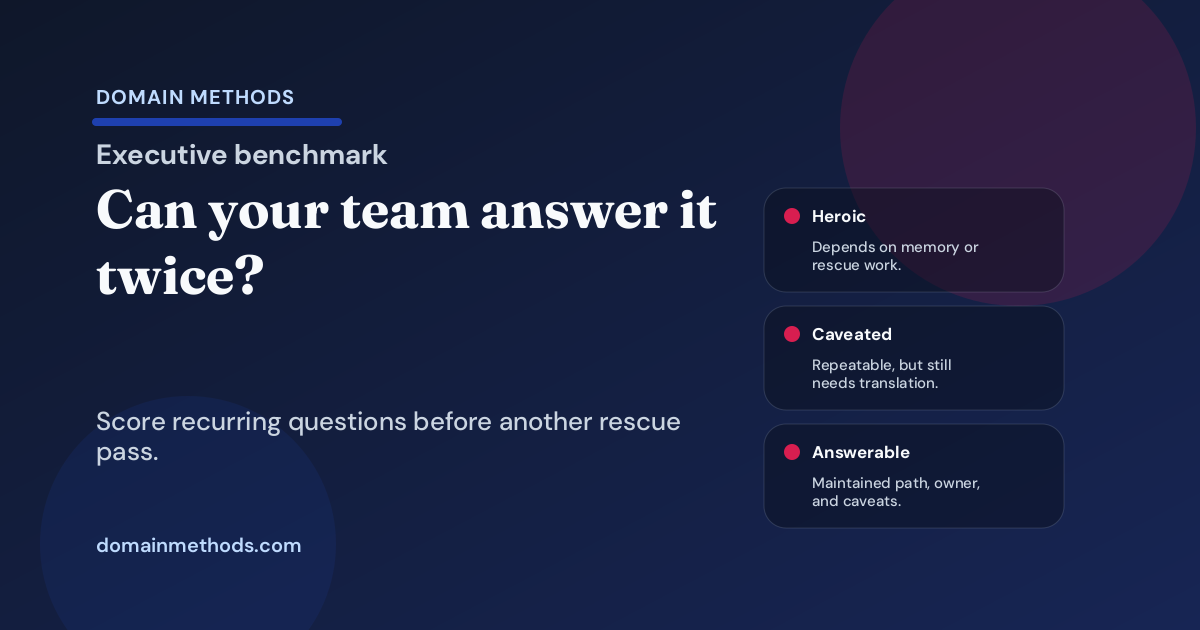
| Heroic | The answer depends on last-minute manual rescue, Slack archaeology, or one operator’s memory. | The team can usually produce an answer, but the process is rebuilt under pressure. |
| Repeatable with caveats | The answer path exists, but caveats, owner judgment, or reconciliation still require live translation. | The business can use the answer if the caveats travel with it. |
| Operationally answerable | The question has a maintained path, known owner, stable caveats, traceable lineage, and a clear confidence level. | The same question can be answered again without restarting the analysis. |
The point is not to shame the heroic state. Every growing company has a few heroic questions. The danger is pretending they are operationally answerable because someone managed to assemble a clean slide by Friday.
The seven dimensions to score
Score the question where recurring executive answers usually break.
| Dimension | What you are testing | Weak-score signal |
|---|---|---|
| Question stability | Does the business ask the same question in the same way each cycle? | The wording changes every meeting, so the team keeps solving a new problem. |
| Owner clarity | Does one accountable owner know what answer is expected? | Several functions have input, but nobody can settle what leadership should use. |
| Maintained answer path | Does the question map to a standing metric, model, dashboard, memo, or worksheet? | The answer starts from a fresh export, spreadsheet, or analyst scratchpad every time. |
| Caveat stability | Do the same caveats recur, and are they documented? | The caveats keep changing, or the same caveat is explained like new information each cycle. |
| Lineage and reconciliation | Can the team trace the answer and resolve disagreement quickly? | The room has to compare CRM, finance, warehouse, and deck logic in real time. |
| Refresh effort | Does the answer refresh through a maintained process? | The question is answerable only after a bespoke rescue pass. |
| Decision consequence | Is the answer tied to budget, staffing, board narrative, or operating priority? | The team uses a directional answer as if it were safe for a high-consequence decision. |
The operator detail that matters: the answer can be technically correct and still operationally weak. If only one person knows why the finance view differs from the CRM view, the business does not really own the answer. It rents it from that person’s memory.
How to score the benchmark
Score each dimension from 1 to 3.
| Score | Meaning | Practical test |
|---|---|---|
| 1 | Strong | The rule is explicit, repeatable, and usable under normal reporting pressure. |
| 2 | Fragile | The rule exists, but the room still depends on caveats, memory, or owner translation. |
| 3 | Weak | The rule is missing, contested, manually rebuilt, or unsafe for the decision being made. |
Then total the seven dimensions.
| Total score | Answerability band | What to do next |
|---|---|---|
| 7-10 | Operationally answerable | Use the answer for the named decision, while keeping the documented caveats visible. |
| 11-15 | Repeatable with caveats | Use the answer carefully. Assign the caveat, reconciliation, or owner fix before the next cycle. |
| 16-21 | Heroic | Do not treat the current answer as a maintained operating fact. Pick the first repair path. |
This is deliberately simple. The benchmark should be usable in a working session, not require a scoring manual.
What each band looks like in real life
Heroic
Heroic questions are not unanswered. That is what makes them easy to miss.
The team does answer them. It just does so by reopening old Slack threads, asking the same analyst to pull a special cut, copying last month’s caveat into a new deck, or reconciling three exports before the meeting starts.
A heroic answer often sounds polished by the time it reaches leadership. The mess is hidden upstream.
The problem is repeatability. If the same question comes back next month and the team has to rediscover the path, the answer was never operationalized. It was rescued.
Repeatable with caveats
This is often the most realistic middle state.
The answer path exists. There is a dashboard, a model, or a recurring worksheet. Someone knows the owner. The caveat is not a surprise.
But the caveat still has to be translated in the room.
Maybe the pipeline number is stable, but sales and marketing still classify sourced opportunities differently. Maybe paid spend is usable directionally, but finance close timing changes the final story. Maybe the board deck can use the metric, but only with a confidence label that explains what changed since last cycle.
Repeatable with caveats is not failure. It becomes failure only when the caveats disappear because the number looks clean.
Operationally answerable
Operationally answerable means the question has a maintained path.
The team can explain:
- what exact question is being answered
- who owns the answer path
- which metric, model, dashboard, memo, or worksheet supports it
- what caveats are stable enough to document
- where the data comes from
- how disagreement gets reconciled
- which decisions the answer is safe to support
This does not mean the answer is perfect. It means the business can ask the question twice and get back to the same operating logic without depending on a rescue sprint.
That distinction matters for executives. Leadership does not only need numbers. They need answer paths they can trust under repeated pressure.
The answerability repair matrix
Use the weakest dimension to choose the next fix. Do not launch a broad reporting cleanup when one answer path is what actually hurts.
| If the weakest dimension is… | First repair move | Avoid this trap |
|---|---|---|
| Question stability | Rewrite the executive question in one sentence and freeze it for the next cycle. | Building a dashboard for a question that keeps changing. |
| Owner clarity | Name the accountable answer owner and the decision owner separately if needed. | Letting every stakeholder contribute context while nobody can settle the answer. |
| Maintained answer path | Tie the question to one standing artifact: dashboard, metric definition, model, memo, or worksheet. | Treating a one-off analysis as if it were production reporting. |
| Caveat stability | Document the caveat that must travel with the answer until the underlying issue is fixed. | Explaining the same caveat live every cycle. |
| Lineage and reconciliation | Map the answer back to source systems and define the rule for handling disagreement. | Letting CRM, finance, and warehouse logic fight in the executive room. |
| Refresh effort | Remove the repeated manual step or make it an explicit maintained process with an owner. | Depending on one operator’s private spreadsheet because it keeps working. |
| Decision consequence | Label what the answer is safe to support: directional, decision-grade, or board-grade. | Using a directional answer to justify a high-consequence decision. |
The practical tradeoff: sometimes the first fix is not technical. It may be a definition record, an owner decision, or a caveat sentence that stops the same confusion from being re-litigated. That can feel small compared with a dashboard rebuild. It is often the faster path to a safer executive answer.
How to use the worksheet
Use the worksheet with one recurring leadership question and one review cycle in mind.
Download the Executive Answerability Benchmark Worksheet (PDF)
A lightweight working-session worksheet for scoring whether a recurring leadership question has a maintained answer path, stable caveats, clear owner, and safe decision use.
Instant download. No email required.
Want future posts like this in your inbox?
This form signs you up for the newsletter. It does not unlock the download above.
Work through it in this order:
- Write the exact executive question.
- Name the decision the answer is expected to support.
- Score the seven dimensions.
- Assign the answerability band.
- Pick the first repair path.
- Decide whether the next cycle needs definition alignment, translation work, or source-of-truth repair.
If the score is heroic, do not ask for a prettier deck first. Name the rescue step that keeps recurring. If the score is repeatable with caveats, make the caveat explicit and owned. If the score is operationally answerable, document the path so the next leader does not have to reverse-engineer it.
Where this should route next
If the benchmark exposes competing definitions across marketing, sales, finance, and data, start with Three Teams, Three Numbers. That is the metric-alignment problem: several teams can defend their answer, but leadership still needs one operating rule.
If the benchmark exposes vague asks turning into repeated analyst rescue work, start with Translate the Ask. That is the translation problem: leaders are asking for a report before the team has agreed on the decision, confidence level, caveat, and answer path.
The goal is not to make every executive question board-grade. The goal is to stop treating a rescued answer like a maintained one.
When a team can answer the same leadership question twice without heroics, reporting starts to feel less like defense and more like an operating system.
Download the Executive Answerability Benchmark Worksheet (PDF)
A lightweight worksheet for scoring whether a recurring leadership question has a maintained answer path, stable caveats, clear ownership, and safe decision use.
DownloadIf every team can defend its number but leadership still cannot pick one
Three Teams, Three Numbers
Use the diagnostic when marketing, sales, finance, and data all bring plausible answers, but recurring executive questions still turn into definition fights.
See the metric-alignment diagnosticIf the executive ask keeps turning into analyst rescue work
Translate the Ask
Use the engagement when leaders ask for a dashboard, report, or cleaner number before the team has translated the decision, owner, caveat, and answer path.
See Translate the AskSee It in Action
Common questions about executive answerability
How is executive answerability different from board readiness?
Can a dashboard make a question operationally answerable?
Who should own this benchmark?
What is the clearest sign a question is still heroic?

About the author
Jason B. Hart
Founder & Principal Consultant
Helps mid-size SaaS companies turn messy marketing and revenue data into decisions leaders trust.