The Ecommerce Profitability Reporting Benchmark
- Jason B. Hart
- Marketing Analytics
- April 25, 2026
- Updated May 19, 2026
Table of Contents
What is the Ecommerce Profitability Reporting Benchmark?
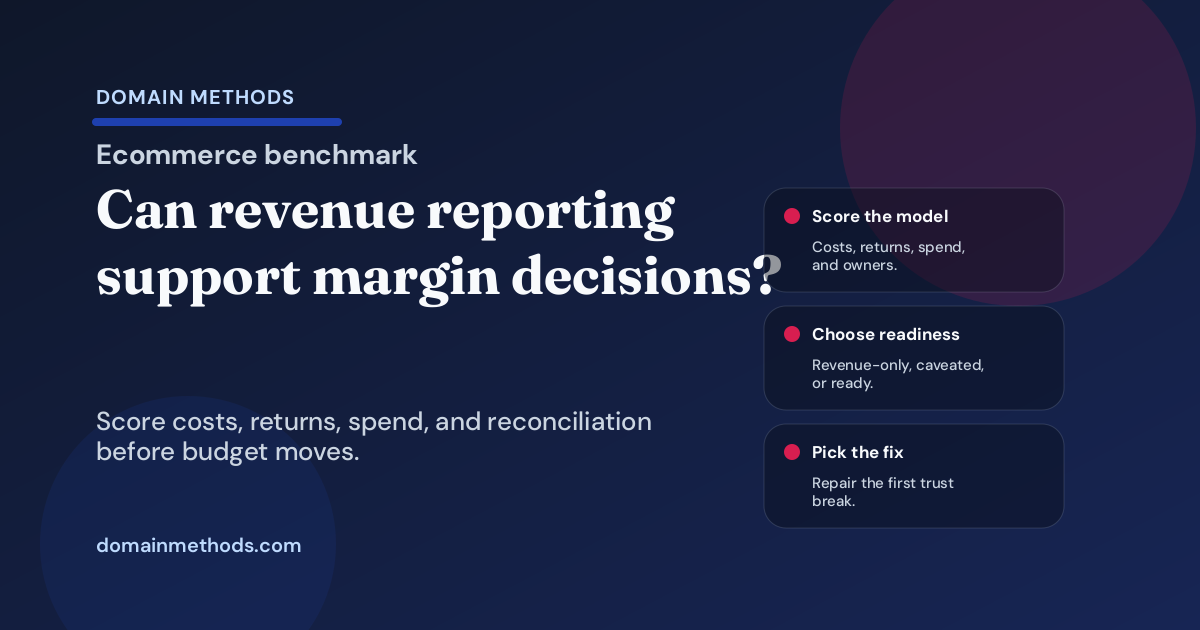
The Ecommerce Profitability Reporting Benchmark is a practical way to decide whether your reporting stack can support margin decisions, or whether it only explains revenue after the fact.
That distinction matters because ecommerce reporting often looks healthy at the top of the funnel and gets messy only after the room asks a harder question.
Orders are up. Revenue is up. ROAS looks acceptable. Then someone asks what happened after discounts, returns, shipping, fulfillment, product cost, and blended acquisition cost. The team opens a second tab, a finance export, a warehouse model, and one spreadsheet that only one person knows how to rebuild.
That is the moment this benchmark is for.
This piece sits next to Shopify Reporting vs Finance Reporting vs a Warehouse Profitability Model, The Ecommerce Data Playbook, and The Ecommerce Data Cheat Sheet. Those guides explain the layers and definitions. This one gives the team a working benchmark for a narrower question: is the model ready to change a margin decision?
Benchmark one decision, not the whole stack
Do not score “our ecommerce reporting.”
That is too broad. Pick one decision the business is about to make and score whether the reporting model can carry that decision without a private rescue process.
Good benchmark targets include:
- pausing or scaling a paid channel because contribution margin changed
- deciding whether a discount is creating profitable demand or just top-line volume
- choosing which products deserve merchandising or media support
- deciding whether returns are changing the channel story
- reviewing whether fulfillment cost is high enough to change offer strategy
- defending a profitability narrative in a leadership or board meeting
A useful benchmark sentence sounds like this:
We are testing whether our current reporting model is strong enough to reduce spend on one channel next month, or whether it is only safe for directional margin learning.
That sentence keeps the room honest. A reporting model can be useful for spotting margin pressure and still be too fragile for a budget cut, pricing change, or board claim.
The four profitability readiness bands
Use four bands. More bands usually make the score look more scientific than it is.
| Readiness band | What it means | Safe uses | Unsafe uses |
|---|---|---|---|
| Revenue-only visibility | The team can see sales, orders, and spend, but margin still has to be reconstructed manually. | Revenue pulse checks, storefront performance, early channel signals. | Product, pricing, channel, or fulfillment decisions that depend on real contribution margin. |
| Margin with caveats | The model can connect some costs and margin logic, but timing, returns, allocations, or reconciliation still need hand checks. | Budget pruning, investigation, directional product/channel review with caveats attached. | Major pricing moves, permanent channel shifts, board-grade margin narrative without review. |
| Decision-grade profitability reporting | Channel, product, discount, return, fulfillment, and contribution logic are repeatable enough for operating decisions. | Recurring budget review, merchandising choices, channel mix decisions, margin improvement planning. | Claiming finance-grade certainty if accounting treatment or close rules still differ. |
| Cleanup-first | The model is too incomplete, contested, or person-dependent to support the named decision. | Identify the first trust break and assign cleanup ownership. | Any decision where the reported margin would become the deciding fact. |
The important part is not the label. It is the behavior the label allows.
A revenue-only view is not useless. It is just not a profitability model. A margin-with-caveats view can still help a team stop obvious waste. It becomes dangerous only when the caveats disappear from the decision memo.
The eight dimensions to score
Score the model where ecommerce profitability usually breaks. These are the places where the meeting moves from dashboard review to spreadsheet archaeology.
| Dimension | What you are testing | Weak-score signal |
|---|---|---|
| Revenue and discount capture | Whether orders, discounts, promo codes, refunds, and net revenue are represented consistently. | Gross revenue is easy to find, but discount drag changes depending on the report. |
| Returns and refund timing | Whether return behavior lands in the right period and at the right level of detail. | A channel looks profitable until return timing catches up weeks later. |
| Shipping and fulfillment cost | Whether fulfillment, shipping, pick-pack, and carrier costs are available for the decision grain. | Product or channel margin has to use a blunt blended cost assumption. |
| Ad spend and channel allocation | Whether spend connects to the same channel, campaign, product, or cohort logic used in reporting. | Paid-platform performance and margin reporting use different channel buckets. |
| CAC-to-margin linkage | Whether acquisition cost can be compared against contribution logic, not just revenue. | CAC looks acceptable until discounts, refunds, and fulfillment drag are counted. |
| Product and channel contribution view | Whether the model can show contribution by the slice the team actually manages. | The business can see total margin but not which product/channel combination is causing pressure. |
| Shopify, finance, and warehouse reconciliation | Whether the model explains why storefront, accounting, and modeled views differ. | The warehouse number is useful, but finance cannot tie it back to a formal source of truth. |
| Owner and review cadence | Whether someone owns the rules, exceptions, and review rhythm for profitability logic. | The model works when one analyst is present and decays when they are not. |
The operator detail that matters: weak profitability reporting rarely fails because one field is missing. It fails because several small caveats compound into one big decision risk.
A team may have clean Shopify order data and decent ad spend, but weak return timing. Or it may reconcile to finance, but only after product-level detail disappears. The benchmark is useful because it points to the first break that blocks the decision in front of the team.
How to score the benchmark
Score each dimension from 1 to 3.
| Score | Meaning | Practical test |
|---|---|---|
| 1 | Strong | The rule is explicit, repeatable, and trusted under normal reporting pressure. |
| 2 | Fragile | The rule mostly works, but depends on caveats, manual review, or a few operators knowing the context. |
| 3 | Weak | The rule is missing, contested, manually rebuilt, or unreliable when the decision matters. |
Then total the eight dimensions.
| Total score | Readiness band | What to do next |
|---|---|---|
| 8-11 | Decision-grade profitability reporting | Use the model for the named operating decision, while documenting any finance or timing caveats. |
| 12-16 | Margin with caveats | Use the signal for pruning and investigation, but keep hard commitments out until the weak dimensions improve. |
| 17-20 | Revenue-only visibility | Treat the current view as commercial reporting, not a margin decision model. Build the missing cost and reconciliation layer. |
| 21-24 | Cleanup-first | Do not use the model for the named decision yet. Pick the first broken input, rule, or owner and fix that before the next review. |
This is not proprietary industry research. It is a working-session benchmark.
The point is to stop arguing about whether ecommerce reporting is “good” and start naming exactly what the current model can safely support.
What each band lets you do
Cleanup-first
Cleanup-first means the team should not use the reported margin number as the deciding fact yet.
The signals are usually visible:
- return timing changes the answer after the meeting
- shipping cost is loaded late, blended too broadly, or pulled from a separate operations sheet
- discount rules differ between Shopify, finance, and marketing reporting
- channel spend does not map cleanly to the product or cohort view being discussed
- the margin answer depends on one person’s spreadsheet notes
The first move here is not a prettier dashboard. It is trust repair.
If shipping cost is the break, fix that input. If discount treatment is drifting, settle the rule. If the warehouse model cannot reconcile to finance at any useful level, document the difference before anyone uses the number to justify a budget move.
Revenue-only visibility
Revenue-only visibility can be useful for speed.
It can tell the team whether sales moved, whether promotions changed demand, whether product velocity shifted, or whether a campaign created visible top-line movement.
But it is not a margin model.
The tell is the phrase, “Yes, but after costs?” If that question always starts a manual rebuild, the team is still operating from revenue visibility. That is fine for a storefront pulse check. It is thin support for a decision about channel budget, product support, or pricing.
This is where a lot of ecommerce operators lose time. They do not need an enterprise transformation before making better decisions. They need to label the current view honestly and stop promoting it into a profitability claim it cannot support.
Margin with caveats
Margin with caveats is often the most useful near-term band.
The team can see enough economics to prune waste, investigate product/channel combinations, or spot discount behavior that deserves attention. But the model still carries caveats that should travel with the decision.
Common caveats sound like:
- returns are delayed, so the last two weeks are directional
- fulfillment cost is allocated at product family level, not SKU level
- finance reconciliation is monthly, while the operating view updates weekly
- paid spend is reliable by channel, but campaign-to-product allocation still needs review
Those caveats are not weakness if they are visible. They are weakness when the room forgets them because the chart looks clean.
A practical tradeoff: margin with caveats may be enough to reduce obviously inefficient spend for one review cycle. It is usually not enough to change pricing, overhaul merchandising, or claim board-grade margin improvement without a reconciliation pass.
Decision-grade profitability reporting
Decision-grade profitability reporting means the model is stable enough to guide recurring operating choices.
The team can explain:
- how Shopify orders become net revenue
- how discounts, returns, and refunds are treated
- where shipping and fulfillment costs enter
- how ad spend maps to channel, product, or cohort logic
- where finance agrees, where it differs, and why
- who owns rule changes and exceptions
This does not mean the model is perfect.
It means the model is repeatable enough that the business can use it without a private analyst rescue process every time the question matters. The answer can still carry caveats. The difference is that the caveats are documented, reviewed, and owned.
The margin decision matrix
Use this table to keep the next conversation practical.
| If the decision is… | Minimum safe band | Why |
|---|---|---|
| Spotting whether a promotion moved demand | Revenue-only visibility | The team needs speed and storefront movement first. |
| Investigating whether a channel may be overfunded | Margin with caveats | Directional contribution can identify waste before a full finance reconciliation. |
| Cutting or scaling paid budget materially | Decision-grade profitability reporting | CAC, returns, fulfillment, and product economics need to be stable enough to defend. |
| Changing pricing or discount strategy | Decision-grade profitability reporting | A wrong margin model can make a pricing change look smart while it quietly damages contribution. |
| Explaining ecommerce margin to leadership or the board | Decision-grade profitability reporting, with finance alignment | Modeled economics can explain the business, but formal reporting still needs a finance anchor. |
| Prioritizing cleanup work | Cleanup-first or revenue-only visibility | The weak band itself tells you which input, rule, or owner needs attention first. |
The matrix is intentionally conservative.
Some teams can act faster because the business context is simple. Others need tighter proof because one product line, carrier cost, or return pattern can swing the answer. The benchmark should make that tradeoff explicit instead of hiding it behind an average margin number.
What to fix first after you score it
Do not turn the benchmark into a list of twenty projects.
Pick the weakest dimension that blocks the named decision and fix that first.
| Weakest dimension | First cleanup move |
|---|---|
| Discounts | Write one net-revenue rule that Shopify, finance, and growth can use in the same review. |
| Returns | Separate early directional reads from return-adjusted decisions, and label the lag explicitly. |
| Fulfillment cost | Get cost available at the lowest useful grain before claiming SKU or channel profitability. |
| Ad spend allocation | Map spend to the same channel/product logic the margin view uses, not a separate platform taxonomy. |
| CAC-to-margin linkage | Stop reviewing CAC beside revenue only; connect it to contribution for the decision slice. |
| Product/channel view | Decide which operating slice matters most before building a dashboard that slices everything poorly. |
| Reconciliation | Document where Shopify, finance, and warehouse numbers differ and which one owns each decision. |
| Ownership cadence | Name the owner, review date, and exception process before the next reporting cycle. |
One concrete operator habit helps: write the next review date beside the caveat.
“Fulfillment cost is blended” is easy to ignore. “Fulfillment cost is blended until the operations export lands in the warehouse by May 15” changes the conversation. It turns a caveat into an operating plan.
Where the benchmark fits in the ecommerce reporting stack
Use Shopify reporting for speed. Use finance reporting for formal truth. Use the warehouse model for repeatable economics across systems.
The benchmark does not replace those layers. It tells you whether the current combination is strong enough for the decision being asked of it.
If your team is still rebuilding profitability from exports, start with The Ecommerce Data Playbook and The Ecommerce Data Cheat Sheet. If the fight is which reporting layer should own the answer, use Shopify Reporting vs Finance Reporting vs a Warehouse Profitability Model. If the model is close but not trusted, this benchmark gives the next working session a cleaner agenda.
The goal is not perfect ecommerce data.
The goal is knowing when a number is safe enough to change the business.
Where to take this next
If the benchmark exposes a real operating gap, use the next step that matches the decision pressure:
- If margin, fulfillment cost, and channel economics still cannot be reconciled, start with Show Me the Margin.
- If attribution and spend allocation are the weak layer, route the problem through Where Did the Money Go?.
- If you need proof from a similar ecommerce reporting cleanup, read the ecommerce warehouse/CDP case study.
Ecommerce Profitability Reporting Benchmark Worksheet
Score eight dimensions, assign the right readiness band, and name the first cleanup move before a margin decision leans on the wrong number.
Instant download. No email required.
Want future posts like this in your inbox?
This form signs you up for the newsletter. It does not unlock the download above.
Download the Ecommerce Profitability Reporting Benchmark Worksheet (PDF)
A lightweight worksheet for scoring whether your ecommerce reporting model is ready for margin decisions, budget moves, and product/channel tradeoffs.
DownloadIf revenue looks healthy until margin, returns, and channel economics enter the room
Show Me the Margin
Use the profitability diagnostic when Shopify, ad-platform, and finance reporting all sound plausible but the business still cannot see which channels and products create healthy growth.
See the profitability diagnosticIf the benchmark exposes brittle source data or modeling rules
Data Foundation
Use Data Foundation when the margin question is clear but costs, returns, joins, and source-of-truth logic cannot survive repeated scrutiny.
See Data FoundationSee It in Action
Common questions about ecommerce profitability reporting benchmarks
How is this different from a Shopify dashboard audit?
Do we need perfect finance-grade data before using contribution margin?
What is the clearest sign our ecommerce reporting is cleanup-first?
Who should own the profitability reporting benchmark?

About the author
Jason B. Hart
Founder & Principal Consultant
Helps mid-size SaaS companies turn messy marketing and revenue data into decisions leaders trust.