The Decision Surface Framework
- Jason B. Hart
- Revenue Operations
- April 24, 2026
- Updated April 23, 2026
Table of Contents
What is the decision surface framework?
The decision surface framework is a practical way to match a reporting surface to the job it is supposed to do: optimization, operating cadence, strategic planning, or executive and board communication.
A lot of teams do not have a reporting shortage.
They have a reuse problem.
One dashboard starts life as a channel-tuning tool. Then it gets dragged into the weekly revenue meeting. Then someone screenshots it for quarterly planning. Then an executive asks whether the same view can support the board pack.
At that point, the argument sounds like a data-quality fight.
A lot of the time, it is really a decision-surface mismatch.
The surface is being asked to do jobs with different confidence bars, different caveat tolerance, and different narrative needs.
That is the gap this framework is meant to close.
It sits next to The Request-to-Decision Translation Ladder, The Reporting Artifact Hierarchy, Should This Dashboard Request Become a Dashboard, a Decision Brief, or a Workflow Change?, and Board Dashboard vs Board Memo vs Board-Ready Scorecard.
Those pieces help with intake, artifact choice, dashboard triage, and board-format selection.
This one handles a different failure mode: what happens after a reporting surface already exists and the business keeps reusing it in the wrong room.
Why this mismatch keeps showing up
Salesforce’s State of Data and Analytics, 2nd Edition research found that 63% of data and analytics leaders say their companies struggle to drive business priorities with data.1
That struggle often shows up long after the team has already built something.
The dashboard is live. The spreadsheet exists. The scorecard has a name. But the business still feels like the number becomes less trustworthy every time it gets reused in a new context.
You can usually spot the operator-level version of this problem quickly:
- a paid-media dashboard is fine for bid and budget optimization, but it gets used to defend annual spend posture to the executive team
- a weekly pipeline inspection view gets reused as a board narrative even though the caveats change every Monday
- a board-safe summary gets pushed back down to the channel team, where it is too coarse to tell anyone what to do next
- a strategic planning slide keeps getting treated like a live operating console, so people start arguing about lag, freshness, and segment cuts the slide was never designed to answer
The surface is not automatically wrong.
It is just carrying the wrong burden.
The four decision surfaces at a glance
Use this framework to separate four common contexts before the room starts debating whether the numbers are “good” or “bad.”
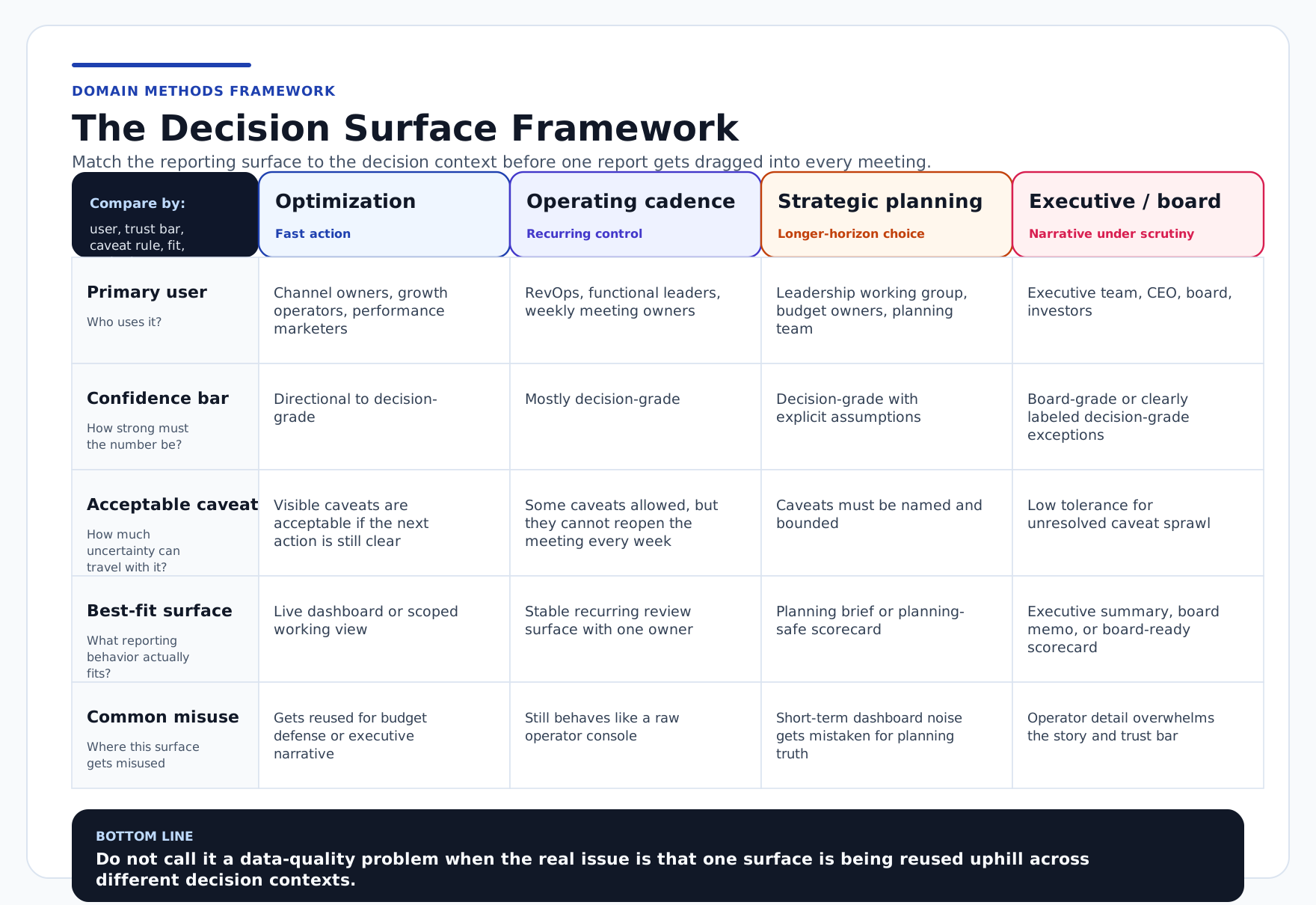
| Decision surface | Primary audience | Confidence bar | Acceptable caveat level | Best-fit reporting behavior |
|---|---|---|---|---|
| Optimization | channel owners, performance marketers, growth operators | directional to decision-grade | visible caveats are acceptable if they still support a near-term action | live exploratory dashboard or scoped working view |
| Operating cadence | RevOps, functional leaders, weekly meeting owners | mostly decision-grade | some caveats allowed, but repeated caveat churn is a warning sign | stable operating review surface with owner and cadence |
| Strategic planning | leadership working group, budget owners, planning team | decision-grade with explicit assumptions | caveats must be named and bounded | tighter planning brief or planning scorecard, not a raw operator dashboard |
| Executive / board communication | executive team, CEO, board, investors | board-grade or clearly labeled decision-grade exceptions | low tolerance for unresolved caveats and metric re-interpretation | executive summary, board memo, or board-ready scorecard |
The important thing is not memorizing the table.
The important thing is noticing when one surface starts getting dragged uphill into a context that needs stronger framing, higher confidence, or tighter ownership.
1. Optimization surface
The optimization surface is for people who need to change something soon.
Think channel mix, campaign pacing, lifecycle conversion friction, sales-process triage, or an alert threshold someone will inspect before the next working session.
The operator question here is usually:
- what should I adjust now?
That means the surface can tolerate more visible caveats than a board or planning artifact can.
A paid-media team can still make a useful call from a dashboard that says, in effect, “this is directional; finance reconciliation lands later.” That is annoying, but it can still be decision-useful if the next move is a budget trim, a creative change, or a segment shift inside the week.
The problem starts when someone takes that same surface into an executive budget conversation and acts surprised when the room pushes back on caveats that were totally acceptable in operator mode.
Optimization surfaces fail when people confuse speed of action with strength of proof.
2. Operating cadence surface
The operating-cadence surface is what a team uses in a recurring review rhythm.
This is the weekly revenue meeting, the monthly pipeline check, the recurring GTM review where the room expects enough consistency that it can compare one cycle to the next without reopening the entire metric model.
The main job here is not exploration.
It is shared operating control.
That means the surface needs a clearer owner, cleaner definitions, and more stable caveat handling than the optimization surface. The room can still tolerate some uncertainty, but it cannot survive endless “before we trust this slide” debate every week.
A good operator test is simple: does the meeting move faster because the surface exists, or does the meeting spend half its time renegotiating what the surface means?
If the second one is happening, the surface is not really serving operating cadence yet. It is still acting like a dressed-up optimization tool.
3. Strategic planning surface
Strategic-planning surfaces are for decisions with longer half-lives.
This is where leadership is deciding headcount sequencing, quarter-level budget posture, channel investment bias, rollout timing, or whether one problem deserves a translation sprint, cleanup pass, or broader rebuild.
Planning surfaces need a different kind of honesty.
They do not need every underlying row-level cut on the screen. They do need assumptions, scenario logic, and confidence framing that can survive a planning conversation without pretending the underlying number is cleaner than it is.
This is where teams often drag in a weekly dashboard and expect it to carry a quarter-shaping conversation.
The result is predictable.
The room starts arguing about freshness, lag, and segment mechanics when the real need was a planning-safe answer like:
- what direction is credible enough to plan against?
- what uncertainty should slow the decision down?
- what would have to improve before this becomes a stronger commitment?
A planning surface should reduce that confusion, not import more of it.
4. Executive and board communication surface
Executive and board communication is the steepest decision surface.
The room needs fewer numbers, clearer narrative framing, and much less tolerance for open caveat sprawl.
That does not mean the surface has to pretend everything is perfect.
It does mean the surface must carry its uncertainty in a controlled way.
A board-safe view can say:
- this is the number
- this is the confidence level
- this is what changed
- this is what leadership should take away
It cannot just drop an operator dashboard into the packet and hope the audience reverse-engineers the right conclusion.
That is why board communication is not just “the same dashboard with better design.” It is a different decision surface with different obligations.
If you need the narrower board-format chooser, use Board Dashboard vs Board Memo vs Board-Ready Scorecard. The point here is broader: do not assume a surface that works in weekly operations is automatically safe for executive narrative.
What goes wrong when one surface gets reused everywhere
Here are the mismatch patterns I see most often.
Optimization surface used for strategic planning
The dashboard answers today’s tuning questions well enough, so the team keeps reusing it in quarter planning.
Now the room is staring at a surface built for movement and control, not for scenario framing.
People start overreacting to short-term noise because the surface was never built to answer “what should we commit to next quarter?”
Operating review surface used for executive storytelling
The weekly report is stable enough that leadership starts treating it like an executive artifact.
But weekly operating surfaces usually carry more caveat texture, owner shorthand, and in-flight cleanup language than an executive room can absorb cleanly.
The result is predictable: leaders hear too much detail, lose the thread, and conclude the number is less trustworthy than it really is.
Board-safe summary used for operator control
This one is quieter but just as damaging.
A board-ready scorecard gets cleaner and tighter over time, so teams start using it as the live working surface.
Now the operator room loses the segment cuts, threshold detail, and error bars it actually needs to do anything.
The surface looks disciplined, but nobody can use it to run the work.
Strategic planning deck used as a recurring operating system
A planning deck often has explicit assumptions, one-time comparisons, and a recommendation posture that works well in one planning cycle.
If the team keeps dragging it back into weekly reviews, the deck starts behaving like a fake dashboard. That is when stale assumptions become invisible and the room stops noticing that the context changed underneath the same slides.
A worked example: one paid-media surface, four different jobs
Imagine a growth leader says, “Can we use the same paid-media dashboard for weekly tuning, next quarter’s budget plan, and the board update?”
That sounds efficient.
It is usually how reuse debt starts.
Here is the cleaner answer:
| Context | What the room actually needs | What usually breaks if the same surface is reused |
|---|---|---|
| Optimization | channel-level movement, spend efficiency, and fast correction signals | nothing breaks if caveats are visible and the owner knows how to work around them |
| Weekly operating review | stable rollup, named owners, and a clear view of what changed since last week | the meeting slows down if the dashboard still behaves like a raw operator console |
| Strategic planning | planning-safe narrative about direction, assumptions, and where the confidence is still soft | the room overweights short-term volatility and underweights planning assumptions |
| Executive / board communication | board-safe summary, explicit confidence language, and a controlled story about performance and risk | the dashboard imports too much detail and not enough interpretation |
Notice what changes.
It is not always the underlying data model first.
It is the reporting behavior around that model.
Sometimes the right move is four totally separate artifacts.
Often the better move is one underlying metric spine with different reporting surfaces layered on top of it.
That is still a split.
It is just a more disciplined one.
How to decide whether to split, upgrade, or contain the surface
When the same report is getting pulled into too many rooms, ask these questions in order.
1. Is the underlying metric spine still the problem?
If definitions still shift between teams, do not waste time polishing the surface. Route first to Three Teams, Three Numbers or the more structural trust work behind it.
2. Is the surface correct for the lowest-stakes room?
If the dashboard is not even good enough for optimization or weekly operating use, do not promote it uphill into planning or executive work. Fix the base use first.
3. Does the next room need a different confidence rule or narrative burden?
If yes, you probably need an upgrade or split.
This is where teams get stuck because they think splitting a surface means duplicating all the work.
Usually it means something simpler:
- keep the operator dashboard for optimization
- create a tighter recurring operating view for the weekly room
- create a planning brief for quarter decisions
- create a board-safe summary for executive communication
4. Who owns each surface?
A surface without an owner usually becomes a shared liability.
The easiest way to keep one dashboard from being misused everywhere is to say who owns it, what decision surface it serves, and where it stops being safe.
That last part matters.
A lot of reporting pain is really boundary pain.
Where this framework hands off to adjacent tools
Use this framework when the surface already exists and the room keeps asking it to do too many jobs.
Use the neighboring tools when the problem is one step earlier or one step narrower.
- Use The Request-to-Decision Translation Ladder when the business still has not named the decision, confidence bar, or owner.
- Use The Reporting Artifact Hierarchy when the team needs to choose the output family itself.
- Use Should This Dashboard Request Become a Dashboard, a Decision Brief, or a Workflow Change? when the request is still specifically stuck on the dashboard noun.
- Use Board Dashboard vs Board Memo vs Board-Ready Scorecard when the room is already firmly in board-format territory.
This matters because the goal is not to build a giant theory of reporting.
The goal is to stop teams from using one surface badly in four different contexts.
Bottom line
Most reporting fights are not really about whether the number is good.
They are about whether the surface is being reused in the wrong room.
The decision surface framework gives you a cleaner way to say that out loud:
- optimization
- operating cadence
- strategic planning
- executive or board communication
If the same surface is climbing that ladder without a new confidence rule, a new owner, or a new reporting behavior, it is probably carrying more than it should.
Split it, upgrade it, or contain it.
Just do not keep calling the mismatch a dashboard problem when it is really a decision-context problem.
Download the Decision Surface Discussion Aid (PDF)
Use this discussion aid to separate optimization, operating cadence, planning, and executive communication before one reporting surface gets forced to do every job.
Instant download. No email required.
Want future posts like this in your inbox?
This form signs you up for the newsletter. It does not unlock the download above.
Sources
- Salesforce, State of Data and Analytics, 2nd Edition. Salesforce reported that 63% of data and analytics leaders struggle to drive business priorities with data. https://www.salesforce.com/en-us/wp-content/uploads/sites/4/documents/research/salesforce-state-of-data-and-analytics-2nd-edition.pdf. Accessed 2026-04-24.
Download the Decision Surface Discussion Aid (PDF)
A practical worksheet for separating optimization, weekly operating review, planning, and executive communication before one report gets forced to do every job.
DownloadIf one metric surface is already creating cross-team conflict
Three Teams, Three Numbers
Use the diagnostic when growth, RevOps, finance, and leadership are all reusing the same number differently and nobody agrees which version is safe for which meeting.
See the metric-alignment diagnosticIf the surface mismatch starts earlier in intake
Translate the Ask
Use the translation sprint when the business is still mixing together the decision, audience, confidence bar, and artifact before the reporting work is even scoped.
See the translation sprintSee It in Action
Common questions about the decision surface framework
What is the decision surface framework?
How is this different from the reporting artifact hierarchy?
Can the same dashboard support more than one decision surface?
When should this escalate into a broader trust or translation project?

About the author
Jason B. Hart
Founder & Principal Consultant
Helps mid-size SaaS companies turn messy marketing and revenue data into decisions leaders trust.