The Data Team Capacity Framework: Build, Borrow, or Bridge?
- Jason B. Hart
- Data strategy
- April 9, 2026
Table of Contents
What Is a Data Team Capacity Framework?
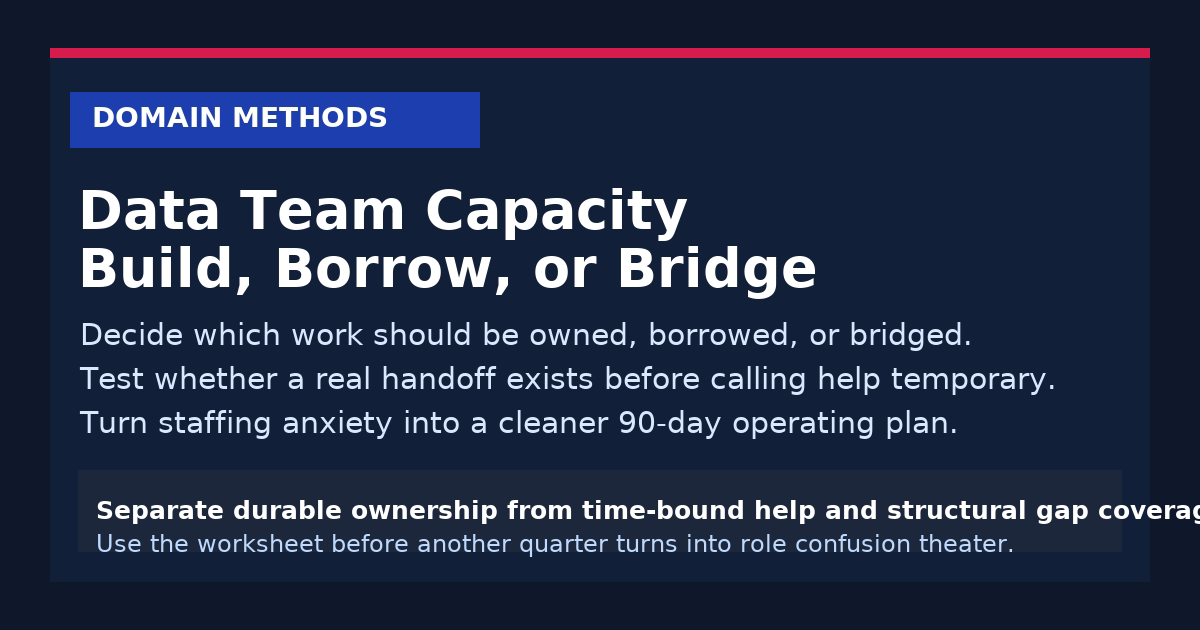
A data team capacity framework is a practical way to decide whether the next analytics problem should be built internally, handled with time-bound outside help, or covered through ongoing augmentation.
That sounds like a staffing question.
Usually it is really an operating-model question.
Most mid-size SaaS teams do not get into trouble because nobody is smart enough. They get into trouble because one team is carrying three different kinds of work at the same time:
- durable platform work that should live inside the company
- specialist cleanup or migration work that does not need a permanent owner forever
- recurring cross-functional translation work that is too important to ignore but too awkward to squeeze into one job description
That operating gap is bigger than one team feeling overbooked. Salesforce’s State of Data and Analytics found that 63% of technical leaders still struggle to drive business priorities with their data. That is exactly the kind of environment where capacity problems get mislabeled as a simple hiring problem instead of what they usually are: an ownership, translation, and sequencing problem.
When those three get blended together, leadership starts asking the wrong question.
Instead of asking, “What kind of help does this problem need?” they ask, “Should we hire someone?” or “Should we find a consultant?” or “Can the current team just push harder for one more quarter?”
That is how teams end up with an impossible job description, a consultant who never really hands work off, or a backlog that keeps moving without ever getting lighter.
The three buckets, stated plainly
The framework is simple on purpose.
Build
Build means the capability is durable and should be owned internally.
Good build candidates usually share a few traits:
- the work is core to how the company runs
- the logic will keep changing with your business
- the output needs a long-term owner
- the team will still care about the capability a year from now
Examples:
- executive revenue reporting logic
- warehouse models that feed core planning workflows
- repeatable lifecycle scoring tied to your own GTM motion
- metric definitions that support leadership, finance, and RevOps every month
If the work is part of your operating system, renting it forever is usually a bad idea.
Borrow
Borrow means bringing in outside expertise for a defined piece of work with a clear end state and a real handoff.
This is where a lot of teams get sloppy. They call something temporary because it feels safer politically, even when nobody can explain how the work will land internally.
Real borrow work usually has all three:
- a narrow problem statement
- a finish line you can name before the work starts
- someone on the internal side who can own the result after handoff
Examples:
- a warehouse migration
- an attribution reset before planning season
- a dbt cleanup with tests and documentation
- a one-time metric-definition workshop that leaves behind owners and decisions
Borrow starts with a handoff date, not just a kickoff date.
Bridge
Bridge means the capability gap is structural, but the company still cannot justify or land the full-time role cleanly.
This is the category teams avoid naming because it sounds messier. It is also the category that explains a lot of real-world operating pain.
A bridge need usually looks like this:
- the work keeps showing up every month or every quarter
- it crosses business and technical boundaries
- the current team does not have spare capacity for it
- the company either cannot hire for it yet or would hire the wrong shape of role if it tried today
Examples:
- ongoing business-to-data translation between marketing, RevOps, and engineering
- a head of data who needs senior augmentation through a long planning cycle
- recurring reporting trust work that is too strategic for a junior analyst and too inconsistent for a neat full-time job description
Bridge work should still have review points.
But unlike borrow, it does not pretend there is already a clean handoff around the corner.
Why teams keep misdiagnosing this as a hiring problem
This is where the fantasy job description shows up.
A leadership team says it needs one person who can:
- fix the warehouse
- translate business asks
- clean up attribution
- settle metric definitions
- support board reporting
- build the dashboards
- keep everyone aligned under deadline pressure
That is not one role. That is a bundle of unresolved operating choices.
I see this most often when a company is feeling some mix of these pressures at once:
- the CFO does not trust the pipeline number
- marketing needs clearer attribution before the next budget call
- RevOps is patching definitions in spreadsheets
- the data team is technically capable but already full
- leadership wants more speed without admitting the system is still fragile
Once that happens, the company starts searching for a person heroic enough to absorb the ambiguity.
That usually fails for a boring reason: the role was designed to contain multiple problems that needed sequencing first.
This is the same pattern behind The Unicorn Analyst Trap and The Business Didn’t Ask for a Dashboard. They Asked for a Decision. The team names a role or an artifact when the real issue is that nobody has sorted durable work from time-bound work from translation work.
The handoff test that separates borrow from bridge
If you remember one part of this framework, make it this one.
A lot of engagements that get described as short-term specialist help are actually bridge needs in disguise.
Use this test.
| Question | If the answer is yes | If the answer is no |
|---|---|---|
| Is there a named internal owner for the work after outside help leaves? | borrow may be viable | you are probably looking at bridge or build |
| Can you describe the finish line before the work starts? | borrow may be viable | the scope is still fuzzy or ongoing |
| Will the capability still be needed repeatedly next quarter? | maybe bridge or build | borrow is more likely |
| Could the company justify a clean full-time hire for this exact gap right now? | build becomes more plausible | bridge becomes more plausible |
| Is the pain mostly about unclear asks and cross-functional translation? | start with translation work first | do not jump straight to hiring or tooling |
Here is the operator detail most teams miss:
When the same person who was supposed to “just help with the migration” is still translating stakeholder requests, patching definitions, and joining weekly planning calls three months later, that is not a project overrun. That is evidence the gap was structural from the beginning.
Call it bridge and manage it honestly.
A simple capacity calculator for the next 90 days
You do not need a big staffing model to make this useful.
Run this lightweight score with the work already in front of you.
Score each statement from 0 to 2.
- 0 = not true
- 1 = partly true
- 2 = clearly true
| Statement | Score |
|---|---|
| This work will still matter in more or less the same form 12 months from now. | |
| There is a credible internal owner who could maintain the result after a handoff. | |
| The main challenge is time-bound specialist work, not recurring ownership. | |
| The same capability gap is likely to show up again next quarter. | |
| The company can justify a clean full-time role for this exact need. | |
| The biggest risk is unclear scope or business-to-data translation, not raw implementation effort. |
Then interpret the score by pattern, not by total alone.
Build pattern
Build is usually the right answer when these are true:
- the work is durable
- there is or should be a long-term owner
- the capability is important enough to justify internal ownership
Borrow pattern
Borrow is usually the right answer when these are true:
- the work is specialist and time-bound
- the end state is concrete
- a handoff owner already exists
Bridge pattern
Bridge is usually the right answer when these are true:
- the capability gap will keep recurring
- the company still cannot justify the exact full-time role cleanly
- someone needs to carry the work now so the business does not keep stalling
If the sixth statement scores highest and the room still cannot explain the actual problem, stop debating staffing and start with Translate the Ask.
Build, borrow, or bridge: examples from real SaaS operating life
Example 1: board reporting keeps breaking because revenue definitions keep moving
This is usually build, with some short-term help around it if needed.
The capability is durable. Leadership will keep needing the number. Finance and RevOps are not going to stop caring next quarter. The company needs internal ownership of the logic, the definitions, and the controls.
A short outside engagement may still help clean up the mess faster. But the final shape should live inside your operating system, not in an external dependency chain.
If the underlying warehouse and model logic are too brittle for that, the right next move is often Data Foundation.
Example 2: your team needs a warehouse migration and dbt cleanup before a funding milestone
This is often borrow.
The work is specialized, important, and deadline-driven. But it also has a clean end state:
- migrate the pipelines
- document the models
- add tests
- leave a handoff package the internal team can own
That is a classic time-bound expertise problem.
Example 3: marketing, RevOps, and data keep getting stuck between vague asks and rebuild requests
This is often bridge first, not a neat hire or a neat project.
The pain keeps recurring because the translation layer is weak. One week it shows up as attribution confusion. The next week it shows up as lifecycle scoring drift. Then it becomes a board-slide argument about pipeline quality.
You can hire around that eventually, but a lot of mid-size SaaS companies are not ready to define the permanent role yet. They still need senior translation and sequencing now.
That is where a bridge model makes more sense than pretending a short project will make the problem disappear.
The mistakes that make this more expensive
Mistake 1: treating every recurring problem like a project
If the same issue keeps resurfacing, it is not automatically a project-management failure. It may be a sign that the gap is structural and needs bridge or build thinking instead of another narrow sprint.
Mistake 2: hiring before the problem is shaped clearly
This is how companies end up writing job descriptions that ask one person to be analytics engineer, RevOps strategist, stakeholder translator, and executive analyst at the same time.
If the ask is still blurry, fix the shape of the work first.
Mistake 3: letting borrow work quietly become permanent without saying so
This is the most common one.
A consultant comes in for a narrow project. The project ends. But the person is still attending weekly meetings because nobody really owns the translation layer, the edge cases, or the cleanup loop.
At that point, leadership should make an explicit decision:
- convert the work into a bridge model with clear review points
- define the internal build path
- or stop pretending the handoff is one meeting away
Mistake 4: using a tool purchase to avoid a capacity conversation
A new tool can help. It cannot answer whether the team has a durable owner, a handoff path, or a structural cross-functional gap.
Buying software to dodge a capacity decision usually gives you one more thing that needs administration while the original problem stays in the room.
A 30-minute working session you can run this week
If you want to use this with your leadership team, keep it small.
- 5 minutes: list the real work hitting the team in the next 90 days
- 5 minutes: mark each item as durable, time-bound, or recurring-but-ownerless
- 10 minutes: run the handoff test and the six-statement capacity calculator
- 5 minutes: decide which items are build, borrow, or bridge
- 5 minutes: write down the owner, handoff date or review date, and the next concrete move
That last step matters.
A framework is only useful if it changes staffing, sequencing, or scope this quarter.
Download the worksheet and run it with the actual operators
Use the worksheet with the people who already feel the pain:
- the head of data who is carrying too many modes of work
- the RevOps lead trying to keep definitions from drifting
- the marketing leader who needs an answer before the budget meeting
- the executive who keeps assuming this is one hire away from fixed
The worksheet includes a 90-day work inventory, a handoff test, a lightweight capacity calculator, and a one-page decision tree so the conversation ends with an actual call instead of another vague discussion about resourcing.
Download the Build / Borrow / Bridge capacity worksheet (PDF)
A lightweight worksheet with a 90-day work inventory, a handoff test, a simple capacity calculator, and a one-page decision tree for the next staffing conversation.
Bottom line
Most teams do not need a more heroic job description.
They need a cleaner way to separate what should be built, what should be borrowed, and what needs a bridge until the company is ready to own the capability properly.
If the ask is still fuzzy, start with Translate the Ask. If the capacity problem keeps tracing back to brittle warehouse logic, weak definitions, and fragile reporting, start with Data Foundation.
The important thing is not choosing the most impressive option. It is choosing the shape of help that matches the problem you actually have.
Sources
- Salesforce, State of Data and Analytics (2nd Edition): 63% of technical leaders say they still struggle to drive business priorities with their data.
Download the Build / Borrow / Bridge capacity worksheet
A lightweight worksheet with a 90-day work inventory, a handoff test, a simple capacity calculator, and a one-page decision tree for the next staffing conversation.
DownloadSee It in Action
Common questions about build, borrow, and bridge decisions
What does build mean in this framework?
What makes borrow different from bridge?
Can outside help start as borrow and turn into bridge?
How do we keep this from becoming consultant propaganda?

About the author
Jason B. Hart
Founder & Principal Consultant
Founder & Principal Consultant at Domain Methods. Helps mid-size SaaS and ecommerce teams turn messy marketing and revenue data into decisions leaders trust.
Jason B. Hart is the founder of Domain Methods, where he helps mid-size SaaS and ecommerce teams build analytics they can trust and operating systems they can actually use. He has spent the better …
Get posts like this in your inbox
Subscribe for practical analytics insights — no spam, unsubscribe anytime.