The Attribution Gap Map: What Your Tools Report vs. What Actually Drives Revenue
- Jason B. Hart
- Marketing analytics
- April 9, 2026
Table of Contents
What Is the Attribution Gap Map?
The attribution gap map is a simple way to show the difference between what your tools can report confidently and what the business actually needs to know about pipeline and revenue.
That difference is where a lot of bad decisions hide.
Google Ads says paid search drove the conversion. Meta says paid social influenced the deal. HubSpot says the lifecycle campaign did the work. GA4 says the last session came from direct. Sales says the deal really moved after a referral and three calls. Finance says none of those reports line up with booked revenue anyway.
Everyone sounds half-right. That is the problem.
HubSpot’s 2026 State of Marketing reporting found that 33% of marketing leaders say measuring ROI is their top challenge.1 And in B2B, the path is messy before reporting even enters the picture: Forrester says an average of 13 people are involved in a purchasing decision.2
So the practical question is not “Which tool is right?”
It is:
Which layer can we trust for which part of the story, and where does that confidence stop?
Why attribution keeps sounding more certain than it really is
Most attribution fights are not really about modeling sophistication. They are about scope confusion.
A platform sees the touches that happened inside or near its own boundary and reports from that vantage point. That is normal. The trouble starts when a local view gets promoted into a company-wide revenue story.
A few patterns show up constantly:
- retargeting looks like a hero because it shows up late in the path
- brand search gets too much credit because it captures demand created elsewhere
- marketing automation overweights the campaign that was easiest to log, not necessarily the one that changed the deal
- web analytics sees session behavior clearly but loses the thread once humans, CRM workflows, and sales motion take over
- CRM and finance hold the strongest revenue signals but often under-credit the earlier touches that created demand in the first place
That is why attribution can feel accurate and still mislead the business. A tool can be doing exactly what it was built to do and still be the wrong place to settle a revenue argument.
The attribution gap map, in one view
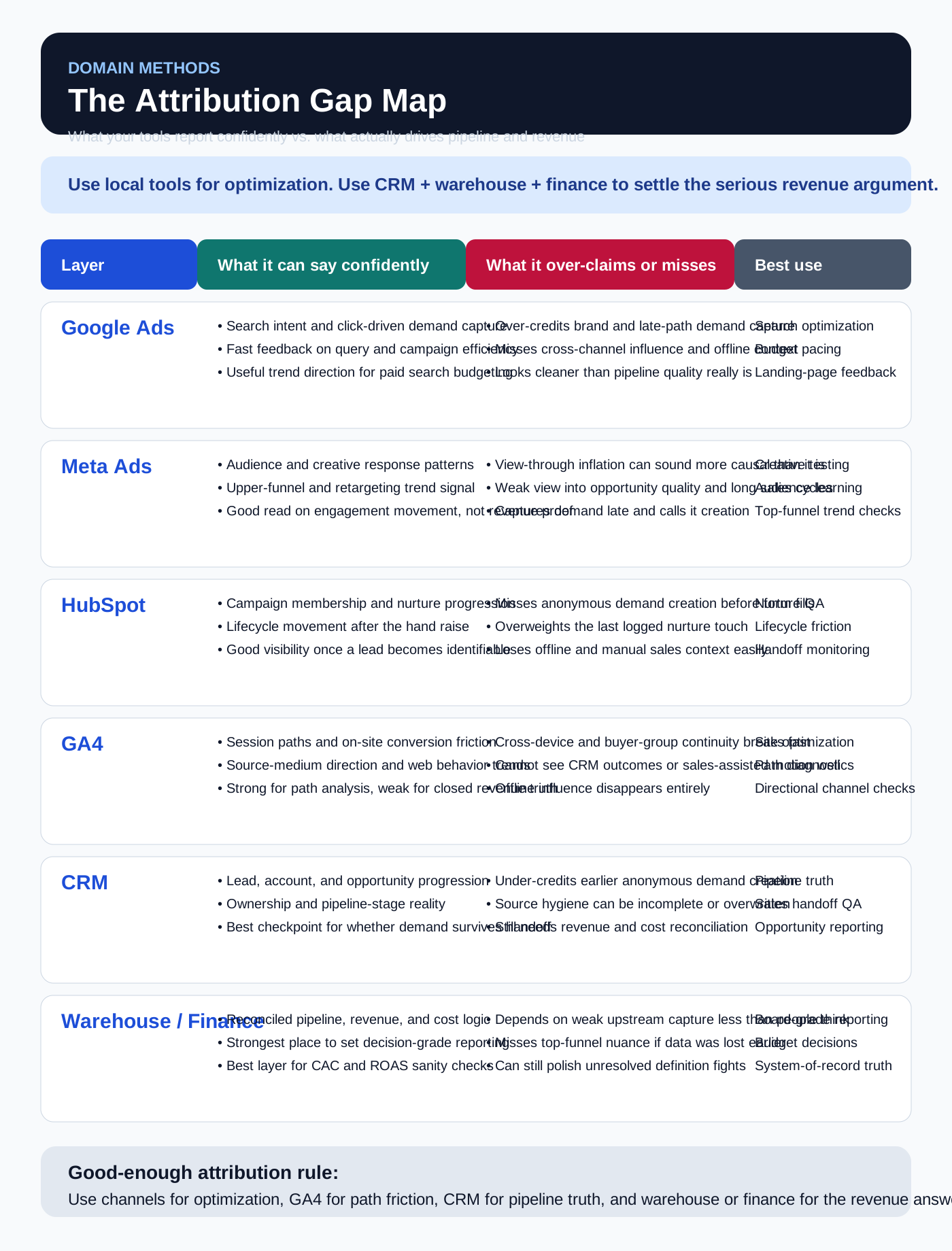
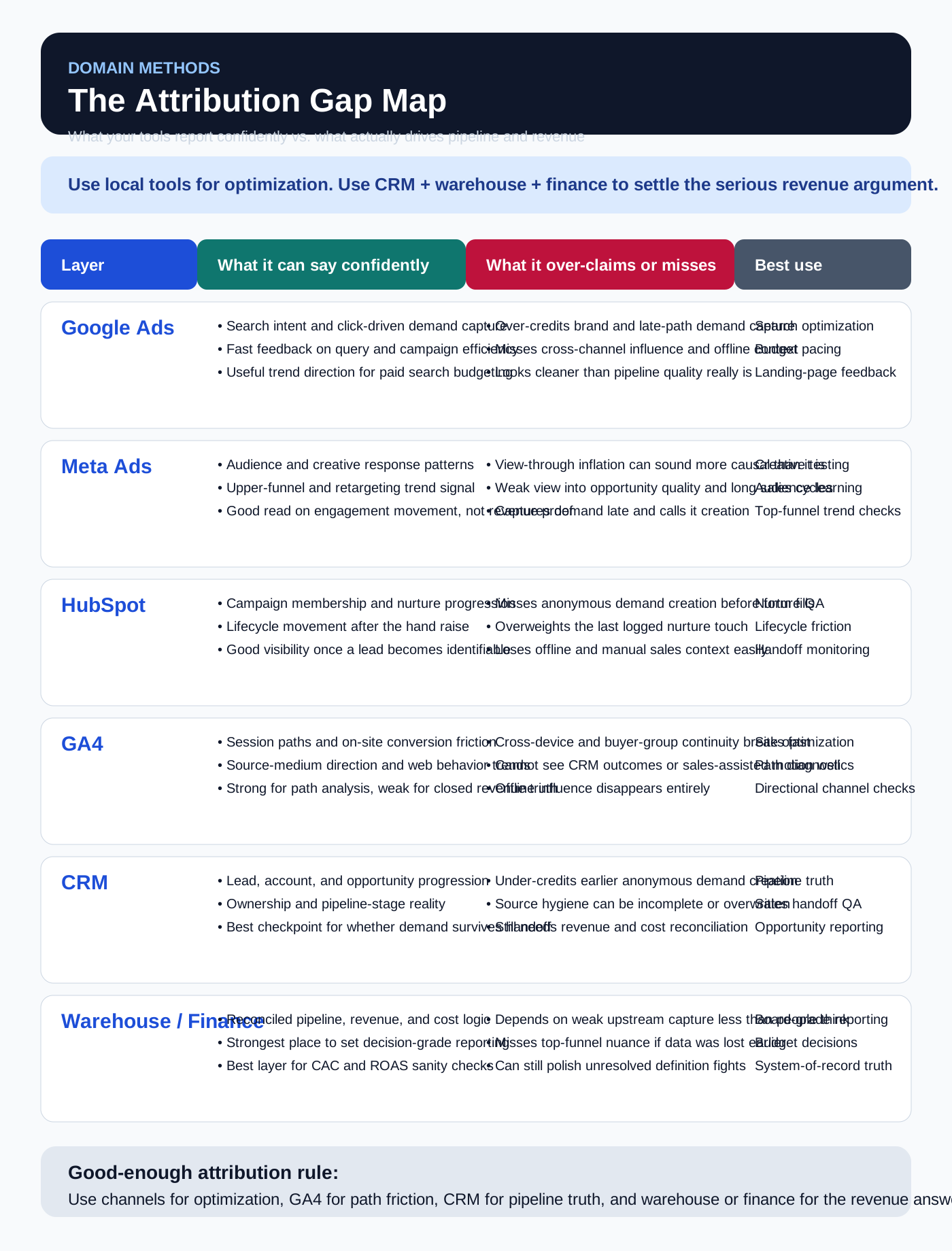
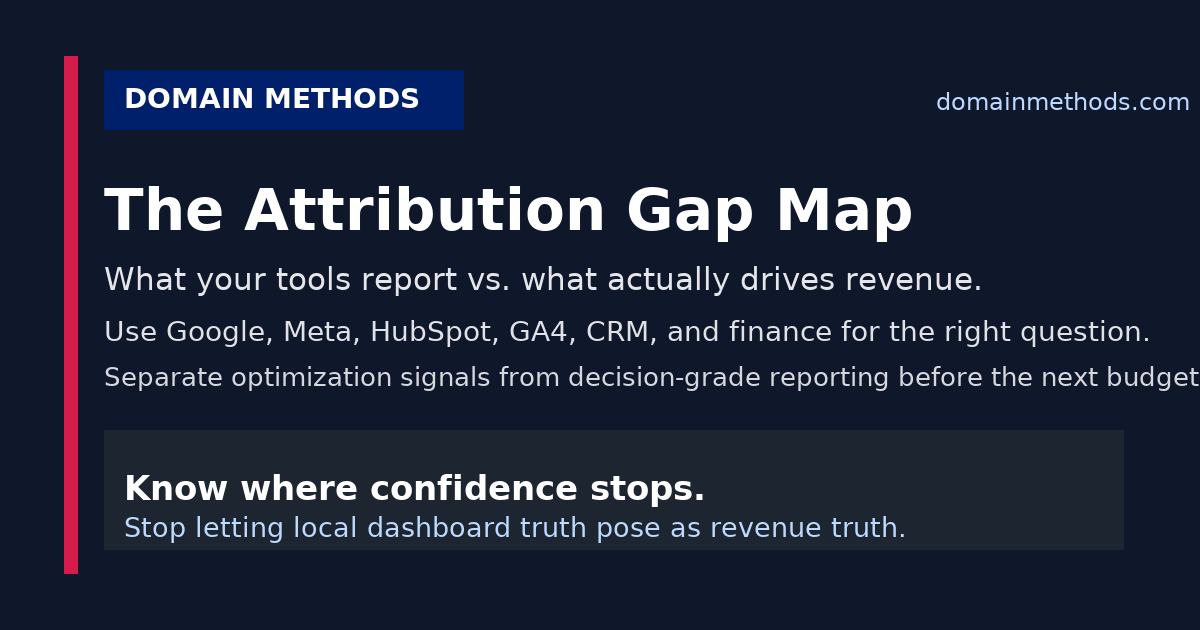
If you want the one-page version for a team discussion, download the graphic here: The Attribution Gap Map.
What does each tool actually know?
The fastest way to reduce attribution noise is to stop treating every layer like it has the same authority.
| Reporting layer | What it can say confidently | What it tends to over-claim or miss | Best use in the business |
|---|---|---|---|
| Google Ads | Click-driven demand capture, query intent, conversion trend inside Google’s field of view | Brand demand it did not create, late-path capture, offline and cross-channel influence | Budget pacing, search optimization, landing-page feedback |
| Meta Ads | Audience and creative response, view-through and click-through engagement patterns | Demand capture disguised as influence, weak visibility into downstream pipeline quality, long B2B buying paths | Creative testing, audience learning, upper-funnel trend signals |
| HubSpot / marketing automation | Form fills, campaign membership, lifecycle progression after identifiable conversion | Anonymous pre-conversion behavior, offline influence, manual sales context, over-crediting the last logged nurture touch | Handoff quality, nurture performance, lifecycle friction |
| GA4 | Session paths, on-site conversion friction, source-medium trend direction | Cross-device continuity, CRM outcomes, buyer-group behavior, offline and sales-assisted context | Website optimization, path analysis, directional channel checks |
| CRM | Lead-to-account-to-opportunity movement, ownership, pipeline stage changes, sales reality | Earlier anonymous demand creation, campaign nuance lost before handoff, incomplete source hygiene | Pipeline truth, sales handoff quality, opportunity-level reporting |
| Warehouse / finance layer | Reconciled pipeline, revenue logic, cost treatment, system-of-record alignment | Top-of-funnel nuance when source capture is weak, anything not intentionally integrated | Decision-grade reporting, CAC and ROAS sanity checks, board-grade explanation |
That table is usually enough to calm down the first round of argument. Not because it answers everything, but because it names the real mistake: the tools are being asked to testify outside their jurisdiction.
Tool by tool: where the gap opens up
Google Ads: strong on search intent, weak on revenue truth
Google Ads is often the cleanest-looking report in the room because search behaves like high intent. When someone types a branded query after weeks of earlier exposure, Google is sitting right there to collect the click.
That does not mean Google created the demand. It often means Google captured the easiest final proof of intent.
What it is actually good for:
- spotting which query clusters create efficient response
- seeing which campaigns are generating qualified traffic spikes or drop-offs
- comparing cost and conversion movement quickly enough to manage spend
What it overstates:
- brand search as a demand creator rather than demand collector
- retargeting and bottom-funnel campaign impact when earlier touches did the heavy lifting
- revenue confidence when CRM linkage is weak or delayed
If your paid search numbers look excellent while pipeline quality is flat, Google is not necessarily wrong. It is just answering a narrower question than leadership thinks.
Meta Ads: useful signal, especially dangerous when treated like proof
Meta is good at surfacing audience response and creative signal. It is much less reliable as a final authority on which spend created revenue in a longer B2B motion.
The operator-level tell is familiar: the view-through numbers look healthy, the retargeting campaigns appear efficient, and the sales team still cannot point to matching opportunity quality downstream.
What Meta is actually good for:
- seeing which creative concepts get attention from the right audience slices
- identifying upper-funnel momentum and retargeting responsiveness
- spotting where paid social is likely helping demand formation
What it overstates or misses:
- assisted influence presented like direct causation
- buyer-group behavior it cannot actually observe end to end
- downstream sales friction, qualification, and deal quality
Meta often belongs in the influence conversation, not the final revenue verdict.
HubSpot: strong after the hand raise, blurry before it
HubSpot and similar automation platforms become useful the moment someone identifies themselves through a form fill, campaign action, or lifecycle event.
That is also where a lot of attribution inflation starts.
If the first clean record in the system is a webinar registration, a nurture form, or a content download, HubSpot can make it look like the campaign created the opportunity even when the real demand had been building for weeks through other channels.
What HubSpot is actually good for:
- campaign membership and nurture progression
- MQL and lifecycle management
- tracking whether leads stall, recycle, or advance after specific marketing actions
What it misses:
- anonymous site history before identification
- sales-created context that never gets logged well
- offline influence, referrals, partner motion, and buying-committee dynamics
If the question is “Did the nurture path help this lead progress?” HubSpot is useful. If the question is “What truly drove revenue this quarter?” it is only one witness.
GA4: great for path friction, weak for business truth
GA4 is good at web behavior. It is not your revenue system.
That sounds obvious, but teams ignore it all the time because GA4 is usually the most available analytics interface on the marketing side.
What GA4 does well:
- highlight which paths convert better on-site
- show where traffic sources are changing direction
- surface page, event, and path friction quickly
What GA4 misses or distorts:
- people switching devices, browsers, or identities
- the account-level reality of B2B buying
- pipeline progression and revenue outcomes once the sales process starts
- offline touches and executive influence that matter a lot in real deals
GA4 is a good tool for asking, “What happened on the site?” It is a bad tool for closing the full argument about what caused revenue.
CRM: closer to revenue, but still not the whole movie
A healthy CRM gets you closer to commercial truth than the channel and web layers because it tracks stage movement, ownership, account context, and opportunity creation.
That is why so many attribution debates finally get serious when someone pulls the CRM report.
It also has blind spots.
If source hygiene is weak, if the first-touch context was lost on the way in, or if sales-created and partner-created motion is inconsistent, the CRM can become a cleaner-looking version of incomplete truth.
What the CRM is actually good for:
- showing whether leads turned into real pipeline
- identifying where channel stories break once sales takes over
- grounding the attribution conversation in opportunities instead of form fills
What it still misses:
- high-quality anonymous demand creation before handoff
- touches that never got captured cleanly upstream
- the cost and revenue normalization needed for decision-grade CAC or ROAS
That is why the CRM should be a major checkpoint, not the final layer.
Warehouse and finance: the strongest place to settle the serious argument
If leadership wants a number that can survive a board conversation, this is usually where the conversation needs to end up.
The warehouse and finance layer can reconcile:
- spend and source data
- CRM and opportunity progression
- billing, bookings, ARR, or recognized revenue logic
- cost treatment that does not change by department
This is where you stop asking, “Which dashboard looks best?” and start asking, “Which definition and system of record are we willing to run the company on?”
The tradeoff is that this layer depends on everything below it. If source capture is weak, CRM linkage is messy, or costs are handled inconsistently, the warehouse can still become a polished container for unresolved arguments.
But when it is healthy, this is the layer that turns attribution from marketing theater into operating judgment.
How to build a good-enough blended attribution model
The goal for most mid-size SaaS teams is not perfect multi-touch truth. It is good-enough attribution that helps the business make better decisions without pretending the blind spots are gone.
A practical blended model usually looks like this:
1. Let platforms optimize the local channel
Use Google and Meta to manage bids, audiences, creative, and conversion trend direction. Do not ask them to be the final judge of pipeline quality or revenue.
2. Use GA4 to diagnose web friction and source direction
GA4 is valuable when the question is about path quality, content flow, or on-site conversion behavior. It should not carry the burden of final revenue attribution.
3. Use CRM reporting to test whether marketing-generated demand survives contact with reality
This is where you pressure-test whether the channels generating response are also generating usable pipeline. If the handoff breaks here, the channel story is already too optimistic.
4. Use the warehouse or finance layer for decision-grade reporting
If the number is going to influence budget reallocation, board narrative, or a serious CAC or ROAS conversation, it needs to be reconciled at the system-of-record layer.
5. Label confidence honestly
One of the fastest improvements a team can make is adding confidence labels instead of pretending every metric is equally solid.
| Reporting question | Best primary layer | Confidence standard |
|---|---|---|
| Which search campaigns are responding now? | Google Ads | Directional |
| Which paid social creatives are creating useful engagement? | Meta | Directional |
| Which site paths are suppressing conversion? | GA4 | Directional to decision-grade, depending on implementation quality |
| Which channels produce opportunities that sales actually works? | CRM | Decision-grade if source hygiene is stable |
| Which channels contribute to pipeline and revenue we can defend to leadership? | Warehouse / finance | Decision-grade |
That framework is boring on purpose. Boring frameworks tend to make better operating decisions than elegant attribution fantasies.
What good enough attribution actually looks like in practice
For a mid-size SaaS company, good enough attribution usually means the business can do five things without drama:
- explain which channels appear to create demand versus merely capture it late
- compare platform claims against pipeline and revenue outcomes on a regular cadence
- state where the blind spots still are without sounding evasive
- make budget shifts with clear confidence labels instead of false certainty
- keep finance, RevOps, and marketing close enough on cost logic that CAC and ROAS are not different math problems in different rooms
That is enough to run smarter growth decisions. You do not need a mystical model before you can get there.
Download the map and use it in the next reporting fight
Use the map in the next budget review, channel debate, or leadership prep session where attribution starts sounding cleaner than it really is.
Download the Attribution Gap Map (SVG)
A one-page visual for showing what each tool can say confidently, where it tends to over-claim, and how to separate optimization reporting from revenue truth.
If the discussion still ends with everyone defending their local dashboard, the next move is usually not another attribution model debate. It is a deeper diagnostic into where the spend story actually breaks.
That is exactly what Where Did the Money Go? is for.
See the Spend DiagnosticSources
- HubSpot, The top challenges marketing leaders expect to face in 2026, citing its 2026 State of Marketing report.
- Forrester, The Verdict Is In: It's Buying Groups For The Win, citing Forrester's Buyers' Journey Survey, 2024.
Download the Attribution Gap Map graphic
A one-page visual showing what each reporting layer can say confidently, what it tends to over-claim, and how to use the stack without pretending every tool sees revenue truth.
DownloadSee It in Action
Common questions about attribution gaps
What is an attribution gap map?
Why do attribution tools and ad platforms keep over-claiming revenue?
What does good enough attribution look like for a mid-size SaaS company?
Should we stop using platform attribution altogether?
Share :

About the author
Jason B. Hart
Founder & Principal Consultant
Founder & Principal Consultant at Domain Methods. Helps mid-size SaaS and ecommerce teams turn messy marketing and revenue data into decisions leaders trust.
Jason B. Hart is the founder of Domain Methods, where he helps mid-size SaaS and ecommerce teams build analytics they can trust and operating systems they can actually use. He has spent the better …
Get posts like this in your inbox
Subscribe for practical analytics insights — no spam, unsubscribe anytime.