Should This Workflow Stay Manual, Go Rules-Based, or Use AI?
- Jason B. Hart
- Data Engineering
- April 18, 2026
- Updated June 17, 2026
Table of Contents
Should this workflow stay manual, go rules-based, or use AI?
A workflow should stay manual when the inputs are still shaky or the cost of a wrong output is too high, it should go rules-based when deterministic logic already handles most of the work, and it should use AI only when trust, repeatability, exception ownership, and review are all strong enough to defend.
That sounds stricter than most AI-readiness content because it is.
Most teams do not need another vague conversation about whether they are “doing AI.” They need an honest answer to one much more practical question:
Should this specific workflow move at all?
That is the part a lot of readiness content still skips. It explains the prerequisites. It warns against hype. It talks about data quality. All of that is useful. But the operating question is usually more immediate than that.
A VP asks whether lead routing can use AI. RevOps wants to automate a cleanup workflow. Customer success wants a churn-priority list. Marketing wants help triaging inbound requests.
The business pressure is not abstract. It is attached to one process and one deadline.
Gartner predicts that at least 30% of generative AI projects will be abandoned after proof of concept by the end of 2025 because of poor data quality, inadequate risk controls, escalating costs, or unclear business value.1 That lines up with what I keep seeing in practice: the failure is often not that the model is impossible. It is that the team tried to automate a workflow before it had earned the right to be automated.
If you want a broader readiness view across data hygiene and operating foundation, start with AI Readiness Through Data Hygiene and How to Evaluate AI Workflow Readiness When CRM Data Hygiene Is Weak. This article is narrower on purpose. It is about the next-step decision for one workflow.
The three honest outcomes
There are only three outcomes that matter here.
1. Stay manual for now
This is the right answer when the workflow is high-risk, the source path still needs caveats, or nobody can say who owns exceptions when the output is wrong.
A lot of teams resist this answer because manual work sounds backwards.
It is not backwards if it keeps you from automating a bad decision.
Manual is often the correct temporary control state when the workflow touches customer messaging, account routing, budget movement, or executive reporting and the team still depends on side spreadsheets, contested fields, or undocumented handoffs.
2. Go rules-based first
This is the answer teams skip too often.
If simple thresholds, queue rules, suppression logic, or deterministic branches handle most of the problem, use them. Do not force AI into a workflow just because the category sounds modern.
Rules-based automation is often the best middle state because it makes the logic inspectable. The receiving team can see why an account landed in a queue. RevOps can debug the branch. Leadership can understand the tradeoff. That visibility matters.
3. Use AI
AI is the right call only when the workflow still creates real value after you remove the parts that deterministic rules can already solve.
That usually means the workflow has some judgment, prioritization, clustering, summarization, or exception-surfacing layer that benefits from probabilistic help. It does not mean the process is messy enough that a model might magically sort it out.
Adverity’s 2025 marketing data quality research says CMOs estimate that 45% of the data their teams use is incomplete, inaccurate, or outdated.2 That is the background condition a lot of teams are trying to automate on top of. If nearly half the operating picture is suspect, the burden of proof on workflow automation should go up, not down.
Start with one workflow, not a broad AI ambition
The fastest way to make a bad call here is to talk about AI in general.
Talk about one workflow.
Good examples:
- route inbound leads to the right owner faster
- score accounts for human review before an SDR sequence starts
- flag records for lifecycle cleanup before a quarterly campaign push
- summarize support or success notes before a renewal prep call
- prioritize pipeline records that need a manual exception check
Bad examples:
- “use AI in RevOps”
- “automate more of marketing ops”
- “make reporting smarter”
If the team cannot name the workflow, the downstream action, and what failure would actually cost, the conversation is still too early.
That is the first gate because it forces the business to stop talking in ambition and start talking in operating reality.
The decision tree I would use in a real meeting
Here is the cleanest version of the branching logic.
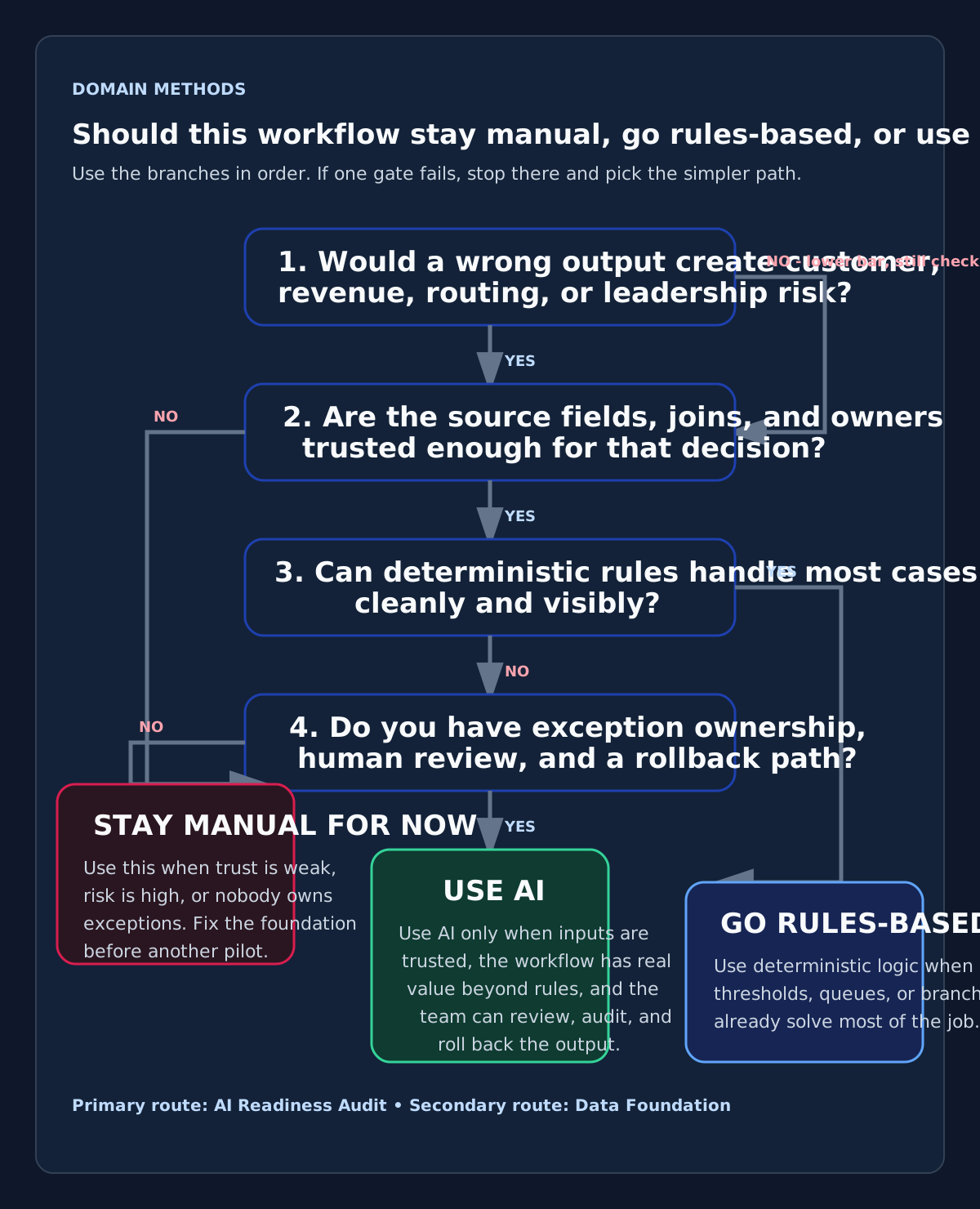
The point of the tree is not to look clever. The point is to stop teams from jumping straight from pressure to implementation.
Gate 1: what happens if the output is wrong?
This is where most teams should start.
If the workflow can change who gets contacted, who gets routed, how pipeline gets prioritized, or what leadership sees in a planning conversation, a wrong output is not just mildly annoying. It changes behavior.
That does not mean every high-risk workflow must stay manual forever.
It means the workflow needs a much higher bar before you automate it.
A useful operator question here is:
If this output is wrong for two weeks, who notices first and what breaks?
If the honest answer is “sales trust,” “customer experience,” “forecast credibility,” or “paid budget movement,” do not treat this like a low-risk productivity experiment.
Gate 2: are the inputs trusted enough for this exact decision?
This is not the same as asking whether the warehouse exists or whether the CRM has fields populated.
It is asking whether the data path behind the workflow is credible enough for the specific job you want the workflow to do.
Things I would pressure-test:
- are the key fields stable and owned?
- do adjacent teams agree on what those fields mean?
- do the joins and mappings hold up without pre-meeting cleanup?
- is the workflow built on a field everyone quietly distrusts but keeps using anyway?
- would the receiving team defend the output in front of leadership?
If the answer to those questions is murky, the workflow is not ready for automation with teeth.
That is where Data Foundation is usually the real next move. The AI decision is not blocked by model choice. It is blocked by the fact that the workflow is still standing on contested operating data.
Gate 3: would deterministic rules already solve most of the problem?
This is the underused branch.
A lot of workflows that get framed as AI candidates are actually better first solved with visible rules.
Examples:
- route accounts above a threshold into a manual review queue
- suppress records missing required ownership fields
- escalate stale pipeline stages after a fixed number of days
- split inbound requests based on clear product, segment, or lifecycle logic
- prioritize cleanup work when specific field combinations are missing
Those are not lesser solutions.
They are often better solutions because they are easier to debug, easier to explain, and cheaper to trust.
If a workflow is mostly repeatable and the important branches are easy to name, rules-based automation is usually the right first move. Use AI later only if the remaining problem still needs probabilistic help.
Gate 4: who owns exceptions, review, and rollback?
This is where otherwise promising AI ideas go off the rails.
The demo works. The proof of concept looks interesting. Then the workflow lands in production and nobody owns the weird cases.
That is not a model problem. That is an operating-model problem.
Before I would bless an AI-assisted workflow, I would want clear answers to these questions:
- who reviews edge cases?
- who can override the output?
- who notices drift or obvious nonsense?
- what happens when the source data is late, missing, or contradictory?
- how do you turn the workflow down without business chaos if it starts misbehaving?
If nobody can answer those cleanly, the right answer is almost never “ship the model anyway and learn.” It is either rules first or manual for now.
How I would classify the three paths in practice
| Path | Best fit | Warning signs | Honest next move |
|---|---|---|---|
| Stay manual for now | High-risk decisions, weak input trust, unclear owners, customer-facing consequences | Side spreadsheets, disputed definitions, no fallback, no exception owner | Fix the trust break or workflow shape before another automation push |
| Go rules-based first | Repeatable workflow, visible branches, deterministic thresholds, clear queue logic | Team wants AI mostly because the category sounds strategic | Write the rule set, review path, and fallback before adding model complexity |
| Use AI | Trusted inputs, real ambiguity left after rules, clear review and rollback, measurable workflow value | People are using AI to hide process ambiguity or bad ownership | Ship narrowly, instrument it, keep a review loop, and prove value before expanding |
That middle column matters.
The biggest failure mode is not choosing the wrong model.
It is choosing AI when the problem was actually one of these:
- bad ownership
- unclear workflow intent
- brittle inputs
- no exception policy
- deterministic logic that would already be good enough
Three examples that make the distinction clearer
Example 1: lead routing for inbound demo requests
If the current routing fight is mostly about missing fields, inconsistent territories, and ownership disputes, do not jump to AI.
If the business cannot defend the routing logic already, AI will just make the same conflict harder to inspect.
A better path is usually:
- clean up the routing fields and ownership rules
- make the deterministic branches visible
- route exceptions into manual review
- add AI only if you later need help with messy free-text context or fuzzy prioritization the rules cannot handle cleanly
That is a rules-first workflow, not an AI-first one.
Example 2: lifecycle cleanup and record prioritization
This is a good place to be skeptical.
A lot of cleanup workflows get framed as AI because the records are messy. But mess is not itself a reason to use a model. Sometimes it is the reason not to.
If the job is mostly detecting blank fields, stale owners, contradictory statuses, or missing handoffs, rules-based automation is usually enough.
If the workflow later needs help clustering free-text notes or spotting likely duplicates that rules keep missing, AI may become useful. But it should earn its way in.
Example 3: renewal-risk prep for customer success
This is one of the cases where AI can make sense faster, because the workflow often combines usage patterns, ticket context, call notes, and account-history signals that are harder to compress into one rigid rule set.
But even here, the gates still matter.
If the source joins are weak or nobody owns what to do when the risk flag contradicts rep judgment, the workflow still is not ready. You do not get to skip the operating discipline just because the use case is more naturally probabilistic.
A simple working-session agenda for deciding honestly
If I had 45 minutes with a RevOps, marketing, or data lead, this is the sequence I would use.
1. Name the workflow and the business consequence
Write down:
- the workflow name
- the team acting on the output
- the downstream action
- what happens if the output is wrong
If the team cannot do that in plain English, stop there.
2. Trace the input path
List the few fields, joins, systems, and owners that actually drive the workflow.
This should be short.
If it becomes an architecture safari, that is useful signal. It usually means the workflow is still too fuzzy or too brittle to automate confidently.
3. Ask what deterministic rules would look like
Force the team to articulate the rule-based version first.
That alone exposes a lot.
If the room can write the branches cleanly, the workflow may not need AI yet.
If the room cannot write them because the work still depends on fuzzy judgment after the obvious rules are stripped out, then AI may have a legitimate job to do.
4. Assign exception ownership
Name the person or team responsible for overrides, weird cases, drift, and rollback.
If nobody wants that responsibility, you have your answer.
5. Choose the smallest safe version
Do not start with the broadest possible automation.
Start with the narrowest version that would still save real time or improve a real decision. Keep the blast radius small enough that the team can learn without creating credibility damage.
Download the gate sheet
Use this worksheet in the next automation conversation where the team needs a clear answer, not another broad AI debate.
Download the AI Workflow Readiness Gate Sheet (PDF)
A one-page worksheet for deciding whether a workflow should stay manual, go rules-based, or use AI based on decision risk, input trust, repeatability, and exception ownership. Download it instantly below. If you want future posts like this in your inbox, you can optionally subscribe below.
Instant download. No email required.
Want future posts like this in your inbox?
This form signs you up for the newsletter. It does not unlock the download above.
Bottom line
The right question is not whether the company is ambitious about AI.
The right question is whether this workflow has earned automation.
If the workflow is risky and the inputs are still suspect, keep it manual for now. If rules already solve most of it, go rules-based first. If real ambiguity remains after the obvious rules are removed and the team can review, explain, and roll back the output, that is when AI starts to make sense.
The practical win is not shipping AI faster.
It is choosing the simplest automation level the workflow can honestly support.
Where to take this next
The worksheet should make one of three next moves obvious:
- If source data, owner authority, or exception paths are weak, start with the AI-Ready Data Diagnostic before automating.
- If the workflow is trusted and the question is how to push it into CRM, marketing automation, or CS systems, use Data Activation.
- If leadership still cannot name the workflow that deserves automation first, use The $500K Question to rank the bets before choosing tooling.
Sources
- Gartner, “Gartner Predicts 30% of Generative AI Projects Will Be Abandoned After Proof of Concept By End of 2025”, July 29, 2024.
- Adverity, “Fixing the Foundation: The State of Marketing Data Quality 2025”, accessed April 18, 2026.
Download the AI Workflow Readiness Gate Sheet (PDF)
A one-page worksheet for deciding whether a workflow should stay manual, go rules-based, or use AI based on risk, trust, repeatability, and exception ownership.
DownloadIf leadership wants a real answer before another pilot
AI-Ready Data Diagnostic
Use the audit when the pressure to automate is real, but the team needs a practical answer on what can ship now, what should stay rules-based, and what should stay manual until the foundation improves.
See the AI-Ready Data DiagnosticIf the real blocker is upstream trust or workflow reliability
Data Foundation
When the workflow falls apart because the records, joins, ownership, or warehouse logic are still shaky, fix the operating foundation before you add automation pressure on top.
See Data FoundationSee It in Action
Common questions about manual work, rules, and AI workflows
When is manual work actually the right answer?
How do I know when rules-based automation is enough?
What makes a workflow genuinely ready for AI?
Should every AI workflow still have a human review step?

About the author
Jason B. Hart
Founder & Principal Consultant
Helps mid-size SaaS companies turn messy marketing and revenue data into decisions leaders trust.