Should This Board-Reporting Request Become a Board Pack, a Confidence Note, or a Data-Foundation Escalation?
- Jason B. Hart
- Revenue Operations
- April 25, 2026
Table of Contents
What is a board-reporting response tree?
A board-reporting response tree is a practical way to decide whether an executive reporting request should become a board pack, a confidence note, a decision brief, or a data-foundation escalation.
The trigger is usually a reasonable question: “Can this go to the board?”
The dangerous part is that the question sounds binary. Either the number is ready or it is not. Either the slide goes in the packet or it gets pulled. Either the team has an answer or it does not.
Real board prep is messier. A metric can be useful enough to shape a conversation and still not be safe enough to carry a board-grade claim. A pipeline trend can be directionally real while the definition is still unstable across RevOps and finance. An attribution read can explain why spend looks inefficient without being strong enough to defend a budget move as fact.
That middle state is where mid-size SaaS teams burn the most time. The board packet is due. The CEO wants the story. Finance wants fewer caveats. Marketing wants credit for progress. RevOps knows the source logic still needs cleanup. Somebody is about to turn a fragile metric into one bullet on a slide.
This response tree gives the team a better set of options than “include it” or “hide it.”
It sits next to The Metric Confidence Ladder, The Reporting Artifact Hierarchy, Board Dashboard vs Board Memo vs Board-Ready Scorecard, and How to Escalate a Directional Metric Without Turning It Into Board-Grade Fiction. Those pieces define confidence levels, artifact formats, and safe metric escalation. This one answers the narrower board-prep question: what should we send when the request arrives before the data is fully safe?
The board request is not always asking for the same thing
Start by naming what leadership is really asking the number to do.
A request for “the board number” may mean four different things:
| Request underneath the request | What leadership really needs | Risk if you choose the wrong response |
|---|---|---|
| Board assurance | A claim the company can defend outside the room | A shaky number becomes institutional truth |
| Decision support | Enough evidence to choose a next move | The team waits for perfection or overstates the signal |
| Status update | A plain-language read on current risk or progress | Caveats disappear and the update sounds cleaner than reality |
| Foundation escalation | Permission to fix the system behind the number | The same caveat returns next quarter with better formatting |
This is not semantics. The artifact should match the job.
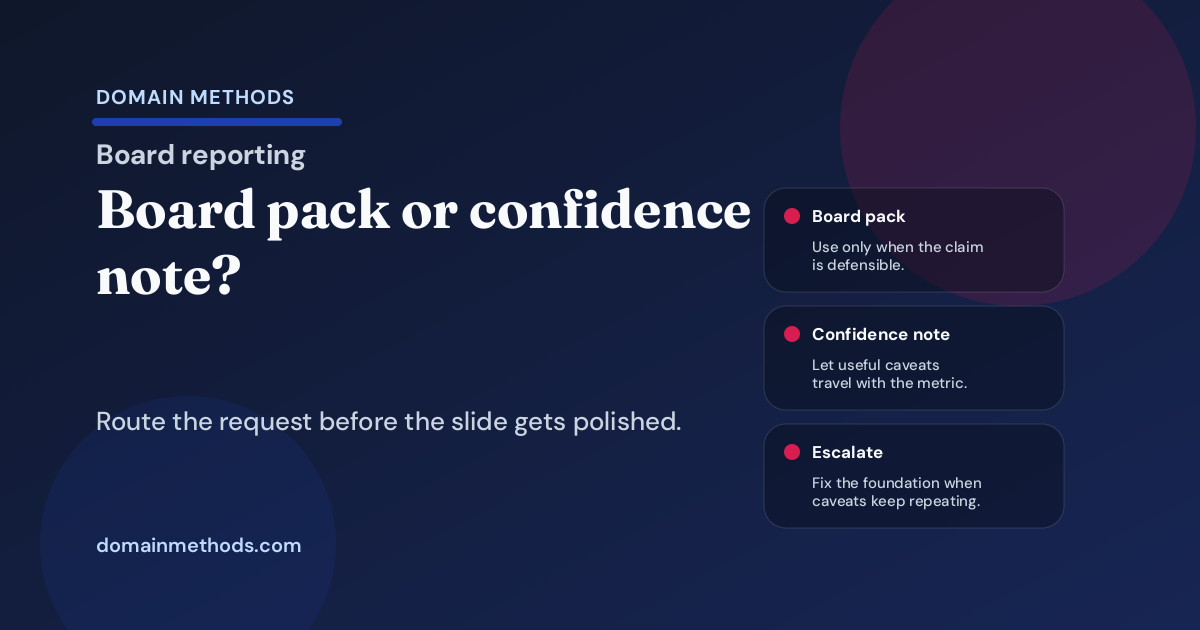
A board pack is for claims the company can stand behind. A decision brief is for a bounded choice where the evidence is strong enough to move. A confidence note is for useful but caveated information that should travel with its limits attached. A data-foundation escalation is for the recurring failure mode that will not be solved by another slide.
A concrete tell: if board prep includes a 45-minute side meeting where finance, RevOps, marketing, and analytics reconcile one number that will appear as one bullet, the request is probably not just a packaging problem. The artifact may need a caveat, a confidence label, or a foundation escalation before it needs prettier formatting.
Use the response tree before the slide gets polished
The worst time to decide confidence is after the deck already looks finished.
That is when people start protecting the artifact instead of the decision. Caveats get shortened. Definitions get summarized. A reconciliation problem becomes an appendix note. The slide is clean, but the operating risk is still there.
Use the tree earlier, while the team can still choose the right response.
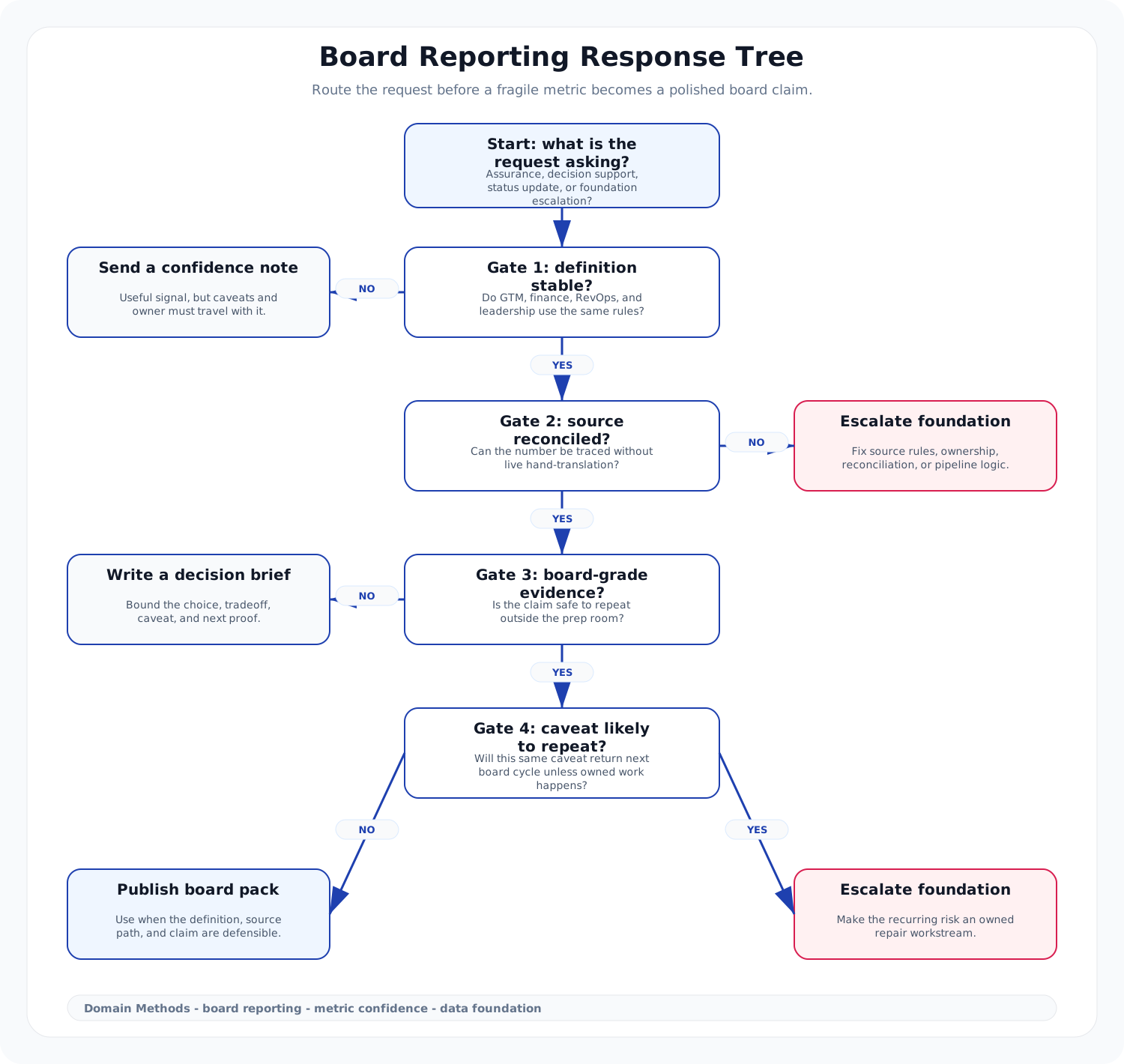
The tree asks five questions:
- What is the request asking the metric to support? Board assurance, a decision, a status update, or an operating escalation?
- Is the definition stable across teams? If not, the response should include a confidence note or alignment work before board-grade claims.
- Can the number be reconciled to source systems without live translation? If not, do not hide the handwork behind a polished board slide.
- What is the evidence level? Directional, decision-grade, board-grade, or cleanup-first?
- Will the caveat repeat unless the foundation gets fixed? If yes, the issue needs an escalation path, not another one-off explanation.
The purpose is not to slow the business down. It is to stop the team from using board pressure as a reason to promote a number faster than its trust level.
When the answer is a board pack
Use a board pack when the claim is stable enough to survive outside the prep room.
That means:
- the metric definition is documented and agreed across the teams that will defend it
- source-system reconciliation is not dependent on one person hand-translating exceptions
- known exclusions are either immaterial or named clearly
- the claim is safe enough to be repeated later without walking it back
- the board needs assurance, not just operating context
A board pack does not require perfect data. It does require a defensible relationship between the claim, the definition, the source path, and the decision being implied.
For example, a board-ready pipeline-health slide can say that enterprise pipeline coverage is down if the team agrees what counts as enterprise pipeline, how stage timing is handled, what exclusions apply, and which source wins when CRM and warehouse models disagree. Without that agreement, the same slide becomes a confidence problem wearing a board-pack costume.
A useful board pack should make the board conversation faster. If the artifact invites a live definition debate, it was probably promoted too early.
When the answer is a confidence note
Use a confidence note when the signal matters but the caveat must travel with it.
This is the underrated option.
A confidence note is not a legal disclaimer. It is a short operating statement that says:
- what the metric is useful for right now
- what it should not be used for yet
- what caveat could change the interpretation
- who owns the next proof
- when the confidence level will be revisited
That can live in the board prep notes, the executive pre-read, or the appendix. The point is to keep uncertainty visible in business language.
Bad caveat:
Pipeline source values include historical nulls and nonstandard campaign mappings.
Better confidence note:
This pipeline trend is useful for reading directional softness in paid acquisition, but it should not be used to reset budget yet because a portion of high-intent opportunities still lacks original-source history. RevOps owns the source cleanup before the next forecast review.
The second version constrains behavior. It tells leadership what the metric can do, what it cannot do, and what work would make it stronger.
That is often more honest than forcing the number into the board pack or hiding it until it is perfect.
When the answer is a decision brief
Use a decision brief when leadership needs to choose a move before every reporting weakness is fixed.
A decision brief is narrower than a board pack. It should say:
- what decision is being made
- what evidence is strong enough to rely on
- what evidence is directional
- what tradeoff leadership is accepting
- what follow-up proof or cleanup is required
This is the right response when the team has enough evidence to act, but not enough confidence to turn the metric into a broad board-grade claim.
For example, the team may have enough evidence to pause spend in one campaign family while attribution cleanup continues. That does not mean the whole attribution model is board-grade. It means the decision is bounded enough that the available evidence can support it.
The operator tradeoff is important: waiting for board-grade evidence can be too slow, but using decision-grade evidence as if it were board-grade creates future credibility debt. A decision brief lets the team move while naming the boundary.
When the answer is a data-foundation escalation
Escalate the foundation problem when the same caveat is likely to return.
This is the moment to be honest. If every board cycle requires manual reconciliation, if the same source-system conflict keeps showing up, or if the confidence note never gets upgraded, the issue is no longer a one-off reporting caveat.
It is an operating risk.
Common escalation signals:
| Signal | What it usually means | Better next move |
|---|---|---|
| One person must explain the number live every time | The reporting logic is not trusted without translation | Document source rules and fallback authority |
| Finance and RevOps reconcile the same metric before each board meeting | Definitions or system-of-record rules are unstable | Run metric-alignment work before the next packet |
| Caveats repeat with no owner | Uncertainty is being managed rhetorically, not operationally | Assign owner, next proof, and review date |
| The board claim depends on spreadsheet patchwork | Source path is not durable enough for repeated use | Fix the foundation before reusing the claim |
| The team keeps adding slides to explain one number | The artifact is compensating for weak trust | Narrow the metric family and repair the failure layer |
This is where Data Foundation belongs. Not because every board question needs a warehouse project. Because some board questions expose reporting infrastructure that is not reliable enough for the job leadership is assigning to it.
The right escalation should be specific: fix original-source capture, document the revenue definition, set a system-of-record rule, reconcile CRM and finance timing, or assign ownership for a metric family. “Improve data quality” is too vague to fund or manage.
A simple operating sequence for the next board request
Use this sequence before a fragile metric turns into a polished slide.
- Write the request in plain English. What is leadership asking this metric to support: assurance, a decision, a status update, or escalation?
- Name the metric family and owner. Pipeline, ARR, bookings, CAC, attribution, retention, margin, or another metric family. Then name who has authority over the definition.
- Check definition stability. If teams use different rules, do not call the metric board-grade yet.
- Check source reconciliation. If the number depends on manual translation, say so before the board artifact is chosen.
- Label confidence. Use directional, decision-grade, board-grade, or cleanup-first language.
- Choose the response. Board pack, confidence note, decision brief, or data-foundation escalation.
- Write the next proof. What would make the metric safer by the next board cycle?
Board Reporting Response Worksheet
Use this lightweight worksheet to route the next board-reporting request into a board pack, confidence note, decision brief, or data-foundation escalation before the slide gets polished.
Instant download. No email required.
Want future posts like this in your inbox?
This form signs you up for the newsletter. It does not unlock the download above.
The best response may be less polished and more useful
The temptation in board prep is to make the artifact look more certain than the operating reality.
That is backwards.
The board does not need every uncertainty removed. It needs to know which claims are safe, which signals are useful but caveated, which decisions can move now, and which reporting problems need executive air cover to fix.
A board pack is powerful when the claim is ready. A confidence note is useful when the signal matters but the limits still matter too. A decision brief helps leadership move without pretending the evidence is stronger than it is. A data-foundation escalation turns recurring caveats into owned work.
If the request keeps exposing metric conflict across marketing, RevOps, finance, and leadership, start with Three Teams, Three Numbers. If the same caveat keeps returning because source logic, ownership, or reconciliation rules are brittle, start with Data Foundation.
Either way, do not let the board deadline decide the confidence level for you.
Download the Board Reporting Response Worksheet (PDF)
A lightweight checklist for deciding whether a board request should become a board pack, confidence note, decision brief, or data-foundation escalation.
DownloadIf the board request exposes cross-team metric conflict
Three Teams, Three Numbers
Use the diagnostic when marketing, finance, RevOps, and leadership can each defend a number but cannot agree which version the business should use.
See the metric-alignment diagnosticIf the reporting request exposes brittle source logic
Data Foundation
Use this when the same board-reporting caveat keeps returning because definitions, ownership, warehouse logic, or source-system rules are not stable enough.
See Data FoundationSee It in Action
Common questions about board-reporting response paths
What is a board-reporting response tree?
When should a request become a board pack?
When is a confidence note better than another slide?
When should the answer be a data-foundation escalation?

About the author
Jason B. Hart
Founder & Principal Consultant
Helps mid-size SaaS companies turn messy marketing and revenue data into decisions leaders trust.