Shopify Reporting vs Finance Reporting vs a Warehouse Profitability Model
- Jason B. Hart
- Marketing Analytics
- April 22, 2026
- Updated May 15, 2026
Table of Contents
Which ecommerce reporting layer should you actually trust?
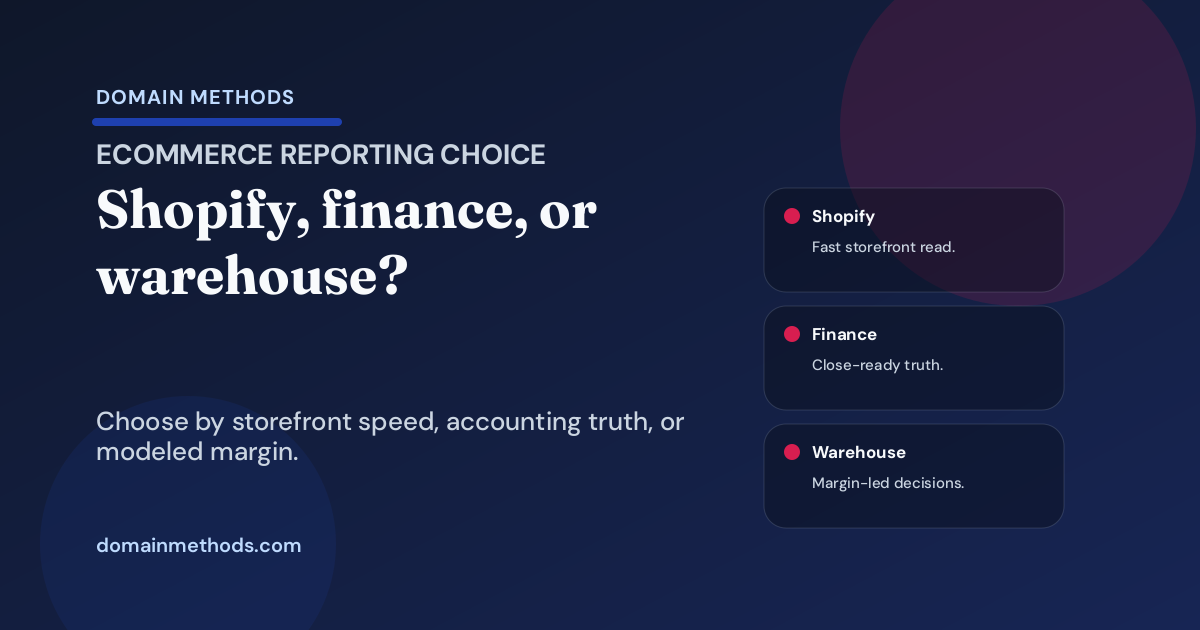
Trust the narrowest layer that can answer the real decision without hiding the economics that matter. Shopify reporting is great for storefront speed. Finance reporting is right for accounting truth. A warehouse profitability model is where you go when the decision depends on channel, product, return, and margin logic living together in one repeatable view.
That is the clean answer.
The messy reality is that ecommerce teams often ask one reporting layer to do all three jobs.
Shopify becomes the daily scorecard, the board story, and the profitability model. Finance becomes the tie-breaker for channel debates it was never built to settle. A warehouse gets treated like the answer before anyone agrees which costs, returns, or timing rules it is supposed to carry.
That is how the room ends up arguing about reports instead of decisions.
This piece sits next to The Ecommerce Profitability Stack and the SaaS-oriented system-of-record comparison, Native CRM Reporting vs Warehouse Reporting vs Spreadsheet Patchwork. Those guides cover the profitability layers themselves and the broader reporting-location debate for SaaS teams. This one answers a narrower ecommerce operator question: which reporting layer should own which decision when Shopify, finance, and modeled margin views do not say the same thing?
Why this choice keeps showing up late
Most teams do not start by asking whether Shopify, finance, or a warehouse should own the answer.
They start with a symptom:
- Shopify says sales are moving, but finance is not ready to celebrate
- finance says gross margin is fine, but channel performance still feels wrong
- marketing wants to scale spend, but returns and discounting keep changing the story later
- the warehouse team has a more complete model, but nobody knows when to trust it over the simpler reports people already use
That is not one reporting problem.
It is three different standards of truth colliding in the same meeting.
One operator-level tell matters here: the real fight is usually about which layer gets to answer the next hard question. If the room is about to ask, “Should we increase spend on this channel?” then storefront revenue alone is probably too thin. If the room is closing the month, a modeled contribution view is helpful context but not the accounting source of truth. If the room is choosing which products deserve more paid support despite returns and fulfillment drag, Shopify and finance each hold part of the story, but neither can carry the whole decision alone.
The three reporting layers in plain English
Shopify reporting
Shopify reporting is the storefront-speed layer.
It is strong when the team needs fast answers about:
- orders and top-line revenue movement
- product velocity
- discount behavior
- store conversion patterns
- near-real-time commercial visibility
Its biggest strength is speed and familiarity.
Its biggest risk is that it looks more decision-complete than it really is. Shopify can tell you what happened in the store. It does not automatically tell you whether the order was profitable after acquisition cost, fulfillment drag, returns, and finance treatment show up.
Finance reporting
Finance reporting is the accounting-truth layer.
It is strong when the question is about:
- reconciliation
- close discipline
- recognized revenue or booked outcomes
- cash and accounting treatment
- what the business is formally prepared to stand behind
Its biggest strength is rigor.
Its biggest risk is that operators start asking it to answer commercial optimization questions it was never built to answer quickly. Finance can tell you whether the number closes cleanly. It usually cannot tell you fast enough which channel, product mix, or campaign behavior should change next week.
Warehouse profitability model
A warehouse profitability model is the decision-support layer.
It is strong when the answer depends on connecting:
- Shopify orders and product behavior
- ad-platform or lifecycle spend
- fulfillment and shipping cost
- returns and refunds
- finance adjustments or accounting guardrails
- contribution logic by channel, product, or cohort
Its biggest strength is that it can hold the economic story together in one repeatable place.
Its biggest risk is overbuilding before the team settles the underlying rules. A warehouse does not rescue fuzzy return treatment, unowned cost inputs, or constant definition changes. It just stores them more professionally.
Shopify reporting vs finance reporting vs warehouse profitability model at a glance
| Layer | Best for | Trust profile | Speed | Common failure mode | Gets dangerous when |
|---|---|---|---|---|---|
| Shopify reporting | Daily commercial visibility, product movement, storefront trend checks | Useful for storefront truth, weak for full economics | Fastest | Teams mistake revenue movement for healthy margin movement | leadership uses it to settle profit, channel, or board-grade questions |
| Finance reporting | Reconciliation, accounting truth, close-ready reporting | Strongest for formal financial truth | Slow to medium | Teams expect it to answer marketing and merchandising questions in operating cadence | operators wait on finance to answer decisions that need modeled commercial context |
| Warehouse profitability model | Channel, product, and margin decisions that need multiple systems together | Highest ceiling for decision-grade economics when rules are clear | Medium | Teams model too much before cost ownership and definition rules are stable | the model becomes impressive but politically untrusted or impossible to maintain |
That table usually settles the first debate.
The harder one is deciding which layer should own specific decisions.
Use Shopify reporting when the question is commercial and short-horizon
Shopify should lead when the team is trying to answer a storefront question, not an economics question.
Good fits:
- Which products are moving right now?
- Did yesterday’s promotion change order volume?
- Which collection or campaign is creating visible demand movement?
- Are conversion rate or average order value moving in the direction we expected?
This is where Shopify earns its keep. It is the fastest clean answer when the business needs commercial visibility before it needs deeper economics.
The mistake is stretching that answer too far.
If the channel looks strong in Shopify, that still does not tell you whether the customer was expensive to win, whether returns will erase part of the gain, or whether a high-volume product is dragging margin once fulfillment friction is counted. That is why How to Calculate True Customer Acquisition Cost and The Ecommerce Profitability Stack matter: they pick up right where storefront reporting starts running out of truth.
A practical operator test: if one person in the room immediately says, “Yes, but what happened after shipping, returns, and ad cost?” then the decision has probably outgrown Shopify-only reporting.
Use finance reporting when the question is formal truth, not commercial speed
Finance should lead when the business needs the answer it can formally reconcile and defend.
Good fits:
- What can we actually recognize and close?
- Which revenue or margin view belongs in formal reporting?
- What should the CFO trust when a monthly number is challenged?
- Which treatment survives accounting scrutiny?
Finance reporting is the right anchor when the discussion is about what the business can stand behind in a formal context.
But finance is not the right tool for everything just because it sounds safer.
If the head of growth is trying to decide which channel to push next month, finance often moves too slowly and too coarsely. It is built to protect accounting truth, not to function as a daily optimization cockpit. The room still needs the commercial and modeled context around what finance confirms.
One operator-level mistake shows up a lot here: teams use finance as the veto layer for every uncomfortable ecommerce question. That creates discipline, but it can also create delay. A team that waits for close-ready truth before making every merchandising or spend decision will miss the operating window that mattered.
Use a warehouse profitability model when the decision depends on economics across systems
A warehouse model should lead when the room is no longer asking, “What happened in Shopify?” or “What can finance close?” and is instead asking, “What should we do next based on the full economic picture?”
Good fits:
- Which channels produce profitable growth after real cost and return behavior?
- Which products look healthy in revenue and weak in contribution?
- Which cohorts deserve more spend once refunds and fulfillment drag are counted?
- Which promotional patterns create vanity growth and weak margin?
This is where a modeled layer earns its keep.
The warehouse is not just a storage choice here. It is the place where the business can repeatedly connect order data, cost logic, return timing, and finance guardrails without rebuilding the argument in a spreadsheet every week.
A good warehouse profitability model should help the team answer questions like:
- did the launch still look good after returns hit?
- did the paid channel still win after blended CAC and fulfillment cost?
- are we optimizing for orders or for healthy contribution?
- which metric is still directional versus decision-grade?
If that conversation is still happening in side sheets and Slack threads, the model does not need to be perfect before it needs to exist. It just needs to be honest enough to change the next decision.
The decision-by-decision view
The cleanest way to choose a reporting layer is to map it to the decision, not to the team that speaks loudest.
| Decision | Best lead layer | Why |
|---|---|---|
| Daily revenue and conversion pulse | Shopify reporting | The team needs storefront speed, not a full economics model |
| Month-end or close-ready truth | Finance reporting | Accounting discipline matters more than speed |
| Channel budget shifts based on real profitability | Warehouse profitability model | Ad spend, returns, and contribution need to live together |
| Product or merchandising prioritization | Warehouse profitability model | Revenue alone hides shipping, discounts, and return behavior |
| Short-term promo monitoring | Shopify reporting, with later warehouse review | Shopify gives the early read, but the margin verdict often arrives later |
| Formal board or lender reporting | Finance reporting, informed by modeled context | Formal truth has to anchor the room, even if the warehouse explains what changed |
That split sounds obvious when written down.
It is less obvious when one dashboard is already built and everyone wants it to do one more job.
When none of the three layers is enough yet
Sometimes the right answer is none of them.
That happens when the team still has unresolved inputs or rules such as:
- contribution logic nobody has signed off on
- return treatment that shifts depending on who is presenting
- fulfillment cost that is still too delayed or too aggregated to use safely
- discounting, shipping, or product-cost rules that have no owner
- one number that changes meaning between marketing, operations, finance, and leadership
At that point, the reporting-layer debate is downstream of a clearer problem.
You do not have a Shopify-versus-finance-versus-warehouse question first. You have an ownership, definition, or data-foundation question first.
That is why this article should sit next to What Should You Fix First: Definitions, Source Data, or Dashboards? and How to Tell Whether You Have a Tools Problem or a Foundation Problem. If the room cannot even agree what cost, return, or timing rule belongs in the answer, choosing the reporting layer is premature.
A practical scorecard for the next working session
If the team needs to settle this in one meeting, score each layer against five questions:
- How fast does the answer need to be useful?
- How much economics beyond revenue does the answer need to carry?
- Does the room need accounting truth, operating truth, or both?
- How repeatable does the answer need to be next month?
- What breaks if we trust the wrong layer too early?
Score Shopify higher when:
- speed matters more than complete economics
- the question is mostly storefront behavior
- the team is choosing where to look first, not making a high-stakes margin call
- the answer will be revisited later with deeper cost logic
Score finance higher when:
- the business needs a formally defensible answer
- the discussion is about reconciliation, accounting treatment, or close discipline
- the room needs the number it can stand behind publicly or formally
- the cost of over-speed is higher than the cost of waiting
Score the warehouse model higher when:
- the decision depends on channel, product, return, and cost interactions
- the room needs one repeatable profitability view across systems
- the business keeps recreating the same reconciliation logic manually
- leadership is making budget or merchandising choices that revenue-only views routinely distort
Download the scorecard
Use this worksheet in the next ecommerce review where Shopify, finance, and modeled margin views are all competing to become the “real” answer.
Download the Ecommerce Reporting Layer Scorecard (PDF)
A lightweight scorecard for deciding which questions should live in Shopify reporting, finance reporting, or a warehouse profitability model. Use it to score speed, economics, trust profile, and failure risk before the next margin debate turns into opinion trading.
Instant download. No email required.
Want future posts like this in your inbox?
This form signs you up for the newsletter. It does not unlock the download above.
Bottom line
Shopify, finance, and a warehouse model are not rivals in the abstract.
They are different tools for different kinds of truth.
Use Shopify for storefront speed. Use finance for accounting truth. Use the warehouse when the business needs a repeatable economic answer that spans channel, product, returns, fulfillment, and contribution logic.
If your team still cannot see which decisions are making money and which ones only look good in the easiest report, start with Show Me the Margin.
If the real problem is that no layer can survive repeated scrutiny because the inputs and logic are still brittle, the next move is Data Foundation.
Download the Ecommerce Reporting Layer Scorecard (PDF)
A practical worksheet for scoring which decisions should live in Shopify reporting, finance reporting, or a warehouse profitability model before another margin debate turns into opinion trading.
DownloadIf revenue looks fine until margin, returns, and channel economics enter the conversation
Show Me the Margin
Use the profitability diagnostic when Shopify, ad-platform, and finance reporting all sound plausible but the business still cannot see which channels and products actually create healthy growth.
See the profitability diagnosticIf this comparison exposes a broader systems-of-record or modeling problem
Data Foundation
Use Data Foundation when the business question is clear but costs, returns, joins, and reporting logic still cannot survive repeated scrutiny.
See Data FoundationSee It in Action
Common questions about Shopify reporting, finance reporting, and warehouse profitability models
When is Shopify reporting good enough on its own?
When should finance reporting win the argument?
Why build a warehouse profitability model instead of just combining spreadsheets?
What if none of the three layers is trustworthy yet?

About the author
Jason B. Hart
Founder & Principal Consultant
Helps mid-size SaaS companies turn messy marketing and revenue data into decisions leaders trust.