Salesforce Data Cloud vs Reverse ETL: Should the CRM Become the Customer Data Layer?
- Jason B. Hart
- Data Activation
- May 24, 2026
- Updated June 17, 2026
Table of Contents
The quick answer: choose based on operating ownership, not the logo
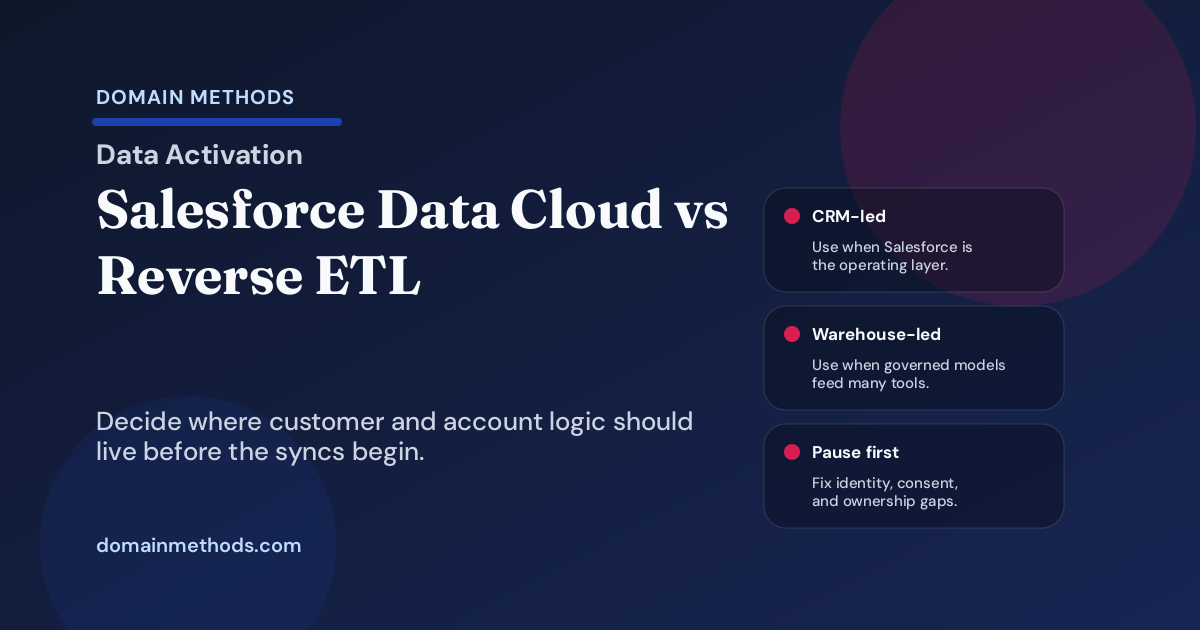
Salesforce Data Cloud can be the right answer when Salesforce is already the operating center of the customer relationship and business users need Salesforce-native activation. Reverse ETL is usually the cleaner answer when the warehouse is the trusted logic layer and Salesforce is one destination among several.
The wrong answer is choosing either one before the team can say who owns the customer logic after the demo is over.
That is the part I see teams skip. A mid-size SaaS company wants better activation, better personalization, better AI, or better account scoring. The vendor conversation turns into a category debate: CDP, Data Cloud, reverse ETL, warehouse-native, composable, platform, automation. Meanwhile nobody has decided which system is allowed to define account status, lifecycle stage, consent, suppression, product usage, or expansion eligibility.
If those rules are not owned, the architecture does not matter yet. You are just deciding which system will sync the confusion faster.
This guide is for Salesforce-heavy SaaS teams deciding whether the CRM should become the customer data layer, whether the warehouse should keep that role, or whether the team needs to fix the operating contract before buying another layer.
Use this alongside the Data Activation Playbook when the real decision is how trusted warehouse logic should reach CRM, lifecycle, sales, customer-success, or AI workflows safely.
Define the options in plain English
Most evaluations get noisy because the same words mean different things in each room. Use working definitions before the shortlist starts.
| Option | Plain-English definition | Best fit | Common risk |
|---|---|---|---|
| Salesforce Data Cloud | A Salesforce-centered customer data layer for profile unification, segmentation, activation, and Salesforce-native workflow support | GTM teams where Salesforce is the operating center and business users need Salesforce-native customer context | Salesforce becomes a second source of truth when warehouse and CRM definitions do not match |
| Reverse ETL / data activation platform | A sync layer that moves governed warehouse models into CRM, lifecycle, ad, product, support, or AI systems | Teams where the warehouse/dbt layer already holds trusted customer, account, lifecycle, and product logic | It gets treated as “just syncs” even though downstream teams rely on the fields |
| Warehouse-native or custom activation | Internal jobs, APIs, warehouse-native features, or product services move modeled data into workflows | Teams with unusual workflows, strict control needs, or product/platform ownership | The team owns reliability, retries, schema drift, monitoring, and support |
| CDP-led activation | A customer-profile and audience layer handles collection, identity, segmentation, consent, and activation | Marketing or lifecycle teams that need profile collection and audience operations | The CDP becomes another place to recreate disputed definitions |
The category is less important than the ownership model. If Salesforce owns the customer layer, Salesforce needs the authority and controls to do that job. If the warehouse owns the customer layer, reverse ETL needs a real operating contract with RevOps, marketing ops, lifecycle, and CS. If neither layer is trusted, the next move is foundation work, not another activation product.
Salesforce Data Cloud vs reverse ETL comparison
Use this table to move the decision out of vendor language and into operating risk. If the team is asking “reverse ETL vs Salesforce Data Cloud,” start with the ownership column, not the feature list. A Salesforce-heavy team can still choose reverse ETL when the warehouse is where definitions are tested, and a warehouse-heavy team can still choose Salesforce Data Cloud when the customer workflow is truly governed in Salesforce.
| Decision lens | Salesforce Data Cloud | Reverse ETL / data activation | Warehouse-native/custom activation | CDP-led activation |
|---|---|---|---|---|
| Where customer/account logic lives | Inside or very near the Salesforce operating model | In warehouse/dbt models, then synced out | In warehouse, internal services, or product/platform code | In a customer-profile/audience platform |
| Who owns identity and matching | Salesforce admins, RevOps, CRM architecture, sometimes data | Data/analytics engineering with RevOps input | Data engineering, platform, product engineering | Marketing ops/lifecycle with data and privacy support |
| How warehouse/dbt logic is reused | Imported or reconciled into Salesforce’s data model | Reused directly from governed models | Reused directly, but custom delivery logic is owned internally | Often copied, mapped, or partially recreated unless tightly governed |
| Business self-serve needs | Strong when users live in Salesforce and need native segmentation/activation | Moderate; business users usually need governed fields and workflow agreements | Low unless internal tooling is built | Strong for marketer-managed audiences and journeys |
| Governance, consent, and suppression | Works when Salesforce is the real governance surface | Works when warehouse rules and destination mappings are owned | Strongest control, highest burden | Strong when consent/profile rules are configured and audited |
| Destination breadth | Strong across Salesforce ecosystem; broader destinations depend on architecture | Strong when the same model must reach many GTM/product systems | As broad as the internal team is willing to build and support | Strong for marketing/lifecycle destinations |
| Maintenance burden | Salesforce data model, admin governance, profile rules, integrations, business-user controls | Model quality, sync monitoring, mapping changes, destination QA, field ownership | Connectors, retries, alerting, security, schema drift, docs, support | Event collection, taxonomy, identity rules, consent, destinations, audience QA |
| Failure mode | CRM users trust a unified profile that is not actually governed across systems | Bad warehouse fields reach every downstream team because nobody owns launch gates | A custom pipeline becomes invisible infrastructure held together by one person | Marketing gets a powerful audience tool that bypasses revenue definitions |
The winner is not the option with the most complete platform diagram. The winner is the option your team can operate when a field is wrong on a Tuesday morning and the campaign, sales route, CS alert, or AI recommendation is already live.
When Salesforce Data Cloud fits
Salesforce Data Cloud fits when Salesforce is not just a destination. It is the place where customer work actually happens.
That can be true for sales-led SaaS teams with mature CRM operations. It can also be true when RevOps has enough authority to make Salesforce the governed customer operating surface for sales, marketing, customer success, and partner workflows. In that case, keeping profile logic near Salesforce can reduce handoffs and make business users faster.
The fit is strongest when:
- Salesforce is the operating center for customer and account work, not merely a reporting endpoint.
- Identity and profile questions are CRM-centric: account hierarchy, contacts, leads, opportunities, activities, renewals, and ownership rules.
- Business users need Salesforce-native segments, actions, or workflow context without waiting on every warehouse change.
- Governance, consent, suppression, and field-change approvals can realistically be enforced inside the Salesforce operating model.
- The team has Salesforce administration and RevOps capacity to maintain the layer after implementation.
The lived-in warning sign is account ownership. If two reps can argue over which account owns a contact, or whether the customer is expansion-ready, and there is no clear resolver, Data Cloud will not solve the argument by existing. It may make the disagreement more visible and more expensive.
Salesforce Data Cloud is an operating-layer choice. Treat it that way. If the team wants it only because AI demos look better with a unified profile, route the conversation through an AI-Ready Data Diagnostic first. AI does not need more profile fields. It needs profile fields the business would trust in a real workflow.
When reverse ETL fits
Reverse ETL fits when the warehouse is already the best place to define customer, account, product, lifecycle, and revenue logic.
That is common in SaaS teams where the business already uses modeled warehouse data for board reporting, product analytics, customer health, attribution, or funnel measurement. If dbt or another modeling layer is where definitions get tested and reviewed, it is usually dangerous to recreate that logic inside Salesforce just because the activation happens there.
Reverse ETL is the better fit when:
- Warehouse models already contain trusted customer/account/lifecycle fields.
- The same fields, scores, or audiences need to reach multiple destinations, not just Salesforce.
- The data team needs to keep control over definitions, tests, lineage, and freshness.
- RevOps and marketing ops can define destination mappings and field ownership with data.
- Salesforce is one activation surface, while HubSpot, Braze, ad platforms, product surfaces, support tools, or AI workflows also need the same governed logic.
The trap is calling reverse ETL “just a sync.” The minute a synced field changes sales routing, lifecycle messaging, renewal intervention, or AI recommendation, it becomes production workflow infrastructure. Someone owns freshness. Someone owns null handling. Someone owns rollback. Someone owns the uncomfortable meeting when the wrong accounts were touched.
If you are in this camp, read the reverse ETL tools comparison and the dbt and reverse ETL guide before turning the architecture into a Salesforce-only debate.
Download the Data Activation Architecture Scorecard
Compare Salesforce-led, reverse-ETL-led, CDP-led, and warehouse-native activation against ownership, readiness, destination scope, and operating risk.
Instant download. No email required.
Want future posts like this in your inbox?
This form signs you up for the newsletter. It does not unlock the download above.
When the warehouse or CDP should lead instead
Some teams should not force the decision into Salesforce Data Cloud vs reverse ETL.
A warehouse-native or custom activation path can be justified when the workflow is product-led, highly controlled, or unusual enough that generic destination syncs create more risk than speed. Think in-app eligibility, embedded product experiences, strict audit requirements, or internal operational services where the business depends on exact behavior.
That path is not cheaper just because it avoids a vendor. The team owns retries, observability, schema drift, documentation, access control, and support. It is a good answer only when the workflow value and control needs justify the operating burden.
A CDP-led path can be the better answer when collection, identity stitching, consent-aware audience operations, and marketer-friendly segmentation are the missing layer. That is especially true for lifecycle programs that need web/app behavior and audience tooling more than warehouse-governed account fields.
But a CDP should not become the place where disputed revenue, lifecycle, or account definitions quietly get recreated because the warehouse/CRM conversation is hard. If the same definition lives in the CDP, Salesforce, and dbt with three owners, the customer data layer is not unified. It is just better branded.
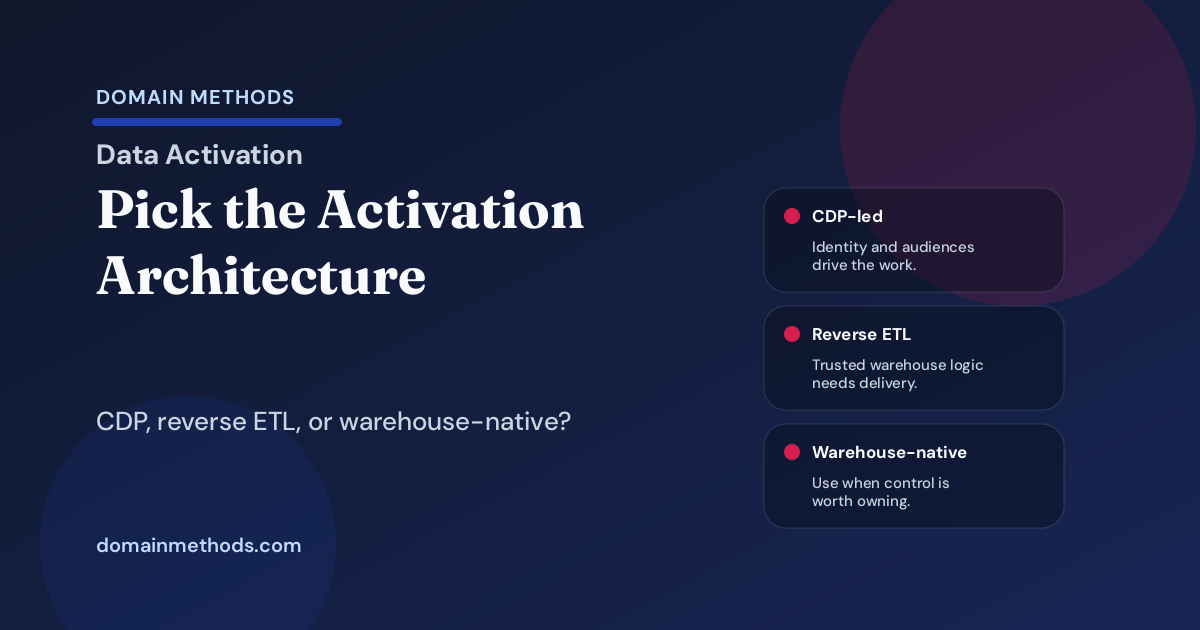
The broader CDP vs reverse ETL vs warehouse-native activation guide is useful if the team is still choosing the overall architecture pattern rather than the Salesforce-specific operating model.
When to pause before buying anything
Sometimes the best architecture decision is “not yet.”
Pause when any of these are true:
| Pause signal | Why it matters | Better next move |
|---|---|---|
| Account/contact matching is messy | Salesforce, warehouse, and marketing systems will assign different customer context to the same person or company | Fix identity and account hierarchy rules through Data Foundation |
| Field ownership is unclear | Nobody knows who can change lifecycle stage, health score, ICP fit, product usage, or suppression fields | Create a field ownership contract before syncing downstream |
| Lifecycle or revenue definitions are contested | Activation will expose unresolved disagreement to sales, marketing, CS, and leadership | Run the definition cleanup before the tool rollout |
| Consent and suppression rules are incomplete | The workflow can create unsafe outreach, duplicated touches, or customer trust damage | Define suppression before activation launch |
| AI use case lacks review thresholds | The team cannot say what AI may suggest, assist, route, or act on | Use the AI-Ready Data Diagnostic to test workflow safety |
| Destination owners cannot monitor failures | A bad sync will keep running because no one owns alerts, rollback, or incident response | Build the activation operating contract first |
A practical operator test: if you would not let a human rep, CSM, or lifecycle marketer use the field without Slack caveats, do not let an automated workflow or AI layer use it at scale.
Practical decision tree
Use these buyer questions before the architecture meeting turns into a feature checklist.
- What exact workflow will change in the next 90 days: sales route, lifecycle audience, customer health action, expansion play, support escalation, or AI recommendation?
- Which system currently has the most trusted version of the customer/account logic needed for that workflow?
- Is Salesforce the operating center for the workflow, or is Salesforce one of several destinations?
- Who can approve changes to the fields or segments after launch?
- Who owns identity matching, account hierarchy, duplicate handling, and person-to-account rules?
- What suppression rules prevent bad outreach, unsafe personalization, duplicate work, or customer trust damage?
- How fresh does the field need to be for the workflow to be safe?
- What happens when the field is missing, stale, or contested?
- Which team gets the alert when a sync fails or a destination rejects records?
- What proof would make this workflow safe enough for AI assistance or automation?
Here is the simplest decision rule:
| If this is true | Lean this way |
|---|---|
| Salesforce is the customer operating layer and business users need native activation | Salesforce Data Cloud |
| Warehouse/dbt logic is trusted and multiple destinations need the same fields | Reverse ETL / data activation platform |
| The workflow is product-led, high-control, or too specific for vendor connectors | Warehouse-native/custom activation |
| Collection, identity, consent, and audience management are the main gaps | CDP-led activation |
| Definitions, identity, consent, or ownership are not trusted | Foundation work before activation |
| The use case exists mainly because of AI or personalization pressure | AI readiness workflow test before launch |
The tool choice should be the last mile of the operating decision, not the first slide of the project.
How Domain Methods would route the work
If the profile, model, or workflow is already trusted and the team needs to push it into GTM systems, start with Data Activation. That is the right path when the operating question is delivery, QA, ownership, and launch readiness.
If Salesforce and the warehouse disagree on account identity, lifecycle stage, source precedence, or revenue definitions, start with Data Foundation. Activation will not make a contested model safer. It will only give it a bigger blast radius.
If the buying pressure is coming from AI, personalization, next-best action, or automated routing, start with AI-Ready Data Diagnostic. The question is not whether a Customer 360 exists. It is whether the customer profile can survive the workflow it is about to influence.
For related reading, the strongest next pieces are the CRM Workflow Reliability Benchmark, the activation data contract guide, and the CRM field ownership checklist. Those are the operating controls that make the architecture choice real.
Final thought
Salesforce Data Cloud vs reverse ETL is not really a software category argument. It is a decision about where customer truth is allowed to live, who can change it, and how much downstream risk the team is ready to own.
If Salesforce is the true operating center, Data Cloud can be a serious option. If the warehouse is the trusted logic layer, reverse ETL may be the cleaner route. If neither layer is trusted, the most mature move is to pause and fix the contract before turning on another sync.
That is less exciting than a platform demo. It is also how you keep activation from becoming a very efficient way to spread bad data.
Download the Data Activation Architecture Scorecard (PDF)
Use the scorecard to compare Salesforce-led, reverse-ETL-led, CDP-led, and warehouse-native activation against ownership, readiness, and operating risk.
DownloadReady to operationalize the decision?
Data Activation
Use Data Activation when the team knows the workflow and needs trusted customer or account data delivered into CRM, lifecycle, ad, product, or AI systems.
See Data ActivationDefinitions still contested?
Data Foundation
Use Data Foundation when account identity, lifecycle stage, source precedence, or warehouse/CRM logic is not trusted enough to expose downstream.
See Data FoundationSee It in Action
Common questions about reverse ETL and Salesforce Data Cloud
How should SaaS teams compare reverse ETL vs Salesforce Data Cloud?
When should Salesforce become the customer data layer?
When is reverse ETL a better fit than Salesforce Data Cloud?
What should a SaaS team fix before choosing either option?

About the author
Jason B. Hart
Founder & Principal Consultant
Helps mid-size SaaS companies turn messy marketing and revenue data into decisions leaders trust.