The Sales Capacity Confidence Check: Is Your Headcount Plan Safe Enough for Hiring, Quota, and Board Decisions?
- Jason B. Hart
- Revenue Operations
- April 27, 2026
Table of Contents
What is the sales capacity confidence check?
The Sales Capacity Confidence Check is a practical way to decide whether a capacity plan is trustworthy enough for the hiring, quota, territory, forecast, or board decision attached to it.
Sales capacity looks precise in a planning spreadsheet. Count the reps. Apply ramp. Multiply by quota or productivity. Adjust for attrition. Compare capacity to the revenue target.
Then the operating meeting starts.
Sales says the new reps will not be productive until later than the model assumes. Finance says the hiring dates moved. RevOps says the territory and account-ownership rules changed. Marketing says pipeline coverage does not support the capacity target. The data team sees rep role, segment, and ramp fields changing after the fact.
The problem is not arithmetic. It is assumption confidence.
A capacity plan can be directionally useful before it is board-grade. It can show that the target is under-covered, that hiring needs to happen earlier, or that a segment is carrying too much pressure. But it should not drive hiring commitments, quota deployment, territory coverage, compensation exposure, or board-facing revenue expectations until the assumptions behind it match the consequence of the decision.
Why capacity planning turns into a revenue argument
Sales capacity sits where headcount, quota, pipeline, territory design, ramp, attrition, finance planning, and CRM reality all meet.
Every team has a reasonable concern:
- Sales wants the plan to reflect real ramp, manager capacity, segment mix, and rep productivity.
- Finance wants bookings capacity, hiring timing, attrition, and expense exposure to tie to the operating plan.
- RevOps wants quota, territory, coverage, and account ownership to be explicit before the model becomes a target.
- Marketing wants demand assumptions to match the pipeline the sales team is expected to work.
- Data and analytics want the source fields to stop changing after the model is already in circulation.
The operator-level detail that usually exposes the weakness is ramp date discipline. A rep starts on paper, gets a territory two weeks later, receives accounts a month after that, and is measured against a quota that assumes productive capacity sooner than the operating system can actually support.
That is how a clean spreadsheet becomes an expensive leadership surprise.
Start with the decision, not the capacity number
Do not start by debating whether the capacity model is “right.” Start by naming what leaders want the model to decide.
| Decision | What leaders usually need | Minimum confidence bar |
|---|---|---|
| Early planning discussion | A rough sense of whether the target is under-covered | Directional may be enough if assumptions are visible |
| Sales hiring approval | A dependable view of timing, ramp, coverage, and productivity | Planning-grade |
| Quota deployment | Stable quota capacity by role, segment, and territory | Planning-grade, with clear caveats |
| Territory or account coverage | Confidence that ownership, segment rules, and account counts are usable | Planning-grade |
| Board forecast or annual plan | A capacity story that survives questions about hiring, ramp, attrition, and quota | Board-grade |
| Data-foundation escalation | Evidence that the plan cannot support decisions until source logic is fixed | Directional evidence is enough to justify repair |
This keeps a familiar mistake from happening: a model built to expose planning risk gets promoted into a board commitment because the spreadsheet looked polished.
The useful question is not, “Do we have enough capacity?”
The better question is: what is this capacity plan allowed to decide right now?
The eight checks that matter most
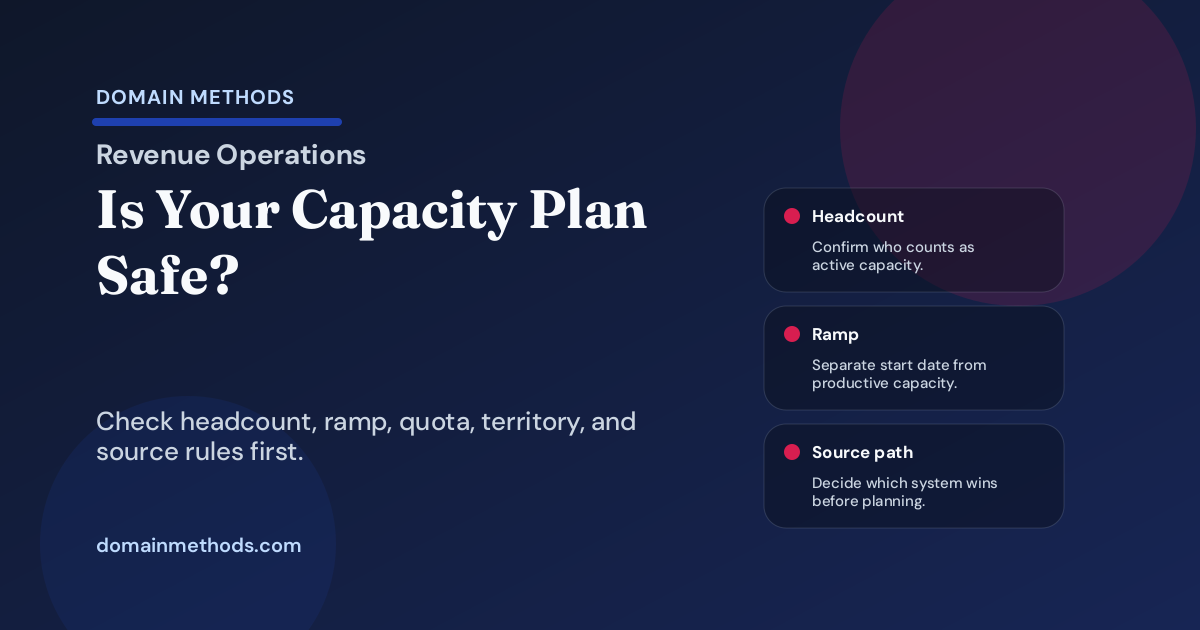
I would check eight controls before treating a sales capacity plan as planning-grade or board-grade.
| Check | What to inspect | What weak confidence looks like |
|---|---|---|
| Headcount roster | Which reps, roles, managers, and start dates are included | HR, finance, and CRM disagree on who is active or when capacity starts |
| Ramp curve | How long each role, segment, or motion takes to reach expected productivity | New hires are modeled as productive before they have accounts, pipeline, or manager support |
| Quota and productivity | Whether quota, attainment, bookings productivity, and historical conversion are comparable | Last year’s blended productivity is applied to a different motion or segment |
| Territory and coverage | How accounts, regions, segments, partners, and whitespace are assigned | Capacity exists on paper but not against reachable accounts |
| Pipeline dependency | Whether demand coverage supports the capacity expectation | The plan assumes reps can produce bookings without enough qualified pipeline |
| Attrition and backfill | How departures, open roles, hiring delays, and backfills affect available capacity | A lost rep disappears from payroll but not from the bookings plan |
| Source precedence | Which HRIS, CRM, finance, warehouse, or RevOps model wins when numbers disagree | The answer changes depending on who exported the latest file |
| Usage rule | What the plan is allowed and not allowed to decide yet | A directional planning model becomes a hiring, quota, compensation, or board commitment |
The tradeoff is speed versus false certainty. You do not need a perfect planning model to see that the target is under-covered. You do need to know whether the current model is strong enough for the decision being attached to it.
A directional capacity view can help leaders move sooner. An unlabeled directional capacity view can help leaders hire too late, over-assign quota, or promise a board number the operating system cannot support.
Directional, planning-grade, board-grade, or not safe yet
Use the confidence band that matches the weakest critical assumption.
| Confidence band | What it means for sales capacity | Safe uses | Not safe yet |
|---|---|---|---|
| Directional | The model shows broad coverage pressure, but important assumptions are unstable or contested | Early planning, gap sizing, cleanup prioritization | Hiring approval, quota deployment, board forecast, compensation exposure |
| Planning-grade | Headcount, ramp, productivity, territory, and source rules are stable enough for one named planning decision | Hiring timing, quota scenario, territory review, pipeline-gap diagnosis | Formal board commitment or broad use outside the documented slice |
| Board-grade | The plan has documented owners, source precedence, caveats, reconciliation, and executive sign-off for the decision | Board forecast, annual-plan narrative, capacity commitment, executive operating cadence | Uses outside the documented scenario, segment, or time period |
| Not safe yet | The model is disputed, manually rescued, or materially inconsistent across teams or systems | Evidence for repair work and leadership escalation | Any decision that changes hiring, quota, compensation, territory, or formal forecast accountability |
For readers using the broader Metric Confidence Ladder, treat planning-grade as the sales-capacity version of decision-grade. The label is narrower because the immediate question is not whether the metric can support every executive decision; it is whether this specific capacity plan can support one hiring, quota, territory, or coverage decision without pretending to be board-grade.
A practical standard: if the team cannot explain when a rep becomes capacity, what territory that capacity applies to, and which system owns the quota/ramp rule, the plan is not board-grade yet.
That does not make the plan useless.
It means the model needs a confidence label before people act as if the label is unnecessary.
What capacity should not decide yet
The most useful output from this check is often the boundary it creates.
Write down what the current capacity plan is not allowed to decide yet.
Examples:
- Do not approve a hiring plan from a capacity model where start dates, ramp dates, and quota dates are mixed together.
- Do not deploy quota by territory if account ownership and segment rules are still changing manually.
- Do not tell the board the revenue plan is covered if attrition and backfill assumptions are outside the model.
- Do not use historical attainment as a productivity assumption if the segment mix, sales motion, or product packaging changed materially.
- Do not make compensation or quota-crediting changes from a capacity plan that finance and RevOps cannot reconcile.
- Do not let a spreadsheet-fixed capacity number become the executive source of truth without naming the source path.
This is not a call to wait for perfect data. Mid-size SaaS companies often need to make capacity decisions before every CRM field, territory rule, and warehouse model is clean.
The discipline is matching the decision to the confidence level. Directional can trigger investigation. Planning-grade can guide a hiring or quota scenario. Board-grade can carry the formal revenue story.
A lightweight repair path
When sales capacity is not ready for the decision, do not turn the fix into a full planning-system rebuild.
Fix the control that is actually lowering confidence.
| Confidence gap | First useful repair | Who should own it |
|---|---|---|
| Headcount roster is unstable | Freeze the active-role list, hiring dates, and capacity-start rules for the planning cycle | Finance, HR, and sales leadership |
| Ramp curve is vague | Define ramp by role, segment, motion, and enablement milestone | Sales leadership plus RevOps |
| Quota/productivity assumptions are blended | Split historical productivity by motion, role, segment, and quota type before applying it forward | RevOps with finance review |
| Territory coverage is weak | Reconcile account ownership, segment rules, and open whitespace before assigning capacity | Sales ops and revenue leadership |
| Pipeline dependency is ignored | Add pipeline coverage and source assumptions next to the capacity plan | Marketing, sales, and RevOps |
| Attrition/backfill is missing | Model expected departures, open-role timing, and realistic replacement ramp | Finance and sales leadership |
| Source precedence is unclear | Name the winning source for role, quota, ramp, territory, and bookings assumptions | Data/analytics with RevOps and finance authority |
| Usage is overreaching | Add a confidence label and a “not for” line to the model, board note, or planning packet | Executive sponsor plus metric owner |
The sequencing matters. If the team cannot agree who counts as active capacity, do not start by refining the board slide. If territories are unstable, do not solve the problem by increasing quota pressure. If pipeline coverage is weak, do not pretend headcount alone closes the gap.
Repair the specific assumption that makes the plan unsafe.
Use the worksheet before the next capacity review
The worksheet below is intentionally lightweight. Use it for one capacity plan and one decision: hiring approval, quota deployment, territory coverage, board forecast, or data-foundation escalation.
Download the Sales Capacity Confidence Worksheet
Use this worksheet to classify one capacity plan, identify the weakest assumption, and decide whether it is safe for hiring, quota, territory, board forecast, or only diagnosis.
Instant download. No email required.
Want future posts like this in your inbox?
This form signs you up for the newsletter. It does not unlock the download above.
Do not use it to audit every revenue-planning model at once. The point is to leave the review with a confidence band, one unsafe use to avoid, a named owner, and the first repair needed before the model gets promoted.
When to bring in outside help
If the conflict is mainly about which team definition should win, start with Three Teams, Three Numbers. Capacity fights often expose a broader metric-alignment problem: Sales, RevOps, finance, marketing, and data can each be locally right while the business still lacks one executive rule.
If the definition is clear but the source path cannot hold, the next move is Data Foundation. Capacity planning cannot support hiring, quota, or board decisions if it depends on unstable CRM roles, undocumented warehouse logic, account-ownership patches, or manual reconciliation that changes by meeting.
For broader context, this confidence check pairs well with The Pipeline Coverage Confidence Check, The Win-Rate Confidence Check, The Quota-Crediting Confidence Checklist, The Retention Confidence Check, and The Metric Confidence Ladder.
The standard is simple: use sales capacity when it helps the business see coverage risk sooner, but do not let it claim more certainty than the headcount, ramp, quota, territory, pipeline, attrition, and source rules can actually support.
Download the Sales Capacity Confidence Worksheet
A lightweight worksheet for classifying whether one sales capacity plan is directional, planning-grade, board-grade, or not safe yet.
DownloadIf Sales, RevOps, finance, and marketing each defend a different capacity answer
Three Teams, Three Numbers
Use the diagnostic when quota, ramp, bookings, pipeline, and territory assumptions are locally explainable but the business lacks one decision rule for which version wins.
Start with the metric-alignment diagnosticIf capacity math breaks in the source systems
Data Foundation
Use Data Foundation when capacity planning depends on brittle CRM roles, HRIS joins, warehouse logic, account ownership, or manual finance reconciliation.
See Data FoundationSee It in Action
Common questions about sales capacity confidence
What is sales capacity confidence?
When is a sales capacity plan only directional?
What makes sales capacity board-grade?
Should capacity planning drive hiring or quota decisions?

About the author
Jason B. Hart
Founder & Principal Consultant
Helps mid-size SaaS companies turn messy marketing and revenue data into decisions leaders trust.