RevOps Agency vs Embedded Operator vs Internal RevOps Lead
- Jason B. Hart
- Revenue Operations
- April 24, 2026
- Updated June 10, 2026
Table of Contents
What is the right operating model for revenue-definition cleanup?
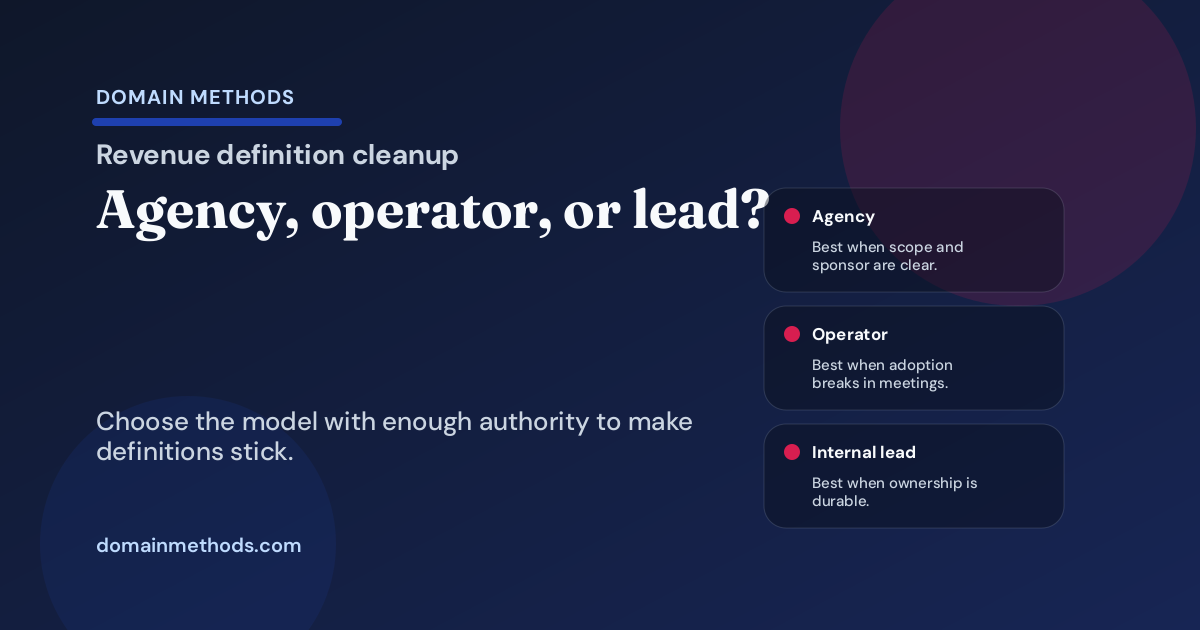
The right operating model for revenue-definition cleanup is the smallest model with enough authority to make the rules stick. Sometimes that is a RevOps agency project. Sometimes it is an embedded operator. Sometimes it is an internal RevOps lead. Sometimes the honest answer is to stop and scope the work before you buy anything.
That last option matters.
Most companies compare these choices as if they are buying capacity. They ask who is cheaper, who can start faster, who has done Salesforce cleanup before, whether a RevOps consultant is different from a RevOps agency, or whether a full-time hire would be more permanent.
Those are reasonable questions. They are not the first ones. If the answer is already “we need outside help,” use the RevOps consulting path to separate a diagnostic, cleanup sprint, embedded operator, and implementation engagement before the procurement conversation gets too generic.
The first question is: what has to change after the definition is written down?
If the answer is mostly documentation, a project model may work. If the answer is behavior across sales, marketing, finance, and RevOps, a clean project plan is not enough. Somebody has to enforce the operating rule when the forecast meeting gets tense, the board deck is late, or a team wants to keep its old number because it makes the story easier.
That is where revenue-definition cleanup gets misbought.
Why revenue-definition cleanup is not just a RevOps project
A revenue-definition problem rarely stays inside RevOps.
The label might be RevOps. The symptoms might live in CRM fields, lifecycle stages, pipeline rules, bookings logic, or attribution definitions. But the pain usually shows up somewhere more expensive:
- the CFO and CRO are not using the same bookings number
- marketing-sourced pipeline changes depending on which deck is open
- the board slide needs a spoken caveat every quarter
- RevOps maintains a private reconciliation file because the official report is not trusted
- the data team can reproduce a number, but the business still argues about whether it means the right thing
That is why the operating model matters. The work is not only “clean up the definitions.” It is “change which definition the company uses when money, targets, and credibility are on the line.” If the team still needs the cleanup sequence itself, start with the 30-day revenue definition cleanup sprint before comparing delivery models.
Salesforce’s State of Data and Analytics (2nd Edition) reports that leaders estimate 26% of their organization’s data is untrustworthy.1 Revenue-definition cleanup is where that trust problem becomes visible: not as an abstract data-quality concern, but as a disputed number in a forecast review, board deck, or compensation conversation.
A good vendor can document the current state. A good operator can help teams make a call. A good internal lead can maintain the rule after the first cleanup. But if the company has not named who can break ties, the best-looking model will still run into the same wall.
The comparison at a glance
| Model | Authority to change rules | Speed to first decision | Handoff risk | Cross-functional adoption | Best-fit cleanup type | Common failure mode |
|---|---|---|---|---|---|---|
| RevOps agency project | Medium if sponsor is strong | Fast once scoped | Medium to high | Good for project cadence, weaker for daily enforcement | defined cleanup, CRM/process audit, documentation, targeted implementation | ships a clean deck or config change that teams stop following six weeks later |
| Embedded operator | Medium to high when given access and sponsor cover | Medium-fast | Medium if handoff is not designed | Strong when the problem lives in meetings, habits, and exceptions | messy definition adoption, tie-breaking, cross-functional operating rhythm | becomes the permanent translator because the company never names the internal owner |
| Internal RevOps lead | High if mandate and executive backing are real | Slowest to land | Lower long-term if role is scoped | Strongest for ongoing ownership | durable rule governance, recurring metric stewardship, executive reporting discipline | gets hired into a role that secretly includes every unresolved revenue-data problem |
| Stop and scope first | Creates authority before the model is chosen | Fastest path to clarity | Low if it prevents a bad buy | Strong only if decisions get made afterward | unclear mandate, conflicting success criteria, no named owner, no agreed metric decision | leadership treats scoping as delay instead of the thing that prevents the next failed engagement |
Use this table as a starting point, not a procurement scorecard.
The important difference is not agency versus operator versus hire. The important difference is whether the model can survive the kind of ambiguity the work will actually create.
When a RevOps agency project is the right fit
A RevOps agency project works when the company can describe the job cleanly enough for a project to stay a project.
Good signs:
- the metrics in scope are named
- the systems involved are known
- the executive sponsor can break ties
- the cleanup has visible deliverables
- someone inside the company will own the definitions after launch
This can be a strong fit for a defined CRM process cleanup, stage mapping exercise, attribution-rule review, dashboard rebuild, or source-of-truth documentation pass. The agency can bring pattern recognition, implementation speed, and outside pressure. That is useful when the company already knows what decision it is trying to protect. If the dispute is still about which records deserve authority, a source-of-truth audit is usually the cleaner first move.
The danger is buying an agency project when the company actually needs authority.
A project plan cannot decide whether sales or finance gets the final word on bookings treatment. A requirements document cannot force marketing and RevOps to retire competing sourced-pipeline logic. A cleaner dashboard cannot stop a team from reverting to the spreadsheet that makes its month look better.
If the work needs those calls, make sure the agency is paired with a real internal sponsor and a decision forum. Otherwise the engagement will produce artifacts instead of adoption.
When an embedded operator is the right fit
An embedded operator works best when the work is too political for a clean vendor project and too transitional for a permanent hire.
This is the middle case a lot of mid-size SaaS companies struggle to name.
They know the revenue definitions are broken. They know the cleanup touches sales, marketing, finance, RevOps, and data. They know another dashboard will not fix the trust problem. But they also do not have enough internal clarity to write a clean job description or hand a vendor a finished scope.
That is where an embedded operator can be valuable.
The operator sits close enough to the operating rhythm to see where definitions break in practice. They can watch which caveats keep appearing in meetings, which fields are ignored, which teams keep maintaining private logic, and which decisions get delayed because nobody wants to own the rule.
The best use cases look like this:
- leadership needs a practical cleanup sequence, not a giant governance program
- competing definitions are creating real meeting friction
- the internal owner exists, but needs help forcing the first set of decisions
- RevOps or data can implement changes, but the business translation layer is weak
- the company needs temporary senior judgment before deciding what to hire permanently
The failure mode is also clear: the embedded operator becomes the forever translator.
If every hard rule still routes through the outside person after six months, the engagement has drifted. Build review points into the work. Decide what gets handed off, what becomes an internal role, and what should stop entirely once the first cleanup is stable.
When an internal RevOps lead is the right fit
An internal RevOps lead is the right answer when revenue-rule ownership is durable and the company is ready to give the role real authority.
That second half is the part teams skip.
A strong internal lead can maintain definitions, run the governance rhythm, enforce CRM behavior, coordinate with finance, and keep executive reporting from drifting. But only if the company lets the role own the rules instead of using it as a human reconciliation layer. For teams that are not sure where to begin, the practical starting point is often choosing the first five metrics to govern instead of trying to govern every revenue number at once.
Good signs you are ready to hire:
- revenue definitions will need ongoing stewardship, not just one cleanup
- leadership can name the role’s authority across sales, marketing, finance, and data
- the company has enough operating clarity that the lead is not walking into a permanent cleanup fire
- there is a real executive sponsor, not just a hiring manager hoping the problem disappears
- the work connects to planning, forecasting, reporting, compensation, or board confidence every quarter
A full-time lead is not the shortcut around scoping. It is the long-term owner once the company knows what it is asking someone to own.
If the job description quietly includes revenue reporting, CRM hygiene, attribution disputes, sales process design, compensation logic, board reporting, data QA, and every urgent dashboard request, that is not a role. It is a backlog wearing a title.
When you should stop and scope first
Sometimes none of the three models is ready.
That does not mean the problem is unimportant. It usually means the problem is important enough that buying the wrong model would waste a quarter.
Stop and scope first when the room cannot answer these questions:
| Scoping question | Why it matters |
|---|---|
| Which revenue decision is currently being damaged? | Without this, the cleanup becomes a generic data-quality project. |
| Which two to four definitions matter first? | Without this, the work expands until nobody can finish it. |
| Who can break ties when teams disagree? | Without this, every model becomes a messenger instead of an owner. |
| Which system or record has to become trusted? | Without this, the cleanup produces parallel truth instead of one operating rule. |
| What has to be true 60 days from now? | Without this, success gets judged by activity, not changed behavior. |
This is the right moment for a short translation or diagnostic step. The output should be a decision brief: metrics in scope, owner map, authority path, system constraints, first cleanup sequence, and recommended operating model.
That is not bureaucracy. It is how you avoid hiring around a question the business has not answered.
A practical selection filter
Use this filter before the next staffing or vendor conversation.
Choose a RevOps agency project when the work is already bounded
The strongest agency fit is a problem with clear edges: known systems, known metrics, known sponsor, known deliverables, and a named internal owner for the after-state.
If the cleanup can be accepted or rejected against a scope, an agency project can move quickly.
Choose an embedded operator when the work needs adoption, not just outputs
The strongest embedded fit is a problem where the definitions are tangled up with meetings, behavior, exception handling, and cross-functional trust.
If the person has to sit close to the operating rhythm and help teams change how decisions get made, a project-only model is probably too thin.
Choose an internal RevOps lead when the ownership is durable
The strongest internal-hire fit is a recurring operating need with clear authority.
If the company needs someone to maintain definitions, guard revenue rules, and run the review rhythm every quarter, the work should eventually live inside the business.
Stop and scope first when the buying question is still vague
If the debate is still “agency or hire?” but nobody can name the damaged decision, the owner, the metric list, or the success condition, pause the comparison.
A small scoping step is cheaper than a failed project, a confused embedded engagement, or a hire who spends their first quarter discovering the real job.
The decision worksheet
Use the worksheet below before you compare proposals or write a role.
Download the Revenue Definition Operating Model Checklist (PDF)
A lightweight worksheet for deciding whether your revenue-definition cleanup needs a RevOps agency project, an embedded operator, an internal RevOps lead, or a stop-and-scope-first step.
Instant download. No email required.
Want future posts like this in your inbox?
This form signs you up for the newsletter. It does not unlock the download above.
What this means for the next revenue meeting
If revenue definitions keep changing by audience, the next move is not automatically another RevOps project, another consultant, or another hire.
The next move is to name the operating rule that has to survive contact with real meetings.
Who can change the definition? Who owns the system logic? Who explains the caveat? Who says no when a team wants its private version back? Who checks whether the new rule is still being used after the first clean deck ships?
Those are operating-model questions.
If the company can answer them, choose the smallest model that can enforce the change. If it cannot, scope the work first. That is usually the fastest path to a cleanup that actually sticks.
Where to take this next
Use the model choice as a sign of what the organization is really missing:
- If the fight is over revenue definitions, handoffs, and who gets to change the number, start with Three Teams, Three Numbers.
- If the business ask itself is still fuzzy, use Translate the Ask before hiring or contracting around the wrong scope.
- If the gap is source precedence, CRM/warehouse reconciliation, or brittle model logic, route the work into Data Foundation.
Sources
- Salesforce, State of Data and Analytics (2nd Edition), reporting that leaders estimate 26% of their organization's data is untrustworthy.
Download the Revenue Definition Operating Model Checklist (PDF)
A practical worksheet for choosing between a RevOps agency, embedded operator, internal RevOps lead, or stop-and-scope-first path before revenue-definition cleanup stalls.
DownloadIf this comparison points to outside help
RevOps Consulting
Use the service path when the team needs help turning revenue-definition cleanup, CRM handoffs, and operating-model ambiguity into a scoped RevOps or data-trust engagement.
See the RevOps consulting pathIf the mandate is still too fuzzy to staff cleanly
Translate the Ask
Use the sprint when leadership knows the revenue-data pain is real, but the request is still an unclear mix of reporting, cleanup, governance, hiring, and operating-model decisions.
Clarify the operating askSee It in Action
Common questions about revenue-definition cleanup operating models
What is the difference between a RevOps agency and a RevOps consultant?
When should we use a RevOps agency for revenue-definition cleanup?
When is an embedded operator better than an agency project?
When should we hire an internal RevOps lead instead?
When should we stop and scope first instead of choosing a model?

About the author
Jason B. Hart
Founder & Principal Consultant
Helps mid-size SaaS companies turn messy marketing and revenue data into decisions leaders trust.