The Revenue Forecast Confidence Check: When Pipeline Is Safe Enough to Plan Around
- Jason B. Hart
- Revenue Operations
- May 22, 2026
Table of Contents
What is the revenue forecast confidence check?
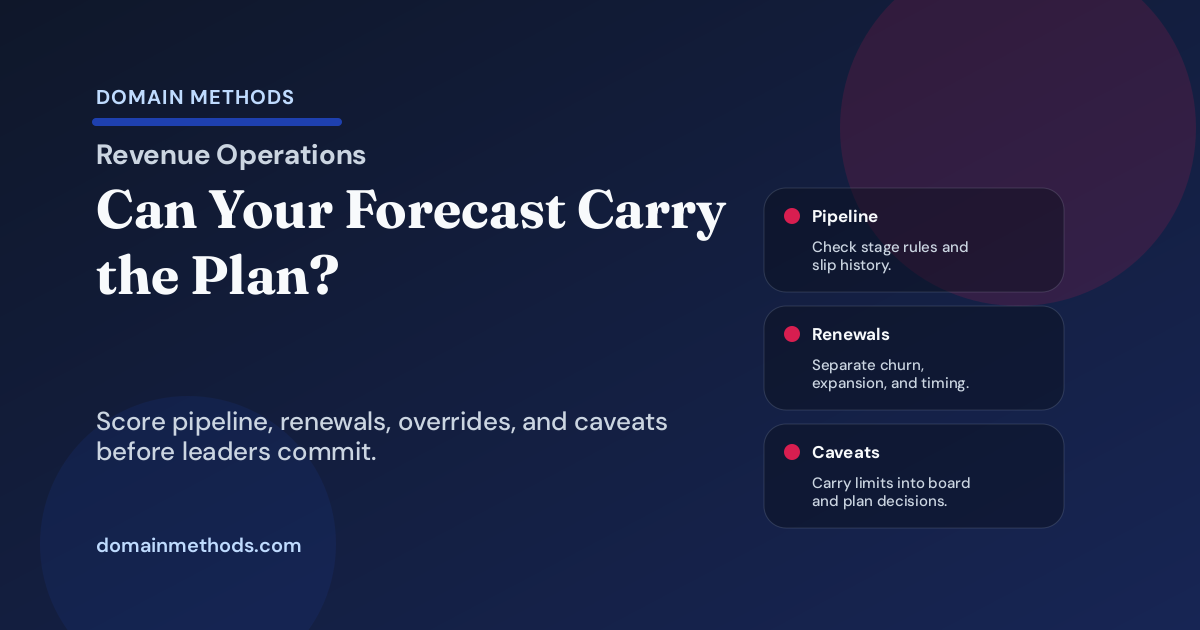
The Revenue Forecast Confidence Check is a practical way to decide whether a pipeline, renewal, expansion, or board-plan forecast is trustworthy enough for the decision leaders want to make with it.
Forecasting gets treated like one number because the meeting needs one answer. The board wants to know whether the plan is safe. Finance wants to know whether cash and hiring assumptions still hold. Sales wants to know whether the quarter can be recovered. Customer Success wants renewal risk visible before it becomes a surprise. RevOps knows the forecast is stitched together from fields that were never designed to carry that much weight.
That is where the trouble starts.
A forecast can be useful before it is board-grade. It can show pressure. It can warn that pipeline is light. It can help a manager coach the right deals or push a renewal owner to clarify risk.
But a forecast should not drive hiring commitments, budget shifts, cash planning, board narrative, or team operating targets until the confidence behind the rollup matches the consequence of the decision.
The useful question is not, “What is the forecast?”
The better question is: can this forecast support the decision in front of us, or is it only directional signal?
Why forecast numbers look cleaner than they are
Revenue forecasts are where a lot of normal operating mess gets compressed into a single executive answer.
The pipeline view depends on stage rules, close dates, deal age, manager judgment, and whether reps treat commit categories the same way. Renewal forecasts depend on account hierarchy, contract dates, usage signals, customer-success risk, expansion opportunities, and finance treatment. Expansion forecasts depend on whether the motion is sales-led, product-led, renewal-led, or a services-heavy negotiation that will not behave like net-new pipeline.
The operator-level detail that usually exposes the weakness is the late-quarter override. A manager knows a deal is shaky but keeps it in commit because the rep has a strong relationship. Finance sees the historical slip rate and discounts it. RevOps sees the close date pushed three times. The CEO sees one number in the forecast slide.
Everyone may be acting reasonably. The forecast is still not carrying its caveats.
That is why forecast confidence has to cover more than pipeline math. It has to cover source precedence, renewal and expansion treatment, override authority, slip history, finance reconciliation, and who owns the caveat when the number leaves the operating meeting.
If those controls are weak, the forecast may still be useful. It is not safe enough for every decision leaders want to attach to it.
Start with the decision, not the forecast number
Do not begin by arguing whether the forecast is “right.” Start by naming what the forecast is being asked to decide.
| Forecast use | What leaders usually need | Minimum confidence bar |
|---|---|---|
| Weekly revenue review | A directional read on risk, coverage, and where management attention belongs | Directional may be enough if caveats are visible |
| Budget pacing | Confidence that spend should accelerate, pause, or move between motions | Decision-grade with clear segment and pipeline logic |
| Hiring plan | Evidence that pipeline, capacity, ramp, and revenue timing can support headcount | Decision-grade, with finance and sales caveats visible |
| Retention or expansion plan | Stable treatment of renewal risk, contraction, expansion, and account ownership | Decision-grade |
| Cash or operating plan | A forecast that finance can reconcile to timing, bookings, renewals, and known risk | Board-grade or explicitly caveated |
| Board narrative | A revenue story that can survive questions about source, timing, caveats, and variance | Board-grade |
| Data-foundation escalation | Evidence that the forecast cannot support the desired decision yet | Directional evidence is enough to justify repair |
This framing prevents a common failure mode: a forecast built for weekly coaching gets promoted into a board or hiring commitment because it was the only number available.
If the decision is headcount-heavy, compare the forecast against the Sales Capacity Confidence Check. If the risk is mostly churn, expansion, or renewal timing, use the Retention Confidence Check to test whether the movement categories are stable enough. If the forecast has to explain what changed since last month, the Revenue Bridge Confidence Check is the better companion.
The eight controls that matter most
I would score a revenue forecast across eight controls before letting it drive a high-stakes decision.
| Control | What to inspect | What weak confidence looks like |
|---|---|---|
| Stage definitions | What makes a deal qualify, advance, commit, slip, or close | Managers use the same stage names for different levels of buyer proof |
| Source precedence | Which CRM, finance, renewal, warehouse, or operating view wins | Teams keep reconciling the forecast in side spreadsheets before each review |
| Pipeline quality | Deal age, close-date movement, source, segment, motion, and owner behavior | Coverage looks fine because stale or repeatedly slipped deals stayed in the denominator |
| Renewal and expansion treatment | Renewal date, churn risk, contraction, expansion, and account hierarchy | Forecasted ARR hides churn risk by blending renewal, expansion, and net-new motion |
| Override authority | Who can change commit, best case, close date, amount, or confidence | Manager judgment exists, but the reason and owner are not recorded |
| Slip history | How often similar deals, segments, or managers move out of period | The forecast ignores a known pattern because the current quarter feels different |
| Finance reconciliation | Whether bookings, ARR, billing, recognition, and cash timing line up | Finance has a second forecast because the operating forecast cannot be used for planning |
| Caveat ownership | Who writes the confidence note and carries it into the board or operating plan | Caveats are discussed live but disappear when the number moves into the deck |
The last control is easy to underestimate. Caveat ownership is what keeps a forecast from becoming theater. If the caveat only lives in the meeting, the next audience receives a level of certainty the operating team did not actually have.
Use confidence bands instead of pretending every forecast has one job
A forecast does not need the same confidence level for every use case.
| Band | What it means | Safe uses | Not safe for |
|---|---|---|---|
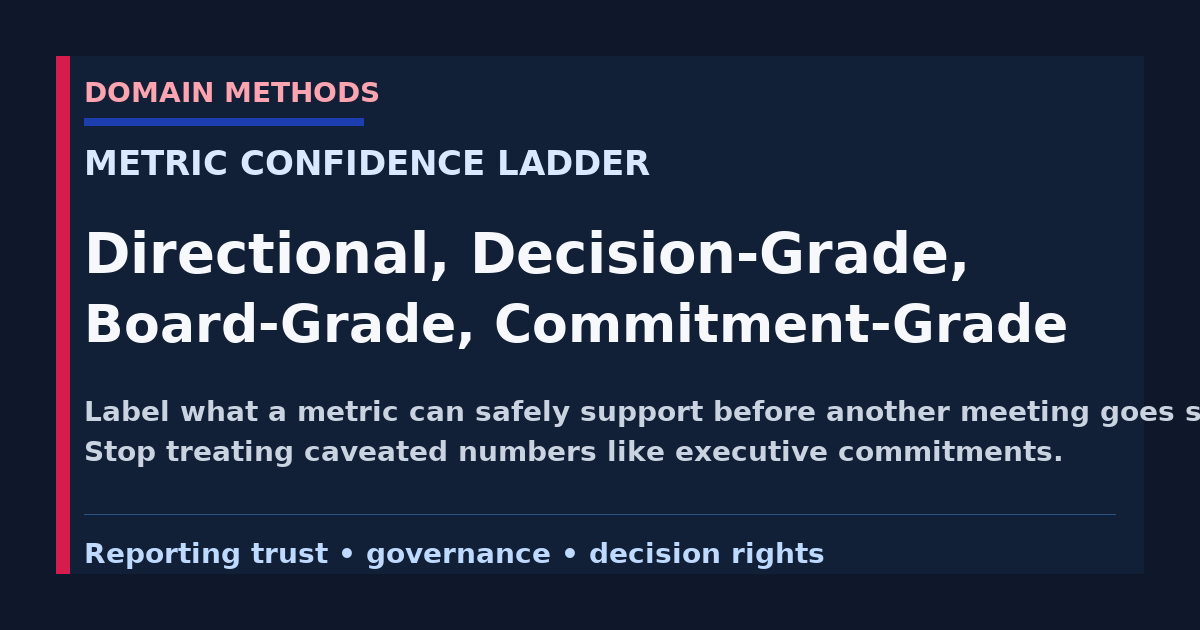
| Directional | The forecast points to pressure or opportunity, but important controls are still weak | Coaching, diagnosis, cleanup prioritization, escalation | Hiring commitments, budget moves, board promises |
| Decision-grade | The forecast can support one named operating decision with visible assumptions and an accountable owner | Budget pacing, segment plan, renewal-focus plan, limited hiring discussion | Broad board narrative unless caveats are explicit |
| Board-grade | The forecast has stable definitions, source precedence, finance reconciliation, override controls, and caveats that travel | Board prep, cash planning, annual-plan narrative, leadership commitments | Decisions outside the documented scope |
| Not safe yet | The forecast is too disputed, manually patched, or caveat-free to use for the requested decision | Evidence for repair work | Any high-stakes operating commitment |
The discipline is not to be pessimistic. It is to stop using one polished number for five different decisions.
A forecast can be decision-grade for weekly budget pacing and not board-grade for a hiring plan. It can be useful for renewal-risk triage and not safe for cash planning. It can justify a data-foundation repair before it can justify a growth investment.
That distinction is often the difference between an operating forecast and a confidence costume.
A small example: fine for coaching, unsafe for a board hiring call
Imagine a mid-size SaaS company forecasting next quarter at $4.8M in bookings against a $5.2M plan. On paper, the gap looks manageable.
The sales team says several late-stage enterprise deals are in commit. Customer Success expects two expansion renewals to land. Finance has not fully reconciled contract timing. RevOps knows three large deals moved close dates twice last quarter and that one manager changed commit categories after pipeline review. The board deck says the team is close enough to justify two more AE hires.
That forecast may still be useful for weekly coaching. The CRO can inspect slipped deals. CS can tighten renewal-risk owners. Marketing can check whether near-term pipeline is coming from channels that actually convert.
But it is not safe enough to approve hiring unless the team can answer a few uncomfortable questions:
- Which late-stage deals are still in the quarter because of buyer proof, not optimism?
- How are renewal, expansion, contraction, and net-new opportunities separated?
- What source wins when CRM, finance, and the renewal view disagree?
- Which override changed the forecast, who approved it, and why?
- What caveat will travel with the number into the board or hiring discussion?
If those answers are missing, the forecast can still trigger action. It should trigger repair before commitment.
What not to use a weak forecast for
A weak forecast should not become the quiet justification for decisions that need stronger controls.
Do not use a directional forecast to:
- approve permanent hiring based on temporary pipeline optimism;
- move budget between channels when stage definitions are unstable;
- promise a board outcome without carrying the caveat;
- set team operating targets that depend on disputed renewal or expansion treatment;
- defend cash timing when finance keeps a separate reconciliation model;
- explain variance when slip history, close-date hygiene, and manager overrides are not visible.
This is not a call to delay every decision until the data is perfect. Mid-size SaaS teams have to operate before every system is clean.
The point is to match the decision to the confidence level. A caveated forecast can support diagnosis. A decision-grade forecast can support one named operating move. A board-grade forecast can carry a leadership narrative.
When those labels are missing, forecast review turns into a ritual where the room debates certainty after the number has already been promoted.
The 30-minute revenue forecast confidence check
Use this sequence when a forecast is about to influence a hiring, cash, budget, board, retention, or operating decision.
- Name the decision. Write the decision in one sentence before opening the spreadsheet. If the decision is vague, the confidence bar will be vague too.
- List the forecast inputs. Separate net-new pipeline, renewals, expansion, contraction, known slip, manager override, finance reconciliation, and any manually patched side model.
- Score the controls. Give each control a 0-3 score: missing, manually rescued, usable with caveats, or documented and owned.
- Apply veto rules. If source precedence, renewal treatment, finance reconciliation, or caveat ownership is missing for a board or cash decision, the forecast cannot be board-grade no matter how good the total score looks.
- Write the caveat in plain English. If the caveat sounds too embarrassing to put in the deck, that is probably the real repair work.
- Assign one owner. Do not assign “RevOps” as a mood. Name the person who owns the next definition, source, override, renewal, or reconciliation repair.
Download the Revenue Forecast Confidence Worksheet
A text-first worksheet for scoring one revenue forecast rollup across stage definitions, source precedence, pipeline quality, renewal and expansion treatment, override authority, slip history, finance reconciliation, and caveat ownership.
Instant download. No email required.
Want future posts like this in your inbox?
This form signs you up for the newsletter. It does not unlock the download above.
What to fix first when confidence is low
The weakest control should drive the next repair.
| Weakest control | First repair | Why it matters |
|---|---|---|
| Stage definitions | Write the stage-entry and commit rules in plain English | The forecast cannot be stronger than the sales process it summarizes |
| Source precedence | Name the winning system and exception path | Side spreadsheets multiply when no source is allowed to win |
| Renewal and expansion treatment | Separate renewal, contraction, expansion, and net-new movement | Blended revenue hides the risk leaders need to see |
| Override authority | Log who changed the forecast and why | Judgment is useful only when the reason travels with the number |
| Finance reconciliation | Tie the operating forecast to finance timing and policy | Cash and board decisions need more than CRM confidence |
| Caveat ownership | Write the confidence note next to the forecast | A caveat that disappears is not a caveat; it is lost context |
This is where a forecast-confidence review often becomes a revenue definition cleanup sprint or a source-of-truth audit. The forecast is the symptom. The operating rule underneath it is usually the work.
If the disagreement is mainly about which team owns the definition, start with Three Teams, Three Numbers. If the team cannot trace the forecast back through CRM, renewal systems, finance, and the warehouse, start with Data Foundation.
The practical standard
A trustworthy forecast is not a perfect forecast.
It is a forecast where leaders know what the number is allowed to decide, which inputs are weak, which caveats travel with it, and who owns the next repair.
That standard is reachable. It does not require a new planning platform first. It usually starts with clearer stage rules, source precedence, renewal and expansion treatment, override logging, finance reconciliation, and caveat ownership.
When those controls are visible, the forecast becomes useful even when it is uncomfortable.
When they are hidden, the forecast may still look tidy. It just should not be allowed to carry the business plan by itself.
Download the Revenue Forecast Confidence Worksheet
A lightweight worksheet for scoring one forecast rollup before it supports a board narrative, hiring plan, budget move, cash plan, or operating commitment.
DownloadIf Sales, RevOps, finance, and leadership each defend a different forecast
Three Teams, Three Numbers
Use the diagnostic when forecast, pipeline, renewal, and revenue definitions are locally explainable but the business lacks one shared decision rule for which answer wins.
Start with the metric-alignment diagnosticIf forecast confidence breaks in the source systems
Data Foundation
Use Data Foundation when CRM hygiene, source precedence, account hierarchy, renewal logic, or warehouse reconciliation cannot support the forecast decision leaders want to make.
See Data FoundationSee It in Action
Common questions about revenue forecast confidence
What is revenue forecast confidence?
When is a forecast only directional?
What makes a forecast board-grade?
Who should own forecast confidence?

About the author
Jason B. Hart
Founder & Principal Consultant
Helps mid-size SaaS companies turn messy marketing and revenue data into decisions leaders trust.