The Revenue Bridge Confidence Check: Can You Explain What Changed Without Rebuilding the Model?
- Jason B. Hart
- Revenue Operations
- April 30, 2026
Table of Contents
What is the revenue bridge confidence check?
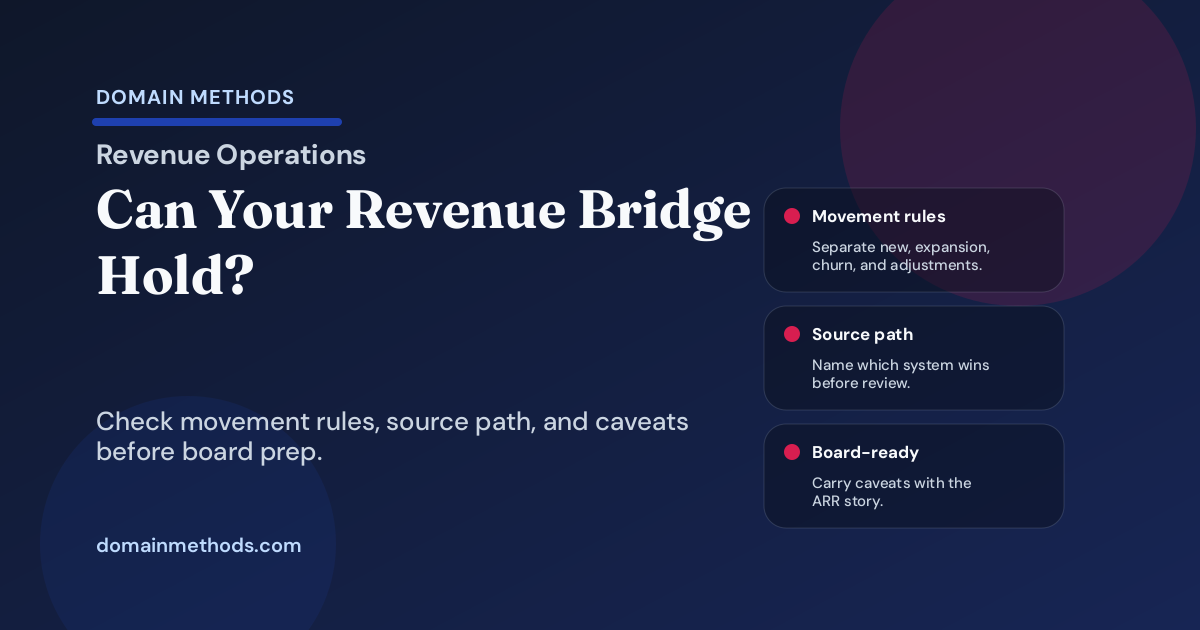
The Revenue Bridge Confidence Check is a practical way to decide whether your ARR or revenue bridge can explain what changed between two periods without turning the executive meeting into a model-rebuild session.
A bridge usually looks calm on the slide. Starting ARR, plus new business, plus expansion, minus contraction, minus churn, plus or minus adjustments, equals ending ARR.
Then the questions start.
Was that downgrade a contraction, a product migration, or a billing-plan correction? Did the expansion count when the order closed, when billing changed, or when finance recognized it? Why does the customer success view show the account as saved while finance shows a net negative movement? Which account family owns the movement when a subsidiary churns and the parent expands?
None of those questions are academic when the bridge is headed into a board deck, forecast review, or operating plan. They decide whether leadership can defend the revenue story or has to ask for another offline reconciliation.
A revenue bridge can be useful before it is board-grade. It can show pressure, surface investigation areas, and justify cleanup. But it should not drive forecast commitments, board narrative, sales-capacity assumptions, or investment choices until the controls behind the movement match the decision attached to it.
Why revenue bridges fail in the meeting
Revenue bridges fail when they combine operating events that belong to different teams, systems, and calendars without naming the rules that reconcile them.
Finance may own recognized revenue and close policy. RevOps may own CRM movement and stage history. Customer Success may own renewal status and contraction context. Sales may own expansion source and crediting. Data or analytics may own the warehouse model that tries to make all of those views agree.
The failure point is rarely one obviously bad dashboard. It is usually a bridge that is locally reasonable in each source and globally confusing when leaders ask what changed.
A common operator-level detail exposes this fast: the same account has a renewal reduction, a late expansion, a product migration, and an invoice timing change inside one quarter. The net number might be correct, but the story depends on which movement event gets named first.
If the bridge cannot separate those events, the leadership team may still have a number. It does not have a defensible explanation.
Start with the decision the bridge has to support
Do not begin by asking whether the bridge ties out. A weak bridge can tie out after enough manual adjustment. Start by asking what the bridge is allowed to decide.
| Decision | What leaders need | Minimum confidence bar |
|---|---|---|
| Weekly revenue review | A directional view of movement and investigation areas | Directional may be enough if caveats are visible |
| Forecast review | Movement categories that explain risk to next-period bookings or ARR | Decision-grade |
| Operating plan | Stable categories for new, expansion, contraction, churn, and reactivation | Decision-grade |
| Board narrative | A story leaders can defend without private reconciliation notes | Board-grade |
| Investor or lender update | Reconciled movement with finance-reviewed caveats | Board-grade |
| Data-foundation escalation | Evidence that source systems or account hierarchy cannot support the bridge | Directional evidence is enough to justify repair |
This is the same discipline behind the Retention Confidence Check and the Pipeline Coverage Confidence Check: a metric is only as strong as the decision it is being asked to carry.
The bridge adds one more layer. It is not just one metric. It is the executive explanation of how several metrics moved together.
The movement categories to settle first
Before leaders debate the story, write down the movement categories the bridge is using.
| Movement category | What to define | Common confidence problem |
|---|---|---|
| Starting ARR or MRR | Opening base, account scope, product scope, currency, and period cutoff | The base changes depending on whether finance, billing, CRM, or warehouse exports it |
| New business | First-time revenue, new product revenue, new logo, or new account family | Sales crediting and finance recognition do not match the bridge category |
| Expansion | Upsell, cross-sell, seat growth, usage growth, packaging uplift, or true-up | Expansion masks contraction or churn elsewhere in the account family |
| Contraction | Seat reduction, usage drop, downgrade, discount, or partial churn | The team cannot separate customer risk from packaging migration |
| Churn | Full customer loss, product loss, workspace loss, subscription loss, or logo loss | Account hierarchy changes whether the customer actually churned |
| Reactivation | Returning customer, restarted subscription, winback, or late renewal | Reactivation is counted as new business in one view and retention rescue in another |
| Adjustments | FX, credits, refunds, migrations, billing-plan changes, corrections, or close policy | Manual adjustments fix the math but do not travel with the operating story |
The practical tradeoff is not detail versus simplicity. It is explainable simplicity versus false simplicity.
A bridge with too many categories becomes unusable in an executive review. A bridge with too few categories makes every hard question sound like a data exception. Most teams need a short leadership taxonomy plus a documented place where edge cases are handled before the meeting.
Directional, decision-grade, board-grade, or not safe yet
Use the confidence band that matches the weakest critical control.
| Confidence band | What it means | Safe uses | Not safe yet |
|---|---|---|---|
| Directional | The bridge shows rough movement, but material controls are missing or caveated | Investigation, cleanup prioritization, early pressure read | Board narrative, forecast commitments, compensation, investor-facing explanation |
| Decision-grade | Definitions, sources, cutoffs, and owners are stable enough for one operating decision | Forecast review, operating plan, renewal/expansion tradeoffs | Uses outside the documented scope, segment, or period |
| Board-grade | The starting base, movement taxonomy, source precedence, account hierarchy, close timing, QA, and caveats are documented and finance-reviewed | Board prep, formal forecast narrative, investor update, executive operating story | Claims that go beyond the governed bridge scope |
| Not safe yet | The bridge is disputed, manually rescued, or materially inconsistent across systems | Evidence for repair work and leadership escalation | Any decision that changes staffing, forecast, investment, or accountability |
A useful test: if the CFO, CRO, and RevOps leader cannot explain why ending ARR changed in the same language, the bridge is not board-grade yet.
That does not mean the bridge has no value. It means leaders need to label what the bridge can safely support before they lean on it harder than the source path can handle.
The five failure modes to diagnose
When the bridge is not safe enough, avoid turning the fix into a generic data cleanup program. Find the control that is lowering confidence.
| Failure mode | What it looks like | First repair |
|---|---|---|
| Movement-category definition problem | Expansion, contraction, churn, migration, and adjustment categories change by team | Write the category rules and edge-case examples before the next review |
| Source-precedence problem | Billing, CRM, finance, and warehouse all produce plausible but different movement | Name the winning source for amount, date, account, and category |
| Account-hierarchy problem | Parent account, subsidiary, workspace, subscription, and CRM account rollups disagree | Define the rollup used for bridge reporting and preserve alternate views as notes |
| Timing or cutoff problem | Contract date, invoice date, finance close, CRM close date, or renewal date changes the period | Publish the cutoff rule and the late-adjustment policy |
| Owner/workflow problem | Nobody owns the explanation until the executive review finds a mismatch | Assign pre-review owners for category changes, caveats, and final sign-off |
The sequencing matters. If the account hierarchy is wrong, do not start with a prettier waterfall chart. If movement categories are blurry, do not solve it with another forecast tab. If finance and RevOps need different views, document the translation rather than pretending one export answers both questions.
This is where a Revenue Definition Confidence Benchmark or a 30-day revenue definition cleanup sprint can sit upstream. The bridge is where those definitions are forced to prove they can carry the operating story.
What the bridge should not decide yet
The most useful part of the check is writing down what the bridge is not allowed to decide yet.
Examples:
- Do not use a directional bridge for board narrative if churn and contraction are still manually reclassified after finance close.
- Do not use the bridge to approve expansion investment if expansion timing changes between CRM close date and billing effective date.
- Do not use account-level movement for sales or CS accountability if parent and subsidiary rollups are still unresolved.
- Do not use a reconciled finance bridge as the only operating view if it hides the renewal or product event that created the movement.
- Do not treat FX, refunds, credits, migrations, and billing-plan corrections as one adjustment bucket if leaders need to know which ones are recurring.
- Do not turn a spreadsheet tie-out into an executive truth source if the rules are understood only by the person who built the tab.
This does not require perfect data. It requires honest labels.
A directional bridge can trigger investigation. A decision-grade bridge can support forecast and operating tradeoffs. A board-grade bridge can carry the executive story. The danger is using one band while pretending it is another.
Use the worksheet before the next revenue review
The worksheet below is intentionally lightweight. Use it for one bridge and one decision: board prep, forecast review, operating plan, renewal readout, expansion investment, or a data-foundation escalation.
Download the Revenue Bridge Confidence Worksheet
Use this worksheet to classify one ARR or revenue bridge, identify the weakest control, name unsafe uses, and assign the next repair before the next executive review.
Instant download. No email required.
Want future posts like this in your inbox?
This form signs you up for the newsletter. It does not unlock the download above.
Do not use it to audit every revenue metric in one sitting. The point is to leave the review with a confidence band, the movement categories that need rules, the caveats that must travel with the story, and the first owner accountable for repair.
When to bring in outside help
If the bridge fight is mainly about which team definition should win, start with Three Teams, Three Numbers. Revenue bridge arguments often expose a broader alignment problem: finance, RevOps, sales, CS, marketing, and data can each be locally right while the business still lacks one shared operating rule.
If the definition is clear but the source path cannot hold, the next move is Data Foundation. A revenue bridge should not depend on brittle account hierarchy, undocumented billing joins, private reconciliation tabs, or warehouse logic that changes by meeting.
For broader context, pair this check with the Revenue Definition Confidence Benchmark when leaders disagree on the metric rule itself, the Retention Confidence Check when churn and expansion movement is the weak spot, and the Pipeline Coverage Confidence Check when the bridge depends on forecast assumptions that sales and marketing still argue about.
Download the Revenue Bridge Confidence Worksheet
A lightweight worksheet for classifying whether one ARR or revenue bridge is directional, decision-grade, board-grade, or not safe yet.
DownloadIf finance, RevOps, sales, CS, and marketing each explain movement differently
Three Teams, Three Numbers
Use the diagnostic when revenue movement categories are locally explainable but the business lacks one shared rule for which number leads the executive story.
Start with the metric-alignment diagnosticIf the bridge breaks because source systems cannot hold the story
Data Foundation
Use Data Foundation when ARR movement depends on brittle account hierarchy, billing joins, CRM handoffs, warehouse logic, or manual finance reconciliation.
See Data FoundationSee It in Action
Common questions about revenue bridge confidence
What is a revenue bridge confidence check?
When is an ARR bridge only directional?
What makes a revenue bridge board-grade?
Is this the same as retention confidence?

About the author
Jason B. Hart
Founder & Principal Consultant
Helps mid-size SaaS companies turn messy marketing and revenue data into decisions leaders trust.