Revenue Band Scoring Logic: How to Apply Scoring to Revenue Bands Without Overfitting
- Jason B. Hart
- Data Activation
- May 18, 2026
- Updated June 17, 2026
Table of Contents
If you are looking for scoring based on revenue bands, the useful question is not “which company size gets the most points?” It is: which revenue band should change lead priority, account routing, or workflow treatment — and how much authority should that score get?
Revenue band scoring is one of those RevOps ideas that sounds simple until it starts moving real work.
A team wants to prioritize better accounts. Someone adds company revenue to the lead score. The enterprise bands get more points because they look valuable. Unknown revenue gets zero. The score ships to Salesforce. Then sales notices that some small accounts are perfect-fit product-led deals, some enterprise accounts are bad-fit procurement marathons, and a surprising number of “unknown” accounts are only unknown because enrichment missed them.
The problem is not revenue bands. The problem is treating revenue bands like the whole scoring model.
Used well, revenue bands are a useful fit signal. They help a SaaS team separate likely ACV, buying motion, implementation complexity, and sales coverage needs. Used badly, they turn firmographic bias into a routing rule and make the CRM look smarter than it is.
What revenue-band scoring is
Revenue-band scoring assigns points to a company based on a broad revenue range, then uses that score as one input in lead, account, or customer prioritization.
The bands are deliberately coarse. You are not trying to know whether a company has $18.4M or $21.7M in revenue. You are trying to decide whether the company looks like the kind of account your motion can serve well.
For B2B SaaS teams, revenue bands usually influence questions like:
- Should this account go to self-serve, SDR follow-up, partner routing, or an account executive?
- Is this a company we can support with our current onboarding and implementation motion?
- Does the expected contract value justify human follow-up?
- Should this signal change campaign audience priority, CRM routing, or an AI-assisted recommendation?
That last question is why this belongs in the same conversation as lead scoring handoffs and AI workflow readiness. Once the score affects a rep queue, routing rule, lifecycle journey, or AI assistant, it stops being a spreadsheet exercise.
Example revenue band scoring table
This is the practical version of applying scoring to revenue bands: choose broad ranges, assign points based on fit, and make the caveat visible before the score changes a workflow.
Start with a table that is boring enough to explain in a sales meeting.
For a mid-market B2B SaaS motion, a first-pass fit score might look like this:
| Company revenue band | Example score | Why it might make sense | Watchout |
|---|---|---|---|
| Unknown | Review separately | Missing enrichment is not the same as poor fit | Do not punish good accounts because the vendor missed the field |
| Less than $1M | 0-5 | Often too small for hands-on sales unless product usage is very strong | Could still be a high-fit PLG account |
| $1M-$10M | 10 | Early commercial fit, but budget and urgency vary widely | Do not over-route before intent exists |
| $10M-$25M | 20 | Often fits a scaling SaaS sales motion and has enough operating pain | Validate by segment and buyer role |
| $25M-$100M | 25 | Strong mid-market fit for many analytics, RevOps, and activation problems | Implementation complexity may rise |
| $100M-$500M | 15-25 | Valuable when the product and sales motion are enterprise-ready | Long cycles can make the score look better than the economics |
| $500M+ | 5-20 | Useful only if enterprise selling, procurement, security, and support are viable | Bigger is not automatically better |
The exact numbers matter less than the curve. A company selling to mid-market SaaS may score $25M-$100M higher than $500M+ because the larger account is not actually a better first motion. A PLG company may treat $1M-$10M accounts differently if usage is strong. An enterprise platform may reverse the weighting entirely.
The operator move is to write down the assumption, then test it against outcomes.
How to apply scoring to revenue bands without creating bias
The easiest mistake is to let bigger companies get more points by default.
That feels intuitive because larger companies have more budget. But budget is only one part of fit. Larger companies may also have slower buying committees, heavier security review, custom requirements, lower urgency, and more political overhead. Smaller companies may be faster, easier to onboard, and better matched to a product-led or lower-touch motion.
A safer scoring rule is:
Give the most points to the revenue band where your product, sales capacity, implementation motion, and buyer urgency actually line up.
That means revenue band scoring should be calibrated against at least four real signals:
| Calibration question | What to check before trusting the band |
|---|---|
| Conversion | Which bands actually convert from qualified lead to opportunity and customer? |
| Sales cycle | Which bands create long cycles that look valuable but clog rep time? |
| ACV and margin | Which bands produce good contracts after support and implementation costs? |
| Workflow success | Which bands adopt the product or operational workflow after purchase? |
If the team cannot answer those questions yet, keep the revenue score directional. Use it to prioritize review, not to automate routing.
A common operator tradeoff: the scoring rule that is easiest to defend in a spreadsheet is not always the rule sales can use cleanly. If your best-fit band is $10M-$25M, say so plainly. Do not bury that choice inside a 100-point model where the enterprise band still looks like the winner because somebody added “strategic account” points later.
Revenue band should rarely be the whole score
Revenue tells you something about capacity and fit. It does not tell you whether the account cares right now.
A useful scoring model separates at least three ideas:
| Score type | What it answers | Example inputs | Do not confuse it with… |
|---|---|---|---|
| Fit score | Is this account structurally right for us? | Revenue band, employee count, industry, region, tech stack, business model | Buying intent |
| Intent score | Is there evidence they are in market or problem-aware? | High-intent pages, demo behavior, ad engagement, comparison content, product usage | Company size |
| Readiness score | Can our team act on this signal safely? | CRM hygiene, owner rules, source reliability, routing path, exception handling | Model sophistication |
A $100M company with no relevant behavior may be a good account for a named list, but it is not necessarily a hot lead. A $7M SaaS company reading pricing, attribution, and data activation content may be more actionable this week.
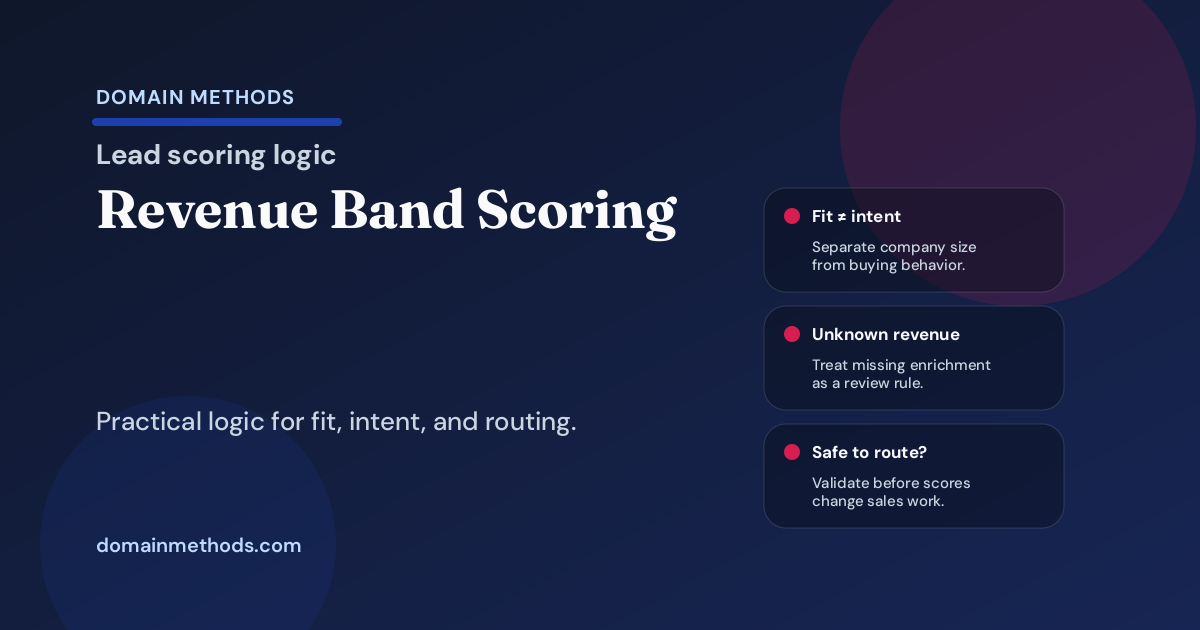
This is why Data Activation work usually starts with the workflow, not the model label. The question is not, “Can we score this account?” The question is, “What should happen differently if the score is trusted?”
Worked example: PLG, sales-led, and mid-market scoring
The same revenue bands can mean different things in different motions.
| Motion | Revenue-band logic | Other signals that must travel with it | First safe use |
|---|---|---|---|
| PLG SaaS | Lower revenue bands may still score well when product usage and activation milestones are strong | Product-qualified behavior, usage depth, workspace growth, owner role | Rep prioritization or lifecycle assist |
| Sales-led SaaS | Mid-market or enterprise bands may carry more fit weight because sales time is scarce | Industry, buyer role, page intent, territory/account ownership | SDR routing or account tiering |
| Mid-market expansion | Current customer revenue band may matter less than usage, adoption, and expansion surface | Product usage, contract shape, support friction, renewal timing | CS prioritization or expansion review |
In the B2B SaaS lead scoring case study, the useful shift was not simply adding another firmographic field. The value came from surfacing product-qualified and fit signals quickly enough for sales to act, cutting high-intent response time from three days to four hours and increasing qualified pipeline by 40%.
That is the bar. The score has to change behavior with enough context that people trust the change.
The unknown-revenue rule matters more than it looks
Unknown revenue is where scoring logic quietly gets unfair.
If unknown gets zero points, the team may suppress small companies, private companies, newer subsidiaries, and accounts where enrichment simply failed. That can make the model look disciplined while hiding a source-data problem.
Use one of these rules instead:
| Unknown-revenue rule | When to use it | Risk |
|---|---|---|
| Neutral score | You have other fit and intent signals strong enough to carry prioritization | Unknowns may still enter sales review too easily |
| Review band | You want RevOps or sales to inspect unknowns above a behavior threshold | Creates manual work, but useful early |
| Inferred band with caveat | You have reliable employee count, funding, product usage, or account hierarchy signals | Can create false precision if inference is weak |
| Suppress until enriched | You have high volume and low sales capacity | May hide good accounts if enrichment coverage is poor |
Whatever rule you choose, make it visible. A hidden missing-data penalty is not scoring logic. It is data quality debt disguised as precision.
Common mistakes in revenue band scoring
Most scoring mistakes are not mathematical. They are operating mistakes.
| Mistake | What happens | Better rule |
|---|---|---|
| Treating unknown revenue as low quality | Good accounts disappear because enrichment missed them | Create an explicit unknown rule |
| Overweighting enterprise bands | Reps chase slow, complex accounts that do not fit the current motion | Weight the best-fit band, not the biggest band |
| Mixing fit with intent | Large accounts look hot even when they showed no buying behavior | Keep fit, intent, and readiness separate |
| Ignoring sales capacity | Too many accounts route to humans without a clear action path | Use bands to match coverage, not just rank accounts |
| Syncing too early | The CRM shows a score sales cannot explain or challenge | Run a handoff review before activation |
| Failing to recalibrate | Old assumptions stay in the model after the market or motion changes | Review outcomes by band each quarter |
The lived-in version: sales asks why an account got routed, marketing points to the score, RevOps points to enrichment, and data says the formula worked as designed. That is not a healthy scoring system. It is an undocumented handoff.
How revenue bands change before AI lead scoring or reverse ETL activation
Revenue band logic gets more sensitive when it moves from analysis to automation.
If a score only appears in a planning spreadsheet, the downside of a bad band is limited. If the same score changes CRM routing, powers an AI sales assistant, suppresses a lifecycle email, or syncs through reverse ETL into multiple tools, the downside expands.
Before activation, answer these questions:
| Activation question | Good enough answer |
|---|---|
| What field is the source of revenue truth? | Named CRM/enrichment/warehouse field with owner and refresh rule |
| Who can override the band? | RevOps or data owner with documented exception path |
| What behavior changes? | Rep priority, segment, lifecycle rule, or manager review is named |
| What should not change yet? | Compensation, quota credit, finance reporting, or board claims stay out until validated |
| Where do bad examples go? | Sales has one visible feedback path, reviewed on a fixed cadence |
If those answers are shaky, the next move may be AI-Ready Data Diagnostic or a smaller CRM workflow reliability check before any scoring model gets more authority.
If the answers are solid and the score needs to reach sales or lifecycle tools, that is a Data Activation problem. The work is not only to calculate the score. It is to move the trusted signal, reason code, freshness, and exception path into the place where the team acts.
Good enough first scoring model checklist
A first revenue-band scoring model is good enough when it passes this checklist:
- The target decision is named. The score supports routing, prioritization, segmentation, or review — not a vague desire for “better leads.”
- The best-fit revenue band is explicit. The highest score reflects the company’s actual motion, not a generic enterprise bias.
- Unknown revenue has its own rule. Missing enrichment does not silently become disqualification.
- Fit, intent, and readiness are separated. Revenue band is one input, not the whole lead score.
- Sales can see the reason. Reps know whether the score changed because of revenue band, product usage, page intent, or another factor.
- The score has allowed and not-yet uses. It may prioritize review now, but it does not control compensation, finance reporting, or full automation without more proof.
- There is a review loop. Bad examples have an owner and cadence.
Download the Lead Scoring Sales Handoff Checklist (PDF)
Use this text-first worksheet to turn revenue-band scoring logic into a practical handoff review: what the score can change, what reps should see, and what proof is still missing before it gets more workflow authority.
Instant download. No email required.
Want future posts like this in your inbox?
This form signs you up for the newsletter. It does not unlock the download above.
That is enough to start. It is not enough to stop learning.
The practical next move
Revenue band scoring is useful when it gives the team a cleaner first cut at fit. It becomes dangerous when it pretends company size is the same thing as buying intent, workflow readiness, or sales trust.
Start with broad bands. Match the curve to your actual sales motion. Keep unknown revenue visible. Separate fit from intent. Then validate the score against real outcomes before it drives routing or AI-assisted action.
If the scoring logic is ready but trapped in analysis, Data Activation is the path for moving it into CRM, sales, lifecycle, or customer workflows.
If the team does not trust the source fields, enrichment, owner rules, or AI workflow boundary yet, start with the AI-Ready Data Diagnostic before the score gets more authority than the system can safely support.
Download the Lead Scoring Sales Handoff Checklist (PDF)
Use the worksheet to decide what a score can change, what sales needs to see, and what proof is still missing before revenue-band logic moves into rep workflows.
DownloadIf the score needs to reach the workflow
Data Activation
Use Data Activation when lead, account, fit, and readiness scores need to move from analysis into CRM routing, rep prioritization, or lifecycle workflows.
See Data ActivationIf the score may drive AI-assisted action
AI-Ready Data Diagnostic
Use the audit when revenue-band logic will influence AI-assisted scoring, routing, prioritization, or automation on top of weak CRM data.
See the AI-Ready Data DiagnosticSee It in Action
Common questions about revenue band scoring logic
What is revenue band scoring?
How many points should each revenue band get?
Should unknown revenue receive zero points?
Can revenue bands drive AI lead scoring or routing?
How do you apply scoring to revenue bands without overfitting?

About the author
Jason B. Hart
Founder & Principal Consultant
Helps mid-size SaaS companies turn messy marketing and revenue data into decisions leaders trust.