The Quota-Crediting Confidence Checklist: Is This Revenue Rule Safe Enough for Compensation?
- Jason B. Hart
- Revenue Operations
- April 27, 2026
- Updated July 10, 2026
Table of Contents
What is the quota-crediting confidence checklist?
The Quota-Crediting Confidence Checklist is a practical way to decide whether a revenue rule is safe enough to affect compensation.
Most teams do not argue about quota credit because they enjoy process debates. They argue because the same deal can be true in several different systems at once.
The CRM says a rep sourced it. The campaign history says marketing influenced it. The partner portal says a channel partner introduced it. The contract says finance recognizes the revenue in a different period. The territory plan says the account moved mid-cycle. Everyone has a version of the story that is not obviously ridiculous.
That is why compensation-sensitive metrics need a higher bar than normal dashboard metrics. A caveated number can be useful in a weekly operating review. A caveated number becomes dangerous when it changes payout, quota attainment, territory credit, partner attribution, or commission expense.
The useful question is not, “Which dashboard is right?”
The better question is: is this crediting rule trustworthy enough for the decision we are about to attach to it?
If the answer is no, the rule may still help the business learn. It should not quietly become the rule that affects someone’s check.
Why crediting rules get expensive fast
Quota crediting sits where data quality, incentives, and executive trust collide.
Sales wants a rule that feels fair to reps and managers. Marketing wants sourced and influenced revenue to show up clearly enough to defend spend. Finance wants commission expense tied to recognized policy, not a spreadsheet exception. RevOps wants the CRM, warehouse, and reporting layers to say the same thing before the dispute lands in leadership.
The pressure shows up in ordinary places:
- A deal is created by an SDR, accelerated by a campaign, closed by an AE, and expanded by customer success.
- A partner introduces an account that was already active in outbound sequences.
- A territory changes after discovery but before contract signature.
- A renewal includes expansion revenue, and two teams want credit for different pieces.
- An opportunity is closed-lost, reopened, and later won under a different owner.
- Finance recognizes revenue in one period while sales wants booking credit in another.
None of those cases are edge cases in a growing SaaS company. They are normal operating mess.
The mistake is pretending the compensation rule can be less explicit than the compensation impact. If the payout consequence is real, the definition needs to be real too.
Start with the decision the rule will drive
Do not begin by auditing every field in the CRM. Start by naming the decision.
| Decision | What leaders usually need | Minimum confidence bar |
|---|---|---|
| Weekly pipeline discussion | A broad read on contribution, ownership, or risk | Directional may be enough if caveats are visible |
| Forecast or capacity planning | A stable operating view for prioritization | Decision-grade |
| Quota attainment or commission payout | A rule that can survive dispute, audit, and retroactive questions | Compensation-grade |
| Partner credit or referral payment | Clear source precedence and eligibility rules | Compensation-grade |
| Finance close or revenue recognition | A reconciled policy-backed number | Compensation-grade or finance-owned exception path |
| Data-foundation escalation | Evidence that the rule cannot safely support the decision yet | Directional evidence is enough to justify repair |
This keeps the conversation honest. A rule can be useful for diagnosing a GTM handoff problem and still be unsafe for payout. It can be good enough for campaign learning and still too fragile for rep compensation.
The danger is letting the word “credit” carry the confidence level by default.
The seven controls that matter most
I would check seven controls before letting a crediting rule affect compensation.
| Control | What to inspect | What weak confidence looks like |
|---|---|---|
| Plain-English definition | What counts, what does not, and which motion the rule covers | Teams can explain the number only by pointing at a report |
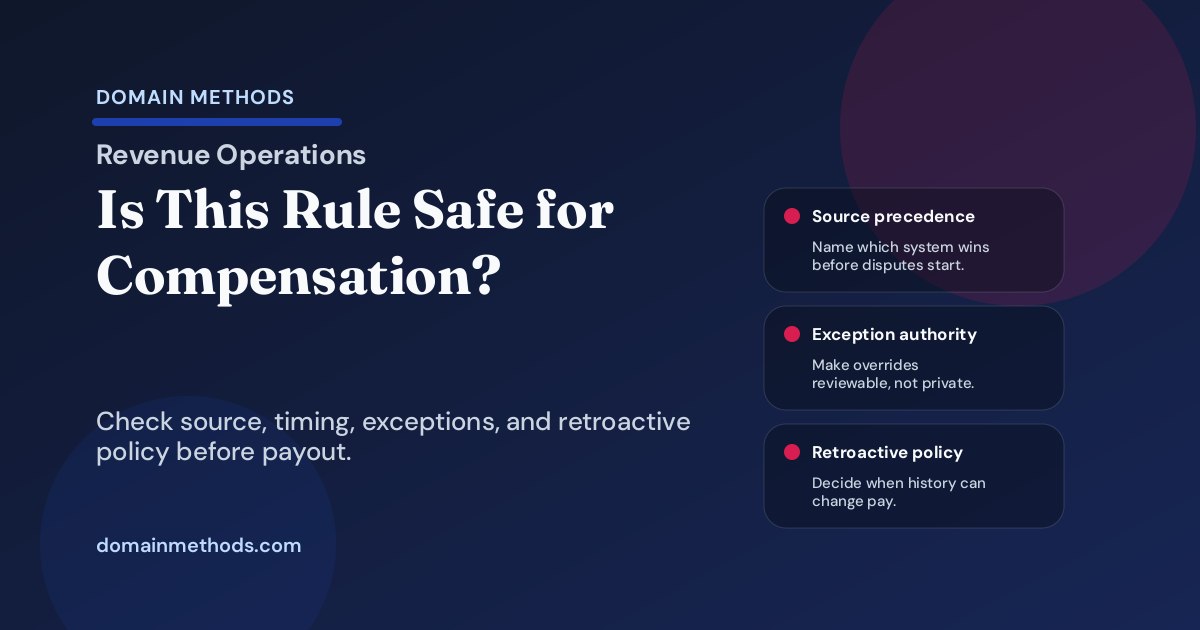
| Source precedence | Which CRM field, warehouse model, finance table, contract record, or partner source wins | The answer changes depending on who exports the file |
| Timing cutoff | Which date locks the rule: lead creation, opportunity creation, stage entry, close date, invoice date, or period close | Payout changes after late data cleanup lands |
| Eligibility and exclusions | Partner deals, expansions, renewals, reopens, duplicates, house accounts, and territory moves | Edge cases are settled privately after the dispute starts |
| Exception authority | Who can approve an override and what evidence is required | Every exception becomes a negotiation with the loudest stakeholder |
| Dispute log | Where challenges are recorded, resolved, and reviewed | The same argument repeats because last quarter’s decision disappeared |
| Retroactive-change policy | When historical records can change credit after payout or reporting | Reps and leaders cannot tell whether the rule is stable or provisional |
The lived-in detail is the cutoff. Many crediting fights are not really philosophical. They are timing fights. The deal was touched before the campaign cutoff, reassigned before the territory cutoff, invoiced after the finance cutoff, or updated after the commission run.
If the cutoff is not explicit, the confidence level is lower than the compensation plan implies.
Directional, decision-grade, compensation-grade, or not safe yet
Use the confidence band that matches the weakest critical control.
| Confidence band | What it means | Safe uses | Not safe yet |
|---|---|---|---|
| Directional | The rule is useful for learning, trend spotting, or prioritizing cleanup, but material controls are missing | Pipeline discussion, attribution learning, surfacing disputed handoffs | Payout, quota attainment, partner payment, retroactive credit changes |
| Decision-grade | The rule is stable enough for a named operating decision with visible caveats and accountable owners | Planning, territory discussion, budget prioritization, executive review | Commission calculation unless compensation controls are complete |
| Compensation-grade | The definition, source precedence, timing, exceptions, dispute log, and retroactive policy are documented and owned | Commission payout, quota credit, partner payment, sales-credit reporting | Uses outside the documented scope or period |
| Not safe yet | The rule is disputed, manually rescued, or materially inconsistent across systems | Evidence for repair work and leadership escalation | Any decision that changes pay, credit, or formal accountability |
A practical standard: if the team cannot explain what happens to a reopened opportunity, the rule is not compensation-grade. If partner and direct-sourced claims are resolved in Slack, the rule is not compensation-grade. If finance and sales use different dates and nobody has decided which date wins for payout, the rule is not compensation-grade.
That does not mean the data has no value.
It means the rule needs a label before it gets promoted into money movement.
Common conflict cases to settle before payout
Some conflict patterns deserve explicit treatment because they recur often enough to stop being surprises.
| Conflict case | Question to settle | Owner pattern |
|---|---|---|
| Sourced vs influenced revenue | Does the plan pay for first source, qualified source, last meaningful touch, or influence only? | Marketing, sales, and RevOps with executive sign-off |
| Partner vs direct-sourced deals | Which source wins when partner introduction and sales activity both exist? | Channel owner plus sales leadership and finance |
| Territory reassignment mid-cycle | Which owner gets credit if the account moves before close? | Sales operations and regional leadership |
| Expansion vs new business | Does expansion credit follow the account owner, originating team, success owner, or product motion? | Revenue leadership plus finance |
| Recycled or reopened opportunities | Does prior owner history matter after a reopen or stage reset? | RevOps with sales leadership |
| Finance-recognized revenue vs sales-credited bookings | Which number controls payout timing and which one controls operating narrative? | Finance owns policy; RevOps owns operating translation |
If the dispute is specifically about whether a partner sourced or influenced the deal, use the Partner Pipeline Confidence Check before the rule reaches payout or board reporting.
The operating tradeoff is fairness versus simplicity. A rule with twenty exception paths may feel fair in the moment and still become impossible to administer. A rule that is too simple may be easy to run and still reward the wrong behavior.
The goal is not a perfect rule. The goal is a rule the business can explain, apply consistently, and improve without surprise payout changes.
What the rule should not decide yet
The most valuable part of the checklist is often the limit it creates.
Write down what the crediting rule is not allowed to decide yet.
Examples:
- Do not use campaign-influenced revenue for commission payout if the team has not defined eligible influence windows.
- Do not pay partner credit from a partner field that sales managers can overwrite without review.
- Do not settle territory disputes from current account owner if the account moved after the opportunity was created.
- Do not use warehouse-calculated credit for payout if finance still reconciles commissions from CRM exports.
- Do not retroactively change rep credit after commission close unless the compensation plan explicitly allows it.
- Do not let a manually patched spreadsheet become the source of truth just because it resolved the last dispute faster.
This is not bureaucracy. It is how you keep an operating signal from becoming an incentive system before it is ready.
Mid-size SaaS teams often need to move before every data model is perfect. That is fine. But when the metric affects pay, the caveat cannot live in one person’s head.
A lightweight repair path
When a crediting rule is not compensation-grade, resist the urge to launch a giant governance program.
Fix the layer that is actually lowering confidence.
| Confidence gap | First useful repair | Who should own it |
|---|---|---|
| Definition is contested | Write the rule in plain English with examples and exclusions | RevOps with sales and finance sign-off |
| Source precedence is unclear | Name the winning system and fallback path when sources disagree | RevOps plus data/analytics and finance |
| Timing cutoff moves | Publish the cutoff date, update policy, and post-cutoff exception rule | Sales ops plus finance |
| Exceptions are private | Create a lightweight exception request and approval log | RevOps with executive sponsor |
| Disputes repeat | Keep a dispute log with final decision, rationale, and next rule change | RevOps and sales leadership |
| Retroactive changes are messy | Define when history can change and whether payout can be clawed back or adjusted later | Finance and executive sponsor |
The sequencing matters. If source precedence is unclear, do not start by redesigning the dashboard. If the source is stable but exceptions are handled privately, do not solve it with a warehouse model. If finance policy and sales-credit policy are different on purpose, document both instead of forcing one number to play both roles.
Repair the control that is actually making the rule unsafe.
Use the worksheet before the next compensation-sensitive review
The worksheet below is intentionally lightweight. Use it for one rule and one decision: rep quota credit, partner credit, expansion credit, sourced pipeline, territory ownership, or revenue recognition handoff.
Download the Quota-Crediting Confidence Worksheet
Use this worksheet to classify one crediting rule, identify the weakest control, and decide whether it is safe for compensation or only safe for operating review.
Instant download. No email required.
Want future posts like this in your inbox?
This form signs you up for the newsletter. It does not unlock the download above.
Do not use it to audit the whole compensation plan in one sitting. The point is to leave the review with a confidence band, a clear unsafe use, a named owner, and the first repair needed before payout depends on the rule.
When to bring in outside help
If the conflict is mainly about which team definition should win, start with Three Teams, Three Numbers. Quota-crediting disputes often expose a broader metric-alignment problem: sales, marketing, RevOps, finance, and data can each be locally right while the business still lacks one executive rule.
If the definition is clear but the source path cannot hold, the next move is Data Foundation. Compensation-sensitive reporting cannot depend on undocumented CRM fields, brittle warehouse logic, private spreadsheet reconciliation, or source precedence that changes by meeting.
For broader context, this checklist pairs well with The Metric Confidence Ladder, How to Escalate a Directional Metric Without Turning It Into Board-Grade Fiction, The GTM Handshake Benchmark, The Revenue Definition Cleanup Sprint, and How to Run a Source-of-Truth Audit Without Turning It Into a Tooling Debate.
The standard is simple: use crediting data when it helps leaders see the operating truth earlier, but do not let the rule change compensation until the definition, source precedence, timing, exception path, dispute log, and retroactive-change policy can survive scrutiny.
Download the Quota-Crediting Confidence Worksheet
A lightweight worksheet for classifying whether one crediting rule is directional, decision-grade, compensation-grade, or not safe for payout yet.
DownloadIf sales, marketing, RevOps, and finance each have a defensible answer
Three Teams, Three Numbers
Use the diagnostic when quota credit, revenue ownership, or metric definitions are technically explainable but politically expensive because no shared decision rule exists.
Start with the metric-alignment diagnosticIf the crediting rule breaks in the source systems
Data Foundation
Use Data Foundation when compensation-sensitive reporting depends on brittle CRM logic, unclear warehouse models, missing lineage, or manual finance reconciliation.
See Data FoundationSee It in Action
Common questions about quota-crediting confidence
What is quota-crediting confidence?
When is a crediting rule not safe for compensation yet?
What is the difference between decision-grade and compensation-grade?
Who should own quota-crediting rules?

About the author
Jason B. Hart
Founder & Principal Consultant
Helps mid-size SaaS companies turn messy marketing and revenue data into decisions leaders trust.