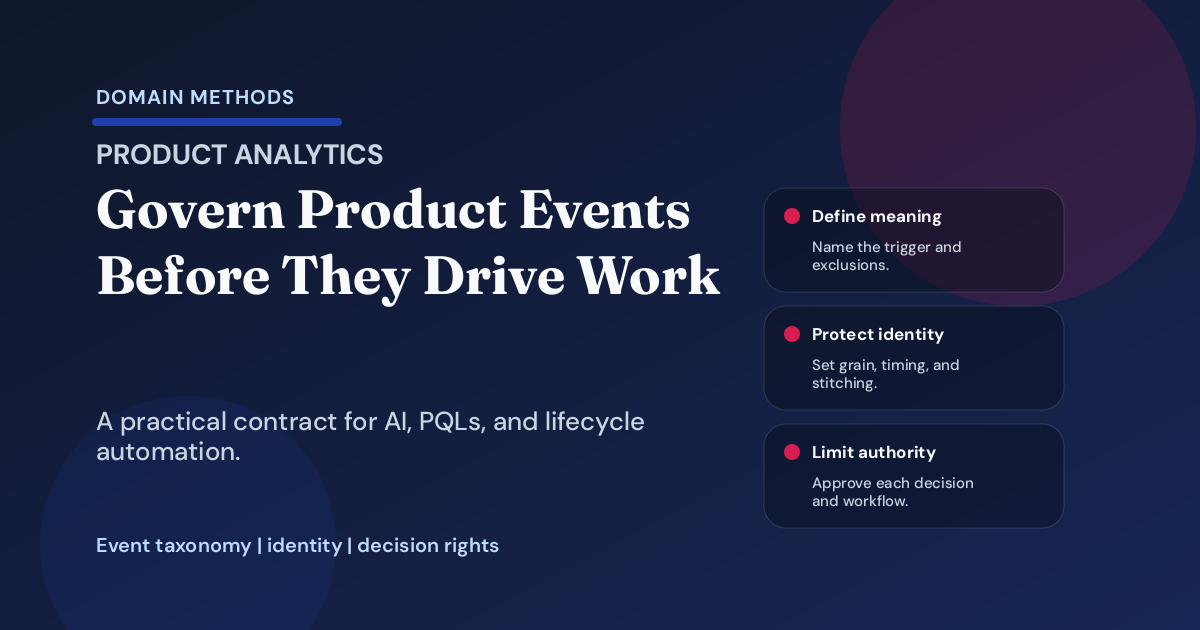
The Product Event Governance Checklist: Before Product Data Feeds AI or GTM Workflows
- Jason B. Hart
- Product Analytics
- July 11, 2026
Table of Contents
What is product event governance?
Product event governance is the operating contract that says what an event means, how it is identified and timed, who may change it, and which decisions it is trusted to support.
A tracking tool can tell you that workspace_activated fired. It cannot tell you whether the event means the same thing to product, growth, data, RevOps, and the AI assistant reading the activation metric next quarter.
That gap causes ordinary, expensive failures. A product team changes an activation trigger from three completed steps to two and the activation rate jumps overnight. An anonymous trial user is stitched to the wrong account and creates a false product-qualified-account signal. A delayed feature-use event enters a lifecycle audience after the customer has already changed plans. The pipeline is technically green; the workflow is still wrong.
This checklist is not a request to document every click in the product. Pick one important event or event family tied to a real decision. Govern that path well enough that the people downstream can explain what changed, why they trust it, and when they should stop using it.
Product Event Contract and Tracking Plan Worksheet
Use this lightweight worksheet to define one product event, set identity and time rules, map downstream consumers, assign change control, and limit which decisions the event may support.
Instant download. No email required.
Want future posts like this in your inbox?
This form signs you up for the newsletter. It does not unlock the download above.
Start with the decision, not the tracking tool
Before anyone debates Segment, RudderStack, Snowplow, Amplitude, Mixpanel, warehouse collection, or a homegrown SDK, name the decision the event is supposed to improve.
Use a sentence a workflow owner can review:
- “Route a trial account to sales after the workspace reaches meaningful team adoption.”
- “Move an account into an onboarding-risk review when setup stalls for seven days.”
- “Measure whether a new collaboration feature changes retained usage.”
- “Give an AI assistant current, inspectable evidence for an account-health summary.”
Avoid starting with “track the button” or “capture feature usage.” Those are implementation tasks, not business decisions.
The operator-level tradeoff is scope. A broad tracking plan feels comprehensive, but it spreads review attention across hundreds of low-stakes events. One governed event family tied to a costly decision usually creates more trust than a beautifully formatted catalog nobody can maintain.
If leadership cannot agree which product-data use case deserves the work, use The $500K Question before expanding instrumentation. Choosing the bet comes before perfecting its telemetry.
The event contract: eleven fields that have to be explicit
A useful contract should fit on one or two pages. It should be specific enough that a new analyst can inspect the event and a workflow owner can reject a risky use.
| Contract field | What to write down | Failure it prevents |
|---|---|---|
| Decision or workflow | The metric, experiment, route, message, score, AI answer, or executive claim the event may support. | Collection expands without a clear business use. |
| Canonical event name | One stable name plus any retired aliases. | Teams count old and new names as different behaviors. |
| Plain-English meaning | What happened in business and product terms. | The event name sounds precise while teams interpret it differently. |
| Trigger and exclusions | The exact condition that fires the event and the conditions that must not. | Retries, previews, test accounts, or partial completion inflate usage. |
| Entity and grain | User, account, workspace, subscription, device, session, or another unit. | User behavior is treated as account intent. |
| Source and owner | SDK, backend service, warehouse model, source table, product owner, and data owner. | Nobody can trace or approve a change. |
| Identity rules | Stable IDs, anonymous-to-known stitching, account membership, parent-child logic, and unresolved matches. | Activity lands on the wrong person or account. |
| Time rules | Event time, processing time, timezone, dedupe window, late arrival, replay, and backfill behavior. | Old or duplicated activity looks current. |
| Property contract | Required fields, allowed values, types, null/default handling, sensitive fields, and version. | A property change silently breaks metrics or audiences. |
| Downstream consumers | Models, dashboards, experiments, scores, audiences, CRM fields, prompts, and board metrics. | A “small” source change breaks work nobody knew depended on it. |
| Change control | Approver, tests, compatibility period, notification path, monitoring, rollback, and review date. | The definition drifts faster than the business can notice. |
The contract has to name both a business owner and a technical owner. Product may own what “activated” means. Data may own the event model, identity logic, and tests. RevOps may own the PQL field. Lifecycle may own the message. If only one team appears on the record, the contract is probably hiding the handoff where risk actually lives.
Define the event precisely enough to disagree before launch
A good event definition creates useful disagreement early.
Take workspace_activated. The name looks obvious until the room asks what counts:
- Did one user complete a setup checklist?
- Did the workspace connect a source and produce a successful output?
- Did two or more teammates perform the core behavior?
- Does a sample project count?
- Can the event fire again after a workspace resets?
- Does activation expire after inactivity?
These are not naming details. They decide who enters an experiment, which accounts sales calls, and what leadership sees as product adoption.
Write the trigger as a testable statement. For example:
Fire
workspace_activated_v2once when a production workspace connects a real data source, completes one successful run, and has activity from at least two non-employee users within fourteen days. Exclude demo, test, internal, and replayed workspaces.
That sentence gives engineering something to implement, analytics something to test, and growth something to challenge. “User activated” does not.
Version the meaning when the business rule changes. Renaming every change creates fragmentation, but silently reusing the same event for a materially different trigger corrupts the history. Keep the old definition queryable, document the compatibility window, and state whether historical metrics will be restated or intentionally break at the change date.
Identity rules decide whether the event belongs to the right customer
Product event programs often look clean at the user level and fall apart when the business acts at the account level.
One person can have an anonymous browser ID, a product user ID, a CRM contact ID, several email addresses, and memberships in multiple workspaces. One workspace can map to a billing account, a Salesforce account, a parent company, or none of those cleanly. PQL and PQA workflows force the identity question into the open.
Document these rules:
| Identity question | Contract answer needed |
|---|---|
| What is the stable event subject? | The immutable user, workspace, account, subscription, or device key. |
| When does anonymous activity join a known profile? | The exact authentication or verification event and whether earlier activity is backfilled. |
| Can one user belong to multiple accounts? | The membership rule and how event context preserves the active workspace. |
| How is workspace activity rolled up to an account? | The deterministic mapping, effective dates, and treatment of ambiguous matches. |
| What happens when identity is unresolved? | Quarantine, directional-only use, or manual review instead of a guessed match. |
| How are employees and test tenants handled? | A durable exclusion rule, not an analyst-maintained spreadsheet. |
The lived-in failure mode is a consultant, agency, or shared-domain user who belongs to several customer workspaces. If the pipeline attaches all their activity to the most recently seen account, the event count can be “complete” and the account signal can still be false.
For downstream CRM ownership, pair this contract with the CRM Field Ownership Checklist. The product event can be right at the source and still become wrong when it is rolled up or written onto the record sales uses.
Time rules matter because workflows have clocks
A dashboard can tolerate some late-arriving events. A lifecycle trigger sent tomorrow morning may not.
The contract should distinguish event time from processing time. It should also say what happens when mobile clients reconnect, imports replay historical activity, duplicate requests arrive, or a bug fix backfills missing events.
Use the workflow to set the rule:
| Workflow | Time question | Safer rule |
|---|---|---|
| Product trend analysis | Can late data be restated without changing a live customer action? | Accept documented late arrival and restate the analysis window. |
| Experiment analysis | Could late or duplicate events change exposure or outcome assignment? | Freeze assignment logic, dedupe deterministically, and document the analysis cutoff. |
| PQL/PQA routing | Could an old event create new sales work? | Carry event timestamp and expiry; do not route stale activity. |
| Lifecycle message | Could the customer’s state change before send? | Re-evaluate eligibility and suppressions immediately before action. |
| AI account summary | Will the assistant present old activity as current? | Include freshness, source, and caveat in the context passed to the assistant. |
A common mistake is measuring freshness at the pipeline level: “events arrive within six hours.” The workflow needs a different answer: “this signal expires after seventy-two hours and cannot create a new task after that.” One describes infrastructure. The other protects work.
Govern properties and derived metrics together
The event name is only part of the contract. Properties often carry the meaning that changes the decision.
For workspace_activated_v2, the workflow may depend on:
workspace_idaccount_idactivation_pathsource_typemember_countfirst_success_atenvironmentevent_version
Each required property needs a type, allowed values, null rule, source, owner, and version path. Avoid default values that make missing data look real. member_count = 0 and member_count = unknown are different operating facts.
Then map every derived consumer. The event may feed an activation rate, an experiment outcome, a PQA score, a lifecycle audience, a churn feature, an AI summary, and a quarterly product metric. The same source event does not automatically deserve the same confidence in every consumer.
This is where the Activation Data Contract picks up the work. The product event contract governs the source signal. The activation contract governs what a warehouse model, score, audience, or field is allowed to change after it leaves the source layer.
Add change control before the first definition change
The first version of the event is rarely the hard part. The hard part is the quiet change six months later.
A product team ships a faster onboarding flow. Engineering moves the trigger from a backend success event to a client confirmation. Growth adds an easier activation path. Data backfills the new property. The dashboard still renders, so everyone assumes the metric survived.
The change record should answer:
- What definition, trigger, property, identity rule, or source is changing?
- Is the change backward-compatible?
- Which dashboards, experiments, scores, audiences, CRM fields, prompts, and executive metrics consume it?
- Who approves the business meaning and who approves the technical implementation?
- How long will old and new versions coexist?
- Which test compares counts, identities, properties, and real examples?
- What pauses the rollout and restores the prior path?
- When will downstream owners review the first live examples?
A strong QA pass includes both positive and negative cases. Confirm that qualifying behavior fires once. Also confirm that demos, retries, test workspaces, anonymous mismatches, replayed events, and incomplete flows do not.
For the downstream launch review, use the Data Activation QA Checklist. It covers destination mapping, freshness, suppression, alerts, rollback, and the first post-launch review after trusted data starts changing work.
Set the confidence bar by decision type
Do not label an event “trusted” once and apply that label everywhere. Trust depends on what the business is about to do with the signal.
On a smaller screen, scroll horizontally to compare all four columns.
| Decision use | Minimum confidence bar | Allowed now | Keep forbidden until the bar is met |
|---|---|---|---|
| Product analytics | Stable meaning, known exclusions, visible version boundaries, directional QA. | Trend analysis, exploratory funnels, manual investigation. | Exact cross-period claims when the definition changed silently. |
| Experimentation | Stable exposure/outcome logic, deterministic identity, dedupe, cutoff, sample-ratio checks. | Experiment readout with documented limitations. | Causal claims when assignment or outcome events drifted. |
| PQL/PQA routing | Tested user-to-account mapping, current signal, reason codes, destination owner, pause path. | Human-reviewed routing or limited rollout. | Automated rep tasks from ambiguous or stale activity. |
| Lifecycle automation | Current eligibility, consent and suppression rules, destination recheck, rollback owner. | Narrow message or journey with holdout and sample review. | Broad customer messaging from stale state or missing exclusions. |
| Churn or expansion scoring | Stable feature history, account grain, outcome definition, reason codes, monitoring. | Human-reviewed prioritization with confidence labels. | Automated intervention or lift claims without workflow and evidence checks. |
| AI assistants | Inspectable source, freshness, identity, caveat, authority level, human-review threshold. | Suggest or summarize within a tested workflow. | Confident answers or actions beyond the event's approved authority. |
| Executive or revenue reporting | Governed definition, reconciled grain, historical comparability, named owner, decision-grade evidence. | Explicitly labeled directional or decision-grade reporting. | Board-grade or revenue claims from ungoverned telemetry. |
This table is intentionally uneven. Product exploration should move faster than customer-facing automation. An event can be useful in a trend chart while still being unsafe for a rep queue or AI action. That is not inconsistency; it is matching the evidence bar to the cost of being wrong.
Worked example: workspace_activated_v2 to PQA routing
Here is the full chain for one product-qualified-account workflow.
| Layer | Governed answer |
|---|---|
| Business decision | Sales reviews accounts that reached meaningful team activation within the last seven days. |
| Event | workspace_activated_v2 fires once after a real source connection, successful run, and two non-employee active users within fourteen days. |
| Entity | Workspace event with immutable workspace_id; deterministic workspace-to-billing-account-to-CRM-account mapping. |
| Time | Backend event time is canonical; duplicates share an idempotency key; signal expires after seven days; backfills never create new sales tasks. |
| Properties | workspace_id, account_id, activation_path, member_count, first_success_at, environment, event_version. |
| Derived metric | account_activation_current is true when at least one eligible workspace activated and the account is not a test, partner, or existing customer excluded from the motion. |
| PQA signal | The score includes activation plus fit, buying-stage, and account context. The event alone does not qualify the account. |
| CRM workflow | HubSpot or Salesforce receives the score, reason code, activation timestamp, and source link; reps review before outreach during the first rollout. |
| Change control | Product approves trigger meaning; data approves identity/tests; RevOps approves CRM behavior; sales leadership approves the outreach play. |
| Rollback | Pause task creation, preserve prior context, quarantine new matches, review bad examples, then restart only after owners sign off. |
Now look at the failure modes the contract exposes:
- If engineering renames the event without maintaining the alias, activation appears to collapse.
- If anonymous activity is stitched after a consultant logs into several workspaces, the wrong account looks active.
- If a seven-day-old event arrives after a mobile reconnect or backfill, sales gets a stale “new” task.
- If
member_countbecomes optional and defaults to zero, a healthy account can fall out of the score. - If the PQA model treats this one event as qualification rather than one feature, product curiosity becomes sales work.
This chain connects source governance to the real handoff shown in the predictive PQL case study. Product behavior becomes useful when its meaning survives identity, scoring, CRM delivery, rep context, and evidence review.
Run a 45-minute product event contract review
Bring one real event, one real account or workspace, and one downstream consumer. Do not review the taxonomy in the abstract.
| Minute | Review question | Owner |
|---|---|---|
| 0-5 | Which decision or workflow is this event allowed to support? | Product or growth owner |
| 5-15 | What exactly fires, what is excluded, and which entity does it belong to? | Product + engineering + data |
| 15-25 | How do identity, event time, late arrival, dedupe, replay, and backfill work? | Data or analytics engineering |
| 25-32 | Which properties and derived metrics consume the event? | Data + metric owner |
| 32-38 | Who approves changes, tests real examples, notifies consumers, and rolls back? | Cross-functional owners |
| 38-45 | Which uses are allowed now, review-only, or forbidden until repaired? | Workflow owner |
End with one of three decisions:
- Approved for the named use. The contract is specific, tests pass, and owners accept the workflow risk.
- Approved with limits. Keep the event directional, human-reviewed, or limited to one workflow while the team watches real examples.
- Not ready. Fix the event meaning, identity, timing, property, lineage, ownership, or rollback gap before the event changes work.
The practical payoff is not a perfect taxonomy. It is knowing what one important event can safely do next.
Route the failure to the right next move
If the event contract fails, do not solve every failure with more instrumentation.
| The contract exposes… | Better next move |
|---|---|
| Unclear event meaning, identity stitching, source precedence, lineage, or historical comparability | Repair the Data Foundation before the signal makes a stronger promise. |
| Product events are about to feed AI answers, scoring, recommendations, or automation without clear authority | Run the AI-Ready Data Diagnostic and classify what may suggest, assist, route, or act. |
| The event is governed, but the downstream field, audience, score, or workflow is not | Write the Activation Data Contract and run Data Activation QA. |
| The team still cannot agree which product-data workflow deserves investment | Use The $500K Question to rank the bet before building more telemetry. |
| A Customer 360 profile is rich but its workflow authority is unclear | Run the Customer 360 workflow survival test. |
Product analytics becomes trustworthy when the event can survive contact with a real decision. That requires more than a clean event name. It requires an explicit meaning, identity, clock, owner, version, test path, and limit on use.
Govern one important event family first. Make the contract inspectable. Let low-risk analysis move with honest caveats, and raise the bar before the same signal routes a rep, messages a customer, informs an executive claim, or gives AI permission to act.
Download the Product Event Contract and Tracking Plan Worksheet (PDF)
A lightweight working sheet for defining one event, its identity and time rules, downstream consumers, change controls, and allowed decision uses.
DownloadProduct data about to feed AI?
AI-Ready Data Diagnostic
Use the diagnostic to decide which product-data signals are safe to suggest, assist, route, or act on before AI turns weak telemetry into confident work.
See the AI-Ready Data DiagnosticIdentity or event meaning still brittle?
Data Foundation
Start with the foundation when event semantics, source precedence, identity stitching, lineage, or change control cannot yet support the workflow promise.
See Data FoundationSee It in Action
Common questions about product event governance
What is product event governance?
Is this the same as an event taxonomy or tracking plan?
Who should own a product event?
When is a product event ready for PQL or PQA routing?
Can the same product event be safe for analysis but unsafe for AI automation?
Does product event collection need privacy or legal review?

About the author
Jason B. Hart
Founder & Principal Consultant
Helps mid-size SaaS companies turn messy marketing and revenue data into decisions leaders trust.