The Partner Pipeline Confidence Check: When Partner-Sourced Revenue Is Safe Enough to Trust
- Jason B. Hart
- Revenue Operations
- July 9, 2026
Table of Contents
What is the partner pipeline confidence check?
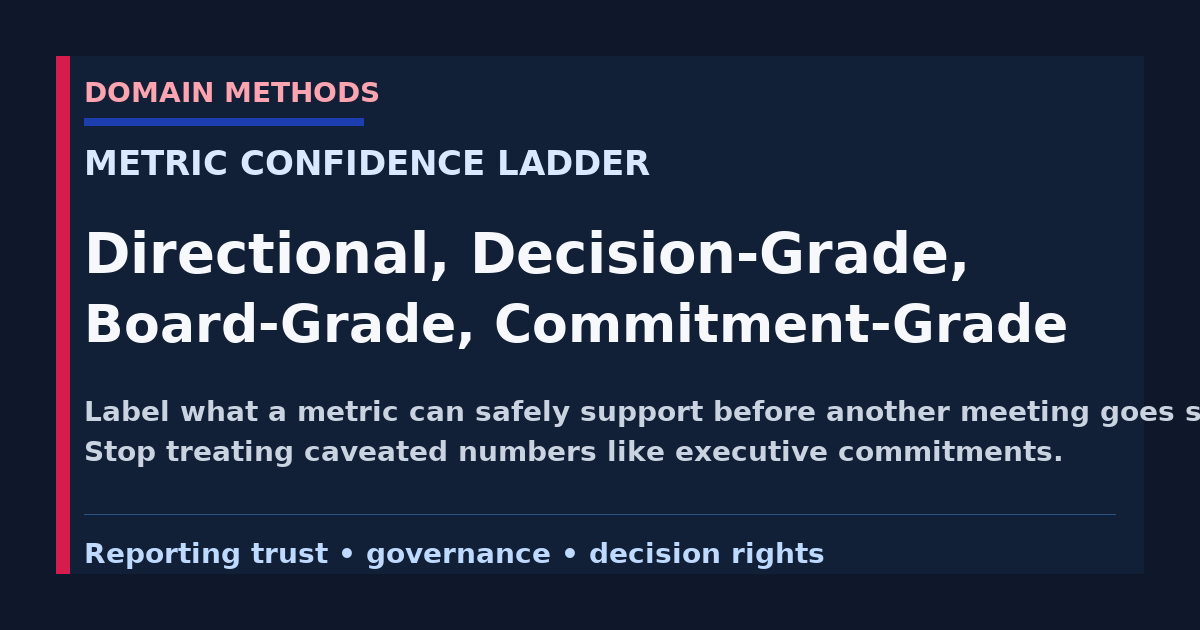
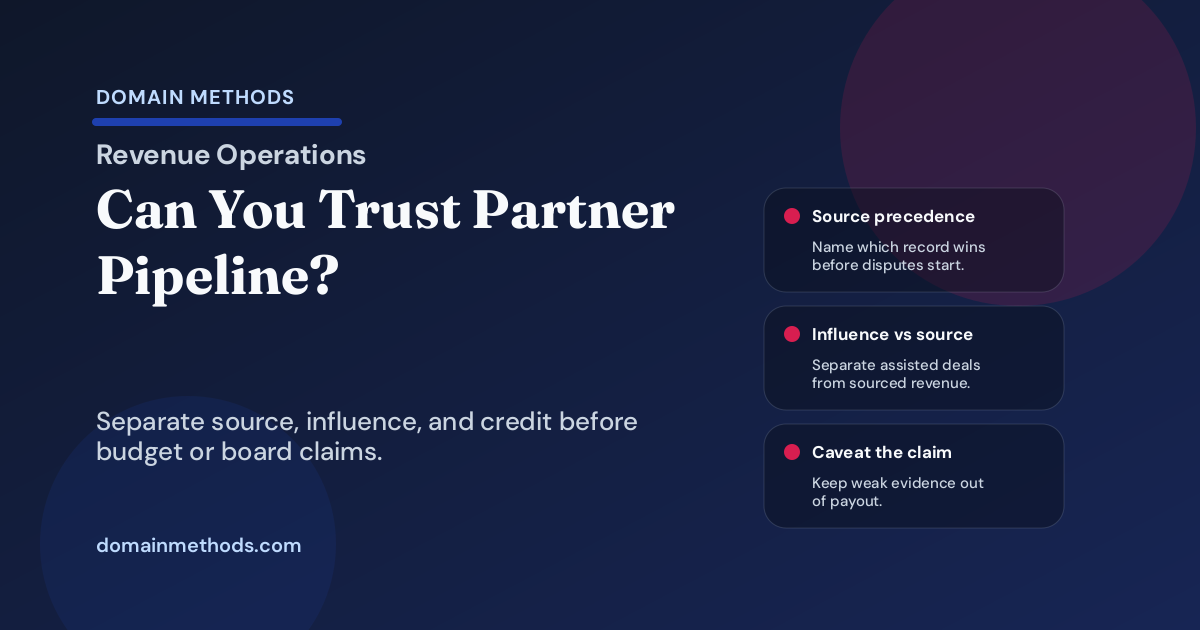
The Partner Pipeline Confidence Check is a practical way to decide whether partner-sourced or partner-influenced revenue is trustworthy enough for the decision leaders want to make with it.
Partner pipeline sounds like a clean number until somebody asks what it should decide.
Marketing may want partner influence included in the channel story. Sales may want source credit to follow the rep who created the opportunity. The partner team may have a portal referral, a co-sell note, or a signed partner agreement. Finance may care only about recognized revenue and commission policy. RevOps may know the account association changed three times before the deal closed.
None of those views are automatically wrong. The problem is letting one partner-pipeline number travel into a budget, commission, or board conversation without saying what evidence sits underneath it.
The useful question is not, “Did a partner touch this deal?”
The better question is: is this partner-pipeline number safe enough for the job the business is giving it?
If the answer is no, the number can still help. It can show where the channel motion is producing signal, where source rules are weak, and where partner reporting needs a cleaner data contract. It just should not quietly become the number that changes spend, credit, payout, or executive narrative.
Why partner pipeline gets messy quickly
Partner reporting sits at an awkward intersection: source capture, attribution, sales credit, partner program economics, and finance recognition.
The messy cases are usually ordinary, not exotic:
- A partner submits a referral after sales has already opened the opportunity.
- A partner influenced the buying committee, but the CRM source says paid search or outbound.
- A reseller relationship exists, but the opportunity was created by an AE and later tagged by the channel team.
- A partner portal accepts a deal, while the CRM campaign history shows multiple earlier touches.
- A co-sell note lives in a text field that never reaches the warehouse model.
- Finance recognizes revenue from the contract, while the partner report still uses booked pipeline.
This is why partner pipeline needs a confidence label. A partner-influenced number can be useful for learning and channel planning without being safe for partner commission. A partner-sourced number can be useful for board color without being safe for quota credit if the source rule is still disputed.
The operating tradeoff is speed versus consequence. You can use imperfect partner data to spot patterns quickly. You need stronger controls before the same number affects money, credit, or a public leadership claim.
Start with the decision the number will support
Do not begin by auditing every partner field. Start by naming the decision.
| Decision | What leaders usually want from partner pipeline | Confidence bar |
|---|---|---|
| Directional channel read | A broad sense of whether partner motion is creating qualified opportunities | Directional is enough if caveats are visible |
| Budget or channel-planning decision | A stable view of which partner motion deserves more investment | Budget-ready / decision-grade |
| Sales credit or partner payout | A rule that can survive disputes, eligibility checks, and audit trail review | Crediting-ready |
| Board or investor narrative | A clean explanation of partner contribution without overstating certainty | Board-grade or explicitly caveated |
| Source-contract repair | Evidence that the current CRM, portal, campaign, or finance path cannot support the decision | Directional evidence is enough to justify repair |
This keeps the conversation honest. A partner metric can be directionally useful and still unsafe for payout. It can help a VP understand channel contribution and still need a caveat before it goes into a board deck.
The mistake is letting the word “partner” carry the confidence level by default.
Sourced, influenced, assisted, or just adjacent?
The first control is definition. Partner pipeline becomes political when teams use the same label for different jobs.
| Label | Practical meaning | Common evidence | Safe use without stronger proof |
|---|---|---|---|
| Partner-sourced | The partner created or introduced the opportunity before direct sales motion owned it | Accepted referral, partner portal timestamp, CRM source, referral agreement | Source reporting, channel planning, crediting only if eligibility rules are documented |
| Partner-influenced | The partner materially affected an opportunity that may have started elsewhere | Co-sell notes, campaign touches, partner meeting history, sales confirmation | Directional contribution, budget discussion, narrative with caveat |
| Partner-assisted | The partner helped validate, implement, expand, or close after the opportunity was already active | Implementation notes, account plan, late-stage partner activity | Operating learning and enablement planning |
| Partner-adjacent | A partner exists in the account ecosystem, but the deal evidence is weak or incidental | Account mapping, partner relationship, loose notes | Do not count as sourced or influenced without a caveat |
The lived-in detail is timing. If a partner referral arrives after an AE has already qualified the opportunity, that may still be useful partner activity. It is not automatically partner-sourced pipeline. If a partner joins a late-stage technical review, that may be meaningful help. It is not automatically sourced revenue.
Write the distinction before looking at the dashboard. Otherwise the dashboard will inherit the politics.
The source-precedence check
Partner pipeline confidence depends on deciding which record wins when sources disagree.
| Source or signal | What it can prove | Where it usually breaks |
|---|---|---|
| Partner portal | Referral submission, acceptance status, partner identity, and sometimes eligibility | Late submissions, duplicate accounts, weak opportunity matching |
| CRM source fields | First source, lead source, opportunity source, or partner flag | Overwrites, inconsistent picklists, source fields that mean different things by team |
| Campaign and touch history | Marketing influence, partner campaigns, event participation, nurture before handoff | Influence windows, missing offline touches, dark social, channel partner activity outside forms |
| Sales notes and account plans | Real co-sell context and buyer conversation history | Unstructured evidence, inconsistent logging, incentive-driven interpretation |
| Opportunity/contact/account association | Which buyer, account, and opportunity the partner activity should attach to | Parent/child accounts, duplicate contacts, merged opportunities, buying committee sprawl |
| Contract and finance records | Recognized revenue, booking date, customer entity, partner payment eligibility | Timing differences from sales reporting and pipeline snapshots |
A practical rule: the portal can prove referral submission, the CRM can prove the operating source only if fields are governed, the campaign layer can prove touch history, and finance can prove recognized revenue. None of those systems should be forced to answer every question alone.
If the team has not decided which source wins for each decision, partner pipeline should stay directional.
Confidence bands for partner pipeline
Use the confidence band that matches the weakest critical control.
| Confidence band | What it means | Safe uses | Not safe yet |
|---|---|---|---|
| Directional partner reporting | The signal is useful, but source, timing, or association controls are incomplete | Learning, trend spotting, channel discussion, repair prioritization | Partner payout, quota credit, board claims, budget reallocation without caveat |
| Budget-ready / decision-grade | Source/influence rules are stable enough for a named planning decision with visible caveats | Channel planning, partner enablement investment, executive operating review | Compensation or partner payment if eligibility and exception controls are incomplete |
| Crediting-ready | Source precedence, eligibility, timing cutoff, exception handling, and dispute logging are documented and owned | Partner credit, sales-credit discussion, commission-sensitive reporting inside the documented scope | Uses outside the documented motion, region, product, or period |
| Board-grade | The definition reconciles to the executive revenue story and the caveats are documented before the board packet is built | Board narrative, investor update, executive planning context | Claims that imply more precision than the source contract supports |
| Source-contract repair first | The number is materially disputed or manually rescued | Evidence for fixing CRM, portal, campaign, association, or finance logic | Any decision that changes spend, pay, credit, or formal accountability |
A simple test: if the same deal can be called partner-sourced in the portal, outbound-sourced in CRM, campaign-influenced in marketing automation, and direct-sold in sales notes, the number is not crediting-ready until precedence is explicit.
That does not mean the partner team gets no credit in the discussion. It means the business needs to label what kind of credit the evidence can support.
What partner pipeline should not decide yet
The most useful output may be the limit you put around the number.
Write down what partner pipeline is not allowed to decide yet.
Examples:
- Do not increase partner budget because influenced pipeline is rising if the influence window is undefined.
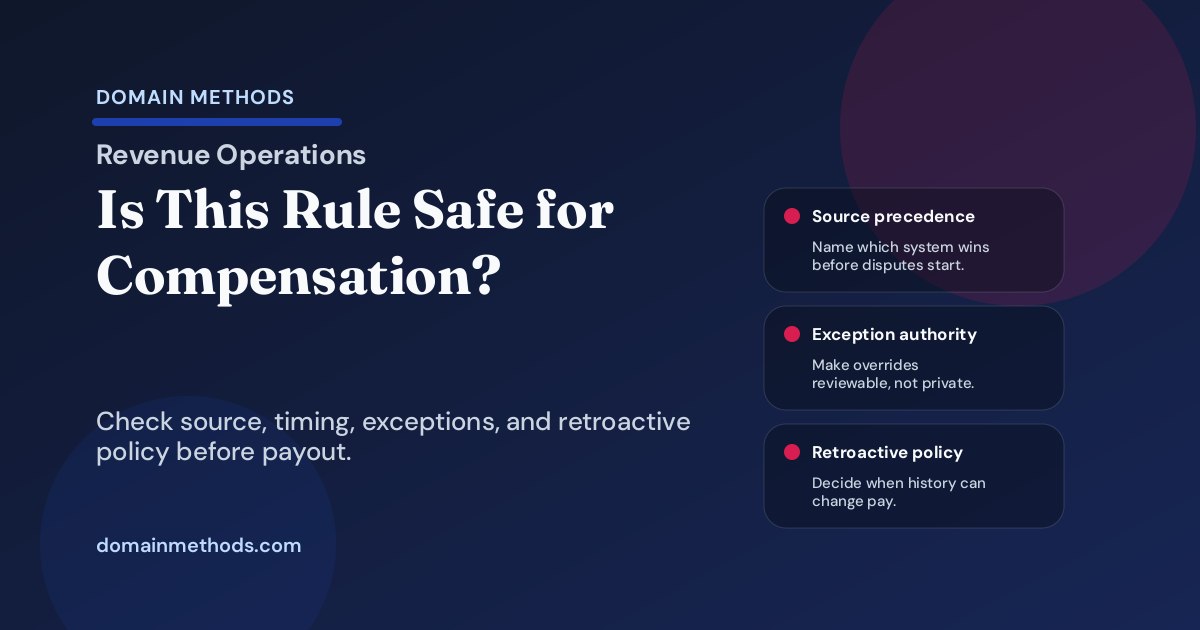
- Do not pay partner commission from a portal referral that sales can challenge without a documented eligibility rule.
- Do not count a deal as partner-sourced when the partner submission happened after opportunity qualification unless the source policy explicitly allows it.
- Do not tell the board partner-sourced revenue doubled if partner-assisted and partner-influenced deals are mixed into the same line.
- Do not use partner pipeline to settle sales-credit disputes when CRM owner, source, and partner acceptance rules disagree.
- Do not reconcile partner ROI from booked pipeline if finance recognizes revenue on a different entity or period.
This is not anti-partner. It is how you keep a valuable route-to-market signal from becoming false precision.
Partner motions often create real revenue that the default attribution model misses. The answer is not to ignore the signal. The answer is to make the source rule strong enough for the consequence attached to it.
A lightweight repair path
When partner pipeline is not ready for the decision, fix the control that is actually lowering confidence.
| Confidence gap | First useful repair | Owner pattern |
|---|---|---|
| Sourced, influenced, and assisted are mixed together | Write the three definitions with examples and exclusions | RevOps with sales, partner, and marketing sign-off |
| Portal and CRM disagree | Name which source wins for referral acceptance, source reporting, crediting, and finance reconciliation | RevOps plus partner operations and finance |
| Timing cutoff is unclear | Publish the referral, opportunity, acceptance, close, and commission cutoffs | Partner operations, sales ops, and finance |
| Account/opportunity matching is weak | Define account hierarchy, duplicate handling, contact association, and opportunity merge rules | Data/analytics with RevOps |
| Sales notes are the main evidence | Convert required co-sell evidence into structured fields or exception review | Sales leadership plus RevOps |
| Exceptions are private | Create a lightweight exception log with approver, evidence, and final ruling | RevOps with executive sponsor |
| Finance does not reconcile | Separate booked pipeline, recognized revenue, and partner-payment eligibility in the reporting layer | Finance with RevOps translation |
The sequencing matters. If the problem is eligibility, do not start with another dashboard. If the problem is opportunity association, do not settle it in a partner-program meeting. If finance and sales intentionally use different timing, document both and decide which one controls the decision in front of the room.
Repair the thing that makes the number unsafe.
Use the worksheet before the next partner review
The worksheet below is intentionally lightweight. Use it for one partner-pipeline number and one decision: a QBR claim, channel-budget ask, partner credit rule, sales-credit dispute, or board narrative.
Download the Partner Pipeline Confidence Worksheet
Use this worksheet to classify one partner-sourced or partner-influenced revenue number, document the unsafe uses, and name the first repair before the number drives spend, credit, or board narrative.
Instant download. No email required.
Want future posts like this in your inbox?
This form signs you up for the newsletter. It does not unlock the download above.
Do not use it to audit the whole partner program in one sitting. The point is to leave the review with a confidence band, one caveat that travels with the number, a named owner, and the first repair needed before the number gets promoted.
When to bring in outside help
If the fight is mainly about which team definition should win, start with Three Teams, Three Numbers. Partner pipeline disputes often expose the same operating problem as revenue-definition fights: sales, marketing, partner leadership, RevOps, finance, and data can each be locally reasonable while the business still lacks one executive rule.
If the partner contribution question sits inside a broader spend-confidence problem, start with SaaS Marketing Attribution or Where Did the Money Go?. Partner motion should not be invisible just because it does not fit cleanly into click-path reporting.
If the definition is clear but the data path cannot hold, the next move is Data Foundation. No amount of meeting discipline will make a brittle source field, ungoverned partner flag, weak opportunity association, or private spreadsheet reconciliation safe for compensation or board narrative.
For broader context, this check pairs well with The Quota-Crediting Confidence Checklist, The GTM Handshake Benchmark, The Attribution Health Check, How to Run a Source-of-Truth Audit Without Turning It Into a Tooling Debate, and Attribution vs MMM vs Incrementality.
The standard is simple: use partner pipeline when it helps the business see channel contribution earlier, but do not let the number claim more certainty than the definition, source precedence, timing, eligibility, and reconciliation rules can support.
Download the Partner Pipeline Confidence Worksheet
A lightweight worksheet for classifying whether one partner-sourced or partner-influenced revenue number is safe for reporting, budget, crediting, or board narrative.
DownloadIf source, influence, and credit rules differ by team
Three Teams, Three Numbers
Use the diagnostic when sales, marketing, RevOps, finance, and partner leaders each have a defensible partner-pipeline answer but no shared decision rule for which version wins.
Start with the metric-alignment diagnosticIf partner contribution is part of your spend-confidence question
SaaS Marketing Attribution
Use SaaS Marketing Attribution when partner, paid, outbound, and campaign influence need a clearer contribution model before budget or channel planning decisions.
See SaaS Marketing AttributionSee It in Action
Common questions about partner pipeline confidence
What is partner pipeline confidence?
What is the difference between partner-sourced and partner-influenced pipeline?
When should partner pipeline stay directional?
Who should own partner pipeline rules?

About the author
Jason B. Hart
Founder & Principal Consultant
Helps mid-size SaaS companies turn messy marketing and revenue data into decisions leaders trust.