Observed, Modeled, Attributed, or Incremental? The Marketing Measurement Confidence Stack
- Jason B. Hart
- Marketing Analytics
- July 9, 2026
Table of Contents
What is the difference between observed, modeled, attributed, and incremental conversions?
Observed evidence comes from an event the measurement system directly captured. Modeled evidence fills part of a gap through inference. Attributed evidence assigns credit under a defined rule. Incremental evidence estimates what happened because of a treatment by comparing it with a credible counterfactual.
Those labels describe different claims. They are not four rungs on a maturity ladder.
An observed conversion can still be duplicated, biased, or disconnected from revenue. A modeled conversion can be useful for bidding without revealing an individual journey. Attribution can organize known touches without proving causality. An incrementality test can support a causal claim in one context without becoming permanent truth for every market, audience, or quarter.
The practical question is not, “Which number is real?” It is:
What created this number, and what decision is it safe to carry?
That question matters when a platform conversion total, an attribution report, a CRM pipeline view, and a lift study all appear in the same budget packet. They may all be useful. They are not interchangeable.
The same conversion total can contain different evidence
Consider a mid-market SaaS company running paid search and LinkedIn campaigns.
A buyer clicks an ad, submits a demo form, and enters the CRM. The form submission is observed. The contact later joins an account, an SDR accepts it, and an opportunity is created. Those events may also be observed, but only if identity, timestamps, and contact-to-account logic survive the handoff.
Now the evidence starts to split.
The ad platform may report a total that includes directly connected conversions and modeled conversions. Google’s current consent-mode documentation says modeled conversions can appear in the standard Conversions column and flow into downstream reporting and bidding. The CRM may credit the opportunity to paid search under an original-source rule. A multi-touch report may split credit across search, LinkedIn, content, and sales touches. A lift test may ask whether the campaign produced more qualified opportunities than the business would have seen without it.
One buyer journey can therefore produce several defensible numbers:
- an observed form submission
- a modeled platform conversion
- attributed pipeline under a source or touch rule
- an incremental estimate from a treatment/control comparison
The values can coexist because they answer different questions. Trouble starts when the slide removes the labels and presents one blended total as observed revenue caused by marketing.
This is especially common in long sales cycles. The fastest signal is usually closest to the platform. The economically strongest outcome appears later in CRM, billing, or finance. Every handoff adds timing, identity, and definition risk.
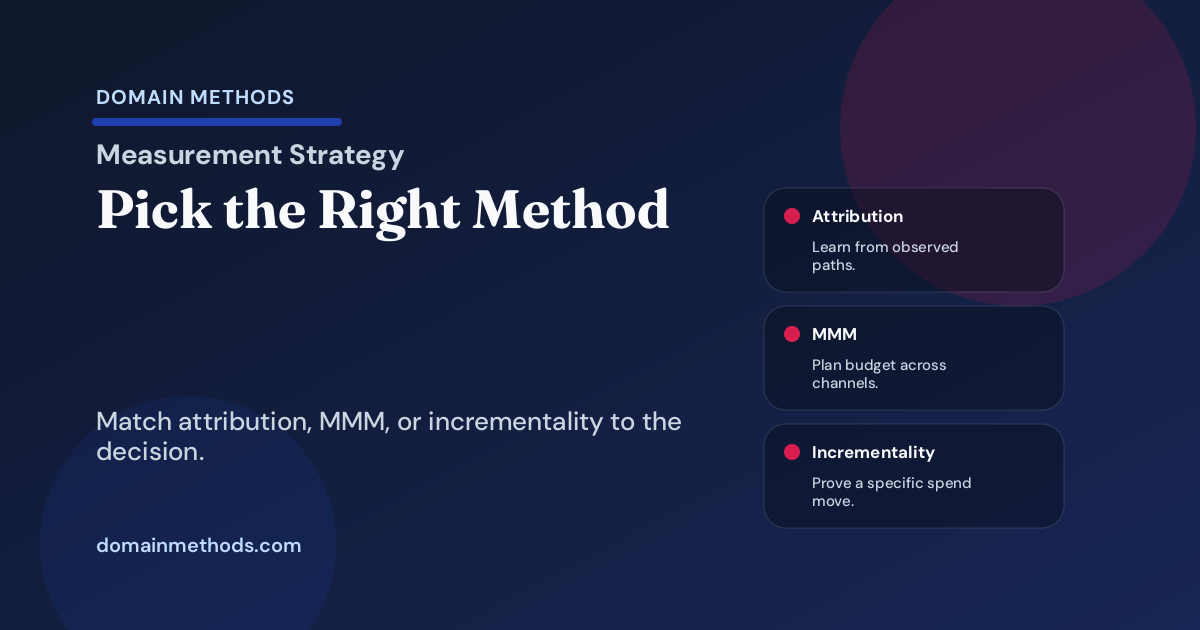
Use the First-Party Measurement Readiness Checklist when the capture and revenue path itself is still unclear. Use the B2B Offline Conversion Feedback Loop when observed CRM outcomes need a governed path back into platform measurement or optimization. Use the Attribution vs MMM vs Incrementality guide when the team needs to choose a method. This article handles the layer between them: the evidence label and its decision right.
Evidence comparison matrix
| Evidence class | How the number is produced | Useful for | What it does not prove | Common failure mode | Caveat the meeting should carry |
|---|---|---|---|---|---|
| Observed | A conversion or outcome is directly captured through the available browser, server, CRM, product, billing, or warehouse path | Event QA, operational reporting, path analysis, reconciliation | That capture is complete, unbiased, deduplicated, or causal | The easiest event to observe becomes the business outcome by default | State the capture boundary, missing channels, dedupe rule, timing, and economic layer |
| Modeled | A platform or model infers missing conversions or paths from observable data and assumptions | Bidding, gap adjustment, directional planning, measurement under partial observability | An individual journey, neutral cross-channel truth, or a directly observed outcome | Modeled values appear in a familiar total and lose their provenance label | State what was modeled, by whom, over which scope, and how it was reconciled |
| Attributed | A rule assigns credit to one or more touches, sources, campaigns, or channels | Source governance, journey diagnostics, pipeline reporting, weekly channel learning | That the credited touch caused the outcome | The credit rule is treated as a causal mechanism or finance truth | State the rule, window, source precedence, exclusions, and revenue definition |
| Incremental | A randomized test or credible counterfactual compares treatment with what likely would have happened otherwise | Causal validation of a specific campaign, spend change, audience, geography, or workflow | Permanent truth outside the tested population, period, treatment, and outcome | One favorable test is generalized to the whole portfolio or future | State the design, uncertainty, scope, outcome, contamination risk, and freshness |
The operator detail is simple: provenance belongs in the report, not in a footnote someone has to ask for.
A report can include all four evidence classes. It should not flatten them into one confidence level.
Which evidence can carry which decision?
Use this as a decision-rights matrix, not a traffic-light scorecard. Many material decisions need a combination.
| Decision | Evidence that can help | What must be true before action |
|---|---|---|
| Campaign QA | Observed events; modeled totals as a secondary signal | Event firing, dedupe, timing, and platform configuration are understood |
| Automated bidding or platform optimization | Observed and modeled conversions | The optimization event is economically useful, modeled scope is known, bad signals can be paused, and outcomes are reconciled downstream |
| Weekly channel tuning | Observed paths plus attributed outcomes | Source rules and campaign taxonomy are stable enough for directional comparisons |
| Quarterly budget allocation | Attributed and modeled evidence, often with MMM or incremental validation | The outcome ties to pipeline, revenue, net revenue, or margin; major uncertainty is explicit |
| Finance reconciliation | Observed CRM, billing, warehouse, and finance outcomes | Credit rules are separated from recognized revenue and accounting definitions |
| Board explanation | Reconciled observed outcomes plus transparent attributed/modeled context | The packet states what is captured, inferred, credited, excluded, and still uncertain |
| Causal lift claim | Incremental evidence from a credible experiment or counterfactual | Treatment, control, outcome, timing, uncertainty, contamination, and scope are documented |
| AI recommendation or automated action | Certified observed/modeled inputs plus a decision-specific confidence label | Owner, exceptions, monitoring, rollback, and prohibited actions are explicit |
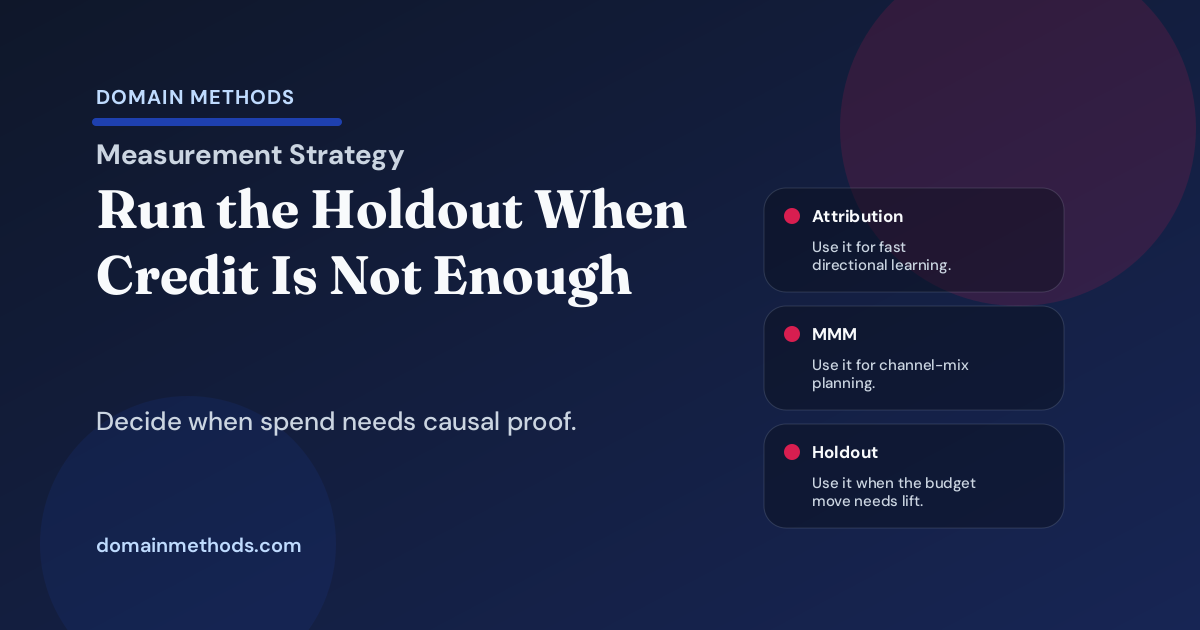
A quarterly budget decision may use attribution to find the pressure point, MMM to frame the portfolio, and a holdout to test the expensive uncertainty. That is not redundancy. It is a division of labor.
The holdout-test readiness guide covers when the causal test is worth running. The MMM guide for SaaS and ecommerce covers the portfolio layer. Neither should be forced to impersonate the other.
The measurement provenance checklist
Before a number changes spend, executive narrative, or an automated workflow, ask seven questions.
- What was directly observed? Name the event, system, timestamp, identity key, and capture boundary.
- What was inferred or modeled? Name the platform or model, the gap it fills, and whether the modeled portion is visible separately.
- What rule assigned credit? Record the attribution window, source precedence, touch rule, dedupe logic, and exclusions.
- What control or counterfactual supports a lift claim? If there is none, do not use causal language.
- Which outcome definition is in scope? Conversion, qualified pipeline, bookings, recognized revenue, net revenue, and margin are different economic layers.
- Which caveat must travel with the number? Consent, identity, timing, missing data, channel coverage, seasonality, contamination, and reconciliation all belong here.
- Who owns the decision this number may change? A metric without a decision owner usually gets overclaimed when convenient and ignored when uncomfortable.
One lived-in failure mode shows up repeatedly: the report is technically correct, but its strongest caveat is delivered verbally. Two weeks later, the screenshot survives and the caveat does not.
Write the caveat into the artifact.
Four confidence labels for the decision
The label belongs to a number for a specific decision. It does not attach to a metric forever.
| Confidence label | Safe use | What remains unsafe |
|---|---|---|
| Operational signal | Event QA, campaign troubleshooting, anomaly detection, workflow monitoring | Budget defense, board narrative, causal claims |
| Directional evidence | Weekly learning, hypothesis building, prioritizing cleanup or tests | Permanent budget moves or automated action without controls |
| Budget-grade evidence | Material planning or allocation when provenance, economics, and caveats are reconciled | Claiming causality unless a causal design supports it |
| Causal proof | A scoped lift claim for the tested treatment, population, period, and outcome | Generalizing the result indefinitely or to untested contexts |
A modeled conversion total may be an excellent operational signal for bidding and only directional evidence for a finance-facing budget review. An observed closed-won event may be budget-grade for total revenue and useless for channel causality. An incrementality test may be causal proof for one market and one quarter, then become stale when targeting, pricing, or sales behavior changes.
Confidence is contextual. That is why the decision must be named first.
Privacy and consent change observability, not the need for judgment
Consent state and platform/browser restrictions affect what can be stored, joined, exported, or modeled. Google’s current consent-mode reference documents different tag behavior when advertising or analytics consent is denied, including limits on storage and some click-ID keyed exports, cookieless pings, and modeling inputs.
The operational consequence is straightforward: the measurement system must record what it could observe and what it inferred under those conditions.
A few guardrails should be explicit:
- server-side delivery is not a consent bypass
- hashing an identifier does not automatically make it anonymous
- first-party data is not automatically exempt from privacy obligations
- platform-modeled conversions should be labeled as modeled evidence, not described as directly observed journeys
- permitted processing depends on client-specific jurisdiction, notices, consent or other lawful basis, contracts, platform terms, and privacy review
This is a data and decision-governance point, not legal advice. Technical documentation can explain platform behavior. It cannot certify a company’s compliance posture.
If the problem is that identity, source precedence, CRM joins, or revenue reconciliation cannot support even the label, the next move is Data Foundation, not a more confident attribution slide.
What changes when AI or automation acts on the number?
A human can notice that a conversion total looks odd and pause. An automated bidder, score, or recommendation workflow may act before anyone asks what the number contains.
That raises the bar in four places:
- Certified inputs. The workflow needs a declared set of observed and modeled inputs, not whatever field happens to be populated.
- Decision-specific confidence. A signal safe for ranking campaign attention may be unsafe for reallocating a material budget automatically.
- Exception handling. Late CRM outcomes, consent changes, identity breaks, attribution-rule edits, and model drift need visible exception paths.
- Rollback. The owner must be able to pause the action when the evidence changes class or falls below the required confidence.
The most dangerous automation is not the one with an imperfect model. It is the one that turns an unlabeled blend into action with no owner or stop condition.
Use the worksheet before the next budget meeting
The worksheet is designed for one live metric or report, not a full measurement transformation.
Download the Marketing Measurement Confidence Stack Worksheet
Label what was observed, modeled, attributed, and incrementally tested; set the decision right; write the caveat; and name the next proof step.
Instant download. No email required.
Want future posts like this in your inbox?
This form signs you up for the newsletter. It does not unlock the download above.
Bring the platform owner, RevOps or CRM owner, analytics owner, and the person who can actually change the decision. In 20–30 minutes, the group should leave with:
- one evidence label for each component of the number
- one economic outcome definition
- one visible caveat
- one allowed decision
- one prohibited claim
- one owner and review date
That is enough to stop the number from changing jobs silently between campaign, finance, board, and automation conversations.
Sources checked
These primary platform sources describe current product behavior and experimental framing. They do not establish neutral cross-channel business truth.
- Google Ads: About consent mode modeling — modeled conversions in conversion reporting and downstream use.
- Google Analytics: Consent mode reference — consent parameters, tag behavior, storage limits, cookieless pings, and modeling inputs.
- Google Meridian GeoX — publisher-agnostic geo experiments and MMM calibration; the page currently describes GeoX as upcoming.
- Meta: Conversion Lift — randomized test/control framing for estimating incremental outcomes within Meta’s measurement environment.
The practical takeaway
Marketing measurement gets dangerous when one number changes evidence class as it moves through the business.
The platform uses it to optimize. Marketing uses it to assign credit. Finance reads it as revenue. Leadership hears it as lift. An AI workflow turns it into action.
The fix is not to reject modeled data, attribution, or experiments. It is to label the evidence honestly and match it to the decision it can support.
If the immediate problem is a spend story nobody can defend, start with Where Did the Money Go?. If the attribution operating layer needs source rules, lifecycle definitions, and durable caveats, use SaaS Marketing Attribution.
A number can be useful without being final truth. The work is making sure everyone knows which kind of usefulness they are looking at.
Marketing Measurement Confidence Stack Worksheet
Label one live metric or report by evidence class, decision right, caveat, owner, and next proof step before the next budget or executive meeting.
DownloadWhen the spend story cannot survive scrutiny
Where Did the Money Go?
Use the diagnostic when platform conversions, attributed revenue, CRM outcomes, and finance numbers all sound plausible but do not support one budget decision.
See the spend diagnosticIf attribution needs a governed operating layer
SaaS Marketing Attribution
Use the focused attribution path when source rules, lifecycle handoffs, evidence labels, and reporting caveats need to become repeatable.
See SaaS Marketing AttributionSee It in Action
Common questions about marketing measurement evidence
What is the difference between observed and modeled conversions?
Is an attributed conversion the same as an incremental conversion?
Can modeled conversions be used for budget decisions?
Does server-side tracking or hashing solve consent requirements?

About the author
Jason B. Hart
Founder & Principal Consultant
Helps mid-size SaaS companies turn messy marketing and revenue data into decisions leaders trust.