What should a new VP of Marketing fix first: channel reporting, funnel definitions, or conversion instrumentation?
- Jason B. Hart
- Marketing Analytics
- April 24, 2026
- Updated May 15, 2026
Table of Contents
What should a new VP of Marketing fix first?
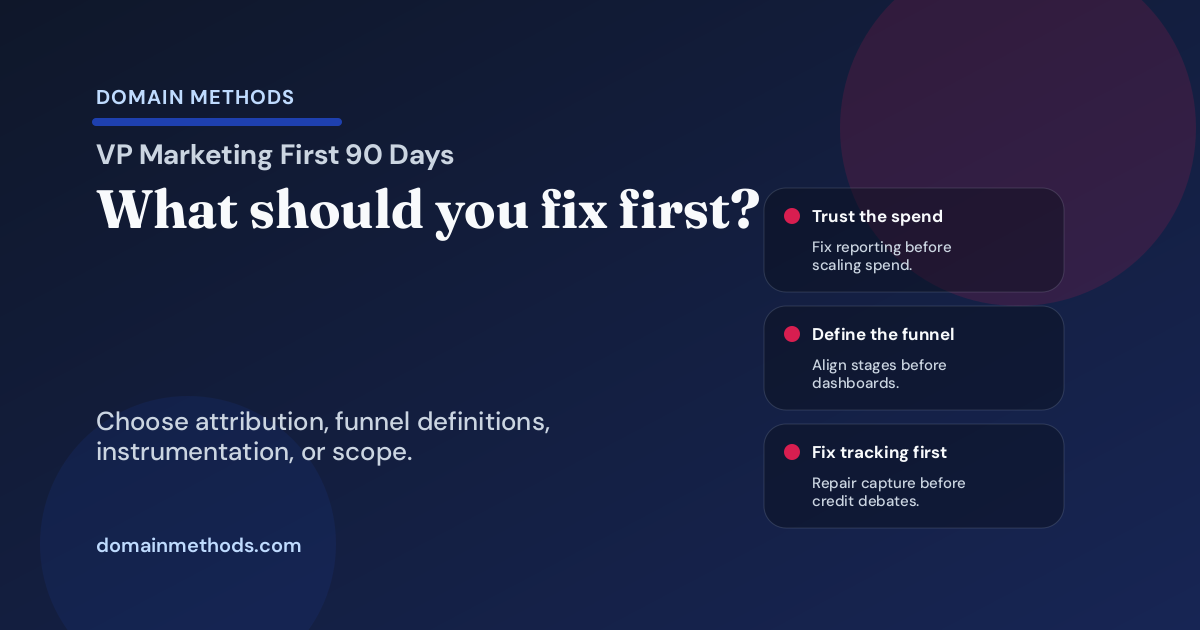
A new VP of Marketing should fix the data problem that is already damaging the next business decision, not the one with the loudest dashboard complaint.
Sometimes that means attribution. Sometimes it means funnel definitions. Sometimes it means conversion tracking. Sometimes it means pausing the build entirely because the team has not translated the leadership ask into a scoped analytics decision.
That distinction matters in the first 90 days. You have a short window to prove judgment. If you spend it polishing channel dashboards while sales and RevOps still disagree about lifecycle stages, the executive meeting will not get calmer. It will just get cleaner slides with the same argument underneath.
This article is the follow-up to the first-30-days data playbook for a new VP of Marketing. That playbook helps you run the initial trust scan. This one helps you choose the first fix after the scan.
The mistake: treating every data problem like an attribution problem
Attribution is an easy first target because it is visible. Paid media has spend. CRM has pipeline. Finance has revenue. The numbers do not match, so the room asks for better attribution.
Sometimes that is the right diagnosis.
But in a mid-size SaaS company, attribution fights often sit on top of more basic operating breaks:
- lifecycle stages mean different things in marketing automation, CRM, and the forecast
- conversion events fire inconsistently or lose campaign context
- routing rules change lead ownership before reporting catches up
- finance and RevOps use different cutoffs for revenue or pipeline inclusion
- the business request is still too broad for a data team to build safely
If those are the real breaks, an attribution project becomes expensive theater. You may get a cleaner model, but the company still cannot agree on what entered the funnel, which stage it reached, or what decision the report is supposed to support.
The first 90 days should be about sequence.
The first-90-days fix-first decision tree
Use this decision tree after the first trust scan. It is intentionally practical. It does not ask which system is most annoying. It asks which failure layer is making the next operating decision unsafe.
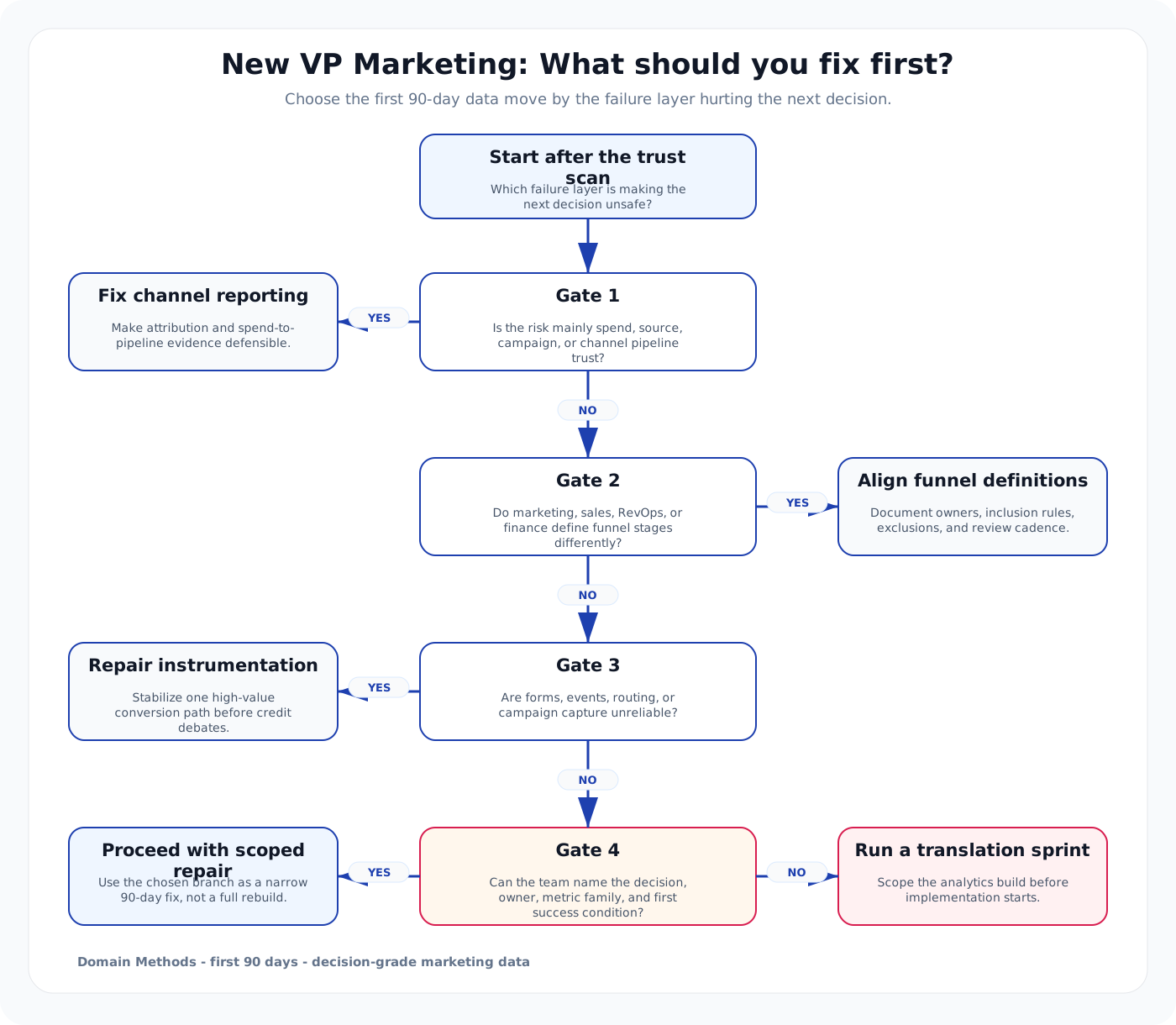
The point is not to make the decision feel mechanical. It is to stop the team from turning a sequencing problem into a generic analytics roadmap.
Gate 1: Is the business decision mainly a channel or spend decision?
Start here because many new marketing leaders inherit budget pressure before anything else.
If the CEO or CFO is asking whether paid search deserves more money, whether events are underperforming, whether partner spend is worth defending, or why sourced pipeline changed, the first break may really be channel reporting.
Good evidence looks like this:
| Signal | What it usually means |
|---|---|
| Platform spend and CRM pipeline disagree by channel | Channel capture or attribution logic is not decision-grade |
| Campaign-level performance changes after manual cleanup | Naming, UTM, or campaign taxonomy is leaking trust |
| Marketing cannot defend which source created the opportunity | Attribution rules need cleanup before budget moves |
| Finance challenges marketing-sourced pipeline in budget meetings | Spend trust is the operating risk |
If this is the pattern, the first 90-day fix should be channel reporting and attribution cleanup. Do not try to rebuild every executive dashboard. Pick the channel story leadership is already using for budget allocation and make that path defensible. If the room is already arguing about whether attribution is even the real issue, use the diagnostic framing in Your Attribution Problem Probably Is Not an Attribution Problem before buying another model.
This is where Where Did the Money Go? fits best. The problem is not that marketing needs prettier reporting. The problem is that spend, source, and pipeline evidence are not strong enough for the decision they are carrying.
Gate 2: Do teams disagree about what the funnel stages mean?
If the disagreement quickly escapes the channel view, move to funnel definitions.
This is the situation where marketing says an account is qualified, sales says it is not really sales-ready, RevOps says the stage logic changed, and finance does not want any of it in the forecast yet. The dashboard may be technically working, but the words inside it are unstable.
A practical operator detail: this usually shows up in meetings as a language problem before it shows up as a data problem. People say “MQL,” “SQL,” “accepted,” “pipeline,” or “influenced” as if the terms are shared. Then someone asks for the inclusion rule and the room discovers there are three versions.
If that is what you see, attribution is not the first move. The first move is funnel definition alignment.
Keep the scope small. Pick the two or three definitions that are affecting the next leadership decision. Document the owner, source system, inclusion rule, exclusion rule, and review cadence. Then use the reporting layer to reflect the rule, not negotiate it live every week. For the governance version of that work, the Metric Definition Governance Playbook gives the team a reusable definition-record pattern.
When funnel or revenue definitions are the dominant break, Three Teams, Three Numbers is the more natural doorway than an attribution diagnostic.
Gate 3: Are conversion events and routing reliable enough to trust?
If definitions are broadly understood but the raw events are unreliable, fix conversion instrumentation before you debate reporting language.
This is where teams lose trust because the business process keeps changing underneath the dashboard:
- forms route differently by region or segment
- UTMs disappear during handoff
- campaign capture works on the landing page but not inside CRM
- demo requests, trial starts, and content conversions are mixed together
- enrichment or routing rules overwrite the context the report needs
The lived-in version is ugly: someone exports a list, checks a few records by hand, finds a missing field, and then nobody trusts the conversion trend for the rest of the meeting.
If this is the pattern, the first 90-day fix should be conversion instrumentation repair. The goal is not perfect data engineering. The goal is a stable event and handoff path that lets the company trust the basic “what happened?” question before it argues about credit.
A useful first pass is to choose one high-value conversion path: demo request, trial signup, contact sales, pricing request, or qualified content conversion. Trace it from landing page to marketing automation to CRM to reporting. Then fix the smallest set of capture and routing rules that make that path decision-grade.
Gate 4: Can the team name the decision, owner, and first success condition?
Sometimes the answer is none of the above.
The company asks for “a dashboard,” “better attribution,” “a data foundation,” or “AI-ready reporting,” but the request is still too broad to build. Nobody can say which decision the work supports, who owns the tradeoffs, what metric family is in scope, or what would count as success in the first 30 to 60 days. If the ask is literally framed as a dashboard request, the dashboard-request decision tree is a useful companion for deciding whether the right output is a dashboard, a decision brief, or a workflow change.
That is not a build problem yet. It is a translation problem.
When that happens, the first 90-day move should be a scoped translation sprint. The output should be a tight decision brief, not a sprawling roadmap:
| Translation question | Why it matters |
|---|---|
| What decision are we trying to improve? | Prevents dashboard-as-a-wish-list work |
| Who owns the definition and tradeoffs? | Prevents passive stakeholder vetoes later |
| Which metric family is in scope first? | Keeps the project from becoming “fix all reporting” |
| What is the first success condition? | Gives the team a real acceptance test |
| What can stay directional for now? | Protects the first 90 days from overreach |
This is where Translate the Ask is the right move. If the problem is unclear scope, do not make the data team guess its way into an implementation plan.
How to choose when two branches look true
Real companies rarely hand you a clean branch. A new VP might find weak attribution, messy stages, and broken conversion capture in the same week.
When two branches look true, use this tie-breaker:
- Fix capture before credit. If the event or handoff is unreliable, do not start by tuning attribution weights.
- Fix definitions before executive dashboards. If teams use different meanings, a nicer reporting layer will only hide the disagreement.
- Fix spend trust before budget reallocation. If the next decision is channel investment, make the spend-to-pipeline story defensible enough to act.
- Scope before build when the request is muddy. If nobody can name the decision and owner, the first deliverable is a decision brief.
The tradeoff is political as much as technical. The “right” data fix is the one that gives the company a safer operating conversation within the first quarter. A theoretically complete analytics rebuild that does not change the next meeting is not the first move.
A simple 90-day sequence
A useful first-quarter plan usually looks like this:
| Window | Focus | Output |
|---|---|---|
| Days 1-15 | Confirm the decision under pressure | one-page trust scan and branch choice |
| Days 16-30 | Validate the failure layer | sample records, definitions, or channel paths checked by hand |
| Days 31-60 | Repair the narrowest decision path | cleaned channel story, definition record, conversion path, or decision brief |
| Days 61-90 | Turn the fix into operating cadence | owner, review rhythm, caveat language, and next-phase scope |
Notice what is missing: a promise to fix every dashboard.
That is deliberate. In the first 90 days, credibility comes from one decision path becoming more trustworthy, not from a giant reporting inventory that nobody has time to govern.
What not to do first
Do not start with a dashboard redesign if the underlying rules are still disputed.
Do not start with a new attribution platform if conversion capture is unreliable.
Do not start with a warehouse or modeling project if leadership has not named the decision it wants to improve.
Do not let every function add one more “while we are in there” requirement. That is how a first-quarter trust fix turns into a six-month data program with no obvious operating win.
A good first move is almost always narrower than the inherited mess. That is what makes it politically survivable.
The bottom line
A new VP of Marketing does not need to prove they can fix every data problem in 90 days.
They need to prove they can tell the difference between a reporting complaint and a decision-risk problem.
If the risk is channel spend trust, fix channel reporting and attribution. If the risk is stage meaning, fix funnel definitions. If the risk is event capture, repair conversion instrumentation. If the risk is a vague mandate, translate the ask before anyone builds.
That sequence will not solve the whole data estate. It will do something more useful in the first quarter: it will make the next important marketing decision safer.
Download the New VP Marketing First-90-Days Decision Tree (PDF)
Use this worksheet to choose the first 90-day data fix after the initial trust scan: channel reporting, funnel definitions, conversion instrumentation, or a scoped translation sprint.
Instant download. No email required.
Want future posts like this in your inbox?
This form signs you up for the newsletter. It does not unlock the download above.
Download the New VP Marketing First-90-Days Decision Tree (PDF)
A lightweight worksheet for choosing the first fix after the initial trust scan: attribution, funnel definitions, conversion tracking, or translation scope.
DownloadIf channel and spend trust is the first break
Where Did the Money Go?
Use the diagnostic when platform dashboards, CRM pipeline, and budget conversations disagree about what marketing is really producing.
See the spend diagnosticIf the request is still too fuzzy to build
Translate the Ask
Use the sprint when leadership has a real question but the team has not turned it into a scoped analytics plan yet.
See the translation sprintSee It in Action
Common questions about the first 90-day marketing data fix
Should a new VP of Marketing fix attribution first?
What if funnel definitions and conversion tracking are both weak?
When should the first move be a translation sprint instead of a build?
How is this different from the first-30-days VP Marketing data playbook?

About the author
Jason B. Hart
Founder & Principal Consultant
Helps mid-size SaaS companies turn messy marketing and revenue data into decisions leaders trust.