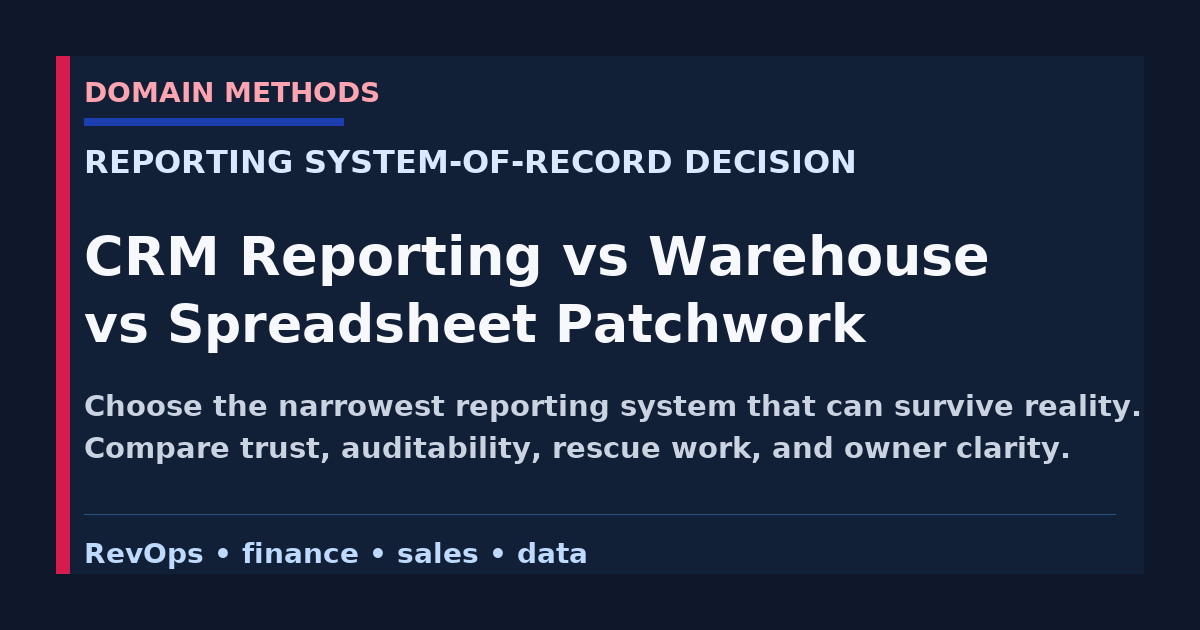
Native CRM Reporting vs Warehouse Reporting vs Spreadsheet Patchwork
- Jason B. Hart
- Revenue Operations
- April 18, 2026
- Updated May 15, 2026
Table of Contents
Where should leadership reporting actually live?
Leadership reporting should live in the narrowest system that can answer the real question without repeated manual rescue, hidden caveats, or cross-team trust fights. That is sometimes the CRM, often the warehouse, and only temporarily a spreadsheet bridge.
That answer is less exciting than a tool debate.
It is also more useful.
Most teams do not get in trouble because they picked the wrong visualization layer. They get in trouble because the number leadership sees is being stitched together by a different operating system every week.
One week the CRM is the source of truth. The next week RevOps exports a CSV and patches it. Then finance shows up with a spreadsheet that “fixes” timing. By the time the board packet is built, nobody is arguing about the chart anymore. They are arguing about which rescue path counts.
That is the real system-of-record decision.
Why this debate shows up so late
Teams usually do not start by asking where reporting should live.
They start with a symptom:
- the forecast review takes too long
- sales and marketing bring different pipeline numbers
- the board deck needs a disclaimer every month
- someone has to rebuild the same spreadsheet before every executive meeting
- the CRM dashboard looks clean until one harder question shows up
At that point, the conversation often gets reduced to tooling.
Should we trust Salesforce? Should we put everything in the warehouse? Should we just keep a spreadsheet until things calm down?
Those are real options. But they are not interchangeable.
Each one carries a different answer to five operator questions:
- who owns the logic?
- how many systems feed the answer?
- how much manual reconciliation is acceptable?
- how hard is it to explain the number under pressure?
- what breaks when the CEO asks a follow-up question?
The three options in plain English
Native CRM reporting
Native CRM reporting means the CRM itself is the main place leadership goes for the answer.
This is often the right move when the question is sales-process heavy, mostly CRM-contained, and the business rules are stable enough that the report does not need much stitching from elsewhere.
Think:
- pipeline by stage
- rep activity and conversion hygiene
- stage aging
- opportunity coverage
- simple sourced-pipeline views when the field discipline is actually real
The biggest advantage is speed.
The biggest risk is false confidence. CRM reports feel official fast, even when the business quietly depends on definitions, mappings, or exclusions that live somewhere else.
Warehouse reporting
Warehouse reporting means the trusted answer is assembled in a modeled data layer before it reaches leadership.
This is usually the right answer when the question depends on more than one system, more than one timing rule, or more than one interpretation risk.
Think:
- pipeline plus product usage
- revenue plus finance timing logic
- attribution blended across CRM, ad platforms, and downstream outcomes
- executive reporting where historical consistency matters more than quick admin convenience
The biggest advantage is auditability and repeatability.
The biggest risk is overbuilding. A warehouse can become an expensive detour if the business still has no settled definitions or no owner who can tell the modeling team what the output is supposed to support.
Spreadsheet patchwork
Spreadsheet patchwork means the business gets to an answer by exporting from one or more systems and reconciling the differences manually.
Every company does this sometimes. That alone does not make it irresponsible.
A spreadsheet can be a reasonable bridge when:
- the question is temporary
- the owner is explicit
- the logic is visible
- the business knows it is buying time, not architecture
The danger starts when the spreadsheet stops feeling temporary.
That is when one heroic operator becomes the invisible middleware between systems, meetings, and executive confidence.
Native CRM reporting vs warehouse reporting vs spreadsheet patchwork at a glance
| Option | Best when | Trust profile | Speed to answer | Maintainability | Reconciliation burden | Common failure mode |
|---|---|---|---|---|---|---|
| Native CRM reporting | The question mostly lives inside CRM-owned process and fields | Can be strong if stage discipline and definitions are already stable | Fast | Good for CRM-contained use cases | Low to medium | Looks official while hidden logic still lives outside the CRM |
| Warehouse reporting | The answer depends on multiple systems, modeled logic, or historical consistency | Highest long-term ceiling when ownership and definitions are clear | Medium | Highest when the data path is governed | Low once the path is stable | Team overbuilds before it settles the business definition |
| Spreadsheet patchwork | A short-term bridge is needed while the real path is being fixed | Highly variable and usually person-dependent | Fastest for one-off rescue work | Low | Highest | Temporary bridge quietly becomes the permanent reporting system |
That table matters because it shifts the question away from “which tool is better?” and toward “what operating burden are we accepting every month?”
1. When native CRM reporting is actually good enough
Native CRM reporting is good enough more often than warehouse-first teams like to admit.
If the executive question really lives inside the CRM, and the commercial process is disciplined, forcing everything through a heavier stack can create delay without adding much truth.
Native CRM reporting is a strong fit when:
- the main entities and business rules already live in the CRM
- the same team owns both process discipline and report consumers
- the number does not need heavy joins to finance, product, support, or billing systems
- leadership mostly needs operational visibility, not a governed historical narrative
- exceptions are rare enough that a spoken caveat is unusual, not routine
A useful operator test is this: can the commercial owner explain the number end to end without opening another system?
If yes, CRM-native reporting may be enough. If not, the CRM may be the system of entry, but not the real reporting system of record.
One common mistake here is letting CRM reports answer board-level questions they were never designed to carry. Pipeline hygiene and board-grade revenue confidence are not the same use case.
2. When warehouse reporting becomes necessary
Warehouse reporting becomes necessary when the question leadership cares about is already bigger than the CRM.
That usually happens when the answer depends on:
- multiple systems of record
- timing adjustments or historical restatement logic
- product or billing behavior outside the CRM
- identity stitching across channels or accounts
- exception handling the CRM report cannot express cleanly
- repeatable executive reporting that cannot survive person-to-person interpretation
This is not just a scale question. It is a confidence question.
The warehouse earns its keep when the business needs a reporting path that can be inspected, repeated, and defended after the meeting gets tense.
A good warehouse reporting setup also reduces a common leadership tax: the pre-meeting scramble where RevOps, finance, and data all try to reconcile a number fast enough to avoid embarrassment. If that sounds familiar, How to Run a Source-of-Truth Audit Without Turning It Into a Tooling Debate is the working-session version of figuring out where the reporting path is actually breaking.
If the same number keeps needing night-before tie-outs, the warehouse is often not “extra architecture.” It is the shortest route out of recurring reconciliation labor. That is also why a page like The Source-of-Truth Maturity Benchmark is useful: it helps teams see whether they really have a governed reporting path or just a more polished reconciliation ritual.
3. When spreadsheets are acceptable as a bridge
Spreadsheets are acceptable as a bridge when the bridge is named honestly.
That means:
- the time window is explicit
- the owner is explicit
- the logic is documented
- the audience understands the confidence limit
- there is already a next step for replacing the bridge
Used that way, a spreadsheet can be the cheapest honest option.
For example, if finance needs one quarter of reconciled board reporting while CRM stage cleanup and warehouse modeling are underway, a controlled spreadsheet layer can be fine.
What makes spreadsheets dangerous is not the file itself. It is the governance vacuum around it.
If nobody can answer these questions, you are already in danger:
- Who owns the logic?
- Who updates it when definitions change?
- Who checks that the export inputs stayed the same?
- What happens if the owner is out for a week?
- Which version should leadership trust when the spreadsheet and dashboard disagree?
Once those questions go unanswered, the spreadsheet is no longer a bridge. It is shadow infrastructure.
When the reporting-location debate is the wrong debate
Sometimes the CRM-versus-warehouse conversation is downstream of a more basic problem.
If teams still disagree on what the metric means, where exceptions belong, or who has authority to settle conflicts, moving the report does not solve the trust break. It just relocates it.
This shows up in patterns like these:
- marketing and sales both say “pipeline” but mean different inclusion rules
- finance wants one timing rule while commercial teams want another
- nobody can say whether the number is directional, decision-grade, or board-grade
- the reporting owner has to ask three stakeholders for approval every time a caveat appears
That is not a platform-selection problem first.
That is a definition-and-authority problem. If the room is still arguing about whether the real blocker is definitions, source systems, or dashboards, What Should You Fix First: Definitions, Source Data, or Dashboards? is usually the cleaner next conversation than another round of reporting-tool comparison.
In that situation, the right first move is closer to Three Teams, Three Numbers than to a reporting rebuild. You need a definition record, owner clarity, and a confidence bar before a system-of-record decision can hold.
A practical scorecard for the next working session
If you need to settle this in one meeting, score each option against the same criteria.
Score native CRM reporting higher when:
- one system already contains the answer cleanly
- the owner is commercial and close to the process
- manual reconciliation is rare
- speed matters more than cross-system modeling depth
- the business question is operational, not board-grade
Score warehouse reporting higher when:
- multiple systems must be joined consistently
- the number gets reused across executive, finance, and operating contexts
- history and restatement logic matter
- repeated tie-outs are already costing time and trust
- the team needs a durable reporting path, not another rescue layer
Score spreadsheet bridge workflows higher when:
- the business needs a short-term answer while a cleaner path is being built
- one named owner can maintain the logic safely for a limited window
- the confidence limits are explicit
- the bridge has a replacement date, not just good intentions
| Decision criterion | Native CRM reporting | Warehouse reporting | Spreadsheet bridge |
|---|---|---|---|
| Mostly one-system question | Strong | Medium | Medium |
| Multi-system consistency | Weak to medium | Strong | Weak |
| Auditability under pressure | Medium | Strong | Weak unless tightly controlled |
| Speed to stand up | Strong | Medium | Strong for one-off use |
| Ongoing maintenance burden | Medium | Medium to strong once governed | Weak |
| Tolerance for owner turnover | Medium | Stronger when modeled and documented | Weak |
| Board-grade confidence potential | Weak to medium | Strong | Weak |
The point of the scorecard is not to produce fake precision. It is to make the tradeoffs visible before the next meeting forces them on you.
A quick worked example
Say a SaaS company needs one number for leadership pipeline reporting.
CRM-native is enough when:
The real question is stage coverage and sales-process health, the stages are disciplined, and nobody needs heavy joins outside the CRM to trust the answer.
Warehouse reporting is necessary when:
Leadership wants pipeline tied to downstream conversion, finance timing, product qualification, or historical restatement logic, and the answer needs to survive scrutiny across functions.
A spreadsheet bridge is acceptable when:
The company is two weeks away from a board meeting, the warehouse model is not ready yet, finance and RevOps can document one temporary reconciliation path, and everyone agrees the spreadsheet dies once the governed path is live.
Same headline question. Three different correct answers.
That is why system-of-record arguments go nowhere when teams skip the operating context.
The real decision is what kind of pain you want to stop
If you are trying to stop dashboard embarrassment, you may overvalue speed. If you are trying to stop board-level trust erosion, you should value auditability more. If you are trying to survive one transition quarter, a bridge may be fine.
What matters is choosing the smallest reporting system that can survive reality.
Not the prettiest architecture. Not the most fashionable stack. Not the fastest screenshot.
The one that can keep answering the next hard question without dragging three teams back into reconciliation theater.
Download the reporting system-of-record scorecardIf the real blocker is that every team still has a different definition of the number, start with Three Teams, Three Numbers. If the debate keeps exposing brittle source systems and recurring manual tie-outs, Data Foundation is usually the cleaner next move.
Download the Reporting System-of-Record Scorecard (PDF)
A practical scorecard for comparing CRM-native reporting, warehouse reporting, and spreadsheet bridge workflows before another leadership meeting turns into reconciliation theater.
DownloadIf three teams already trust three different versions of the same number
Three Teams, Three Numbers
Use the diagnostic when the reporting-location debate is really an argument about definitions, ownership, and which team gets to declare the official version.
Start with the metric-alignment diagnosticIf the reporting fight keeps exposing brittle systems underneath
Data Foundation
When the real issue is weak CRM hygiene, warehouse logic debt, manual joins, or recurring reconciliation work, fix the path underneath the report.
See Data FoundationSee It in Action
Common questions about CRM reporting, warehouse reporting, and spreadsheet patchwork
When is native CRM reporting good enough for leadership reporting?
When does warehouse reporting become necessary?
Are spreadsheets always the wrong answer?
What if the real problem is not the reporting tool but the metric definition itself?

About the author
Jason B. Hart
Founder & Principal Consultant
Helps mid-size SaaS companies turn messy marketing and revenue data into decisions leaders trust.