Media Mix Modeling for SaaS and Ecommerce Budget Decisions
- Jason B. Hart
- Marketing Analytics
- May 11, 2026
- Updated July 9, 2026
Table of Contents
What is media mix modeling?
Media mix modeling, or MMM, is a way to estimate how different marketing channels and outside factors contribute to business outcomes over time, so leaders can make better portfolio-level budget decisions.
That is the plain-English version.
The operator version is even shorter: MMM helps answer whether the overall mix of spend is probably too heavy, too light, or misallocated across channels.
It does not tell you why one buyer clicked, why one opportunity converted, or whether one campaign deserves credit for one deal. That is not the job. MMM is a planning instrument, not a perfect source of truth.
This distinction matters because a lot of teams reach for MMM at the wrong moment. They are tired of attribution fights, privacy gaps, walled-garden reporting, and platform ROAS inflation, so MMM starts to sound like the grown-up answer. Sometimes it is. Sometimes it is just a more expensive way to avoid fixing definitions, taxonomy, and decision ownership.
If the budget question is real, MMM can be useful. If the data underneath it is unstable, the model will mostly quantify the mess.
Use this alongside the Marketing Attribution Playbook when you need the broader operating model behind the measurement decision, not just this narrower tactic. For SaaS teams specifically, that means treating MMM as a planning layer above revenue attribution, not as a replacement for clean CRM source logic, pipeline definitions, and campaign taxonomy.
Media mix modeling for SaaS: what it can and cannot decide
Media mix modeling for SaaS is strongest when leadership needs a portfolio-level view of where spend is probably underfunded, overfunded, or hitting diminishing returns. It can help a team compare paid search, paid social, lifecycle, events, partners, and brand investment when user-level tracking is incomplete and the board still needs a budget story.
It is weaker when the question is too close to the ground. If the team needs to know which campaign created one opportunity, fix the attribution operating layer first. If the team needs to know whether one expensive budget move actually caused lift, use MMM to identify the candidate and then consider a holdout, geo-lift, or other incrementality test.
The practical SaaS constraint is revenue timing. Spend may move this month, pipeline may be created next month, the opportunity may close a quarter later, and expansion or churn effects may show up long after the original campaign. MMM can still help, but only if the business has enough history and enough agreement on which outcome the model is allowed to explain.
Why MMM is back in the conversation
MMM never really disappeared. It just spent a long time feeling too slow, too enterprise, or too academic for mid-size teams that wanted faster digital feedback.
Now it is back for practical reasons:
- user-level tracking is less complete than it used to be
- ad platforms grade their own homework
- buying journeys span devices, committees, dark social, partners, and offline influence
- finance and boards want budget answers that do not depend on one platform’s attribution window
- ecommerce leaders care about contribution margin, not just gross attributed revenue
- SaaS leaders need to explain pipeline and revenue movement when CRM source logic is incomplete
That is the real pressure. Not model fashion. Evidence pressure.
A VP of Marketing can usually live with imperfect attribution for weekly optimization. The conversation changes when the same VP has to defend a six-figure budget move, explain why branded search is still funded, or justify paid social spend when the CRM story and platform story do not match.
MMM belongs in that second conversation. It gives the team a way to step back from the click path and ask what the portfolio appears to be doing over time.
The budget decision MMM is actually good for
MMM is strongest when the question is broad enough that touch-level attribution is the wrong altitude.
Use MMM for questions like:
- how should we think about channel mix next quarter?
- where do we appear to be hitting diminishing returns?
- which channel families may be underfunded or overfunded?
- how much should we trust paid media contribution when platform reporting is inflated?
- which channels deserve a tighter incrementality test before we move real money?
- how did seasonality, promotions, pricing changes, or macro conditions change the read?
That is different from campaign management.
A paid search manager still needs fast query, campaign, and conversion feedback. A lifecycle team still needs cohort and journey reporting. A RevOps team still needs source logic that sales and finance can understand. MMM does not replace that operating layer.
It sits above it.
The useful output is not a mystical answer. It is a planning-grade view of where the budget story probably needs adjustment, caveat, or deeper proof.
When MMM is premature
The fastest way to waste money on MMM is to ask it to carry a decision before the business has made the inputs trustworthy enough.
A model can be statistically sophisticated and operationally useless if the basics are not stable.
Here are the warning signs I would take seriously before starting:
| Readiness area | Strong enough for MMM | Premature for MMM |
|---|---|---|
| Spend history | Channel spend is mapped consistently over enough time to see patterns. | Campaign naming, channel grouping, or agency exports change every few months. |
| Outcomes | Revenue, pipeline, orders, or margin outcomes are trusted enough for leadership use. | Marketing, finance, CRM, Shopify, and the warehouse disagree on the number that matters. |
| Channel taxonomy | Paid search, paid social, affiliates, events, lifecycle, partner, and offline categories are documented. | The same spend shows up under different names depending on the report. |
| Business context | Promotions, seasonality, pricing changes, launches, outages, and sales-capacity shifts are recorded. | The model sees spikes and dips but nobody can explain what happened in the business. |
| Decision ownership | The team knows which budget decision the model should support. | The project brief says “better measurement” but no one knows what will change if the model says yes or no. |
The tradeoff is simple: MMM can tolerate imperfect data. It cannot rescue ungoverned data.
For SaaS, that usually means the CRM, pipeline stages, source definitions, opportunity dates, and revenue recognition logic need enough stability to support the read. For ecommerce, it means gross Shopify revenue is rarely enough. Returns, discounts, fulfillment cost, new vs returning customers, subscription effects, and contribution margin may all change the budget answer.
If the team cannot agree on the outcome, the model will become a new room for the old argument.
Minimum useful inputs for a real MMM conversation
You do not need a perfect enterprise data warehouse before MMM is possible. But you do need a minimum viable operating record.
At a minimum, I would want to see:
- weekly or monthly spend by channel and, where useful, major campaign family
- consistent outcome history tied to the decision: revenue, pipeline, orders, contribution margin, trials, opportunities, or bookings
- a documented channel taxonomy that maps platform exports into business categories
- seasonality and promotion markers so the model is not guessing why the business moved
- pricing, packaging, discount, product-launch, and market-event notes where those changes affected demand
- sales-capacity, territory, or pipeline-process context for SaaS teams
- margin, returns, inventory, fulfillment, and repeat-purchase context for ecommerce teams
- stakeholder agreement on what decision the model should influence
The last bullet is not soft. It is the control point.
If the CMO wants a channel-allocation answer, finance wants a board-grade revenue explanation, and the data team thinks the project is a modeling exercise, the output will disappoint at least two of those groups.
MMM readiness is not only data readiness. It is decision readiness.
How MMM fits with attribution and incrementality
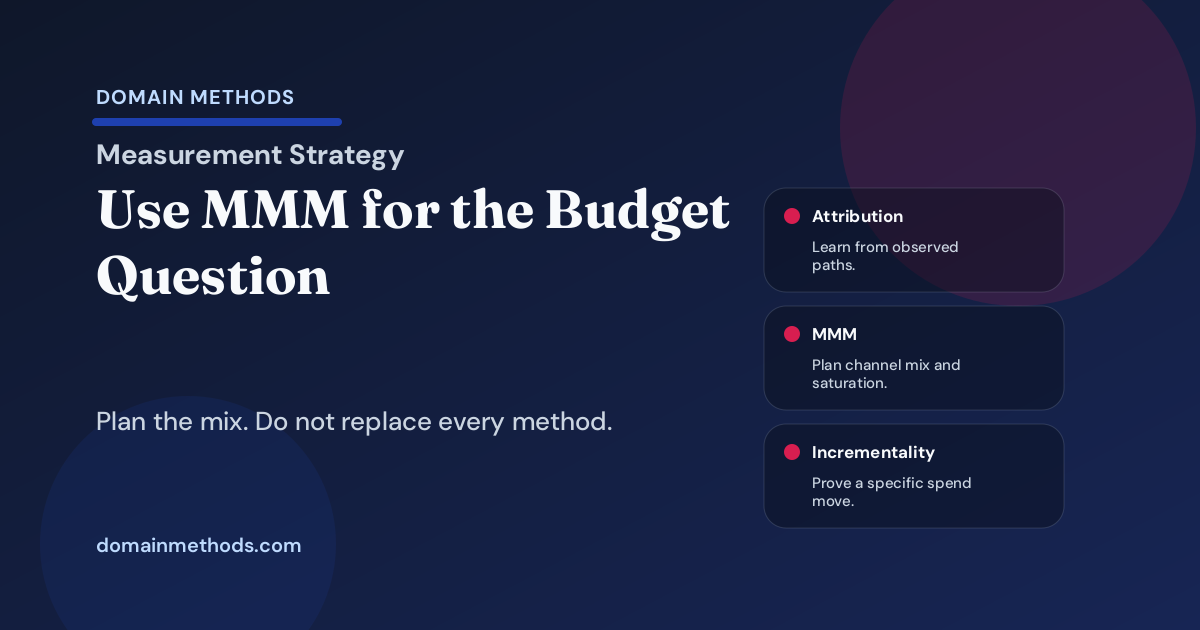
The cleanest way to avoid measurement theater is to give each method a job.
| Method | Best use case | Decision altitude | What it does well | What it overclaims if misused | Good next step when not ready |
|---|---|---|---|---|---|
| Platform reporting | Fast in-channel optimization and delivery management. | Campaign and platform level. | Shows what the platform can observe quickly. | Claims channel value as if the platform saw the whole business. | Reconcile to CRM, warehouse, Shopify, and finance outcomes. |
| Attribution | Observed-path learning and directional source/campaign reads. | Journey and pipeline operating layer. | Helps teams understand which touches and sources appear near pipeline or revenue. | Pretends partial journey visibility is causal proof. | Clean source logic, attribution windows, and confidence labels. |
| MMM | Portfolio budget allocation and response-curve planning. | Channel-mix and planning layer. | Estimates broad contribution, saturation, seasonality, and diminishing returns. | Treats model output like a command instead of decision support. | Stabilize spend/outcome history and business-context markers. |
| Incrementality testing | Causal proof for a specific spend, audience, geo, or treatment decision. | Experiment or decision-specific layer. | Estimates lift when the question is narrow enough to isolate. | Runs expensive tests for questions that are too small or poorly isolated. | Use MMM or attribution to identify where a test is worth the trouble. |
| Qualitative attribution | Sales context, self-reported source, customer interviews, and dark-social clues. | Narrative and diagnostic layer. | Captures influence the tracking stack misses. | Turns anecdotes into budget math without caveats. | Use it to shape hypotheses, not to replace measurement. |
A healthy stack does not force these methods to compete for one throne.
Attribution helps the team learn fast. MMM helps leadership plan the portfolio. Incrementality testing helps settle specific expensive uncertainties. Qualitative signals keep the team honest about influence that never appears cleanly in a tracked path.
The work is deciding which decision needs which confidence level.
For the broader measurement-stack view, start with Attribution Didn’t Die. It Just Got Demoted.. If the next move is a specific spend holdout, use Incrementality Testing for SaaS Budget Moves: When to Run a Holdout Test. If the issue is still basic SaaS attribution trust, the Marketing Attribution Playbook is the better starting point.
Why a useful MMM should be calibrated with incrementality evidence
MMM and experiments should operate as a feedback loop.
The model finds the expensive uncertainty. A narrower experiment tests one claim inside it. The result becomes calibration evidence, with its uncertainty and scope intact. Then the team reruns the model and checks whether the budget recommendation changed enough to matter.
Calibration does not mean forcing the model to match one lift study. Google Meridian describes calibration as using experiment results and business knowledge to set channel-specific priors. Its documentation also warns that an experiment and an MMM rarely estimate ROI in exactly the same way. Different time windows, populations, spend baselines, and treatments create translation risk.
That is why the operator question is not, “Did the experiment validate the MMM?” It is, “What did this test teach us about one uncertain part of the model, and did that evidence change the decision?”
1. Use MMM to find the expensive uncertainty
Start with the model output that could move real money or leave a material blind spot:
- a response curve suggests a channel is near diminishing returns
- platform ROAS and the model disagree enough to change the plan
- an upper-funnel channel has a wide contribution range
- the proposed reallocation is too large to rest on historical correlation alone
This keeps testing attached to a decision. A team does not need a lift study for every coefficient. It needs better evidence where uncertainty and financial exposure meet.
2. Choose one testable claim
“Prove the entire MMM” is not an experiment brief.
A useful claim is narrower: branded search captures demand that would have converted anyway; paid social prospecting creates qualified pipeline beyond the existing baseline; YouTube or CTV contributes enough demand to justify more spend; a retargeting or promotional program changes net revenue or contribution margin.
Write the claim, the treatment, the eligible population, the outcome, and the budget decision before choosing the design. If the team cannot do that, the model has found a debate, not yet a test.
3. Run the narrowest credible experiment
The design has to fit the operating reality. Depending on the decision, that could be a geo experiment, audience or user holdout, conversion-lift study, time-based heavy-up or go-dark test, or an account/cohort test for a long-cycle SaaS motion.
Use the SaaS holdout-test readiness guide for the detailed design and contamination questions. The important point here is restraint: test the smallest claim that can materially change the plan.
For SaaS, the outcome may need two clocks. A trusted leading indicator such as an accepted lead, product-qualified account, or qualified opportunity can support an earlier read. Closed-won revenue may mature a quarter later. The team can use the leading outcome for a time-sensitive decision only if it records the caveat and commits to reconciling the later pipeline and revenue result.
Sales behavior matters too. A territory change, capacity constraint, or rep treating test accounts differently can swamp the media effect. That is not a footnote for the analyst. It changes what the result is allowed to claim.
4. Feed the result back as calibration evidence
A test result can inform a channel prior, coefficient range, response curve, or expected ROI range. It should not enter the model as permanent ground truth.
Carry the full evidence record with it:
- market, audience, and period tested
- treatment and control definition
- outcome and economic layer
- point estimate and uncertainty
- known contamination or execution limits
- date after which the evidence should be reviewed or retired
Google’s current Meridian guidance says there is no single formula for translating an experiment into a prior. It also recommends carrying the additional uncertainty created when the experiment’s estimand differs from the MMM’s. Meta’s Robyn documentation similarly supports calibration with causal experiments, but platform documentation describes a method, not neutral portfolio truth.
A publisher-run lift study can still be useful. Treat it as evidence about the publisher’s tested environment, not automatic validation of every channel or every MMM coefficient.
5. Rerun the model and inspect the decision
The useful deliverable is a before-and-after decision record, not merely a lower model error score.
Compare:
- the pre-calibration contribution or ROI range
- the post-calibration contribution or ROI range
- the change in marginal-return or budget-allocation guidance
- whether that guidance is stable enough for the planned decision
- the evidence expiry date or retest trigger
If the recommendation barely moves, say so. The experiment may have reduced uncertainty without changing the allocation. If the recommendation changes materially, document which assumption moved and who approves the budget response. If the calibrated model becomes more confident than the evidence deserves, widen the uncertainty rather than polishing the number.
The calibration loop in practice
| MMM finding or uncertainty | Best experiment question | Possible design | Calibration input produced | Decision that may change | Main caveat |
|---|---|---|---|---|---|
| SaaS paid social has a wide contribution range, while sales capacity varies by territory | Does prospecting create more qualified pipeline than the current baseline? | Matched geo or account-cohort holdout | Qualified-pipeline lift range, followed by later revenue reconciliation | Whether to move the next quarter's prospecting budget | Rep behavior, territory capacity, and long outcome lag can contaminate the read |
| Branded search appears to take more credit than its marginal contribution warrants | How much demand converts when branded search is reduced or held out? | Geo or time-based holdback | Incremental conversion or revenue range under the tested spend change | Whether to defend, trim, or redeploy branded-search spend | The tested baseline and demand conditions may not persist |
| Ecommerce paid social looks efficient on platform ROAS but weak on margin | Does prospecting increase net revenue and contribution after returns and discounts? | Audience holdout or geo test | Incremental net-revenue or contribution-margin range | Whether to scale prospecting or change customer/product mix | Promotions, seasonality, and new-versus-returning mix can distort the result |
| YouTube or CTV has a wide model range and little touch-level visibility | Does a regional heavy-up create enough demand to justify more spend? | Matched-geo heavy-up | Channel lift range for the tested markets and period | Whether upper-funnel spend receives a larger portfolio share | Too few comparable regions can leave the estimate unstable |
This loop does not make weak inputs safe. Broken outcome definitions, inconsistent spend taxonomy, missing promotion markers, sales-capacity changes, or unreliable margin logic can corrupt both the experiment and the MMM. Use the First-Party Measurement Readiness Checklist before calibration if the capture and reconciliation layer is still shaky.
One experiment is local to its market, period, audience, treatment, and outcome. It does not validate the full model. It can also go stale after changes in creative, targeting, product, pricing, competition, channel mechanics, or sales execution.
The Attribution vs MMM vs Incrementality guide helps assign the right job to each method. Calibration is the handoff between two of them: incrementality supplies scoped causal evidence, while MMM uses that evidence to improve a broader planning view without pretending the scope disappeared.
SaaS examples: where MMM helps and where it does not
For SaaS, MMM can help when the company has meaningful spend across channels and leadership needs a planning view that is not trapped inside campaign attribution.
Useful SaaS questions include:
- should we keep funding paid social when CRM-sourced pipeline looks weak but total demand moves after spend changes?
- are webinars, events, partners, and paid search all being judged by attribution rules that favor only the most trackable paths?
- are we seeing diminishing returns in non-brand search or paid social after a certain spend level?
- did a pricing change, sales-capacity constraint, or product launch distort the channel read?
- should the next budget cycle shift dollars across demand creation, capture, and lifecycle programs?
The lived-in detail is that SaaS MMM often breaks in the handoff between marketing activity and revenue reality. Spend data may be clean enough. Website and form data may be good enough. Then the opportunity source, account hierarchy, renewal/expansion treatment, and booked-revenue logic start pulling the read sideways.
That does not make MMM impossible. It means the data-foundation work has to happen before the model becomes a budget artifact.
If the source-of-truth problem is still unresolved, Where Did the Money Go? is usually the better first engagement than jumping straight into modeling.
Ecommerce examples: why ROAS is not the same as contribution
For ecommerce, MMM gets interesting when platform ROAS is too flattering and finance wants a more complete spend story.
Useful ecommerce questions include:
- is branded search actually incremental, or is it harvesting demand that would have converted anyway?
- is retargeting creating lift or mostly claiming customers already close to purchase?
- is Meta prospecting still adding new demand after returns, discounts, and fulfillment costs?
- should YouTube, CTV, or influencer spend be judged by short-window platform revenue or a broader demand read?
- how do promotions, seasonality, inventory constraints, price changes, and shipping costs affect the channel story?
The tradeoff for ecommerce is margin context.
A model that explains gross revenue can still point the team toward the wrong spend decision if contribution margin is weak, returns spike, or the channel mix shifts toward low-margin products. Platform ROAS can look healthy while net revenue and contribution tell a quieter story.
That is why ecommerce MMM should not stop at attributed revenue. It should at least pressure-test the relationship between spend, net revenue, customer mix, and margin.
If that margin layer is the real blocker, Show Me the Margin is often the sharper next step than a modeling project.
A practical MMM readiness checklist
Before buying, building, or commissioning MMM, answer these questions in order.
| Readiness question | Green light | Caveat | Stop and fix first |
|---|---|---|---|
| What budget decision will MMM support? | A specific channel-mix, planning, or investment decision is named. | The decision is broad but tied to a planning cycle. | The project is framed only as “better measurement.” |
| Is spend history usable? | Spend is consistently mapped by channel over enough time. | Some channel cleanup is needed but the history is mostly recoverable. | Spend taxonomy changes so often that trends are not trustworthy. |
| Are outcomes trusted? | Leadership agrees on the revenue, pipeline, order, or margin metric. | The metric is usable with caveats. | Teams still fight over which outcome is real. |
| Is business context documented? | Promotions, seasonality, launches, pricing, and major operational shifts are recorded. | Context exists but needs cleanup before modeling. | The model would see movements with no explanation. |
| Is attribution already doing its job? | Attribution handles tactical learning without being overclaimed. | Attribution is useful but poorly caveated. | Attribution chaos will leak into the MMM discussion. |
| Is a holdout test a better fit? | The question is too broad for one test, so MMM belongs first. | MMM can identify candidates for future tests. | The decision is narrow enough that causal testing should come first. |
| Will the output change action? | Leadership has agreed how the read will affect budget. | The model will inform, not decide, the next cycle. | Nobody knows what will happen when the answer arrives. |
If most rows are green, MMM may be a useful next move.
If several rows are caveat-heavy, the project may still work, but the first phase should be cleanup and expectation-setting, not model theater.
If the stop column dominates, the business is not ready for MMM. The smarter move is to repair the measurement foundation first.
Download the MMM Readiness Checklist (PDF)
Use this lightweight worksheet to score spend materiality, history, taxonomy, outcome trust, SaaS or ecommerce context, decision ownership, and whether MMM is the right next move.
Instant download. No email required.
Want future posts like this in your inbox?
This form signs you up for the newsletter. It does not unlock the download above.
Common failure modes
MMM fails less often because the math is impossible and more often because the operating agreement is missing.
The common patterns are familiar:
- too little history for the decision being asked
- unstable channel definitions and campaign taxonomy
- outcome metrics that do not reconcile to finance or revenue reality
- ignoring seasonality, promotions, pricing changes, and sales-capacity constraints
- treating the model as a command instead of a planning input
- forgetting margin, returns, discounts, or product mix in ecommerce
- using MMM to avoid a hard incrementality test
- using MMM to settle a political argument the organization has not actually framed
The last one is the quiet killer.
A model can help a leadership team make a better decision. It cannot make the leadership team agree on what decision is being made.
What to do if you are not ready
Not ready for MMM does not mean stuck.
It usually means the next move is more concrete:
- Fix the spend-to-outcome trail. Make sure channel spend, campaign taxonomy, CRM or Shopify outcomes, and finance-trusted metrics can be explained in one operating view.
- Clean up attribution’s job. Keep attribution useful for tactical learning, but stop making it carry portfolio allocation or causal proof by itself.
- Run a narrower holdout where the decision demands it. If the question is specific enough to isolate, a lift test may teach more than a broad model.
- Document confidence levels. Mark what is directional, decision-grade, and board-grade so leadership knows which decisions the evidence can safely support.
- Choose the service path by blocker. If the spend story is unclear, start with Where Did the Money Go?. If attribution logic is the blocker, use SaaS Marketing Attribution. If the issue is broader revenue reporting trust, Revenue Analytics may be the right lane.
That sequence is less glamorous than buying a modeling tool.
It is also more likely to produce a budget decision the business can trust.
Sources checked July 9, 2026
These are methodology and product sources, not neutral proof of channel performance:
- Google Meridian: Calibrate treatment priors for using experiments and domain knowledge in priors, carrying uncertainty, and accounting for differences between experiment and MMM estimands.
- Google Meridian and Meridian GeoX for the MMM-to-geo-experiment calibration workflow. GeoX is still described as upcoming.
- Google: Experimentation and the value of marketing for the experiment-to-model feedback loop.
- Meta Robyn and its calibration features for calibration with causal experiments and model refresh behavior.
The bottom line
MMM is useful when the decision is portfolio-level, the spend is material, the outcome is trusted enough, and leadership knows what will change if the model says the mix is wrong.
It is not a replacement for attribution. It is not a replacement for incrementality testing. It is not a shortcut around messy definitions.
Used well, media mix modeling helps a SaaS or ecommerce team move from platform-credit arguments to budget-confidence conversations.
Used too early, it becomes one more impressive artifact sitting on top of data nobody believes.
That is the decision to make first: are you ready for MMM, or are you ready to make the measurement system trustworthy enough that MMM can finally be useful?
MMM Readiness Checklist
A lightweight worksheet for scoring whether spend history, outcomes, taxonomy, business context, and decision ownership are ready for media mix modeling.
DownloadWhen spend confidence is the real problem
Where Did the Money Go?
Use the diagnostic when platform reporting, attribution, finance, and revenue outcomes disagree before the next budget call.
See the spend diagnosticIf attribution still needs the operating layer
SaaS Marketing Attribution
Use the focused attribution service when the team needs clean source logic, channel caveats, and reporting rules before MMM can carry a planning conversation.
See SaaS Marketing AttributionSee It in Action
Common questions about media mix modeling
When should a SaaS company use MMM?
How is MMM different from attribution?
How is MMM different from incrementality testing?
What data do you need before MMM is useful?
Is MMM useful for ecommerce brands?
How do incrementality experiments calibrate an MMM?

About the author
Jason B. Hart
Founder & Principal Consultant
Helps mid-size SaaS companies turn messy marketing and revenue data into decisions leaders trust.