Where Marketing Data Science Actually Pays Off: Use Cases Worth Building After the Foundation Is Trusted
- Jason B. Hart
- Data Activation
- May 12, 2026
- Updated August 7, 2026
Table of Contents
Marketing data science pays off when it changes a decision someone already has to make.
That sounds obvious until you sit in a planning meeting where the wish list starts with models instead of decisions: churn prediction, propensity scoring, MMM, next-best action, AI summarization, creative fatigue detection. All of them can be useful. All of them can also turn into expensive side projects if the team cannot say what gets decided differently on Monday morning.
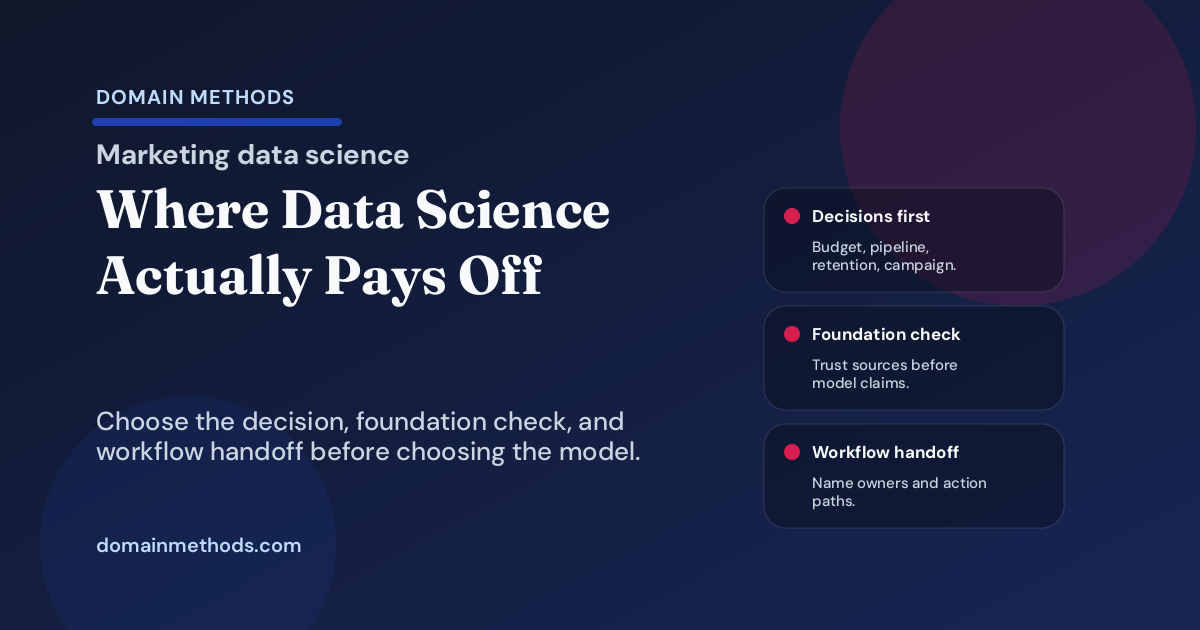
The better starting question is plain: what decision gets better if this signal is trusted?
For mid-size SaaS teams — and ecommerce teams when the underlying measurement, profitability, or warehouse-to-action problem resembles the SaaS problem — that question matters more than the model label. A decent score that reaches the right workflow with clear reason codes can beat a sophisticated model trapped in a notebook. A beautiful forecast built on unstable stage definitions can make the board deck worse, not better.
This is the practical map.
The useful frame: decision first, model second
Marketing data science is not one thing. It is a set of techniques that help teams make better bets with incomplete information.
The useful work usually falls into six decision types:
| Decision type | Examples | What improves if the signal works |
|---|---|---|
| Budget decisions | MMM, incrementality testing, response curves, spend forecasts | Which channels deserve more, less, or different spend |
| Audience and customer decisions | Segmentation, LTV/CLV modeling, propensity scoring, next-best action | Which customers, accounts, or cohorts deserve different treatment |
| Pipeline and revenue decisions | Lead scoring, account prioritization, pipeline forecasting, win-rate confidence | Which opportunities get attention and which forecast deserves trust |
| Retention and expansion decisions | Churn risk, customer health scoring, expansion propensity | Which accounts need intervention and why |
| Creative and campaign decisions | Creative fatigue detection, campaign clustering, anomaly detection | Which campaign signals deserve action instead of another dashboard argument |
| AI workflow decisions | Routing, summarization, QA, exception handling, decision support | Which repetitive judgment calls can be assisted without creating new risk |
The trap is treating that table like a shopping list. It is not.
Pick the row where the current decision is expensive, frequent, and visibly weak. Then choose the lightest signal that would help the owner make a better call.
Budget decisions: where MMM, incrementality, and response curves belong
Budget data science is usually the first thing leadership asks about because spend is visible. A board or finance partner does not care whether paid social has a clean dashboard. They care whether the next $500,000 should go into paid social, branded search, CTV, partner marketing, or retention.
This is where media mix modeling, marketing mix modeling, incrementality testing, spend forecasting, and response curves can help. Different teams use MMM, media mix modeling, and marketing mix modeling to describe the same operating question: what should carry the budget decision when platform attribution is not enough?
| Use case | Decision it improves | Minimum foundation | First MVP version | What not to overclaim |
|---|---|---|---|---|
| Media mix modeling | Portfolio-level budget allocation across channel families | Consistent spend history, trusted outcome data, seasonality/promo context, channel taxonomy | Directional model that explains saturation and response bands | Do not treat MMM as campaign-level truth or a replacement for source cleanup |
| Incrementality testing | Whether a specific spend move caused lift | Clear test unit, stable outcome, holdout or geo logic, decision owner | One test on a material uncertainty like branded search, retargeting, or paid-social scaling | Do not generalize one test to every channel forever |
| Channel response curves | How returns change as spend scales | Enough variation in spend and outcomes to see diminishing returns | Range-based scenario model for the next budget cycle | Do not present the curve as precise if inputs are noisy |
| Spend forecasting | What revenue or pipeline may happen under different spend plans | Shared definitions for spend, bookings, revenue, contribution, or pipeline | Simple scenario forecast with confidence bands | Do not hide assumptions behind a single forecast number |
A practical example: if ecommerce leadership is arguing over platform ROAS, the first step may not be a complicated model. It may be a contribution-margin-aware holdout test on branded search or retargeting. If a SaaS team is trying to defend a quarterly budget mix across several channel families, MMM readiness may matter more than another multi-touch attribution dashboard.
For the measurement layer, connect this back to the existing guidance on why attribution got demoted and when a team should run a holdout test before moving marketing budget. If the core problem is spend trust, the commercial route is usually Where Did the Money Go?.
Audience and customer decisions: segmentation only matters if treatment changes
Segmentation, LTV modeling, propensity scoring, and next-best-action systems are useful when different customers should get different treatment.
They are weak when the team uses them only to decorate a dashboard.
| Use case | Decision it improves | Minimum foundation | First MVP version | What not to overclaim |
|---|---|---|---|---|
| Customer segmentation | Which audiences need different messaging, offers, onboarding, or sales motion | Identity resolution, clean account/customer attributes, useful behavior data | 3-5 actionable segments with named treatment differences | Do not create segments nobody can activate |
| LTV / CLV modeling | How much acquisition cost or retention effort a customer can justify | Revenue, margin, cohort, product-usage, and retention history | Coarse value bands used for budget or prioritization | Do not pretend early value predictions are finance-grade without validation |
| Propensity scoring | Which users/accounts are likely to convert, expand, or respond | Stable historical examples and current behavior signals | Score bands with reason codes and suppression rules | Do not route actions from a black-box score without context |
| Next-best action | What a rep, marketer, or CS owner should do next | Clear workflow ownership and accepted action library | Recommendation queue with human review before automation | Do not automate unclear judgment calls just because the score exists |
The operator detail that matters: a segment is only real if someone changes a message, budget, route, or workflow because of it. Otherwise it is a prettier taxonomy.
For teams trying to move warehouse intelligence into actual tools, the Data Activation Playbook and Data Activation service path are usually more useful than another strategy deck.
Pipeline and revenue decisions: score only what sales will actually use
Pipeline data science can look impressive fast. Lead scoring, account prioritization, pipeline forecasting, and win-rate modeling all produce numbers that feel useful.
The hard part is the handoff.
If sales does not trust the source data, if marketing and sales disagree on stage definitions, or if the CRM loses campaign and product context before the opportunity is created, the score becomes one more field nobody uses.
| Use case | Decision it improves | Minimum foundation | First MVP version | What not to overclaim |
|---|---|---|---|---|
| Lead scoring | Which leads or accounts should sales work first | Clean capture, stage logic, response outcomes, feedback loop | Tiered score with reason codes and a clear SLA | Do not call it predictive if it only repeats firmographic bias |
| Account prioritization | Which target accounts deserve outreach or expansion motion | Account hierarchy, fit data, engagement signals, ownership rules | Priority bands by segment and buying signal | Do not confuse activity volume with buying intent |
| Pipeline forecasting | Which pipeline number leadership can plan around | Stable stage definitions, close dates, slippage history, finance alignment | Forecast range with caveats and owner notes | Do not turn a fragile forecast into board certainty |
| Win-rate confidence | Whether conversion rates are safe for hiring, quota, or budget plans | Consistent stage gates, source labels, and opportunity rules | Confidence label by segment/source/stage | Do not average together motions that behave differently |
A good lead score tells sales why the account is worth action and what to do next. A bad one tells sales to trust a number that cannot explain itself. If the first version relies on firmographics, keep the revenue band scoring logic simple enough for RevOps and sales to inspect.
If this is the bottleneck, start with the lead scoring sales handoff checklist before building a bigger model.
Retention and expansion decisions: churn risk needs reason codes, not just risk bands
Customer health and churn prediction can be valuable because post-sale teams often have too much signal spread across product usage, support, billing, lifecycle, and CRM notes.
The useful question is not “can we predict churn?” It is “can CS do anything different with this warning?”
| Use case | Decision it improves | Minimum foundation | First MVP version | What not to overclaim |
|---|---|---|---|---|
| Churn-risk scoring | Which accounts need intervention before renewal risk becomes obvious | Product usage, support, billing, lifecycle, and account hierarchy data | Red/yellow/green risk bands with reason codes | Do not alert CS without explaining what changed |
| Customer health scoring | How CS should prioritize accounts and playbooks | Agreed health definition and reliable usage/account context | Health score plus action category | Do not mix product adoption, sentiment, billing, and renewal risk without ownership |
| Expansion propensity | Which accounts may be ready for upsell or cross-sell | Usage depth, segment fit, contract context, and product milestones | Expansion-ready list with human review | Do not treat usage volume as willingness to buy |
The lived-in failure mode is alert fatigue. If every account becomes “medium risk,” nobody acts. If the model cannot say whether the risk came from usage drop, support friction, billing behavior, or account ownership, CS still has to do the investigation manually.
For a safer handoff pattern, use the customer health score checklist before pushing churn-risk signals into CRM or AI-assisted workflows. The PLG churn activation case study shows what this looks like when the signal actually reaches the workflow.
Creative and campaign decisions: find the weak signal before it becomes a budget fight
Creative and campaign data science is useful when it catches changes humans miss or clusters messy campaign evidence into something a team can act on.
This is not the same as declaring a “winning creative” because one dashboard has a higher click-through rate.
| Use case | Decision it improves | Minimum foundation | First MVP version | What not to overclaim |
|---|---|---|---|---|
| Creative fatigue detection | When to refresh creative before performance falls apart | Creative IDs, spend, impression, frequency, conversion, and margin context | Fatigue flags by asset and audience | Do not confuse audience saturation with bad creative |
| Campaign clustering | Which campaigns behave similarly enough to evaluate together | Clean naming, channel taxonomy, campaign objective, and spend history | Cluster view by objective, funnel role, or audience | Do not average campaigns that answer different questions |
| Anomaly detection | Which performance movements need investigation | Stable baselines, seasonality awareness, and alert ownership | Exception queue with a named owner | Do not alert on every normal fluctuation |
| Incrementality-informed tests | Which campaign changes deserve proof | Testable decision, clean exposure/outcome logic, margin context | One test plan for a material spend decision | Do not run experiments as maturity theater |
A useful anomaly alert says, “This paid social prospecting cohort is behaving differently than expected, and the owner should check spend pacing, creative fatigue, and conversion quality.” A useless alert says, “Metric changed.”
For ecommerce teams, this is where platform reporting, Shopify revenue, net revenue, returns, and contribution margin often disagree. The right next step may be a data model repair before a model-building sprint.
AI workflow decisions: automate only after the operating judgment is clear
AI workflow use cases are where a lot of teams want to jump first. Summaries, routing, chat interfaces, workflow recommendations, QA agents, and next-best actions all feel practical.
This is also where phrases like AI use cases for marketing analytics and predictive marketing analytics can get vague fast. The useful version is not a chatbot floating above the business. It is a trusted signal or workflow assist tied to a real operating decision — but only when the workflow has a clear decision boundary.
| Use case | Decision it improves | Minimum foundation | First MVP version | What not to overclaim |
|---|---|---|---|---|
| Routing | Where requests, leads, accounts, or exceptions should go | Source truth, ownership rules, priority logic | Assisted routing with exception queue | Do not automate ambiguous ownership disputes |
| Summarization | What a human needs to know before action | Trusted source docs/data and clear summary target | Account, campaign, or issue summary with source links | Do not let summaries become untraceable opinions |
| QA | Which data, campaign, or workflow outputs need review | Known checks, pass/fail rules, and escalation owner | QA checklist with human sign-off | Do not ask AI to judge rules the team has not defined |
| Exception handling | Which cases should leave the normal workflow | Clear suppression, override, and risk rules | Exception queue with reason codes | Do not hide edge cases inside automation |
| Decision support | Which next step a human should consider | Enough context to explain recommendation and caveat | Recommendation plus evidence, caveat, and next action | Do not turn support into command without confidence labels |
A common pattern: leadership asks for AI routing before the team agrees who owns edge cases. The model may be technically possible, but the workflow is not ready.
That is the right moment for the AI-Ready Data Diagnostic or the practical hygiene sequence in AI readiness through data hygiene. For the broader POV on what AI can and cannot fix in marketing analytics, see AI won’t fix your data. The answer is not a bigger model.
How to choose the first use case
Use a simple screen before anything goes on the roadmap.
Download the Growth Bet Evaluator worksheet
Use this scoring sheet to rank data science, AI, activation, and analytics ideas by decision impact, evidence strength, and workflow readiness before one becomes the next expensive roadmap bet.
Instant download. No email required.
Want future posts like this in your inbox?
This form signs you up for the newsletter. It does not unlock the download above.
| Question | Green signal | Warning sign |
|---|---|---|
| What decision changes? | One owner can name the decision and current pain | The use case is described as “better insights” |
| Is the decision expensive or frequent enough? | The wrong call wastes budget, pipeline, retention, or team capacity | It is interesting but not operationally urgent |
| Is the data foundation good enough? | Source, definition, owner, and refresh logic are trusted enough for the first version | Teams still argue over which dashboard is right |
| Can the workflow absorb the signal? | There is a field, queue, meeting, SLA, or route where the signal will be used | The output will sit in a dashboard nobody owns |
| What is the first MVP? | A score band, shortlist, alert, reason code, or scenario range can help now | The team needs a perfect model before anyone can act |
| What confidence label applies? | Everyone knows whether the signal is directional, decision-grade, or unsafe | The number will be presented without caveats |
The best first project is rarely the most advanced one. It is the one where a small trusted signal can change behavior quickly.
That might be a lead-score handoff, a churn-risk reason-code workflow, a budget-readiness model, a campaign taxonomy repair, or a simple AI QA queue. The right answer depends on where the operating pain is already visible.
What to do if the foundation is not ready
If the screen exposes weak definitions, broken source data, or unclear ownership, that is not failure. It is useful discovery.
Do not bury the warning inside a model caveat. Name the blocker:
- Source data is not reliable enough.
- Definitions are not stable enough.
- The workflow owner is unclear.
- The score cannot explain itself.
- The decision is not expensive enough to justify the build.
- The model would create more confidence than the evidence deserves.
Then choose a smaller next step. Fix the capture logic. Tighten the metric definition. Create the first reason-code table. Move one trusted segment into the CRM. Add human review before automation. Build a directional score before pretending it is decision-grade.
The point is not to avoid data science. The point is to attach it to a decision the business can actually use.
The practical next move
If the team has a long list of possible data science or AI ideas, do not rank them by technical ambition. Rank them by operating leverage:
- Which decision is most expensive when wrong?
- Which decision happens often enough to matter?
- Which signal can the team trust soonest?
- Which workflow can absorb the signal without creating chaos?
- Which use case would make the next quarter’s plan clearer?
That is where marketing data science actually pays off: not in the model name, but in the moment a leader can make a better call with less anxiety and more evidence.
If the question is which use case deserves investment, start with The $500K Question. If the useful signal already exists but is stuck in the warehouse, look at Data Activation. If the pressure is AI but the foundation is shaky, start with the AI-Ready Data Diagnostic.
Download the Growth Bet Evaluator worksheet
A lightweight scoring sheet for ranking data science, AI, activation, and analytics bets by decision impact, evidence strength, and workflow readiness.
DownloadIf the roadmap is getting expensive
The $500K Question
Use the growth-leverage diagnostic to decide which data science, AI, or activation bet is worth building before the team commits another quarter to it.
See the growth diagnosticIf the signal needs to reach the workflow
Data Activation
Use Data Activation when trusted scores, segments, and recommendations need to move from warehouse analysis into CRM, marketing, sales, or customer-success workflows.
See Data ActivationSee It in Action
Common questions about marketing data science use cases
What are practical data science use cases for marketing teams?
What data foundation is needed before marketing AI works?
Should we start with lead scoring, churn prediction, segmentation, or MMM?
How do you avoid building models nobody uses?

About the author
Jason B. Hart
Founder & Principal Consultant
Helps mid-size SaaS companies turn messy marketing and revenue data into decisions leaders trust.