The Marketing Budget Pacing Variance Readout: Spend, Pipeline, CAC, or Timing?
- Jason B. Hart
- Marketing Analytics
- May 15, 2026
- Updated June 10, 2026
Table of Contents
What is a marketing budget pacing variance readout?
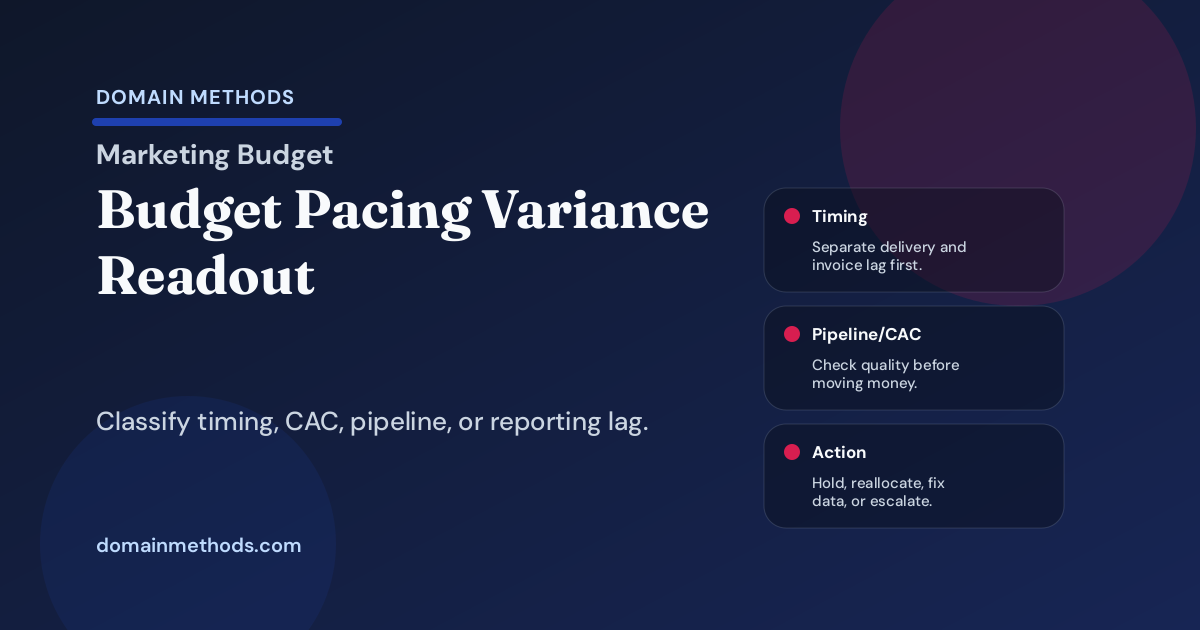
A marketing budget pacing variance readout is a short operating review that separates spend timing, reporting lag, pipeline quality, CAC movement, and actual performance before leaders move money mid-quarter.
Most pacing meetings start too late in the argument. Someone shows that paid search is 18% under plan, paid social is burning faster than expected, or pipeline is not keeping up with spend. Then the room jumps straight to the fight: cut spend, shift spend, blame attribution, or ask finance for more time.
That is how teams make expensive moves from a blurry signal.
The better first question is simpler: what kind of variance are we looking at? A delivery variance is not the same as a pipeline-quality variance. An invoice timing issue is not the same as CAC deterioration. A CRM campaign mapping break is not the same as a channel that stopped working.
This readout is for the weekly or month-end moment when the quarter is still alive and the team needs a decision. It is not a replacement for attribution, MMM, or incrementality testing. It is the operating layer between the numbers disagreeing and the business doing something expensive.
Start with the variance, not the explanation
Before anyone explains what happened, write down the actual variance.
| Question | What to capture |
|---|---|
| What was the plan? | Budget, channel, campaign family, geography, segment, or time period. |
| What happened? | Actual spend, pipeline, CAC, revenue, or margin result against that plan. |
| What is the decision window? | This week, this month, before quarter close, or before next planning cycle. |
| What action is on the table? | Hold, reallocate, pause, accelerate, repair reporting, or escalate to a diagnostic. |
| Who owns the call? | Growth, finance, RevOps, sales, or leadership. |
That first table keeps the meeting honest. If the only action on the table is a $10,000 campaign cap adjustment, you do not need a board-grade measurement debate. If the action is moving $300,000 between channel families before the quarter closes, the evidence bar is different.
A common operator mistake is letting every pacing miss inherit the loudest narrative in the room. Finance sees overspend. Marketing sees platform learning. Sales sees weak opportunity quality. RevOps sees campaign-source mess. Each may be partly right. The readout forces the team to classify the variance before choosing the remedy.
Separate spend timing from performance
Not every pacing miss is a performance miss.
Start with the mechanical layer:
- did the campaign launch late?
- did platform delivery under-serve because caps, bids, audience size, or approvals changed?
- did invoices post in a different week than the media actually ran?
- did daily spend spike because a pacing rule reset?
- did the reporting view include committed spend, delivered spend, invoiced spend, or recognized expense?
- did the ad platform, finance export, and warehouse refresh on different schedules?
This sounds boring. It is also where a lot of reactive budget decisions get stopped.
One SaaS growth team may see paid social 22% under plan on the finance view because the invoice posts late. Another may see Google Ads over plan because daily delivery caught up after a slow first week. In neither case has the channel performance story been answered yet.
The useful output from this step is not a perfect reconciliation. It is a label: timing issue, delivery issue, source mismatch, or real performance issue still under review.
If campaign naming or source fields are part of the confusion, use the Campaign Taxonomy and UTM Governance Checklist before you ask the pacing report to carry a budget decision it cannot support.
Then check pipeline quality and CAC
Spend pacing only matters because it is supposed to create something the business values.
Once timing is separated, compare the variance against the revenue layer:
| Signal | Useful read | Watch-out |
|---|---|---|
| Qualified pipeline | Is pipeline creation keeping up with the spend plan? | Raw lead volume can look fine while sales-fit quality collapses. |
| CAC or payback | Is customer acquisition cost moving outside the expected band? | CAC can look worse temporarily when pipeline has not matured yet. |
| Opportunity movement | Are opportunities advancing, stalling, or recycling? | Stage changes can lag spend by weeks in longer SaaS cycles. |
| Revenue recognition | Is finance seeing the same outcome period as marketing? | Closed-won, booked, billed, and recognized revenue can answer different questions. |
| Contribution or margin | Is the spend creating profitable growth? | Ecommerce and SaaS-adjacent teams can overreact to gross revenue. |
The operator detail here is timing. A campaign can be behind pipeline in week two and perfectly fine by week six. A channel can look efficient in-platform while creating low-fit opportunities that sales quietly ignores. A month-end variance can look like a budget miss when the real problem is that the decision cycle is longer than the reporting window.
Do not let platform ROAS or lead volume outrank the business metric if the business metric is available. If CAC is the core pressure point, pair this review with How to Calculate True CAC so the team is not comparing media spend to a vanity denominator.
Where attribution and reporting lag distort the readout
After spend timing and pipeline quality, inspect the reporting layer.
The usual suspects are familiar:
- attribution windows that credit last month for this month’s spend
- offline conversions that sync late or fail silently
- CRM campaign records that do not match ad-platform campaign families
- UTMs that changed mid-campaign
- warehouse jobs that refresh after the executive packet is already exported
- opportunity source rules that overwrite the campaign signal the team expected to see
- finance periods that do not match marketing reporting periods
This is where the conversation can slide into an attribution argument. Resist that. The question is not “Which model is perfect?” The question is whether the current readout is safe enough for the decision in front of the team.
Use three confidence labels:
| Confidence label | What it means | What it can support |
|---|---|---|
| Directional | The signal is useful but still caveated. | Investigation, watchlist, small reversible moves. |
| Decision-grade | Timing, source, pipeline, and owner checks are strong enough for the named move. | Budget hold, reallocation, pause, or acceleration inside the agreed scope. |
| Cleanup-first | The variance may be real, but the source logic is too weak to act on safely. | Measurement repair, source cleanup, or a diagnostic before the budget move. |
These labels reduce theater. Leadership does not need every caveat. They need to know what the number is allowed to do.
For broader measurement-method questions, use Attribution vs MMM vs Incrementality or Incrementality Testing for SaaS Budget Moves: When to Run a Holdout Test. This readout is narrower: what can we responsibly do before the quarter gets away from us?
The four actions that should come out of the meeting
A pacing review should end with one of four decisions.
| Action | Use when | Example |
|---|---|---|
| Hold | The variance is mostly timing, delivery, or reporting lag. | Keep spend steady for one more week while delayed conversions and finance posting catch up. |
| Reallocate | The variance is decision-grade and tied to a real performance or pipeline-quality issue. | Move budget from a weak campaign family to a stronger one with better qualified pipeline. |
| Fix data | The team cannot tell whether the variance is real because source logic is broken. | Repair UTM rules, CRM campaign mapping, or warehouse refresh before the next budget call. |
| Escalate | The variance affects enough budget, confidence, or leadership pressure to need a focused diagnostic. | Run a spend-confidence diagnostic before quarter-end instead of debating platform exports every week. |
The important part is that every action has an owner and a follow-up proof point. “Monitor” is not an action unless someone names what will be monitored, when, and what threshold changes the decision.
A practical readout sentence sounds like this:
Paid social is 14% over plan on delivered spend, but qualified pipeline is still inside the expected band and finance posting is one week behind. Hold spend for seven days, refresh the CRM-to-finance view on Monday, and revisit only if CAC moves outside the agreed threshold.
That is much better than “paid social is over budget” or “attribution is broken.”
Use the worksheet before the budget call
The worksheet is intentionally lightweight. It is designed for the operator who has to walk into the next spend meeting with a cleaner story, not for a data team trying to build a full measurement system overnight.
Budget Pacing Variance Worksheet
Classify one pacing variance, name the evidence behind it, assign a confidence label, and choose hold, reallocate, fix data, or escalate.
Instant download. No email required.
Want future posts like this in your inbox?
This form signs you up for the newsletter. It does not unlock the download above.
Use it for one variance at a time:
- write the planned and actual spend, pipeline, CAC, or revenue movement
- classify the likely source: timing, delivery, taxonomy, attribution lag, pipeline quality, CAC, or revenue-recognition timing
- name the evidence still needed
- assign the owner and confidence label
- choose the next action and follow-up date
If the worksheet keeps landing on cleanup-first, that is not a failed meeting. It is evidence that the team should stop pretending the pacing report is a decision system.
When to bring in help
Bring in help when the variance has become a recurring leadership tax.
One noisy week can be handled by a good operator. A repeated pattern is different: every budget call starts with platform exports, CRM screenshots, finance caveats, and a different version of CAC. That is not just a reporting inconvenience. It means the business is making spend decisions with a confidence layer nobody owns.
If the problem is immediate spend confusion, start with Where Did the Money Go?. If the issue has spread into pipeline, revenue, forecast, and leadership reporting, the stronger path is Revenue Analytics.
Either way, do not wait until the post-quarter retro to decide what the number meant. By then, the budget move has already happened.
Download the Budget Pacing Variance Worksheet (PDF)
A lightweight worksheet for separating spend timing, reporting lag, pipeline quality, CAC movement, and the next action before a quarter-end budget decision.
DownloadWhen the spend story needs a fast reality check
Where Did the Money Go?
Use the diagnostic when ad platforms, CRM, revenue, and finance views disagree before the next budget call.
See the spend diagnosticIf pacing has become a revenue-reporting problem
Revenue Analytics
Use the service path when the team needs a more durable spend-to-pipeline and spend-to-revenue reporting layer.
See Revenue AnalyticsSee It in Action
Common questions about budget pacing variance reviews
What is a marketing budget pacing variance readout?
How is this different from attribution reporting?
When should the team move budget after a variance review?
What if the readout shows the data is not trustworthy enough?

About the author
Jason B. Hart
Founder & Principal Consultant
Helps mid-size SaaS companies turn messy marketing and revenue data into decisions leaders trust.