Lead Scoring Sales Handoff Checklist: When a Score Is Safe Enough for Reps to Trust
- Jason B. Hart
- Data Activation
- April 30, 2026
- Updated June 17, 2026
Table of Contents
What is a lead scoring sales handoff?
A lead scoring sales handoff is the operating agreement that tells sales what a score means, what behavior should change, and what should stay unchanged until the score proves itself in the field.
That sounds basic. It is where a lot of scoring projects quietly fail.
The model may be decent. The warehouse may have useful product signals. The dashboard may show lift. But if the sales team receives a new field in Salesforce with no explanation, no playbook, and no feedback path, the score becomes one more number reps learn to ignore.
The uncomfortable middle is where the real work happens. A score can be promising enough to influence rep attention and still not be ready to own routing, compensation logic, or board-level pipeline claims.
That is the handoff problem.
The score is not the workflow
A lead score is only useful when it changes a specific operating behavior.
In one product-led motion, the useful signal was not “this account is interesting.” Sales already knew some accounts were interesting. The useful signal was: this trial account crossed a product-engagement threshold that usually disappears if an SDR waits three days. The score mattered because it changed who got called first and what context appeared in the CRM.
That distinction shows up in the B2B SaaS lead scoring case study. The result did not come from AI as theater. It came from product-qualified signals reaching Salesforce fast enough for reps to act: qualified pipeline increased 40%, high-intent response time dropped from three days to four hours, and reps had enough context to avoid calling blind.
The handoff should name the exact behavior the score will change:
| If the score changes… | The handoff must define… | Do not skip… |
|---|---|---|
| Rep prioritization | Which accounts move to the top of the queue and for how long | What happens when a rep disagrees |
| Routing | Which segment, territory, or owner rule wins | The fallback for duplicates or ambiguous accounts |
| Alerts | What event triggers the alert and what action follows | Whether the alert expires |
| SLA timers | Which score band starts the clock | Who pauses or resets it |
| Pipeline reporting | Which scored leads count in a forecast view | Whether the score is validated enough for leadership claims |
A score without this agreement is not operationalized. It is just visible. If the fit score includes company size, use a simple revenue band scoring rule that sales can explain instead of hiding the logic behind a black-box field.
The minimum handoff table
Before reps trust a score, put the operating rules in one place.
Keep it plain. The point is not to impress the data team. The point is to make sure the next sales manager, campaign owner, or RevOps admin can explain what changed without opening a model notebook.
| Handoff question | Good enough answer | Warning sign |
|---|---|---|
| What decision does the score support? | “Prioritize SDR follow-up for active trials above 70.” | “Help sales focus on better leads.” |
| What signals explain the score? | Product milestones, fit criteria, recent activity, and source freshness are visible to reps. | Reps only see a number. |
| Who owns source quality? | Named owners exist for product events, CRM fields, syncs, and scoring logic. | Everyone assumes someone else fixes bad examples. |
| What should not change yet? | Routing or SLA automation waits until false-positive review is complete. | The score immediately affects every downstream process. |
| How does sales give feedback? | Reps flag bad scores in one field or workflow, reviewed weekly by RevOps/data. | Feedback lives in Slack threads and disappears. |
The warning signs are usually obvious to operators. A rep says, “This account got a 92, but they are a student.” Marketing says, “The campaign sourced it, but product usage says nothing happened.” Data says, “The score is right based on the table we were given.”
That is not a model problem yet. It is a handoff problem.
What the score can change now
Not every score needs the same authority on day one.
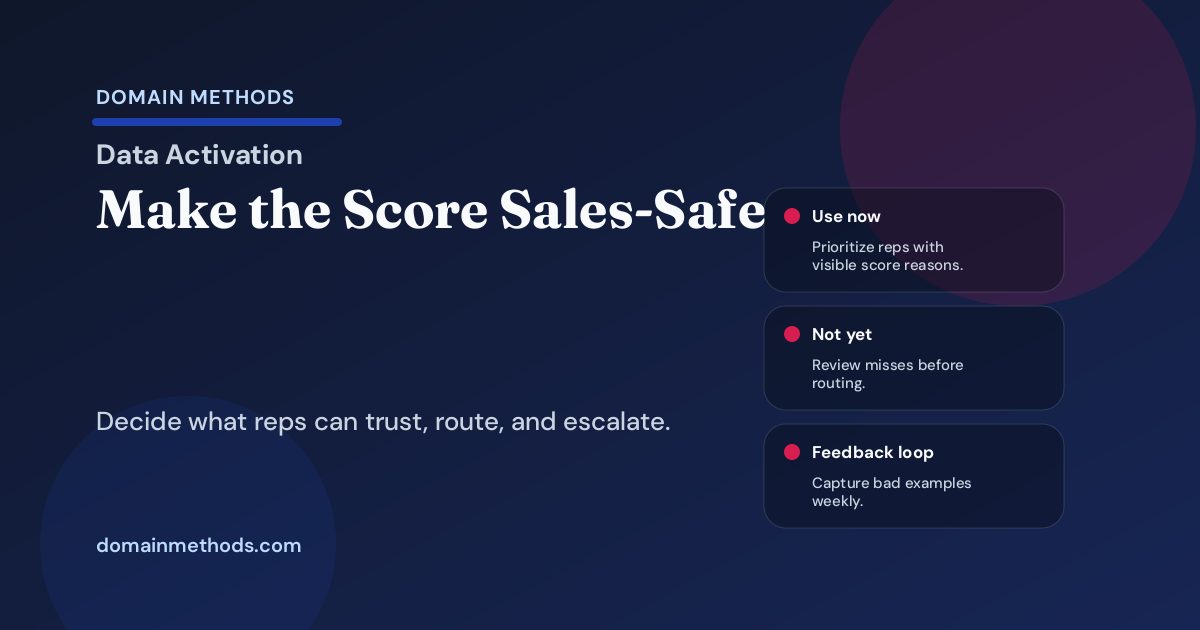
A useful handoff separates safe use from premature escalation:
| Use the score for now | Do not use it for yet | Proof or ownership needed before escalation |
|---|---|---|
| Rep queue prioritization | Automatic reassignment across territories | Territory exception owner and duplicate-account fallback |
| Manager review of high-intent accounts | Compensation, quota credit, or sourced-pipeline claims | Finance/RevOps agreement on crediting logic |
| Slack or CRM alerts with context | Unreviewed SLA penalties | Alert freshness, expiration, and false-positive review |
| Campaign learning and audience refinement | Budget shifts based only on score volume | Closed-loop conversion review by segment |
| Pilot routing for one segment | Company-wide routing policy | Stable owner rules and documented recovery path |
This is where many teams overreach. They see a lift chart and want the score to govern everything. Sales adoption usually improves when the first use is narrower: call these accounts first, show these signals, flag misses here, and review the pattern next week.
The fastest way to lose trust is to let a score make a decision that the organization has not agreed it is allowed to make.
What reps need to see
Reps do not need the model internals. They do need enough context to act without guessing.
A rep-facing handoff should answer four questions in the CRM or sales workspace:
- Why this account now? Show the behavior or fit change that made the score move.
- What should I do next? Name the recommended action: call, email, route, review, or wait.
- How fresh is the signal? A seven-day-old product event and a two-hour-old product event do not mean the same thing.
- Where do I flag a bad score? Make the feedback path part of the workflow, not a side conversation.
This is why data activation matters. The score is not finished when it lands in a dashboard. It is finished when the right context reaches the rep inside the system where the follow-up happens.
If the CRM cannot show the explanation, owner, freshness, or next action, start there before adding another scoring band.
When CRM or AI readiness is still the blocker
Sometimes the right handoff decision is “not yet.”
That is not failure. It is better than letting a shaky score become a sales process everyone resents.
Use the handoff review to identify which blocker you actually have:
| If the blocker is… | The next move is probably… | Related path |
|---|---|---|
| Duplicate or poorly linked lead/account records | Fix source precedence and matching before automation | Data Foundation |
| Lifecycle or owner fields drift by team | Stabilize CRM ownership and stage rules | CRM Workflow Reliability Benchmark |
| Reps cannot explain bad examples | Add visible score factors and feedback capture | AI Workflow Readiness Checklist |
| Score is useful but trapped in reporting | Push the signal into CRM, Slack, or sales workflows | Data Activation |
| Marketing and sales disagree on what “qualified” means | Reset the definition before routing changes | Three Teams, Three Numbers |
A good handoff meeting ends with one of two answers: “we can use the score for this specific behavior now,” or “we know exactly what has to be fixed before it gets more authority.”
Both are useful.
The 45-minute handoff agenda
Do not turn this into a six-week governance project. One focused working session is enough to find the obvious gaps.
| Time | Discussion | Output |
|---|---|---|
| 0-5 min | Name the score and target decision | One sentence: “This score will change…” |
| 5-15 min | Review the signals and explanations reps will see | Required CRM fields and context cards |
| 15-25 min | Check freshness, owners, and sync path | Named owner for each failure point |
| 25-35 min | Set allowed / not-yet boundaries | Current authority level and escalation rule |
| 35-45 min | Define the feedback loop | Where bad examples go and who reviews them |
The agenda works best with one real scored account on screen. Abstract policy debates get shorter when everyone can see the actual Salesforce record, product events, owner, and recommended action.
Download the Lead Scoring Sales Handoff Checklist (PDF)
Use this text-first worksheet to run the 45-minute handoff review, set allowed/not-yet boundaries, and name the proof needed before a lead score gets more sales authority. Download it instantly below.
Instant download. No email required.
Want future posts like this in your inbox?
This form signs you up for the newsletter. It does not unlock the download above.
A score earns authority in stages
The goal is not to slow down every lead scoring project until it becomes perfect.
The goal is to stop confusing a promising score with an operating agreement.
Start with a narrow behavior. Give reps the reason behind the score. Name the owners. Review the misses. Then give the score more authority only when the workflow earns it.
If the score is ready but the handoff path is not, the next move is Data Activation: getting the trusted signal into the tools and rules where sales actually works.
If the score keeps exposing source-data, CRM hygiene, or workflow ownership issues, start with the AI-Ready Data Diagnostic or Data Foundation before the score gets more power than the system can safely support.
Download the Lead Scoring Sales Handoff Checklist (PDF)
A lightweight meeting worksheet for deciding what the score can change, what reps should see, and what proof is still missing before escalation.
DownloadIf the score is ready but the workflow is not
Data Activation
Use Data Activation when product, CRM, and warehouse signals need to reach reps as trusted routing, prioritization, and follow-up workflows.
See Data ActivationIf sales does not trust the inputs yet
AI-Ready Data Diagnostic
Use the audit when weak CRM hygiene, source precedence, or ownership makes the scoring workflow too risky to automate.
See the AI-Ready Data DiagnosticSee It in Action
Common questions about lead scoring handoffs
When is a lead score ready for sales to trust?
Should a lead score automatically route accounts to reps?
What usually makes reps ignore a good scoring model?
How does this differ from an AI readiness or CRM hygiene review?

About the author
Jason B. Hart
Founder & Principal Consultant
Helps mid-size SaaS companies turn messy marketing and revenue data into decisions leaders trust.