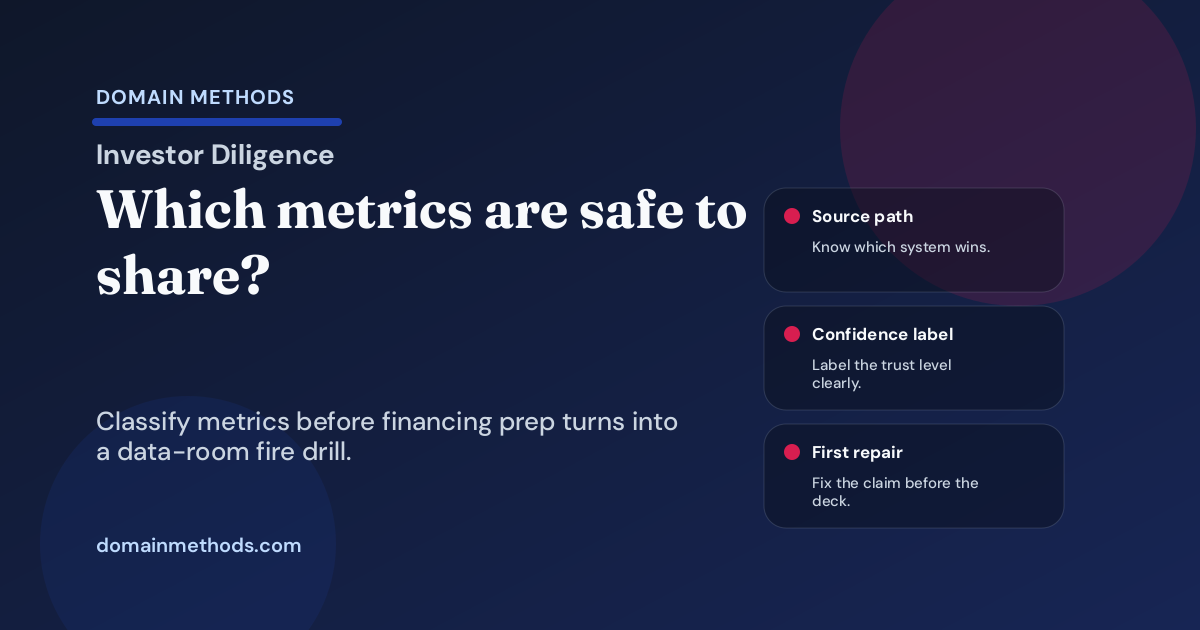
Investor Diligence Metric Readiness Checklist: Which Revenue Numbers Are Safe to Share?
- Jason B. Hart
- Revenue Operations
- June 3, 2026
- Updated June 4, 2026
Table of Contents
What is investor diligence metric readiness?
Investor diligence metric readiness is the test of whether a revenue or marketing metric is safe to share when the audience is allowed to ask hard questions about definition, source, ownership, and evidence.
Internal reporting gives teams a lot of forgiveness. A dashboard can be useful even if the source note is messy. A pipeline chart can help a VP spot a trend even if RevOps still needs to clean up two stages. A CAC number can guide a budget conversation even if Finance has not blessed every cost allocation.
Investor diligence is different.
The number is not just helping the team operate. It is being used to support a claim about the business. That claim may affect financing, valuation, a strategic review, a board narrative, or the confidence investors place in the operating model.
That does not mean every metric has to be perfect. It means the team needs to know which numbers can carry weight, which ones need caveats, and which ones should stay out of the data room until the underlying source path is repaired.
The diligence risk is not just wrong numbers
The obvious fear is that a number is wrong. The more common problem is that the company cannot explain why the number should be trusted.
A revenue leader says pipeline coverage is 3.2x. Finance asks whether renewals are included. Marketing asks why sourced pipeline does not match campaign reporting. RevOps knows the stage history table changed last quarter. The warehouse has the corrected logic, but the board deck still uses a CRM export that someone manually adjusted on Monday.
That is the failure mode diligence exposes. Not one bad dashboard. A weak operating contract around the metric.
When diligence starts, the buyer of the work is often not asking for a months-long data transformation. They need a practical answer to a sharper question:
Which numbers are safe enough to share, and what caveat travels with the ones that are not?
Start with the decision the metric will support
Before arguing about the dashboard, name the external decision.
| Diligence use | What the number has to support | Minimum confidence bar |
|---|---|---|
| Early investor conversation | Directional shape of the business | Directional with visible caveats |
| Board or financing prep | A stable leadership narrative | Board-grade or clearly caveated decision-grade |
| Data-room support | Evidence behind a claim | Diligence-ready for the stated scope |
| Strategic review | A decision about growth, spend, or risk | Decision-grade with source evidence |
| Valuation-sensitive claim | A number another party may model against | Diligence-ready or not used |
This is where teams get into trouble. A metric that was built for operating discussion gets promoted into investor proof because it looks polished. The chart has a title, a trend line, and a decimal point. Nobody asks whether the source path behind it can survive the next question.
If the company is still rebuilding the same number by hand every month, the metric may be useful. It is not diligence-ready.
The seven checks I would run first
Use this as a practical screen before a revenue or marketing metric leaves the internal room.
| Check | What to verify | Operator-level tell |
|---|---|---|
| Source of record | Which system wins when CRM, finance, billing, marketing automation, and warehouse disagree | People stop saying “it depends which export you use” |
| Definition owner | Who can approve the metric formula and edge cases | The owner can explain exclusions without opening three tabs |
| Business owner | Who carries the number into the decision | The person presenting it also understands its caveats |
| Last reconciliation | When it last matched the trusted finance or warehouse view | There is a date, not a vague “recently” |
| Manual adjustment | What spreadsheet logic or hand edit changed the number | Adjustments are named, not hidden in a final deck tab |
| Evidence trail | Where the supporting query, report, or reconciliation lives | Another operator can reproduce the path without guessing |
| Caveat boundary | What the number should not be used for yet | The caveat travels with the number, not in someone’s head |
The practical question is not whether the metric is interesting. It is whether the team can show its work without turning diligence prep into archaeology.
Which numbers usually break first
The same categories tend to create trouble because they sit across multiple teams and systems.
ARR and revenue movement
ARR movement looks clean in an executive chart and messy in the handoff between CRM, billing, finance, and the warehouse. New, expansion, contraction, churn, reactivation, credit, refund, and timing adjustments can all get flattened into one story.
If Finance recognizes the movement one way and RevOps reports the operating view another way, the metric needs source precedence and a caveat before it becomes diligence support.
Pipeline and stage conversion
Pipeline metrics depend on stage definitions, close-date hygiene, opportunity source, account ownership, and whether sales leaders use the CRM the same way across segments.
The diligence risk is not only stage inflation. It is that historical conversion rates may be built on definitions the current team no longer uses. If the stage rules changed, the old trend needs a note.
CAC, payback, and attribution
CAC and payback often combine spend data, opportunity source, revenue timing, sales cost treatment, and attribution logic. That is a lot of places for the number to become directionally helpful but externally fragile.
If the team cannot explain which costs are included, which revenue period is used, and how source is assigned, the number should not be treated like clean investor proof. Use the attribution gap map to separate optimization signals from decision-grade reporting before leaning on the metric.
Retention, churn, and expansion
Retention can break on account hierarchy, billing status, renewal timing, contraction treatment, product-line movement, or customer-success overrides. A churn number can be true inside one system and misleading for an investor story if the starting population is not explicit.
The Retention Confidence Check is a useful adjacent test when the diligence risk is specifically about NRR, gross retention, churn, contraction, or expansion.
Lead-source and campaign history
Lead-source history is a common trap because the old source field often carries years of process drift. Imports, SDR edits, enrichment tools, attribution rewrites, campaign taxonomy changes, and missing UTMs all live inside the same column.
That does not make the data useless. It means the team needs to say what the field is good for: trend direction, campaign diagnosis, budget proof, or nothing beyond cleanup evidence.
Use five confidence labels, not one fake yes/no
A diligence check should not collapse every metric into “approved” or “bad.” That forces teams to either overclaim or hide useful signals.
| Label | What it means | Safe uses | Unsafe uses |
|---|---|---|---|
| Directional | Useful for trend spotting, diagnosis, or prioritization, but controls are incomplete | Internal investigation, cleanup planning, early narrative shape | Investor proof, valuation-sensitive claims, board-grade commitments |
| Decision-grade | Stable enough for one named operating decision with caveats visible | Budget, staffing, prioritization, focused executive choice | Broad data-room proof without source evidence |
| Board-grade | Strong enough for leadership reporting within a documented scope | Board narrative, executive review, recurring KPI packet | Claims outside the documented scope |
| Diligence-ready | Definition, source, owner, reconciliation, evidence, and caveat trail can withstand external review | Data-room support, investor diligence, financing prep | Uses beyond the approved definition or period |
| Not ready | The metric may expose a real issue, but the source path or definition is too weak | Repair evidence, risk flag, cleanup backlog | Any external claim |
The important move is matching the label to the decision. A directional lead-source trend can still help prioritize campaign taxonomy cleanup. It should not become proof that one channel drives the majority of revenue.
Write the caveat before the question arrives
A useful caveat is not a vague apology. It is an operating boundary.
Weak caveat:
This number may not be perfect.
Useful caveat:
Pipeline source is decision-grade for 2025 enterprise opportunities because Salesforce source, campaign taxonomy, and warehouse opportunity history were reconciled on May 28. It is directional for self-serve pipeline before Q4 because imports and enrichment overwrites were not consistently logged.
That caveat tells leadership what the number can support, what it cannot support, and where the repair work lives.
The operator detail matters. A caveat that names the system, period, owner, and unresolved risk is useful. A caveat that says “data quality” is just a warning label nobody can act on.
Choose the repair path by failure type
Once a metric fails the readiness test, do not immediately default to a warehouse rebuild. Pick the smallest repair that changes the next decision.
| Failure type | First repair | Escalation path |
|---|---|---|
| Definition conflict | Freeze the formula, exclusions, and edge cases | Three Teams, Three Numbers |
| Source precedence conflict | Decide which system wins by metric and period | Data Foundation |
| CRM history drift | Document the affected period and stop overclaiming old trend lines | Data Foundation |
| Finance reconciliation gap | Reconcile operating and finance views for the claim being made | Data Foundation or metric alignment |
| Manual spreadsheet bridge | Name the adjustment, owner, and sunset plan | Source-of-truth repair |
| Missing caveat owner | Assign who carries the caveat into leadership and investor prep | Metric governance cadence |
A lot of diligence-prep work gets expensive because teams try to fix every historical issue at once. The better first move is to protect the claim leadership is about to make.
A 30-minute diligence readiness pass
If the team is short on time, run this working session for each high-stakes metric.
- Name the claim. What will leadership say using this number?
- Name the source path. Which systems, reports, models, and spreadsheets create it?
- Name the owner. Who owns the definition and who presents the number?
- Check the latest reconciliation. When did it last match the trusted view?
- Find hidden edits. Where did a manual adjustment, import, enrichment overwrite, or deck-level change alter the number?
- Assign the confidence label. Directional, decision-grade, board-grade, diligence-ready, or not ready.
- Write the caveat. What should the number not be used for yet?
- Pick the first repair. Definition, source precedence, CRM history, finance reconciliation, spreadsheet bridge, or caveat ownership.
That sequence is deliberately plain. In investor prep, plain beats impressive. A simple table with owners, caveats, and repair paths is more valuable than a beautiful dashboard nobody can defend.
Download the Investor Diligence Metric Readiness Checklist
Use this text-first worksheet to classify one high-stakes metric, write the caveat that should travel with it, and choose the first repair before investor or financing review.
Instant download. No email required.
Want future posts like this in your inbox?
This form signs you up for the newsletter. It does not unlock the download above.
Where Domain Methods fits
If the diligence risk is mostly cross-functional disagreement, start with Three Teams, Three Numbers. The work is aligning the operating definition, owner, caveat, and decision path before the company asks investors to trust the number.
If the risk is source precedence, CRM history, warehouse logic, or finance reconciliation, start with Data Foundation. The issue is not messaging. The source path cannot hold the claim yet.
If the team needs a fast read on what is safe, what is directional, and what will break first, a focused analytics audit can create the diligence-prep map before the bigger repair work begins.
Sources and adjacent reading
- The Board Fire Drill Recovery Playbook for stabilizing executive reporting after a trust break.
- The Metric Confidence Ladder for broader confidence-language discipline.
- The Revenue Definition Confidence Benchmark for testing whether revenue definitions can support leadership decisions.
- The Source-of-Truth Maturity Benchmark for diagnosing whether the source path can support board-grade reporting.
Download the Investor Diligence Metric Readiness Checklist
A lightweight worksheet for classifying one revenue, pipeline, CAC, retention, or attribution metric before investor diligence or financing review.
DownloadIf investor prep exposes different answers from Sales, Marketing, RevOps, and Finance
Three Teams, Three Numbers
Use the diagnostic when leadership needs one trusted revenue answer before metric disagreements show up in the board deck or data room.
Start with metric alignmentIf the number breaks because the source path cannot hold
Data Foundation
Use Data Foundation when the blocker is CRM logic, warehouse models, source precedence, lineage, or brittle reporting handoffs.
See Data FoundationSee It in Action
Common questions about investor diligence metric readiness
What is investor diligence metric readiness?
Which metrics usually break first during diligence?
Does every metric need to be diligence-ready before talking to investors?
What should we do if Finance, RevOps, and Marketing disagree on a diligence metric?

About the author
Jason B. Hart
Founder & Principal Consultant
Helps mid-size SaaS companies turn messy marketing and revenue data into decisions leaders trust.