The Inherited Reporting Debt Triage Playbook
- Jason B. Hart
- Revenue Operations
- April 25, 2026
Table of Contents
What is inherited reporting debt?
Inherited reporting debt is the reporting estate a new leader gets on day one: dashboards that may or may not be trusted, spreadsheets that keep the weekly meeting alive, board-slide cuts nobody wants to rebuild, and metric definitions that changed three times before anyone wrote them down.
The problem is not that the team has too many reports. The problem is that nobody knows which reports still deserve authority.
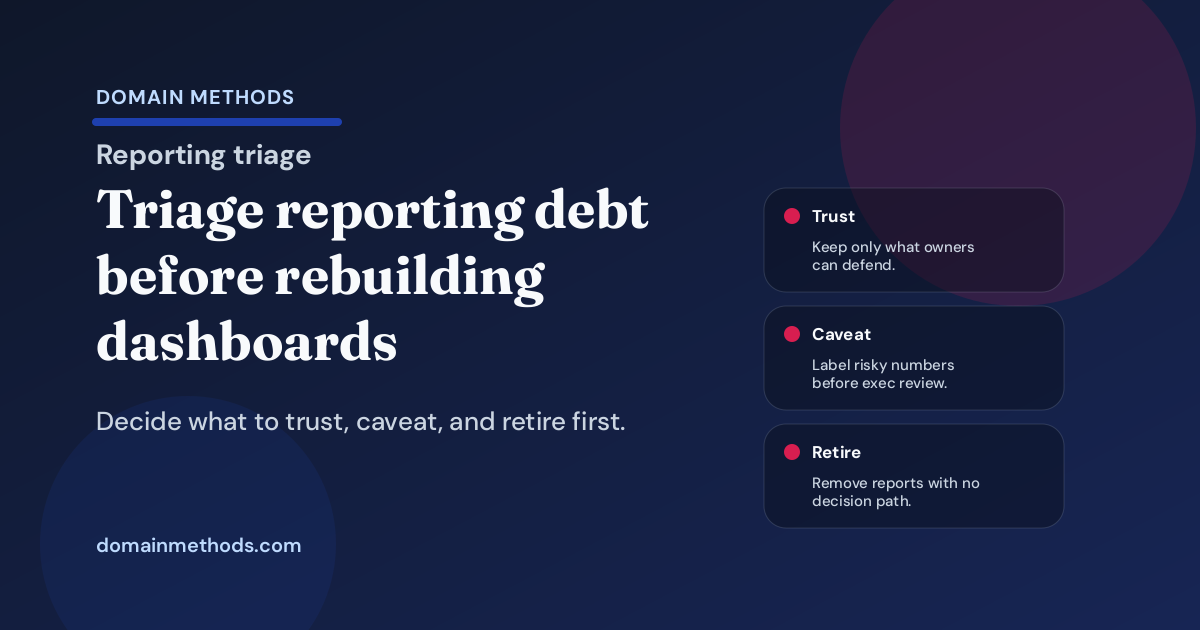
A new growth, RevOps, analytics, or data leader can lose weeks trying to understand the history behind every dashboard tab. That is usually the wrong first move. The better first move is to separate reporting assets by decision value and risk: what can we trust now, what needs a caveat, what must be fixed before the next leadership cycle, and what should quietly go away. If the first pass exposes one politically fragile KPI instead of a whole estate problem, use the broken-metric triage guide to decide whether ownership, definition, or pipeline work should move first.
This playbook is for that first pass. It is not a redesign brief. It is the operating triage before the redesign brief becomes honest.
When this playbook matters most
Use this when you join or inherit a team and hear some version of:
- “The dashboard exists, but nobody uses it in the meeting.”
- “Finance has the number, marketing has the trend, and RevOps has the caveat.”
- “We keep updating this spreadsheet because the dashboard cannot answer the real question.”
- “The board deck has its own logic because the normal reports do not survive scrutiny.”
- “Everyone agrees the reporting is messy, but nobody agrees what to fix first.”
The lived-in detail: the report with the most political weight is often not the one with the cleanest data. It is the one somebody used during a high-pressure meeting and never had permission to retire. If you do not name that history, the cleanup will look like a tooling decision when it is really a trust and ownership decision.
The four-week triage sequence
Week 1: Inventory the reports people actually use
Do not start with the BI folder tree. Start with the operating calendar.
List the recurring meetings where numbers are used: pipeline review, marketing performance, forecast review, board prep, product growth review, ecommerce margin review, and any weekly leadership meeting where somebody says “can you pull the latest?”
For each meeting, capture the report, owner, audience, cadence, and decision it claims to support. If there is no decision, write that down. A report without a decision is not automatically useless, but it should not outrank a report that drives budget, hiring, pipeline inspection, or customer action every week.
Week 2: Tag trust before changing anything
Before you touch the dashboard, tag each artifact with a confidence label:
- Trusted for now: the definition is clear enough and the owner can defend it.
- Useful with caveats: the trend helps, but the number needs context.
- Risky for leadership use: the report may be directionally interesting but should not drive budget, forecast, compensation, or board decisions yet.
- Unknown: nobody can explain the source, definition, or refresh logic quickly.
This is where a lot of cleanup gets uncomfortable. A dashboard can be beautifully formatted and still be risky. A spreadsheet can be ugly and still be the only artifact with the business logic the meeting actually uses. The job is not to reward the cleanest surface. The job is to find the decision risk.
Week 3: Decide what to keep, caveat, fix, retire, or defer
Use this table for the first sorting pass:
| Reporting asset status | What it means | Action for the next 30 days |
|---|---|---|
| Keep and trust | Clear owner, stable definition, recurring decision use | Leave it alone except for light documentation |
| Keep with caveat | Useful trend, known limitation, still helpful in meetings | Add a visible caveat and name the next proof needed |
| Fix before next cycle | High-visibility asset with definition, source, or owner risk | Scope one cleanup sprint with an owner and deadline |
| Retire or merge | Duplicate, stale, or politically preserved report with no real decision | Remove it from the meeting path after owner sign-off |
| Defer | The report matters later, but upstream trust is not ready | Park it until source or definition work is done |
A practical rule: if a report has no owner and no decision, do not let it become the first rebuild. If a report has high executive visibility and a weak definition, it probably deserves the first cleanup sprint even if the underlying SQL is boring. For metric families that already carry leadership or board pressure, the Revenue Definition Confidence Benchmark gives you a sharper way to decide whether the number is still directional, decision-grade, or board-grade.
Week 4: Scope the first credible cleanup move
By week four, the goal is not to have the whole reporting estate fixed. The goal is to know the first move well enough to defend it.
That move should be small enough to finish and important enough to matter. Examples:
- standardize one pipeline metric across the leadership meeting and board deck
- replace one spreadsheet-backed weekly view with a governed source and a visible fallback rule
- retire three stale reports that keep confusing the performance review
- rewrite one dashboard request into a decision brief because the business question was never clear — use the dashboard-request decision tree if the team is still debating whether the work is a dashboard, brief, or workflow change
- freeze one metric as directional until source ownership is cleaned up
The anti-pattern is the heroic rebuild plan: a broad dashboard reset, a new warehouse roadmap, or a new tool evaluation before the organization agrees which decisions are blocked.
The triage worksheet
Use the worksheet to score the top inherited reporting assets before the first cleanup sprint is scoped.
Download the Inherited Reporting Debt Triage Worksheet (PDF)
Score inherited reports by decision value, trust level, owner clarity, and cleanup priority before you order another dashboard rebuild.
Instant download. No email required.
Want future posts like this in your inbox?
This form signs you up for the newsletter. It does not unlock the download above.
A good triage score should answer five questions:
| Triage question | Why it matters |
|---|---|
| Which meeting uses this report? | Reports attached to recurring decisions deserve more attention than idle dashboard tabs. |
| What action changes if the number moves? | If no action changes, the report may be commentary, not operating infrastructure. |
| Who can defend the definition? | Ownerless metrics turn every review into a debate. |
| How costly is a wrong answer? | Board, budget, compensation, and forecast uses need a higher confidence bar. |
| What would we stop doing if this report disappeared? | If the honest answer is “nothing,” retire or merge it. |
Where this routes next
If the triage shows the team keeps asking for reports before the decision is clear, start with Translate the Ask. The work is not another dashboard yet. It is turning pressure into a decision brief the data team can actually build against.
If the triage shows the same metric means different things across marketing, sales, finance, and RevOps, use Three Teams, Three Numbers. The work is definition alignment before the next executive review turns into another reconciliation exercise.
If the triage shows source systems or warehouse logic cannot support the reports that matter, then Data Foundation enters the conversation. But do not start there by reflex. First prove which reporting surfaces are worth fixing.
The point of the first month
The first month is not about being the person who finally rebuilds everything.
It is about becoming the person who can say, clearly: these reports can be trusted, these need caveats, these should be retired, and this is the first cleanup move that will make leadership decisions safer.
That is how reporting debt stops being inherited folklore and becomes an operating plan.
Download the Inherited Reporting Debt Triage Worksheet (PDF)
A lightweight worksheet for scoring inherited dashboards, reports, and spreadsheet rituals by decision value, trust level, owner clarity, and cleanup priority.
DownloadIf the inherited reporting mess is really an unclear business ask
Translate the Ask
Use this when teams keep requesting dashboards before the decision, owner, cadence, and required action are clear enough to build the right thing.
See Translate the AskIf the same number changes meaning across teams
Three Teams, Three Numbers
Use this diagnostic when marketing, sales, RevOps, finance, and data cannot defend one shared definition for the metrics leadership already uses.
See the metric-alignment diagnosticSee It in Action
Common questions about inherited reporting debt
What is inherited reporting debt?
Should a new leader rebuild the dashboard stack first?
How do we decide which reports to retire?
Where does this fit with source-of-truth work?

About the author
Jason B. Hart
Founder & Principal Consultant
Helps mid-size SaaS companies turn messy marketing and revenue data into decisions leaders trust.