Incrementality Testing for Ecommerce Growth Teams: When ROAS Is Not Enough
- Jason B. Hart
- Marketing Analytics
- May 12, 2026
- Updated June 10, 2026
Table of Contents
What is ecommerce incrementality testing?
Ecommerce incrementality testing is a way to estimate whether paid media, promotions, or lifecycle treatments created additional orders, net revenue, or contribution margin that would not have happened without the treatment.
That last phrase is the whole point: would not have happened without the treatment.
Most ecommerce teams already have plenty of reports. Meta has a number. Google has a number. Shopify has a number. Northbeam, Triple Whale, GA4, the warehouse, and finance may each have a number too. The problem is not that nobody can produce ROAS. The problem is that the numbers answer different questions.
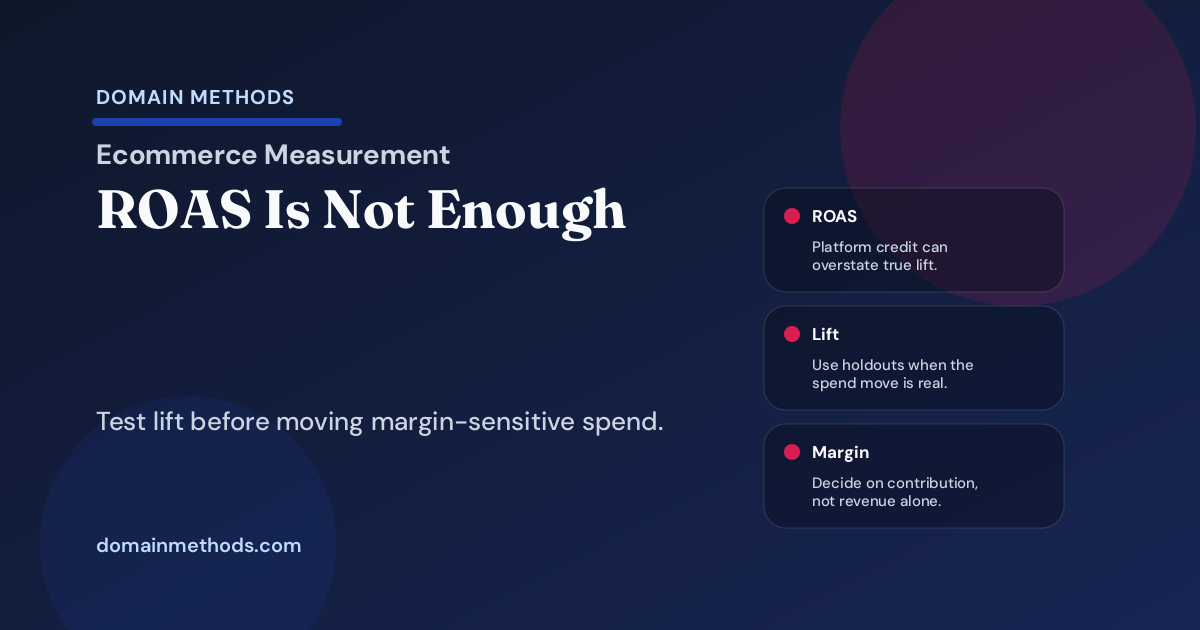
Platform ROAS asks, “What revenue did this platform claim?” Incrementality asks, “What did the business actually gain because we spent the money?” Those are not the same question, especially when retargeting, branded search, discounts, returns, subscriptions, and repeat purchases are involved.
If the decision is small and reversible, directional ROAS can be enough. If the team is about to move serious budget, defend upper-funnel spend, cut retargeting, or explain why gross revenue grew while contribution margin did not, the evidence level needs to rise.
Why ecommerce ROAS can look better than reality
ROAS is useful when it is used at the right altitude. It becomes dangerous when the business treats it as profit, causality, and budget permission in one number.
The common failure modes are practical, not academic:
| Where ROAS gets inflated | What happens in the meeting | Why incrementality matters |
|---|---|---|
| Branded search | Paid search gets credit for people who were already looking for the brand. | The question is how much demand would have arrived through organic, direct, email, or marketplace behavior without buying the click. |
| Retargeting | Audiences close to purchase show beautiful ROAS. | The test is whether ads changed behavior or just followed shoppers who were already returning. |
| Meta prospecting | Platform reporting claims sales from a broader influence window. | The team needs to separate real demand creation from demand capture and modeled credit. |
| YouTube, CTV, creators, or upper funnel | Last-click reports under-credit the channel while platform or survey reads may overclaim it. | The decision needs a lift read or portfolio signal, not a fight over one attribution view. |
| Promotions | Revenue spikes after the offer. | The margin question is whether the promotion created profitable incremental demand or pulled forward orders at a discount. |
| Email and SMS | Owned channels look extremely efficient. | The useful question is which sends, segments, or suppression groups actually changed purchase behavior. |
The operator detail is that ROAS often fails at the exact moment the conversation gets expensive. A channel can look efficient on gross sales and still be weak after discounts, returns, payment fees, pick-pack cost, shipping subsidy, and product margin. A finance leader is not being difficult when they ask for contribution context. They are asking whether the growth is worth keeping.
That is why an ecommerce incrementality conversation should sit next to margin reporting. If the team cannot connect spend to net revenue and contribution margin, the test may estimate lift against the wrong outcome. For the margin layer, see The Ecommerce Profitability Stack: From Revenue Vanity to Margin Clarity and How to Calculate True Customer Acquisition Cost, Not the Vanity Version.
Start with the decision, not the testing method
Do not begin with “we should run incrementality tests.”
Begin with the decision the business is trying to make:
- Should we cut branded search, or is it protecting demand we would otherwise lose?
- Should we reduce retargeting because it is mostly harvesting shoppers who would buy anyway?
- Should Meta prospecting get more budget even when last-click ROAS looks weaker than search?
- Should YouTube, CTV, creator, or awareness spend survive the next budget review?
- Should we change the promotion calendar if revenue lift is coming with weak contribution margin?
- Should email or SMS holdouts become part of the lifecycle testing cadence?
- Should we move budget between markets because one region appears to respond better?
A good test question is narrow enough that the answer changes behavior. “Is Meta incremental?” is usually too broad. “Can we move 15% of retargeting spend into prospecting for the next four weeks without reducing net revenue or contribution margin?” is a question a leadership team can act on.
This is the same discipline behind Incrementality Testing for SaaS Budget Moves: When to Run a Holdout Test. The method comes after the budget decision, not before it.
Which ecommerce questions deserve an incrementality test?
The best candidates have three traits: the spend is material, the current reports disagree, and the answer will change action.
| Question | Why it deserves testing | What the team should decide in advance |
|---|---|---|
| Branded search defense | Branded terms can look profitable while capturing demand that would have arrived anyway. | Which revenue loss, if any, would justify keeping the spend? |
| Retargeting pressure | Retargeting often over-credits shoppers already close to purchase. | How much flat or negative lift would trigger a budget reduction? |
| Meta prospecting scale | Prospecting may create demand that last-click undercounts, but platform ROAS may overstate it. | Which outcome matters: first order, new customer, payback window, or contribution margin? |
| YouTube or CTV proof | Upper-funnel channels rarely fit clean click-path attribution. | Which market, audience, or timing window can isolate the signal? |
| Promotional holdouts | Discounts can create revenue while hurting margin or pulling purchases forward. | What counts as success: gross revenue, net revenue, margin, repeat purchase, or inventory movement? |
| Geo lift tests | Market-level variation can test budget or media pressure when user-level control is unrealistic. | Which geographies are comparable enough and how long the read must run? |
| Email/SMS suppression | Owned channels look efficient because they reach warm customers. | Which segments can be withheld without harming customer experience or operational promises? |
The tradeoff is that tests are not free. They consume audience, time, spend, and trust. A growth leader can defend one sharp test tied to a real decision. It is much harder to defend a measurement program that keeps creating experiments no one is willing to act on.
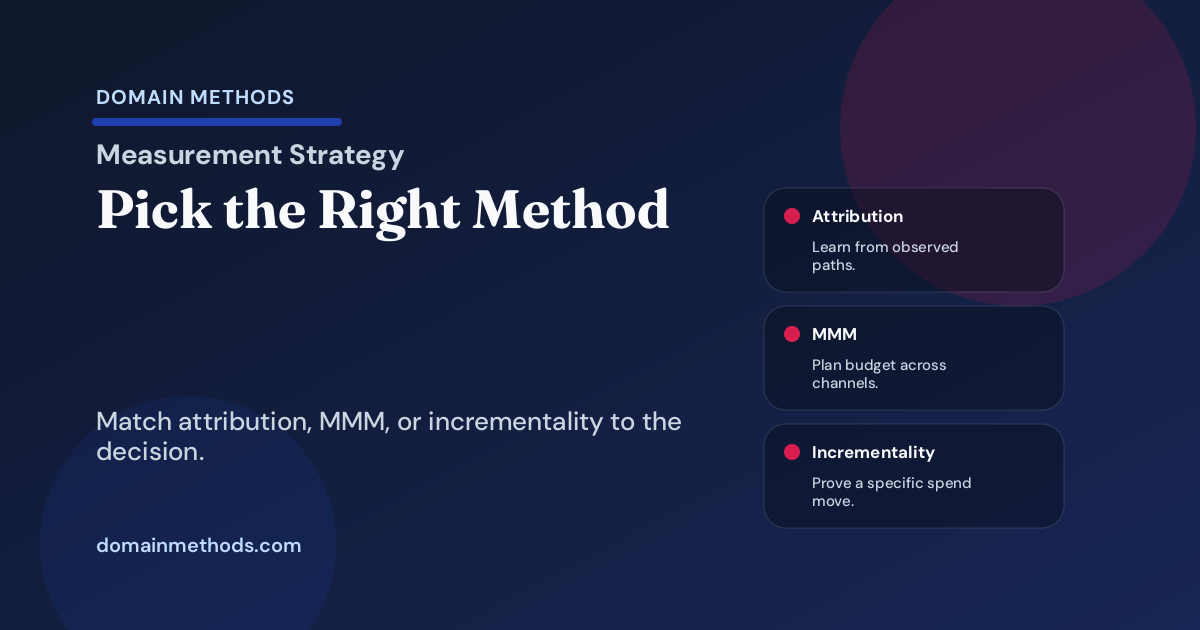
Holdout, geo lift, platform lift, or MMM?
Different methods answer different ecommerce questions. Treating them as interchangeable is how teams end up with a sophisticated report and no decision.
| Method | Best use | Watch the caveat |
|---|---|---|
| Attribution / platform ROAS | Fast campaign management, creative learning, path visibility, and day-to-day optimization. | It assigns or models credit. It does not prove what would have happened without spend. |
| Platform conversion lift | A contained platform question where the platform can create exposed and control groups. | It is useful, but the platform still defines the environment, eligibility, and measurement rules. |
| Customer or audience holdout | Email/SMS, lifecycle, retargeting, or audience-level treatments where withholding exposure is feasible. | Holdout contamination and customer-experience risk need active management. |
| Geo or market-level lift | Broad spend shifts, YouTube/CTV, market launches, or channels where user-level control is weak. | Markets must be comparable enough, and local noise can swamp small effects. |
| MMM | Portfolio-level allocation, diminishing returns, and channel-mix planning over time. | MMM is a planning instrument. It will not settle every campaign or audience question. |
| Qualitative or post-purchase signal | Directional context for dark social, creators, brand, or messy purchase paths. | Useful context is not causal proof. Do not ask survey data to carry a budget move alone. |
For the broader measurement-stack tradeoff, Attribution Didn’t Die. It Just Got Demoted. explains why attribution still matters after privacy changes and walled-garden reporting. The ecommerce incrementality layer is more specific: when platform credit is no longer strong enough to move paid-media budget.
The data that needs to be clean before testing
A test does not rescue bad definitions. It usually exposes them.
Before an ecommerce team treats a result as decision-grade, check the inputs that will decide the read:
| Data area | What needs to be stable | Why it matters |
|---|---|---|
| Spend and campaign taxonomy | Channels, campaigns, UTMs, markets, and audience labels have to map consistently. | Otherwise the test cannot explain what was actually changed. |
| Shopify and order data | Orders, refunds, discounts, taxes, shipping, and net revenue need consistent treatment. | Gross sales can make a weak test look like a win. |
| Contribution margin | Product cost, payment fees, shipping subsidy, pick-pack, and fulfillment cost need usable assumptions. | Budget decisions should not stop at attributed revenue. |
| Customer status | New vs returning, subscriber vs one-time, high-LTV vs promotion-sensitive segments need clear rules. | Incremental revenue from the wrong customer mix can mislead the next move. |
| Promotion and inventory context | Discounts, launches, stockouts, merchandising, and seasonality must be known. | Marketing may get blamed or credited for operational context. |
| Decision ownership | Growth, finance, data, ecommerce, and leadership must agree on the action rule. | If no one agrees what happens after the read, the test becomes another slide. |
For many teams, the first useful move is not a test. It is the cleanup work that makes a test interpretable. The ecommerce data layer has to connect storefront, ad platforms, fulfillment, and finance well enough that the result can survive scrutiny. The Ecommerce Data Playbook is the broader foundation for that work.
How to classify the result
Incrementality results should not all receive the same confidence label. A weak read can still be useful if the team uses it correctly. The problem starts when a directional result becomes a board-grade claim because everyone wanted the answer to be clean.
Use three labels before the test launches:
| Evidence label | What it means | Safe use | Unsafe use |
|---|---|---|---|
| Directional | The read suggests a likely pattern, but sample, isolation, timing, or margin caveats are meaningful. | Guide the next test, reduce obvious waste, or add caveats to a budget discussion. | Permanent budget shifts, finance-grade claims, or vendor/tool victory laps. |
| Decision-grade | The setup is clean enough, the outcome is trusted, and the result is strong enough to change the named decision. | Move budget, change the cadence, pause a tactic, or scale a channel with documented caveats. | Treat the result as permanent truth across seasons, products, or customer segments. |
| Unsafe | The result is too contaminated, too thin, or tied to unstable definitions. | Identify the blocker and fix taxonomy, data, margin, or test design. | Presenting the number as proof because the team already wanted the decision. |
The lived-in detail here is meeting behavior. If finance, growth, and data all know the confidence label before launch, the read has a better chance of changing action. If the label is chosen after the number appears, the team will usually grade the test by whether it supports the plan they already liked.
What to do if you are not ready to test
Not ready is not failure. It is a useful diagnosis.
If the team cannot isolate the audience, cannot trust net revenue, cannot connect spend to campaign taxonomy, cannot see contribution margin, or cannot name the decision owner, the next move is not to fake a test. The next move is to make the evidence usable.
A practical cleanup sequence looks like this:
- Name the spend decision and the amount at risk.
- Decide whether the current evidence is only attribution, MMM, platform lift, or actual incrementality.
- Fix the one definition that would make the result unusable.
- Choose the outcome that matters: net revenue, new customer, repeat purchase, contribution margin, or payback.
- Write the action rule before the test starts.
Holdout-Test Readiness Worksheet
Use this worksheet to score whether an ecommerce budget move is material, isolatable, trusted, and worth testing before you run a holdout or lift read.
Instant download. No email required.
Want future posts like this in your inbox?
This form signs you up for the newsletter. It does not unlock the download above.
If the blockers are mostly platform, attribution, and spend-trust problems, start with Where Did the Money Go?. If the blockers are mostly discounts, returns, fulfillment cost, product margin, and contribution logic, start with Show Me the Margin.
The goal is not to become more sophisticated. The goal is to stop treating platform credit as profit proof when the budget decision deserves better evidence.
Download the Holdout-Test Readiness Worksheet (PDF)
A lightweight worksheet for scoring whether a paid-media decision is material, isolatable, trusted, and worth testing before you move spend.
DownloadWhen paid-media reporting cannot explain where the money went
Where Did the Money Go?
Use the diagnostic when platform ROAS, attribution, Shopify, and finance reporting disagree before the next budget move.
See the spend diagnosticIf the budget question is really a margin question
Show Me the Margin
Use the profitability diagnostic when revenue looks healthy but discounts, returns, fulfillment, product mix, and contribution margin change the answer.
See the margin diagnosticSee It in Action
Common questions about ecommerce incrementality testing
What is incrementality testing in ecommerce?
Why is platform ROAS not enough for ecommerce budget decisions?
When should an ecommerce brand run a holdout or lift test?
What data should be clean before an incrementality test?
What should we do if we are not ready for a clean test?

About the author
Jason B. Hart
Founder & Principal Consultant
Helps mid-size SaaS companies turn messy marketing and revenue data into decisions leaders trust.