How to Tell Whether a Broken Metric Is an Ownership Problem, a Definition Problem, or a Data Pipeline Problem
- Jason B. Hart
- Revenue Operations
- April 21, 2026
- Updated May 15, 2026
Table of Contents
How do you tell whether a broken metric is an ownership problem, a definition problem, or a pipeline problem?
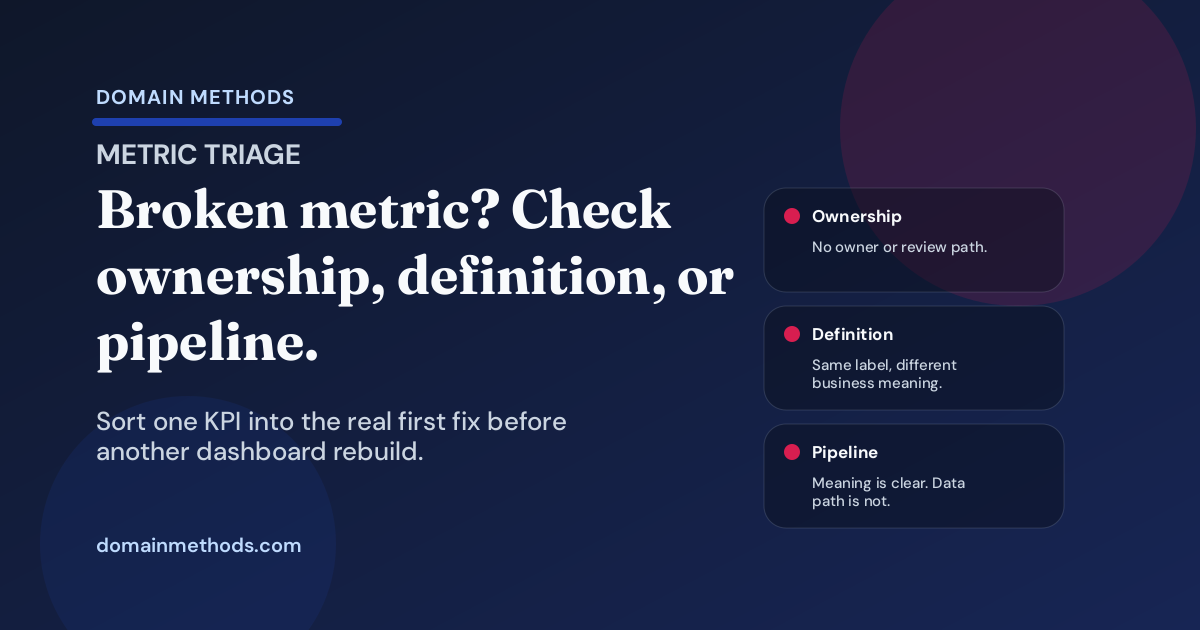
Start by asking where trust breaks first. If nobody clearly owns the number, start with ownership. If teams use the same label to mean different things, start with definition cleanup. If the owner and meaning are mostly clear but the answer is still late, brittle, or wrong, start with the data path.
That sounds obvious. It usually is not obvious in the meeting.
Most teams do not walk into a forecast review or spend-defense conversation saying, “We have identified the exact failure layer.” They walk in saying some version of:
- pipeline is off again
- CAC moved and nobody trusts why
- sourced revenue looks different in every deck
- the dashboard says one thing and the backup sheet says another
- the KPI keeps changing depending on who is talking
Those sentences all sound like one problem. They are not one problem.
That distinction matters because the first fix changes depending on the layer. If the problem is ownership, more SQL will not save you. If the problem is definition, another dashboard pass just republishes the argument. If the problem is the data path, another alignment meeting will produce a better glossary and the same broken answer.
This article is intentionally narrow. It is not a full metric governance playbook, a source-of-truth audit, or a dbt remediation guide. It is for the earlier, messier, more common moment: one KPI is unstable right now and the team needs to decide what to repair first.
Why teams misdiagnose a broken KPI so often
A broken metric rarely introduces itself politely.
It usually shows up as friction in a live operating moment:
- a weekly pipeline review where the same slide gets re-litigated again
- a board-prep conversation where somebody says, “Use the finance number, not the dashboard”
- a paid-spend review where sourced pipeline sounds more precise than anyone in the room actually believes
- a forecast call where the answer survives only because one operator quietly patched the inputs first
When that happens, teams tend to jump to the nearest visible artifact. If the argument surfaced in a dashboard, they blame the dashboard. If it surfaced in a warehouse-fed report, they blame the warehouse. If it surfaced in CRM, they call it dirty data.
The visible artifact is often just where the problem became expensive enough to notice. Not where it began.
One operator-level clue shows up again and again: the room is arguing about the number, but each function is actually defending a different kind of certainty. Finance wants a board-safe answer. Marketing wants something useful enough to defend spend. RevOps wants a number that can survive a recurring meeting without heroics. Data wants the business to stop changing the rules after the model is built.
Nobody is necessarily wrong. They are just protecting different standards of trust.
Start with one metric, not a whole reporting program
If you are diagnosing whether the problem is ownership, definition, or pipeline, keep the scope painfully small at first.
Use one metric. Use one operating moment. Use one decision.
Good examples:
- qualified pipeline in the weekly forecast
- marketing-sourced pipeline in the spend review
- bookings in CRO/CFO reconciliation
- conversion rate in the board pack
- CAC in the monthly planning review
Bad starting point:
Our reporting is messy.
That sentence is too broad to route anything.
A practical starting frame is:
Which single metric is making the room least willing to move forward without caveats?
That question gives you something you can actually triage. It also keeps the diagnosis from drifting into a six-month improvement program before anyone has chosen a first repair path.
The three failure layers that matter most
For one broken KPI, I usually sort the first diagnosis into three main layers.
1. Ownership failure
This layer leads when the number technically exists, but nobody has the authority or obligation to keep it trustworthy.
Common signs:
- nobody can say who owns the metric end to end
- the same caveat keeps coming back every month with no owner-level correction
- one reliable operator is still the real fallback path for interpretation
- a definition or exception changes, but nobody can say who approved it
- the room asks three people what the metric means and gets three different confidence levels
Ownership failure is not the same thing as cross-functional disagreement. It is narrower and more structural.
The problem is that the metric has no real steward with decision rights. That usually means no one owns:
- the final answer in a tense meeting
- caveat language
- approval for changes
- escalation when two systems disagree
- follow-through after one trust break exposes the same old hole
If that is the leading problem, you do not start by rebuilding the report. You start by naming the owner, the review rule, and the fallback behavior.
2. Definition failure
This layer leads when the label is shared but the business meaning is not.
Common signs:
- pipeline means one thing in sales and another in finance
- sourced revenue is used like a board-grade number even though it is really directional
- CAC looks stable until the room asks which spend and revenue windows were included
- one KPI seems fine until someone asks which records should be excluded, delayed, or reclassified
- the argument keeps restarting at the glossary level
Definition failure is one of the easiest layers to confuse with pipeline failure because both can produce different answers in different places. The difference is where the disagreement lives.
If the room still has competing business meanings for the metric, the reporting layer is not the first fix. You are still fighting over what the number is supposed to represent.
That is where a route like Three Teams, Three Numbers becomes more relevant than a broader systems cleanup. You need owner-backed agreement on meaning before another artifact pass earns trust.
3. Pipeline or model failure
This layer leads when the owner and meaning are mostly clear, but the answer still cannot survive the actual data path.
Common signs:
- the source fields are late, duplicated, or incomplete
- joins, syncs, or transformations produce a clean-looking but brittle answer
- the metric is right in one report and wrong in another because one rule changed downstream but not upstream
- the reporting logic is explainable on paper and still unreliable in practice
- the business can describe the intended answer clearly, but the warehouse, CRM sync, or reporting model cannot carry it cleanly
This is where the first repair actually belongs in the source, sync, model, or reporting path.
The practical mistake here is over-correcting into governance language when the business meaning is already clear enough. If the room agrees what qualified pipeline is, but the stage history and lifecycle data are still unreliable, another definition workshop is not the first fix. The first fix is the path. When that path runs through a warehouse model, the same sequencing logic applies to choosing the next dbt repair instead of trying to clean up tests, models, owners, and sources all at once.
That is often where Data Foundation becomes the right route.
A comparison table I would put on screen in the meeting
If the conversation is getting muddy, use a table like this.
| What the room is experiencing | Likely leading layer | What to document now | First fix to avoid |
|---|---|---|---|
| The metric keeps changing depending on who explains it | Ownership | named owner, reviewer, caveat path, escalation rule | a dashboard redesign without owner authority |
| The same metric label means different things by team | Definition | plain-English meaning, exclusions, confidence level, dispute owner | pipeline cleanup before the meaning is settled |
| The meaning is mostly agreed, but the answer is still late, brittle, or inconsistent | Pipeline / model | source break, sync issue, model logic, proof-of-fix condition | another alignment session that ignores the path |
| The room cannot even name the real metric or decision yet | Stop and scope | metric in scope, decision in scope, why the ask is still fuzzy | pretending the problem is already ready for repair |
That last row matters.
Sometimes the honest answer is not ownership, definition, or pipeline yet. Sometimes the honest answer is that the room is still blending three requests into one vague complaint.
If you cannot name the metric, the decision, and the specific operating moment that keeps breaking, you probably need Translate the Ask before you choose a repair lane confidently.
What not to do when one KPI breaks trust
This is usually where the waste starts.
Do not rebuild the dashboard just because the problem became visible there
Dashboards are often the place where unresolved disagreements become public. That does not make the dashboard the first fix.
A prettier artifact can make a broken metric look calmer for a week. It rarely makes it more trustworthy.
Do not launch a full data-governance program for one live metric fight
Sometimes the metric problem is a real signal of a broader governance gap. That does not mean the first move should be a sprawling governance initiative.
If one KPI is already causing pain, use it as the forcing function. Fix the live failure layer first. Then decide whether the pattern repeats broadly enough to justify a bigger program.
Do not call everything a pipeline problem because the report is technical
A lot of teams blame the warehouse because the warehouse is where the business logic became visible. That does not mean the business meaning was settled before it got there.
If the room still argues over the definition itself, pipeline repair alone usually just makes the disagreement more automated.
Do not call everything a definition problem because the meeting got political
Some metric fights are genuinely political because the underlying path is unreliable. If the teams actually agree on the meaning, but the answer still breaks because of source instability, sync timing, or brittle model logic, you do not need another alignment ritual first. You need the path repaired.
The shortest triage sequence I would use live
If I had ten minutes in a messy metric-review meeting, I would ask these in order. If the request itself is still fuzzy before a metric is even named, use the broader dashboard-versus-decision-brief intake tree first, then come back to the metric-level triage.
1. Can we name the metric and the decision without hand waving?
If not, stop and scope.
A useful answer sounds like this:
We are trying to make next week’s budget decision using marketing-sourced pipeline.
A weak answer sounds like this:
We just need the marketing numbers to be more trustworthy.
The second version is too vague to route.
2. If the number changed today, who would be expected to explain it?
If the room does not have a clear answer, ownership failure is probably leading.
This question is better than asking who technically built the report. The builder is not always the owner. The person who can defend the metric, settle caveats, and absorb the consequences is much closer to the real owner.
3. If we lined up three teams, would they describe the metric the same way?
If not, definition failure is probably leading.
Ask specifically about:
- what the metric includes
- what it excludes
- what confidence level the room should treat it with
- where the edge cases live
When the teams answer those differently, you do not have a stable shared metric yet.
4. If the owner and meaning are mostly clear, where does the data path still break?
Now ask the pipeline question.
Look for the exact place trust starts eroding:
- source field quality
- stage logic or sync timing
- warehouse transforms
- reporting rollups
- exception rules that got patched in one place and not another
That makes the first repair path much more concrete than saying, “the data pipeline is messy.”
5. What would count as proof that the first fix worked?
This is the step teams skip when they want to sound strategic.
A better proof-of-fix statement looks like this:
- next week’s forecast uses one qualified pipeline answer without a side-sheet correction
- the spend review can defend sourced pipeline as directional without relitigating exclusions
- the board-prep metric carries one owner-approved caveat instead of three conflicting explanations
- the dashboard and backup workbook no longer diverge for the KPI in scope
If you cannot write that sentence, the first fix is still too vague.
A practical routing guide for the next move
Once you sort the metric into the right layer, the route should get simpler.
| If the diagnosis says… | Next move | Why |
|---|---|---|
| this is mainly an ownership problem | tighten owner authority, review rules, and caveat ownership | the number will keep drifting until someone is accountable for keeping it trustworthy |
| this is mainly a definition problem | run metric-alignment work first | the room is still fighting over what the KPI means |
| this is mainly a pipeline / model problem | repair the source, sync, model, or reporting path | the business meaning is clear enough, but the systems still cannot carry it reliably |
| we still cannot define the problem cleanly | stop and scope first | you are still blending ambiguity with repair work |
One operator warning is worth keeping in mind here: the same metric can contain more than one failure layer. That is normal. The job is not to pretend only one layer exists forever. The job is to decide which layer has earned the right to lead first.
That single sequencing choice is often the difference between a useful repair and another month of polite reporting theater.
Use the worksheet in the next working session
If you want a simple way to run this diagnosis without turning it into another dashboard argument, use the worksheet below in the meeting.
Download the Broken Metric Triage Worksheet (PDF)
A lightweight worksheet for sorting one KPI into the right first repair path: ownership, definition, pipeline, or stop-and-scope. Download it instantly below. If you want future posts like this in your inbox, you can optionally subscribe below.
Instant download. No email required.
Want future posts like this in your inbox?
This form signs you up for the newsletter. It does not unlock the download above.
A good use of the worksheet is not to audit every KPI in the company. It is to force one live metric fight into a cleaner sequence:
- name the metric
- name the decision
- identify the leading failure layer
- choose one first fix
- define the next meeting where the room will test whether trust actually improved
That is enough to move faster than most teams do.
Bottom line
When one KPI breaks trust, the first job is not to make the report prettier. It is to figure out whether the break starts in ownership, definition, or the data path.
If nobody owns the number, start there. If the label hides a business argument, fix the definition. If the owner and meaning are mostly clear but the answer still cannot survive the path, repair the pipeline.
And if the room still cannot name the metric, the decision, or the live operating moment in scope, do not fake precision. Stop and scope first.
Download the Broken Metric Triage Worksheet (PDF)
A lightweight worksheet for sorting one KPI into the right first repair path: ownership, definition, pipeline, or stop-and-scope.
DownloadIf the room is really fighting about what the metric means and whose version should win
Three Teams, Three Numbers
Use the diagnostic when marketing, sales, finance, and data are still carrying different definitions, caveats, and confidence rules into the same reporting conversation.
See the metric-alignment diagnosticIf the business answer is clear but the systems still cannot produce it reliably
Data Foundation
Use the broader engagement when the metric definition is largely settled but the source logic, models, joins, or reporting plumbing still keep the answer from surviving real scrutiny.
See Data FoundationSee It in Action
Common questions about diagnosing one broken metric
What does it mean when a metric has an ownership problem?
How is a definition problem different from a pipeline problem?
Should we rebuild the dashboard first if the number looks wrong?
When should we stop and scope before picking a repair lane?

About the author
Jason B. Hart
Founder & Principal Consultant
Helps mid-size SaaS companies turn messy marketing and revenue data into decisions leaders trust.