How to Scope a Data Foundation Cleanup Before You Hire Anyone
- Jason B. Hart
- Data Strategy
- April 20, 2026
- Updated May 15, 2026
Table of Contents
What does it mean to scope a data foundation cleanup before hiring?
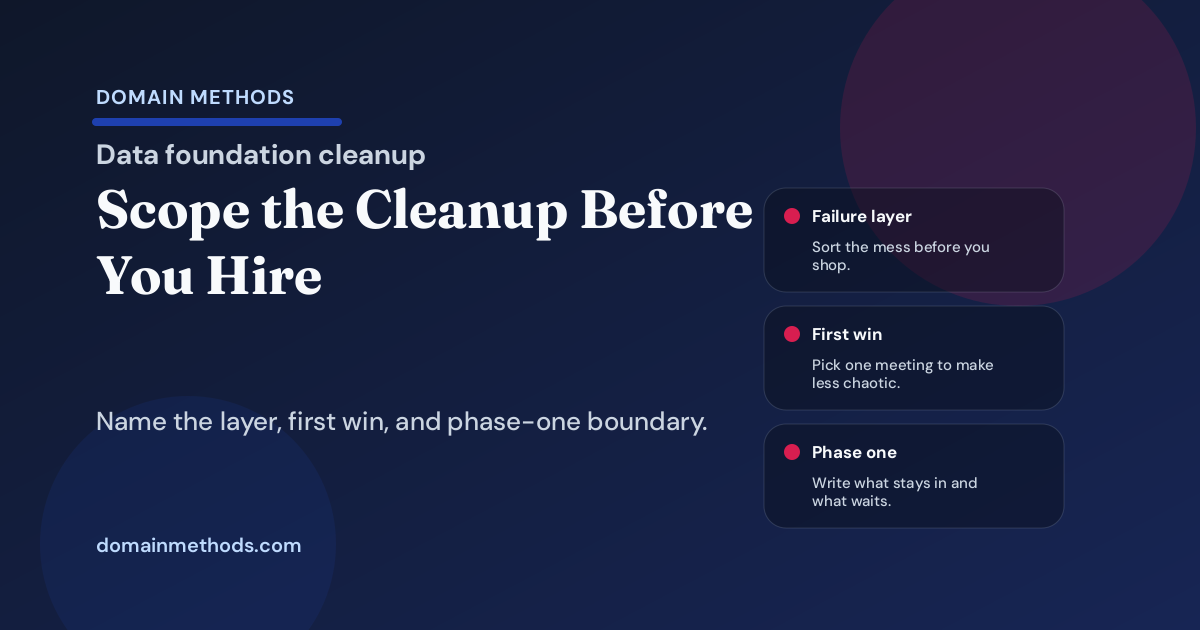
Scoping a data foundation cleanup before hiring means deciding what is actually broken, what a first win should look like, and what belongs inside phase one before you ask a vendor, freelancer, or new hire to absorb the ambiguity for you.
That is a more valuable step than most teams give it credit for.
A lot of companies say they need help with the data foundation when what they really mean is some mix of these:
- pipeline reporting keeps getting re-litigated in forecast calls
- dashboards exist, but nobody wants to defend the numbers without caveats
- dbt work has become brittle and the business cannot tell which models are safe to trust
- finance, RevOps, marketing, and data all think they are describing the same KPI when they are not
- leadership wants to hire someone, but nobody can explain what should be fixed first
That last point matters.
Hiring is often treated like progress when the real missing step is problem definition.
If the company cannot tell whether the mess is mainly definitions, source quality, reporting logic, or workflow ownership, then the search process tends to produce one of two bad outcomes:
- you buy a lot of confidence and not much clarity
- you hire someone into a role designed to carry unresolved organizational debt
That is why this article sits next to, but does not duplicate, pieces like How to Tell Whether You Have a Tools Problem or a Foundation Problem, The Data Partner Evaluation Scorecard, and Fractional Analytics Partner vs Freelancer vs First Full-Time Analytics Hire. Those pieces help you diagnose the category of problem, evaluate outside help, or choose a staffing model. This one handles the step before all of that: tightening the cleanup brief so the hiring conversation stops drifting.
Why teams hire into ambiguity so often
Most cleanup efforts do not start with a clean brief.
They start with an expensive feeling.
A board meeting got tense. A spend review exposed metric drift. A new leader inherited reporting nobody trusts. Someone says the warehouse needs work. Someone else says the CRM is the real problem. The data team says the requests keep changing. Marketing says the reports are technically correct and still unusable.
All of those can be true at once.
The mistake is turning that whole knot into a job description or a vendor search before anyone has named the first constraint.
One operator-level pattern shows up here all the time: the first hiring conversation quietly becomes a proxy argument about accountability. Leadership says they need an analytics hire. RevOps thinks they need cleanup support. The data team thinks they need fewer random requests. Finance wants fewer board-slide caveats. Nobody is lying. They are just describing different symptoms from different seats.
That is how the scope starts bloated and still somehow vague.
If you have already felt one failed freelancer engagement, one stalled partner search, or one job req that seemed to contain three roles at once, there is a good chance the missing work was not more candidate volume. It was better scoping.
What actually belongs inside a data foundation cleanup
A data foundation cleanup is usually not one thing.
It is a bundle of layers that have been allowed to blur together.
A practical cleanup scope usually includes some combination of:
- definition work - what the metric means, what it excludes, and what confidence level the business needs
- source-system cleanup - lifecycle drift, duplicates, missing fields, broken handoffs, inconsistent statuses, and late updates
- modeling and reporting logic - transformations, joins, dbt assumptions, reporting rollups, and brittle exceptions
- workflow ownership - who approves the metric, who maintains the logic, who catches exceptions, and how the answer travels into a real meeting or action
That list matters because a lot of teams keep saying foundation when they mean one of those layers much more than the others.
If the real issue is that sales and marketing never settled what counts as qualified pipeline, you do not have a warehouse-first problem. If the definition is stable but lifecycle data is garbage, you do not have a workshop-first problem. If the systems are mostly fine but the number keeps changing between a dashboard and a board pack, your problem may be reporting logic or artifact ownership more than raw data plumbing.
A better scoping brief does not pretend those layers are unrelated. It just refuses to let them all lead phase one at the same time.
Sort the four failure layers first
Before you talk about hiring, sort the cleanup into the layer that should lead first.
That does not mean only one layer matters. It means one layer should anchor the first round of work.
1. Definition conflict
This layer leads when the room still uses the same words for different realities.
Common signs:
- pipeline means one thing in RevOps and another in finance
- sourced revenue gets used like a board-grade number when it is really directional
- marketing, sales, and data all think they own the metric definition
- every review still starts with a glossary argument
This is where teams often need Translate the Ask or a focused alignment sprint before they need a larger build lane.
2. Source-system quality
This layer leads when the business largely agrees on the answer it wants, but the source data feeding that answer is unreliable.
Common signs:
- stage progression is inconsistent by rep, team, or region
- campaign associations are missing or overwritten
- lifecycle fields are incomplete or backfilled too late to help
- spreadsheet cleanup keeps happening before every important meeting
This is the layer where a scoping brief should name the field-level trust break, not just say the CRM is messy.
3. Modeling and reporting logic
This layer leads when the definition is reasonably clear and the raw systems are good enough, but the transformations or reporting rollups are still fragile.
Common signs:
- dbt models encode business rules nobody has documented well
- the dashboard answer is technically reproducible and still wrong for the meeting
- one exception-handling rule has expanded into a pile of special cases
- downstream reports disagree because the logic changed in one place but not another
This is often where a cleanup turns from hand waving into real data foundation work.
4. Workflow ownership
This layer leads when the answer might be technically defendable, but nobody owns the process of keeping it trustworthy in live use.
Common signs:
- the same caveat keeps reappearing every month
- nobody can say who approves definition changes
- the metric works until one team changes process and nobody updates the reporting path
- the number exists, but the business still relies on Slack, exports, and last-minute side sheets to interpret it
A lot of hiring briefs underweight this layer because it sounds softer than SQL, dbt, or pipeline architecture. In practice, it is often the reason the cleanup does not stick.
A quick sorting table for the first scoping pass
Use a table like this before you draft the hiring brief.
| Symptom showing up in the room | Likely leading layer | What to document now |
|---|---|---|
| The same KPI label means different things by team | Definition conflict | The plain-English definition, exclusions, and who can settle disputes |
| Everyone agrees on the metric, but the inputs are still dirty | Source-system quality | Which fields, stages, syncs, or IDs are actually breaking trust |
| The source data is usable, but the dashboard still misleads | Modeling and reporting logic | Which model, rollup, exception rule, or reporting artifact changes the answer |
| The answer exists, but nobody keeps it stable across meetings | Workflow ownership | Named owner, review rhythm, fallback behavior, and escalation path |
The goal is not perfect diagnosis on day one. The goal is choosing which layer has earned the right to lead phase one.
Define the first success condition before you define the role
This is the step most teams skip.
They write a role before they write success.
A better sequence is to define the first success condition in plain English.
Good first success conditions sound like this:
- the weekly forecast review uses one qualified pipeline definition without a side spreadsheet override
- the board-prep revenue slide carries fewer caveats because recognized revenue and bookings now have an explicit reporting hierarchy
- the marketing spend review can defend sourced pipeline as directional instead of pretending it is finance-grade
- the new hire or partner can inherit one stable owner-approved metric family instead of a backlog of half-settled fights
Weak success conditions sound like this:
- clean up the data foundation
- improve reporting trust
- fix dbt
- make the dashboards better
Those phrases are not useless. They are just too broad to steer a hiring decision.
One practical test helps here: if the first success condition would be impossible to observe in a real meeting, it is probably still too abstract.
What to document before hiring anyone
Before you start comparing vendors, candidates, or staffing models, write down five things.
1. The decision that keeps breaking
Name the live operating moment.
Examples:
- weekly pipeline forecast
- monthly board deck prep
- paid spend defense conversation
- GTM to finance handoff on bookings or revenue
- executive review of pipeline coverage or CAC
If you cannot name the decision, the scope will drift toward technical activity instead of business usefulness.
2. The leading failure layer
Do not just say everything is broken. Write which layer should lead phase one and why.
For example:
Phase one leads with definition conflict because sales, marketing, and finance still use qualified pipeline differently, which makes every downstream report look worse than it is.
Or:
Phase one leads with source-system quality because lifecycle statuses and campaign associations are too inconsistent for any pipeline answer to survive a spend review.
That sentence alone improves the hiring conversation.
3. The first success condition
Write one concrete before-and-after statement the room can test in 30 to 45 days.
4. The owner expectations
Say who needs to participate and what the hired person is actually expected to own.
That includes:
- who must approve metric changes
- who supplies business context
- who inherits the operating rhythm after the initial cleanup
- who can unblock cross-functional disputes
If that list is blank, you are probably shopping for someone to absorb ambiguity, not solve a scoped problem.
5. The phase-one boundary
Write what is in and what is out.
That matters more than most teams want to admit.
A lot of cleanup projects fail because they quietly expand from one broken metric family into every upstream and downstream grievance the company has been carrying for a year.
Use a three-bucket boundary table before the search starts
A boundary table keeps the project honest.
| Bucket | What belongs there | Example |
|---|---|---|
| Fix now | Work that must move for the first success condition to happen | clarify one metric definition, repair one broken lifecycle field set, stabilize one reporting model used in the forecast |
| Scope now, fix later | Work that clearly matters, but should not block the first win | document the next metric family, map broader warehouse debt, inventory adjacent dashboard cleanup |
| Do not pull into phase one | Real problems that will sprawl the project if they enter too early | full stack redesign, every dashboard refresh, broad taxonomy overhaul, generic instrumentation wish list |
That third bucket is where a lot of discipline lives.
If nobody is willing to write down what should stay out, the project is still being defined emotionally instead of operationally.
Warning signs you are shopping for help too early
You are probably starting the hiring or vendor search too early if:
- the role description still sounds like some blend of analytics lead, RevOps fixer, dashboard owner, and data translator
- every stakeholder can describe the pain, but nobody can name the first stable outcome
- the company keeps talking about hiring quality before it has written the phase-one boundary
- leadership wants one person to settle definitions, repair source data, rebuild models, improve reporting, and absorb executive translation all at once
- the team keeps saying “we just need someone senior” instead of naming the failure layer
That last one is especially common.
Seniority can help. It cannot compensate for a scope that still contains three different jobs and no first win.
If that pattern sounds familiar, The Unicorn Analyst Trap is the blunt companion piece.
How to turn the scoped cleanup into a better hiring conversation
Once the scoping work is done, the hiring or vendor conversation gets much easier.
Instead of asking, “Can you help us clean up the data foundation?” you can ask better questions:
- here is the leading failure layer - how would you sequence phase one?
- here is the first success condition - what would you need from us to hit it in 30 to 45 days?
- here is what is explicitly out of scope - where would you push back if the work starts expanding?
- here is the owner map - what would you expect these people to decide versus merely review?
- here is the next layer waiting behind phase one - what would you scope now without trying to fix it immediately?
That shift improves both candidate quality and buying quality.
It also makes staffing-model decisions easier.
If the problem is now tightly scoped and mostly executional, a freelancer may be fine. If the work still needs cross-functional translation and priority-setting, a fractional partner may fit better. If the capability is durable, owned, and likely to matter next year, a full-time hire becomes more credible.
But that choice only gets easier after the cleanup brief stops being mush.
A practical rule for the next leadership meeting
If the room is still debating whether the problem is definitions, source quality, reporting logic, or ownership, do not start with resumes. Start with scoping.
That does not slow progress down. It keeps the first real investment from being spent on confusion.
The point is not to create a perfect requirements document. The point is to create enough clarity that the first outside help, whether consultant or hire, is pointed at the right failure layer and judged against a real operating outcome.
That is usually the difference between a cleanup that reduces trust drag and a cleanup that just produces more artifacts.
Download the Data Foundation Cleanup Scoping Worksheet (PDF)
Use this worksheet to name the failure layer, first success condition, phase-one boundary, and owner expectations before you start the next hiring or vendor conversation. Download it instantly below. If you want future posts like this in your inbox, you can optionally subscribe below.
Instant download. No email required.
Want future posts like this in your inbox?
This form signs you up for the newsletter. It does not unlock the download above.
The question behind the hiring question
When a leadership team says, “Should we hire someone to fix the data foundation?” the real question is usually, “Can we define the cleanup tightly enough that the next investment improves trust instead of inheriting our ambiguity?”
That is a healthier question.
It leads to cleaner scopes, better vendor conversations, stronger hires, and fewer projects that quietly turn into a dumping ground for everybody else’s unresolved frustrations.
If your team is still too split to name the problem cleanly, start with Translate the Ask. If the scoping work makes the structural debt obvious, move into Data Foundation. Either way, do the scoping before the shopping.
Download the Data Foundation Cleanup Scoping Worksheet (PDF)
A practical worksheet for naming the failure layer, first success condition, phase-one boundaries, and the brief you should take into the first hiring or vendor conversation.
DownloadIf the cleanup ask is still fuzzy and nobody agrees what the real problem is
Translate the Ask
Use the sprint when leadership knows the reporting pain is real but the next move is still being described as some vague mix of cleanup, tooling, dashboards, and hiring.
See the translation sprintIf the scoping work exposes deeper warehouse, dbt, or source-logic debt
Data Foundation
Use the broader engagement when the business can finally name the right cleanup problem but the systems underneath it are still too brittle to support a trustworthy answer.
See Data FoundationSee It in Action
Common questions about scoping a data foundation cleanup
What does a data foundation cleanup usually include?
How do I know whether the real problem is definitions or systems?
What should success look like in the first 30 to 45 days?
Should I hire full time before the cleanup is scoped?

About the author
Jason B. Hart
Founder & Principal Consultant
Helps mid-size SaaS companies turn messy marketing and revenue data into decisions leaders trust.