How to Run a Revenue Definition Cleanup Sprint in 30 Days
- Jason B. Hart
- Revenue Operations
- April 17, 2026
- Updated April 30, 2026
Table of Contents
What Is a Revenue Definition Cleanup Sprint?
A revenue definition cleanup sprint is a short, cross-functional push to stop the same revenue-number fight from hijacking every forecast review, board prep session, and executive meeting.
It is not a grand metric-governance transformation. It is not a data-warehouse rebuild disguised as a workshop follow-up. It is the first month of practical cleanup after the company admits the number problem is real.
That distinction matters because most teams do eventually acknowledge the pain. The argument has happened enough times. The CFO is tired. The CRO is defensive. RevOps is translating between decks again. Everyone agrees something is off.
Then the cleanup itself goes sideways.
Somebody tries to fix every metric at once. Somebody else turns it into a dashboard redesign. Finance keeps its own backup logic because the warehouse version is still not safe. The sprint becomes a bucket for unresolved ownership, stale stage logic, and political resentment.
That is why the first 30 days need structure.
Salesforce’s State of Data and Analytics (2nd Edition) reports that leaders estimate 26% of their organization’s data is untrustworthy.1 When the untrusted data sits inside revenue reporting, the damage shows up fast: delayed decisions, extra reconciliation labor, and leadership meetings that feel polished but fragile.
This guide is about preventing that first month from turning into another vague cleanup initiative.
When You Actually Need This Sprint
Run a revenue definition cleanup sprint when:
- leadership keeps seeing different revenue or pipeline numbers in adjacent meetings
- finance, sales, marketing, and RevOps all use the same label for different business realities
- the board deck still needs a spoken disclaimer every time the revenue slide appears
- one heroic operator is stitching together the trusted number by hand before important meetings
- everyone agrees the definitions are broken, but nobody has turned that agreement into a sequence
If the room still cannot agree on what the fight is actually about, start with The ‘What Does Revenue Even Mean Here?’ Workshop Guide or the broader metric alignment workshop format.
If the room already knows the pain is real, this sprint is the next move.
The Goal of the First 30 Days
The goal is not perfection.
The goal is to leave the month with four things:
- a small set of leadership-critical revenue metrics with explicit definitions
- a named owner and source of truth for each one
- a visible record of what still needs fixing in CRM, finance workflows, warehouse logic, or reporting
- a short review cadence so the same conflict does not restart next month
That is enough to lower executive friction quickly.
Anything broader belongs in the next phase, not inside the sprint itself.
Start Narrow: Pick the Metrics That Actually Matter Right Now
This is the first place teams make the sprint too big.
They say the revenue problem touches everything, which is usually true. Then they load the sprint with bookings, ARR, MRR, sourced pipeline, qualified pipeline, recognized revenue, churn, expansion, sales velocity, payback period, and every field that ever annoyed someone in Salesforce.
That is how you lose the month.
Start with the two to four metrics creating the most executive drag.
A good filter is simple:
| Metric | Where it creates pain now | Why it belongs in the sprint first |
|---|---|---|
| Qualified pipeline | weekly forecast and sales-marketing arguments | it changes near-term planning decisions |
| Marketing-sourced pipeline | budget reviews and channel defense | it changes spend and accountability conversations |
| Bookings | CRO/CFO alignment and board narrative | it affects commercial confidence fast |
| Recognized revenue or ARR | board reporting and planning | it shapes leadership credibility and timing decisions |
If a metric is not changing an important meeting right now, it probably does not belong in the first 30 days. If the recurring break is the period-over-period ARR story, the Revenue Bridge Confidence Check gives the bridge-specific follow-on test after definitions are named.
That is not avoidance. It is scope control.
Week 1: Collect the Real Definitions and the Trusted Reports
Do not start by debating the definitions live. Collect them first.
Ask each function involved to submit four things:
- the definition they use today, in plain English
- the report, dashboard, or spreadsheet they trust most
- the system or model behind that number
- the decision that number is supposed to support
Then ask one sharper question:
- what do you believe is wrong with the other team’s version?
That last answer usually tells you where the sprint will get stuck.
If finance says marketing is using a number that cannot survive board scrutiny, that matters. If marketing says finance is collapsing sourced pipeline and closed revenue into one narrative that hides campaign signal, that matters too. If RevOps says both teams are actually reading from private spreadsheet variants, that matters most.
What to capture in week one
| Team | Current metric label | Trusted source | What the number is used for | Main complaint about the other version |
|---|---|---|---|---|
| Finance | recognized revenue | finance workbook / ERP export | board reporting and planning | commercial teams treat bookings like revenue |
| Sales | bookings | CRM opportunity report | forecast and performance narrative | finance logic arrives too late for pipeline conversations |
| Marketing | sourced pipeline | CRM campaign report or model | channel and spend decisions | sales stages and attribution rules keep shifting |
| RevOps / data | whichever number survives reconciliation | warehouse model plus manual QA | executive reporting and cleanup burden | everyone wants one number without agreeing on use case |
You are not looking for elegant answers here. You are making the contradictions visible before the sprint burns time pretending they do not exist.
Week 2: Run One Decision-Focused Alignment Session
By week two, you should know which metrics deserve the room.
Now force the conversation into decisions.
The core rule of the meeting should sound something like this:
We are not here to prove one team is right. We are here to decide which version of the number is fit for which decision, and what has to change so leadership can use it without improvising caveats.
That framing matters because most revenue-definition fights are really use-case fights.
Finance wants a number that survives scrutiny. Sales wants a number that reflects commercial momentum. Marketing wants a number that is usable for channel decisions. RevOps wants a number that can be reproduced without heroics.
Those are all reasonable goals. The mistake is treating them like they should collapse into one universal metric automatically.
The decision table to fill in during the session
| Metric | Primary decision it supports | Canonical definition | Key exclusions | Source of truth | Confidence needed | Owner |
|---|---|---|---|---|---|---|
| Qualified pipeline | weekly forecast | opportunities that meet agreed stage and fit rules | recycled deals, hand-raisers without qualification | CRM plus documented QA rules | decision-grade | RevOps + sales ops |
| Marketing-sourced pipeline | budget allocation and leadership narrative | opportunities with agreed sourcing logic | influence-only touches | CRM association model with documented caveats | directional to decision-grade | marketing ops |
| Recognized revenue | board and finance reporting | revenue recognized under finance rules | forward-looking contract value | finance system / ERP | board-grade | finance |
| Bookings | commercial momentum | signed contract value under defined contract rules | unapproved or unbooked pipeline | CRM plus finance reconciliation rule | decision-grade | sales ops + finance |
If the team cannot finish the definition cleanly in the room, write down the unresolved point and assign the owner who will resolve it.
An explicit unresolved decision is still progress. A fake consensus is not.
Week 3: Trace the Logic Path and the Manual Workarounds
Once the definitions are directionally chosen, the sprint has to move out of language and into workflow.
This is where teams discover whether the number problem is mostly:
- definition ambiguity
- source-system inconsistency
- warehouse/modeling debt
- spreadsheet patching
- ownership confusion
Usually it is some combination.
The practical question for week three is:
Where does the business currently compensate manually for a number it does not fully trust?
That manual compensation layer is gold.
If finance still exports the warehouse result to a spreadsheet before the board deck, that tells you something. If RevOps rewrites stage logic in a private tab before the weekly forecast, that tells you something too. If marketing refuses the official sourced-pipeline chart and keeps a separate version for budget defense, that is not just behavior. That is a systems diagnosis.
What to trace for each priority metric
- where the metric is presented
- where it is actually calculated
- where manual adjustments happen
- who approves or overrides the logic today
- which caveats repeat every cycle
A simple logic-path table
| Metric | Presented in | Calculated in | Manual patch today | Repeat caveat | Most likely fix type |
|---|---|---|---|---|---|
| Bookings | forecast deck | CRM report plus finance adjustment | finance adds contract cleanup notes | timing and contract treatment | definition rule plus handoff fix |
| Marketing-sourced pipeline | growth review | CRM or warehouse model | marketing keeps a side spreadsheet for exclusions | attribution and stage drift | ownership plus source logic cleanup |
| Recognized revenue | board deck | ERP / finance model | manual explanation added in deck notes | timing versus bookings confusion | narrative plus metric labeling fix |
This is the part of the sprint where the cleanup gets real.
It also keeps the team from doing something lazy like redesigning the dashboard before fixing the handoff underneath it.
Week 4: Ship the Few Fixes That Reduce Leadership Confusion Fastest
The final week is where discipline matters most.
Do not reward the loudest backlog. Reward the fixes that make the next important meeting cleaner.
That usually means shipping a short list such as:
- one approved definition record for each sprint metric
- one reporting-label change so meetings stop collapsing unlike numbers under one heading
- one source-of-truth decision for the leadership-facing version
- one owner assignment for future changes
- one follow-up implementation list for warehouse, CRM, or finance logic work that cannot fit inside the first month
A useful week-four triage lens
| Candidate fix | Business effect by next meeting | Do it now or later? |
|---|---|---|
| rename the board metric so bookings and recognized revenue stop being conflated | immediate clarity | now |
| document sourced-pipeline exclusions and owner | immediate clarity plus governance | now |
| rebuild the entire revenue model | important, but too large for sprint one | later |
| standardize every lifecycle stage in the CRM | useful, but likely too broad | later unless directly blocking a sprint metric |
| replace every dashboard touching revenue | tempting, but often premature | later |
The right question is not “what else is broken?”
The right question is “what will stop the next leadership conversation from turning into the same reconciliation ritual?”
The Owner Map You Need Before the Sprint Ends
Revenue-definition cleanups fail when everyone can see the problem but nobody has authority over the next change.
Make the owner map explicit.
| Area | Business owner | System/process owner | What they are accountable for |
|---|---|---|---|
| metric definition | finance, sales, or marketing leader depending on the metric | RevOps / analytics partner | business meaning, approved exclusions, use case |
| source-of-truth system | function using the number most formally | data / RevOps / finance ops | where the number is calculated and published |
| reporting label and narrative | executive report owner | RevOps / finance / analytics owner | whether the meeting artifact uses the right metric name and caveats |
| follow-up technical fixes | relevant business sponsor | data engineering / RevOps / finance ops | implementing the backlog created by the sprint |
If the business owner and system owner are both fuzzy, the sprint is not done.
That does not mean every technical fix must be complete. It does mean the next argument should not start with “I thought someone else owned that.”
What Not to Do During the Sprint
This section is where a lot of teams save themselves.
Do not do these in the same 30-day window unless one of them is directly required for a sprint metric:
- try to govern every KPI in the company
- turn the sprint into a warehouse replatforming debate
- redesign all revenue dashboards before the labels and logic are settled
- use a new tool purchase as a substitute for source-of-truth decisions
- ask RevOps to keep mediating the fight without giving anyone authority to decide
One operator-level reality worth stating plainly: the fastest way to kill momentum is to let every function smuggle its wishlist into the cleanup sprint.
Sales wants forecast cleanup. Marketing wants attribution clarity. Finance wants board-safe reporting. Data wants model debt addressed correctly.
All valid. Still not all sprint-one scope.
The sprint works when it reduces ambiguity around the few metrics that matter most now.
The Closing Artifact Set
By the end of day 30, you should be able to hand leadership a short packet with:
- the definition record for each sprint metric
- the decision log showing what was resolved, what remains open, and who owns it
- the owner map
- the next-meeting guidance for which metric to use where
- the follow-on implementation list for deeper fixes
That packet is what keeps the sprint from becoming one more smart conversation with no operating afterlife.
If you need help forcing those decisions and getting the right people to stop defending different versions of the same number, start with Three Teams, Three Numbers.
If the sprint exposes deeper system debt — brittle warehouse logic, repeated manual patches, weak model ownership, or finance-vs-CRM source conflicts — the next step is usually Data Foundation.
Use This Sprint When the Real Cost Is Delay, Not Just Confusion
Most revenue-definition fights are expensive long before they become catastrophic.
They show up as:
- another half-day lost to reconciling last week’s number
- another executive meeting that spends the first fifteen minutes defining the metric again
- another budget conversation that gets postponed because nobody trusts the denominator
- another board deck that looks cleaner than the actual state of confidence
That is the real cost.
A 30-day cleanup sprint is not about making the company feel organized. It is about removing enough ambiguity that the business can move again.
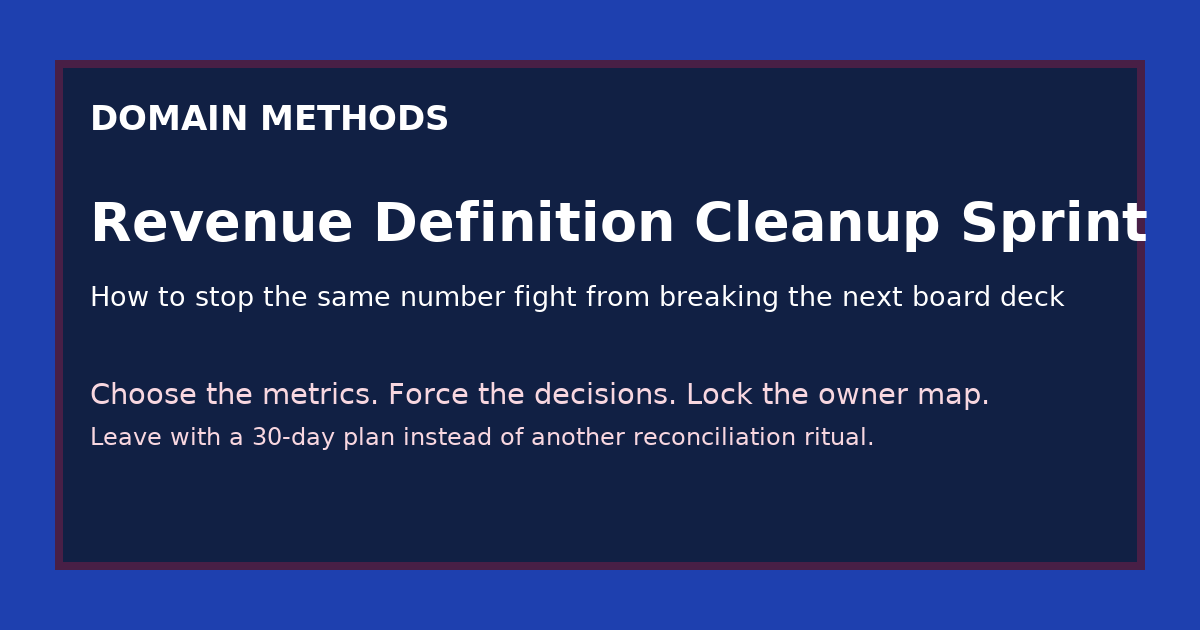
If you are already at the point where the same number fight is stealing time from planning, forecasting, or board prep, do not open another broad cleanup initiative. Run a narrower sprint. Pick the metrics that matter. Force the decisions. Lock the owner map. Leave with a definition record and a real next step.
Start with Three Teams, Three NumbersSources
- Salesforce, State of Data and Analytics, Second Edition. Salesforce reported that business leaders estimate 26% of their organization's data is untrustworthy.
Download the Revenue Definition Cleanup Sprint Worksheet (PDF)
A lightweight 30-day worksheet with a week-by-week plan, owner map, definition record, decision log, and next-meeting checklist.
DownloadIf revenue fights are already slowing leadership down
Three Teams, Three Numbers
Use the diagnostic when finance, sales, marketing, and RevOps are all defending different versions of the same number and you need a fix sequence before the next planning cycle.
Start with the metric-alignment diagnosticIf the sprint exposes deeper model or system debt
Data Foundation
When the real blocker is not the meeting itself but the brittle source logic underneath it, this is the path for fixing the foundation behind the numbers.
See Data FoundationSee It in Action
Common questions about revenue definition cleanup
How is this different from a revenue definition workshop?
Which metrics should go into the sprint first?
Who should own the sprint?
What should we avoid during the first 30 days?

About the author
Jason B. Hart
Founder & Principal Consultant
Helps mid-size SaaS companies turn messy marketing and revenue data into decisions leaders trust.