Incrementality Testing for SaaS Budget Moves: When to Run a Holdout Test
- Jason B. Hart
- Marketing Analytics
- May 4, 2026
- Updated July 9, 2026
Table of Contents
What is a holdout test in marketing?
A marketing holdout test compares a group that receives the marketing treatment with a similar group that does not, so the team can estimate lift instead of only assigning attribution credit.
That sounds technical, but the operating question is plain: would this revenue, pipeline, trial volume, or customer behavior have happened anyway?
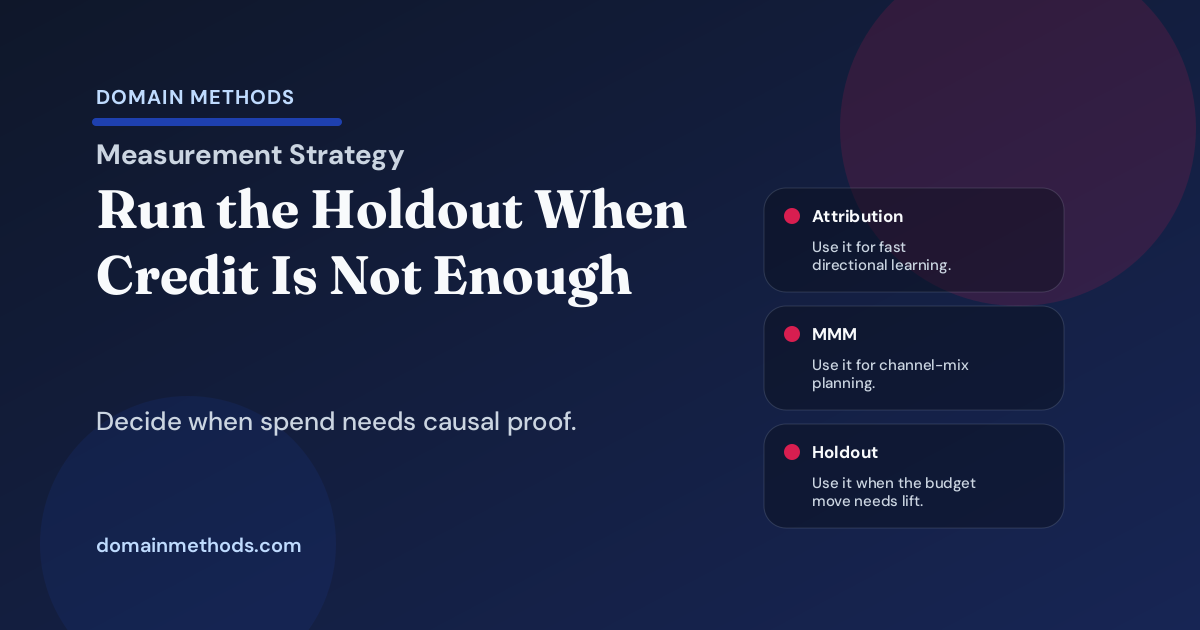
Most mid-size SaaS teams do not need a bigger methodology debate. They need a better rule for when the evidence level should rise. Attribution may be enough for weekly optimization. MMM may be enough for portfolio planning. A holdout, lift test, or geo-style incrementality read belongs in the room when the budget move is large enough that a directional report will not survive the next executive question.
The mistake is treating holdout testing like a maturity badge. It is not. It is a tool for a specific kind of expensive uncertainty.
Use this alongside the Marketing Attribution Playbook when you need the broader operating model behind the measurement decision, not just this narrower tactic.
Incrementality testing for SaaS: the primary use case
For SaaS, incrementality testing is most useful when the business is about to make a meaningful spend change and attribution cannot carry the causal claim by itself.
That usually means one of four situations:
- a paid channel looks weak in CRM attribution but leadership suspects it creates demand earlier in the journey
- a partner, event, direct-mail, or brand program influences pipeline but does not show clean last-touch credit
- a budget shift is large enough that finance needs more than platform reporting before approving it
- a regional, segment, or audience split is clean enough to test without breaking the go-to-market motion
The hard part is not the math. It is operational isolation. Mid-size SaaS teams have long sales cycles, small sample sizes, routed territories, active SDR follow-up, product-led touches, and enterprise accounts that do not behave like anonymous ecommerce shoppers. A test can still be worth running, but only when the decision is material and the setup is honest about those constraints.
That is why this article is the primary SaaS incrementality-testing guide. The ecommerce incrementality testing guide handles ROAS, Shopify, margin, and contribution-profit questions; this page handles SaaS budget moves where the causal question has to survive pipeline timing, sales follow-up, and revenue attribution caveats.
The budget decision has to come first
Do not start with the method.
Start with the spend decision leadership is actually considering:
- should we move budget from paid search into paid social?
- should we scale a partner channel that looks under-credited in attribution?
- should we cut branded search because platform ROI looks too easy?
- should we keep funding retargeting, direct mail, events, or YouTube when CRM credit looks weak?
- should an ecommerce team keep branded search, paid social prospecting, affiliate, YouTube/CTV, or promotional spend when Shopify revenue, platform ROAS, and contribution margin disagree?
- should we defend a budget increase when finance does not trust the reported pipeline impact?
A useful test question is narrow enough to change behavior. “Does marketing work?” is too broad. “Can we move $250,000 from branded search into non-brand paid social next quarter without hurting qualified pipeline?” is closer.
For ecommerce, the same rule applies. “Is Meta incremental?” is too loose. “Can we reduce retargeting by 20% next month without losing net revenue after returns, discounts, fulfillment cost, and contribution margin?” is closer. If the decision is specifically an ecommerce ROAS or margin question, use the ecommerce incrementality testing guide as the more concrete companion.
That specificity matters because tests are not free. They consume time, audience, budget, and political capital. A VP can usually defend one clean test tied to a real budget decision. It is much harder to defend a scattered experimentation program that exists because the reporting team wanted a more sophisticated deck.
When attribution is enough
Attribution is enough when the decision is tactical, the path is visible enough, and the downside of being directionally wrong is limited.
Use attribution for questions like:
- which campaigns appear to create better lead quality this month?
- which source paths show up before qualified pipeline?
- which channel is creating activity but not moving the opportunity forward?
- where should the team look first before a larger budget discussion?
That is useful work. It does not need to pretend it is causal proof.
The operator detail I care about is whether the report is being used at the right altitude. A channel manager moving daily spend between campaign families can live with a directional signal. A CMO moving a six-figure quarterly budget cannot always rely on the same signal, especially if the report depends on partial journey visibility, walled-garden data, messy CRM handoffs, or ecommerce reports that stop at gross Shopify revenue while contribution margin tells a different story.
If the question is fast learning, attribution may be enough. If the question is a material spend shift, attribution is usually only the opening evidence.
For the broader role of attribution inside a modern stack, start with Attribution Didn’t Die. It Just Got Demoted.. This article sits one layer lower: when the budget decision needs causal pressure-testing, not another credit-assignment pass.
When MMM is enough
Marketing mix modeling can be enough when the question is portfolio-level allocation and the business has enough history to make the model useful. If that is the decision in front of you, start with the Media Mix Modeling for SaaS and Ecommerce Budget Decisions guide before treating a holdout as the next step.
MMM is better suited for questions like:
- are we overfunding one channel family relative to its likely contribution?
- what does historical spend suggest about diminishing returns?
- how should leadership think about broad channel mix when user-level visibility is incomplete?
- which channels deserve more scrutiny before the next planning cycle?
That is different from asking whether one specific campaign, audience, region, or channel tactic created incremental lift.
A good MMM read can tell leadership where the portfolio is probably heavy or light. It can help reset the budget conversation away from last-click theater. But it will not always tell you whether this specific next move should happen now.
That is where holdout testing earns its place. MMM can point to the questionable area. A holdout or lift test can answer the narrower causal question if the setup is feasible.
When a holdout test is worth the trouble
Run a holdout test when five conditions are mostly true.
| Readiness question | Strong signal | Weak signal |
|---|---|---|
| Is the spend material? | The decision affects enough budget, pipeline, or executive confidence to justify test cost. | The decision is small, reversible, or mostly tactical. |
| Can you isolate the treatment? | You can split by geography, audience, account group, channel exposure, or campaign eligibility without contaminating the control. | Everyone sees everything, sales manually works both groups, or platform delivery cannot be controlled. |
| Does timing fit the sales cycle? | The measurement window captures a meaningful leading indicator or revenue proxy. | The sales cycle is longer than the decision window and no trusted intermediate metric exists. |
| Is the outcome trusted? | The team agrees which conversion, pipeline, revenue, or customer metric will decide the read. | Marketing, sales, RevOps, and finance still argue about what the outcome means. |
| Will the result change action? | Leadership has pre-agreed what happens if the result is positive, flat, or negative. | The test will become another slide in the same argument. |
The last row is the one teams skip.
A holdout test is only worth doing if the business is willing to act on the answer. If a negative result will be dismissed as “the sample was weird” and a positive result will be overclaimed as permanent truth, the test is not ready. The governance around the decision is part of the measurement design.
Which incrementality design fits a long SaaS sales cycle?
The unit you can keep separate should drive the design. Not the method that looks best on a planning slide.
A B2B team may have only a few closed-won outcomes during the media decision window. Accounts move between territories. Reps work named accounts across campaign boundaries. One opportunity may collect several contacts. In that environment, a person-level split can be statistically tidy and operationally meaningless.
| Design | Best when | Assignment unit | Main contamination risk | Candidate outcome | Evidence limitation |
|---|---|---|---|---|---|
| User-level platform conversion lift | The platform can randomize eligibility or exposure and conversion volume is sufficient. | Person, user, or platform account | Cross-device identity, off-platform touches, and platform-scoped outcomes | Qualified conversion or uploaded CRM event | Platform-scoped lift is not automatically portfolio or revenue truth. |
| Account or matched-cohort holdout | Accounts can be assigned before sales or lifecycle treatment begins. | Account or matched account cohort | Reps treat groups differently or account hierarchies leak across groups. | PQA/PQL, meeting, qualified opportunity, or expansion | Matching improves comparability; it does not create perfect randomization. |
| Geo or territory test | Regions can be matched and treatment can remain distinct. | Geography or sales territory | Regional demand, sales capacity, and overlapping media differ. | Pipeline creation, trusted revenue proxy, or net-new ARR | Too few comparable regions can leave the estimate unstable. |
| Time-based or switchback design | Geography is limited, but treatment timing can change repeatedly. | Time window, market-period, or alternating eligible cohort | Seasonality, carryover, and a buying cycle longer than the switch period | Trusted leading indicator plus lagged pipeline | Carryover can blur the treatment and control periods. |
| Champion-challenger workflow test | A score or model changes routing, prioritization, or action. | Account, lead, customer, or workflow item | Adoption differences, manual overrides, and uneven follow-up | Action rate, qualified pipeline, retention, or expansion | It proves the activated workflow in this setting, not the model everywhere. |
The champion-challenger version is especially useful when the intervention is not media alone. If a propensity score changes which accounts an SDR works, the test has to cover the score, routing rule, rep behavior, and downstream outcome as one operating system. That is the point where Predictive GTM Models with Lift Proof may be a better route than treating the problem as channel attribution.
Publisher-run conversion-lift studies can answer a real question about that publisher’s ads. They do not become neutral proof for the whole portfolio. Geo experiments can be more publisher-agnostic, but regional differences and small region counts still travel with the result. The method changes the caveat; it does not remove it.
Which outcome can mature before the decision expires?
The economically strongest outcome is not automatically the most responsible test endpoint. A nine-month closed-won result may arrive after the next two budget decisions. A form fill may arrive tomorrow and train the platform toward leads sales never accepts.
| Outcome level | Typical speed | Proximity to business value | Main overclaim risk | Responsible endpoint when... |
|---|---|---|---|---|
| Immediate platform conversion | Hours to days | Low unless the conversion itself has proven value | Calling more form fills or trials a revenue result | The test is about campaign response and the downstream caveat is explicit. |
| Trusted leading indicator | Days to weeks | Moderate when its relationship to pipeline is stable | Treating a PQA, accepted lead, or meeting as guaranteed revenue | The definition is governed and historical conversion is understood. |
| Qualified pipeline event | Weeks to months | High for SaaS demand decisions | Ignoring stage drift, rep behavior, or opportunity inflation | Stage rules and sales handling stay stable through the test. |
| Closed revenue or bookings | Months or longer | Very high | Crediting media for pricing, sales-capacity, or deal-quality changes | Volume and timing support a read and the business can wait. |
| Retention or expansion | Months to quarters | Highest for lifecycle economics | Generalizing from a cohort before renewal conditions mature | The intervention targets post-sale behavior and follow-up is stable. |
Longer-lag outcomes can sit closer to economic truth. They also increase decision delay, attrition, contamination, and exposure to unrelated sales, product, pricing, and market changes. The responsible answer is often a pre-agreed pair: one trusted leading indicator for the first read, then lagged pipeline or revenue for confirmation. Label the early read as directional evidence, not board-grade proof.
What can contaminate the result before launch?
Assign one decision owner to review these conditions before launch and at every test checkpoint:
- SDRs and AEs do not know treatment status, or their allowed behavior is documented.
- Territory and account reassignment is frozen or logged.
- Overlapping campaigns and lifecycle journeys are suppressed or measured.
- Brand and search spillover across geographies is understood.
- Product, pricing, packaging, and promotion changes are logged.
- Stage definitions stay fixed during the test.
- CRM merges, deduplication, and account-hierarchy changes are auditable.
- Delayed offline conversions use a consistent event-time rule.
- Treatment eligibility cannot change silently after assignment.
- Manual score or routing overrides are logged by group.
Write the stop/restart rule before launch. A territory redesign, stage-definition change, broken upload queue, or large treatment leak may require pausing the read, repairing the operating condition, and restarting. A control group cannot rescue a bad outcome definition or a treatment that never stayed isolated.
A practical decision rule
Use this rule before you design the test.
| Decision state | What it means | Best next move |
|---|---|---|
| Attribution is enough | The question is tactical, reversible, and mostly about observed path learning. | Use attribution with explicit caveats. Do not overbuild. |
| MMM is enough | The question is portfolio-level and historical signal is more useful than isolating one tactic. | Use MMM or blended planning evidence, then choose where to investigate next. |
| Test later | The decision is important, but isolation, timing, or outcome definitions are not ready. | Fix the measurement setup before pretending a holdout will be clean. |
| Run the holdout | The spend is material, the treatment is isolatable, the outcome is trusted, and the result will change action. | Write the test plan, success rule, caveats, and decision owner before launch. |
This is not a statistics framework. It is a meeting framework. When the team is still deciding whether attribution, MMM, or a holdout should carry the question, use the Attribution vs MMM vs Incrementality comparison before designing the test.
Before the test starts, the team should be able to finish these sentences:
- If lift is clearly positive, we will…
- If lift is flat or negative, we will…
- If the result is directional but not decision-grade, we will…
- If the test is contaminated, the fallback evidence will be…
Those sentences prevent the post-test meeting from turning into a second attribution fight.
Where teams overclaim holdout results
Holdout tests can create false certainty too.
The common failure modes are familiar:
- the exposed and withheld groups are not comparable
- sales or customer success behavior contaminates the control group
- the sample is too small but the deck still shows a confident percentage lift
- the test window misses the real revenue cycle
- the outcome metric changes midstream
- one channel test gets generalized across the whole marketing portfolio
A test does not become board-grade because it has a control group. It becomes more credible when the business can explain what was tested, what was not tested, what caveats travel with the result, and which future decision the result is allowed to influence.
That is why confidence labels still matter. A clean directional lift test can be useful for deciding the next learning step. It may still be unsafe for a permanent annual budget shift.
How to use the worksheet
Use the worksheet before the budget meeting, not after someone has already promised the test.
Holdout-Test Readiness Worksheet
Choose the assignment unit, design, outcome, contamination controls, action rules, and evidence label before the test starts.
Instant download. No email required.
Want future posts like this in your inbox?
This form signs you up for the newsletter. It does not unlock the download above.
In a 20- to 30-minute review, fill out:
- the exact budget decision and amount of spend at risk
- the current evidence source: attribution, MMM, platform reporting, CRM, or finance view
- the assignment unit, design, treatment and holdout rules, and primary outcome
- the contamination risks, expected lag, stop/restart condition, and pre-agreed actions
- the evidence label the result is allowed to carry
The worksheet is intentionally lightweight. It is meant to make the room sharper, not turn the team into an experimentation department overnight.
The next step if the test is not ready
Sometimes the most valuable answer is “not yet.”
If the holdout cannot be isolated, the right move may be fixing channel tagging, audience definitions, or campaign eligibility rules. If the outcome is disputed, the work may belong in attribution governance or revenue analytics before experimentation. If the sales cycle is too long, the team may need a trusted leading indicator before the test can support a budget decision.
That is not failure. It is better to name the readiness gap than to run a test that gives leadership a cleaner-looking version of the same uncertainty.
If the immediate pain is conflicting spend signals, Where Did the Money Go? is the diagnostic path. If the model, caveats, and attribution workflow need to become an operating system, SaaS Marketing Attribution is the deeper build.
Sources
Sources checked July 9, 2026. Platform documentation describes platform methods, not neutral portfolio truth.
- Google, Experimentation and the value of marketing.
- Google, About incrementality testing.
- Google, Meridian GeoX (currently described as upcoming).
- Meta, Conversion Lift.
Download the Holdout-Test Readiness Worksheet (PDF)
A two-page worksheet for choosing the test design, outcome, contamination controls, and evidence label before a SaaS budget move.
DownloadWhen the spend story needs more than attribution credit
Where Did the Money Go?
Use the diagnostic when attribution, ad platforms, CRM, and revenue reports disagree before the next budget move.
See the spend diagnosticIf the attribution system itself needs rebuilding
SaaS Marketing Attribution
Use the focused attribution service when the team needs to separate optimization signals, budget decisions, and causal proof without pretending one model can answer everything.
See SaaS Marketing AttributionSee It in Action
Common questions about SaaS incrementality testing and budget decisions
What is a holdout test in marketing?
When should a SaaS team use incrementality testing?
How is a holdout test different from attribution?
When is MMM enough instead of a holdout test?
What makes a holdout test unsafe?

About the author
Jason B. Hart
Founder & Principal Consultant
Helps mid-size SaaS companies turn messy marketing and revenue data into decisions leaders trust.