Best Hightouch Alternatives for Reverse ETL
- Jason B. Hart
- Data Activation
- May 19, 2026
- Updated June 9, 2026
Table of Contents
Best Hightouch alternatives for reverse ETL: the quick answer
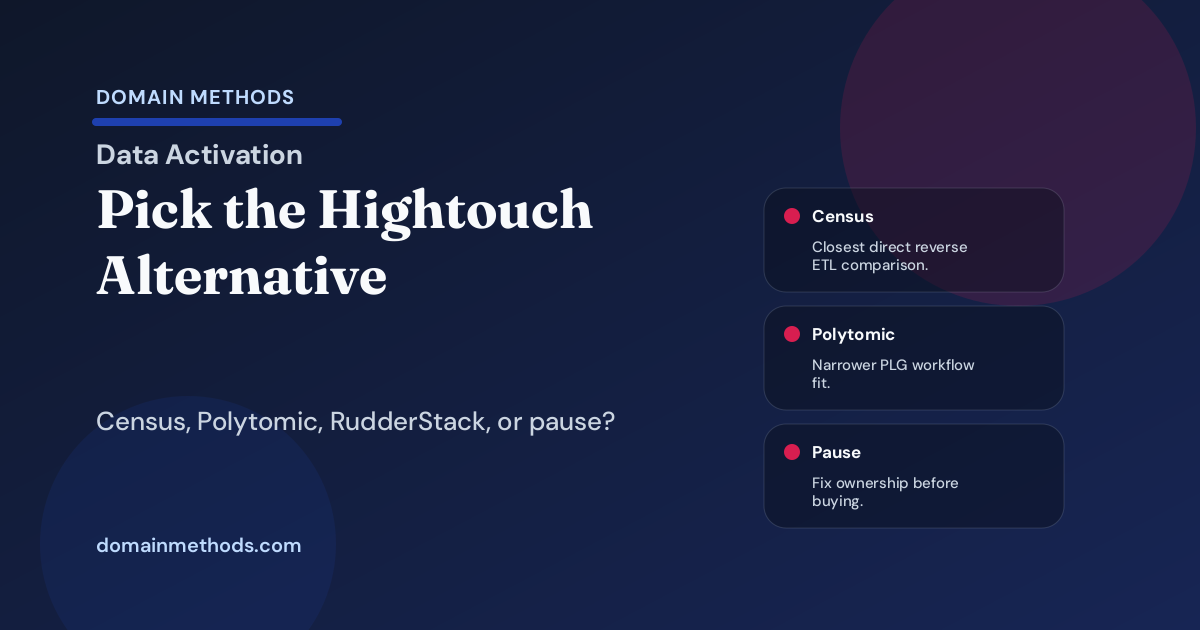
The best Hightouch alternative is not always another reverse ETL platform. It depends on what the team is really trying to move: a trusted warehouse field, a lifecycle audience, a product signal, an event stream, or a workflow that is not ready to automate yet.
For most mid-size SaaS teams, use this short version:
| Situation | Better short-list | Why |
|---|---|---|
| You want the closest direct warehouse-to-destination comparison | Census | It solves a similar reverse ETL job: modeled warehouse data into CRM, lifecycle, sales, and marketing tools. |
| You have a narrower PLG or product-signal workflow | Polytomic | It can be a slimmer fit when a technical/product-led team wants a focused sync layer instead of broad GTM activation sprawl. |
| You are rethinking event collection, identity, and customer-data infrastructure | RudderStack or a CDP path | The decision may be bigger than reverse ETL. The operating owner changes. |
| The workflow is highly specific and engineering already owns the surface | Custom syncs | Control can be worth it when the workflow is strategic enough to justify maintenance. |
| The first workflow, owner, or trusted model is still vague | Do not buy yet | A platform will make unclear logic easier to distribute, not easier to trust. |
That last row is where a lot of vendor evaluations should start. If the team cannot name the destination, owner, field, action, freshness rule, and failure path, the problem is not that Hightouch lacks a feature. The problem is that the activation workflow has not earned automation yet.
Use this alongside the Data Activation Playbook when the real decision is how trusted warehouse logic should reach CRM, lifecycle, sales, customer-success, or AI workflows safely.
Why teams look for Hightouch alternatives
Hightouch usually enters the conversation because someone wants to get warehouse-modeled data into the tools where the business works: Salesforce, HubSpot, Braze, Marketo, ad platforms, support tools, product surfaces, or customer-success systems.
The alternatives conversation tends to show up for a few practical reasons:
- Cost pressure. The first use case looked small, but the platform decision created a bigger recurring line item than leadership expected.
- Governance worry. Growth, RevOps, lifecycle, and product all want syncs, and the team can see sprawl coming.
- Ownership mismatch. Data owns the models, RevOps owns CRM fields, marketing owns journeys, and nobody owns what happens when the value is wrong downstream.
- Category confusion. The buyer is comparing Hightouch to Braze, Segment, RudderStack, Hevo, Denodo, Chargebee, or MuleSoft even though those tools often do different jobs.
- Workflow immaturity. The business wants activation, but the first decision that should change is still fuzzy.
The operator-level sign is the vendor spreadsheet with 40 rows and no column for “who owns the workflow after launch.” That is how teams turn a useful activation layer into another place for definitions to drift.
Census vs Hightouch is the closest direct comparison
If the question is “what is the closest alternative to Hightouch for reverse ETL?” the most practical answer is usually Census.
Both tools can move modeled warehouse data into business systems. Both can support CRM enrichment, lifecycle audiences, sales alerts, ad suppression, customer-success fields, and other activation workflows. The difference is less about whether either product can sync data and more about how the team wants to operate the sync layer.
Use the deeper Census vs Hightouch reverse ETL comparison when the shortlist is already those two tools. Use this article when the team is still asking whether the alternative is Census, Polytomic, RudderStack, custom syncs, or no platform yet.
| Decision lens | Hightouch | Census |
|---|---|---|
| Best when destination breadth matters quickly | Strong | Strong, but usually feels more controlled when CRM/lifecycle discipline is the priority |
| Best when the team wants a calmer warehouse-first operating model | Good if scope is governed tightly | Often stronger fit |
| Risk to watch | Sync sprawl before ownership is clear | Treating warehouse-first discipline as a substitute for downstream adoption |
| First question to ask | Which teams need this field or audience this quarter? | Which business systems should trust this modeled output, and who owns it? |
Neither tool fixes weak definitions. If the customer tier, lifecycle stage, churn-risk score, or account owner is still contested, you are not choosing a sync tool yet. You are exposing a governance problem.
Polytomic for narrower PLG and product-led workflows
Polytomic belongs in the conversation when the first workflow is narrower and more technical than a broad GTM activation rollout.
A PLG team may need to move product-qualified account signals, workspace activity, usage thresholds, churn-risk markers, or onboarding status into Salesforce, HubSpot, a lifecycle tool, or a CS workflow. If the team knows the workflow and wants a leaner sync layer, Polytomic can be a credible alternative to evaluating Hightouch for everything.
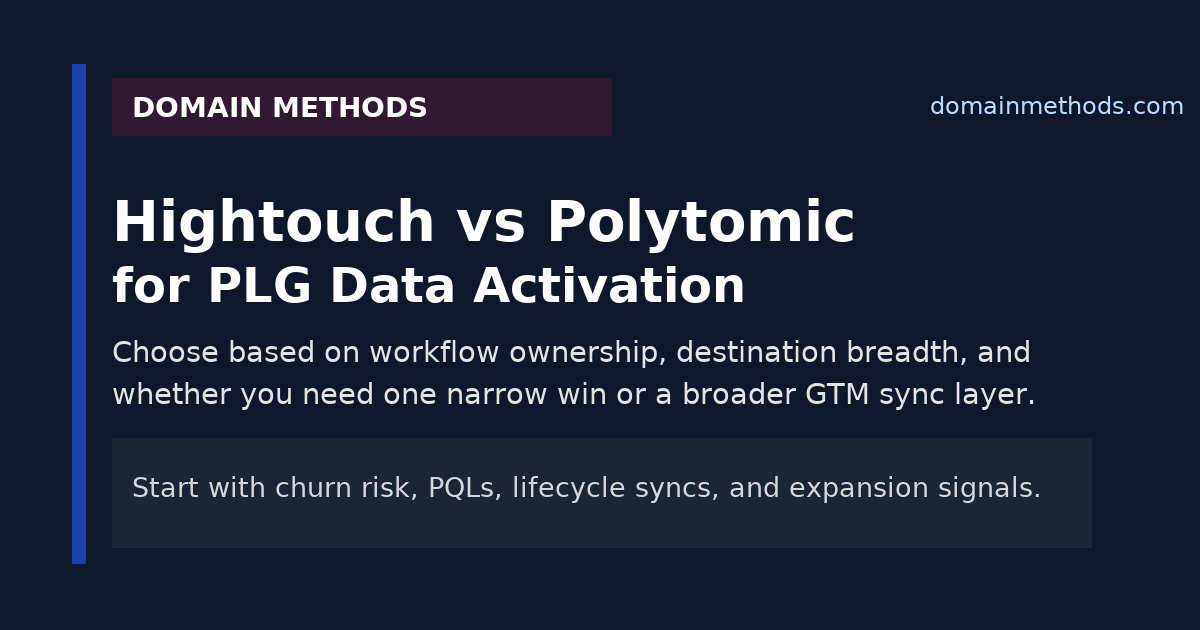
Read Hightouch vs Polytomic for PLG Data Activation if the question is specifically product-led. The practical split is this:
| Choose Polytomic when… | Choose broader Hightouch-style activation when… |
|---|---|
| The workflow is narrow, technical, and close to product or PLG operations. | Several GTM teams need many destinations quickly. |
| A small technical team can own sync setup, QA, and field discipline. | Marketing, sales, product, and success all expect activation coverage. |
| The first job is about getting one product signal into one operating system. | The first job is already a multi-destination lifecycle or revenue program. |
The warning sign is buying breadth because the first workflow is not sharp. Breadth is useful after you know what deserves to move.
RudderStack when the decision is broader than reverse ETL
RudderStack often appears in Hightouch-alternative searches, but it is not always a direct replacement conversation.
If the team is deciding how events are collected, how identity is resolved, where customer profiles are assembled, and how data moves through the stack, RudderStack may belong on the list. But that is a broader customer-data infrastructure decision than “which tool should sync a dbt model into Salesforce?”
This is where the architecture conversation matters. CDP vs reverse ETL vs warehouse-native activation is the better companion if the buyer is still deciding whether the operating layer should be CDP-led, reverse-ETL-led, or warehouse-native.
Use RudderStack-style options when the company needs to revisit the customer-data pipeline itself. Use reverse ETL when the warehouse already has trusted logic and the missing piece is operational delivery.
Custom syncs when engineering ownership is justified
Custom syncs are not a bad answer. They are just an expensive answer if the team has not priced the operating burden.
A custom sync can be right when:
- the workflow is narrow and strategically important
- the destination is unusual or deeply embedded in the product
- security, permissions, or audit needs are hard to handle in a vendor UI
- engineering already owns the surrounding system
- the business can tolerate a slower first launch in exchange for more control
The maintenance list is not theoretical. Someone owns retries, failed jobs, field mapping changes, null handling, schema drift, backfills, permissions, documentation, and the incident where a downstream field quietly stops updating before a campaign or sales play runs.
If the team has that capacity, custom can be the right move. If the motivation is mostly “we do not want another subscription,” compare the subscription against the internal maintenance bill honestly.
When adjacent tools are not direct Hightouch replacements
A lot of searches flatten every vendor into “Hightouch alternative.” That makes the evaluation worse.
Use this map to keep the categories clean:
| Tool or category | Usually what it is | The real question |
|---|---|---|
| Braze | Engagement destination / journey orchestration | Do we need governed audiences pushed into Braze, or are we choosing where campaigns run? |
| Denodo | Data virtualization / logical data access | Do we need governed access to data, or operational fields pushed into business tools? |
| Hevo | Ingestion / ELT | Are we getting data into the warehouse, or activating trusted warehouse data out of it? |
| Chargebee | Billing and subscription source system | Is billing data an input to activation, not the activation layer itself? |
| Segment | CDP / event collection and audience infrastructure | Are we solving identity/event collection, or warehouse-to-destination sync? |
| MuleSoft | Integration middleware / API-led connectivity | Is this a broad systems-integration problem or a specific reverse ETL workflow? |
This category discipline saves time. A team choosing between Hightouch and Braze may really need both: Hightouch or another reverse ETL layer to move governed audiences, and Braze to run the lifecycle experience. A team choosing between Hightouch and Hevo may be mixing up data ingestion with data activation.
How to choose a Hightouch alternative without buying the wrong layer
Use the buying conversation to answer operating questions, not just vendor questions.
| Decision factor | What to ask | What the answer tells you |
|---|---|---|
| CRM / lifecycle ownership | Who owns the destination field or audience after it lands? | Whether RevOps, lifecycle, CS, or product can actually use the sync safely. |
| Destination count | Is this one workflow in one tool, or several teams across many tools? | Whether a narrow tool, broad platform, or staged rollout is a better fit. |
| Warehouse and dbt maturity | Is the source model tested, documented, and trusted enough to expose? | Whether activation is ready or Data Foundation work comes first. |
| QA / retry needs | What happens when the sync fails, duplicates, or sends a stale value? | Whether the team needs vendor-managed monitoring or can own custom reliability. |
| Governance risk | Could a bad field affect revenue, compensation, customer messaging, or support? | Whether stricter ownership and review are required before launch. |
| Time to first workflow | What useful decision should change this quarter? | Whether speed matters more than architecture elegance. |
The strongest vendor answer is usually obvious after this table is filled in. If the table is full of blanks, the next move is not a bigger RFP.
Download the Reverse ETL Evaluation Matrix (PDF)
Use this lightweight scorecard to compare Hightouch alternatives against connector fit, destination ownership, QA burden, governance risk, and time to first workflow before the next vendor call.
Instant download. No email required.
Want future posts like this in your inbox?
This form signs you up for the newsletter. It does not unlock the download above.
The do-not-buy-yet checklist
Do not buy Hightouch, Census, Polytomic, RudderStack, or a custom sync project yet if these questions are still unanswered:
- What is the first workflow that should change this quarter?
- Which system receives the data?
- Which team owns the field, audience, or score after it lands?
- What action should a rep, marketer, CS manager, or product owner take because of it?
- Which warehouse model or source field is trusted enough to expose?
- How fresh does the data need to be for the workflow to matter?
- What happens when the sync fails or sends a value the business disputes?
- Who approves expansion to the second and third workflows?
A practical example: if sales wants a product-qualified account score in Salesforce, the hard part is not only pushing the score. It is agreeing on the score inputs, refresh cadence, owner, rep action, and rollback plan when a high-value account looks wrong. The platform can help with delivery. It cannot decide whether the business trusts the score.
What to do before the vendor call
Before the next demo, write a one-page activation brief:
- Workflow: the exact business action that should change.
- Source model: the warehouse table, dbt model, event stream, or billing field behind the signal.
- Destination: the CRM, lifecycle, ad, support, CS, or product system receiving it.
- Owner: the person accountable for field meaning and downstream use.
- Failure path: what happens when the data is late, blank, duplicated, or disputed.
- Expansion rule: what evidence justifies adding another destination or workflow.
That brief will tell you whether the right answer is Census, Polytomic, RudderStack, custom syncs, or Hightouch after all. More importantly, it will keep the buying decision tied to one workflow the business is prepared to own.
If the decision is really vendor selection, pair this guide with the Census vs Hightouch comparison and Hightouch vs Polytomic for PLG Data Activation. If the question is where dbt fits, read dbt and reverse ETL. If the question is broader architecture, use CDP vs reverse ETL vs warehouse-native activation.
If your team knows the first workflow and needs help shipping it cleanly, Data Activation is the implementation path. If leadership is still unsure which workflow is worth the quarter, start with The $500K Question.
See Data ActivationDownload the Reverse ETL Evaluation Matrix (PDF)
A lightweight scorecard for comparing Hightouch, Census, Polytomic, custom syncs, and adjacent architecture choices before the vendor call.
DownloadReady to ship the workflow?
Data Activation
Use the implementation service when the tool decision is really about getting trusted warehouse data into CRM, lifecycle, sales, or product workflows.
See Data ActivationStill choosing the first workflow?
The $500K Question
Start with the diagnostic when the team is still debating which activation workflow is valuable enough to automate this quarter.
See the growth diagnosticSee It in Action
Common questions about Hightouch alternatives
What is the closest alternative to Hightouch for reverse ETL?
Is RudderStack a Hightouch replacement?
When should a SaaS team use custom syncs instead of Hightouch?
Are Braze, Denodo, Hevo, Chargebee, Segment, or MuleSoft Hightouch alternatives?
When should the team not buy any reverse ETL platform yet?

About the author
Jason B. Hart
Founder & Principal Consultant
Helps mid-size SaaS companies turn messy marketing and revenue data into decisions leaders trust.