Fix Instrumentation First vs Fix Definitions First vs Buy Attribution Software First
- Jason B. Hart
- Marketing Analytics
- April 20, 2026
- Updated May 15, 2026
Table of Contents
What should a SaaS team fix first before it buys more attribution software?
Fix the first layer where the revenue story stops being believable. Sometimes that is instrumentation. Sometimes it is metric definitions. Sometimes it is owner accountability. Buy software only after the room can describe the break honestly.
That answer disappoints people who want a cleaner software conversation.
It is still the right answer.
Most attribution fights do not start with a careful choice between three good options. They start with a bad meeting:
- paid reports look stronger than the CRM story
- RevOps has one sourced-pipeline view and finance has another
- marketing wants a tool because the current answer feels weak
- nobody can tell whether the real break is tracking, definitions, or workflow ownership
That is when teams get expensive in a hurry.
They buy software to compensate for weak capture. They reopen tracking when the room still disagrees on what the stages mean. They argue about model choice when the real problem is that nobody owns the exception path once source data goes sideways.
A useful first move is the one that improves truth fastest, not the one that sounds most advanced.
Why teams keep getting this decision wrong
The first mistake is treating attribution as one problem.
It is not.
The same executive complaint - “I do not trust this report” - can mean at least four different things:
- source evidence is missing before the CRM ever inherits it
- source evidence survives, but lifecycle or revenue definitions drift by team
- the workflow between marketing, RevOps, sales, and finance has no real owner
- the operating system is stable enough that better attribution software could actually help
Those are not interchangeable situations.
If you skip that distinction, every option looks plausible for about ten minutes. Then the new tool, the new dashboard, or the new tracking cleanup inherits the same unresolved argument.
That is why Your Attribution Problem Probably Is Not an Attribution Problem matters here. A lot of teams jump straight to model fixes before they trace where the story is actually being lost.
The four real first moves
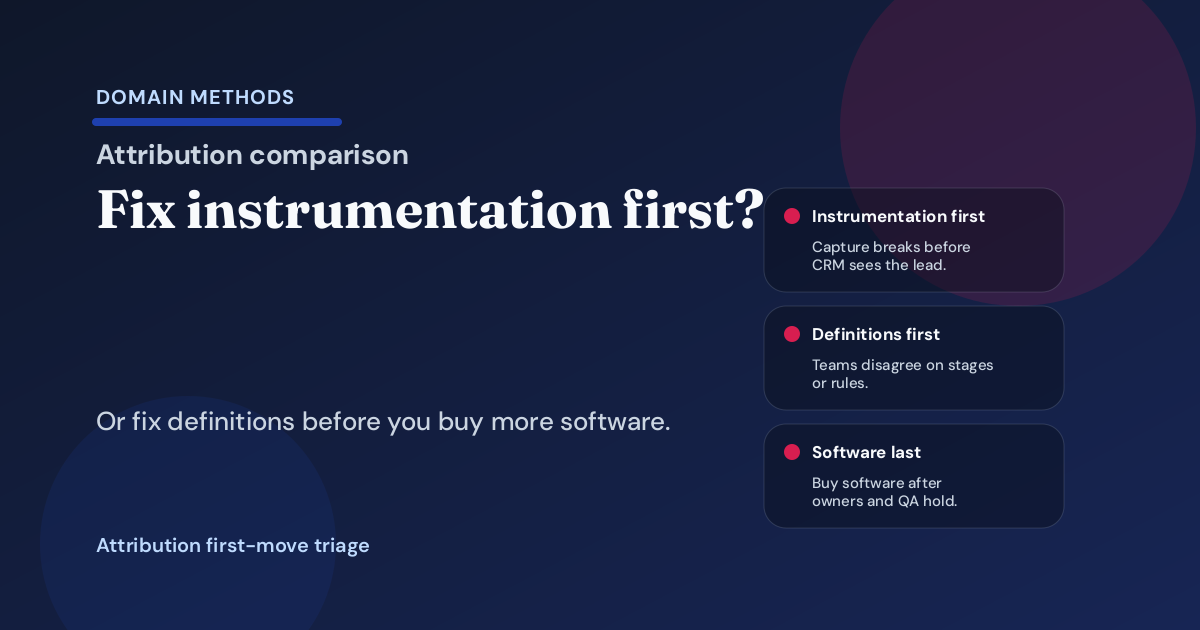
1. Fix instrumentation first
This is the right first move when the evidence is getting lost early.
Think:
- broken UTMs
- forms not passing source fields reliably
- missing events or conversion markers
- CRM syncs that drop campaign context before anyone can use it
- channel data that dies before opportunity creation even starts
Instrumentation work is upstream truth repair.
It is usually worth doing first when the team can already agree on the meaning of the target metric but cannot trust the raw evidence feeding it.
2. Fix definitions first
This is the right first move when the evidence exists, but the business meaning keeps moving.
Think:
- one team says sourced pipeline, another says influenced pipeline, and finance uses a third rule
- stage names stayed the same while qualification rules changed under them
- revenue linkage logic changed, but reporting language did not
- every dashboard looks tidy until someone asks what the metric actually includes
Definition cleanup is less glamorous than software buying.
It is also the move that prevents cleaner confusion.
3. Buy software first
This is the right first move far less often than buyers want it to be.
Software can help when the operating system underneath it is already stable enough to inherit.
That means:
- source capture is mostly reliable
- stage and revenue rules are stable enough to encode
- owners are named
- the team can support QA and implementation
- the remaining gap is genuinely about modeling, visibility, or repeatability
If those conditions are not true, the new tool usually gives the same disagreement a nicer interface.
4. Reset owner accountability first
This is the move teams forget to name.
Sometimes the room does not need more tracking work or a better definition workshop first. It needs someone to own the path between source capture, CRM rules, reporting caveats, and exception handling.
If nobody can answer these questions, you are not in software-buying territory yet:
- Who owns source capture standards?
- Who approves lifecycle-definition changes?
- Who checks whether campaign context survives conversion?
- Who decides whether the number is directional, decision-grade, or good enough for leadership?
That is not a tooling gap. It is an operating gap.
The comparison at a glance
| First move | Best when | Time-to-value | False-confidence risk | Coordination burden | What it does not fix |
|---|---|---|---|---|---|
| Fix instrumentation first | Source capture, events, or field persistence are visibly broken before the report is assembled | Medium-fast | Medium if teams still define the metric differently | Medium | It will not settle sourced-pipeline rules, influence logic, or revenue definitions by itself |
| Fix definitions first | Teams still disagree on what the number means or what counts in/out | Medium | Lower, because it prevents polished nonsense | High at first, then lower later | It will not restore missing UTMs, lost events, or broken CRM syncs |
| Buy attribution software first | Capture and definitions are already stable enough that better modeling and visibility can actually help | Medium | Highest when teams buy it too early | Medium to high | It will not repair weak source data, drifting lifecycle rules, or absent ownership |
| Reset owner accountability first | The room cannot name who owns standards, exceptions, or the trust bar for the report | Fast if leadership is willing to decide | Lower, because it makes future work less ambiguous | High in the short term | It will not replace actual tracking or definition cleanup once ownership is named |
The point of that table is not to produce fake precision.
It is to stop the room from pretending these moves are substitutes when they solve different failures.
Symptoms that look like instrumentation problems but are really definition problems
This is where a lot of teams burn time.
The report looks unstable, so everyone assumes source capture is failing. Sometimes it is. But these patterns usually point somewhere else:
- the same lead can count as sourced in one report and influenced in another
- lifecycle-stage conversion rates changed because the stage meaning changed, not because the campaign mix changed
- one team wants opportunity creation by created date while another wants it by accepted date or booking date
- campaign context survives, but nobody agrees which downstream milestone proves the channel worked
Those are not tracking bugs first.
They are business-definition bugs.
If you patch instrumentation in that environment, you can end up with cleaner raw data feeding a still-unstable metric story.
Symptoms that look like definition problems but are really instrumentation problems
The reverse mistake happens too.
Teams can spend weeks in a definitions debate when the deeper problem is brutally simple:
- UTMs are inconsistent enough that paid traffic is landing in a junk drawer
- forms or lead routing drop the original source before opportunity creation
- one conversion event fires twice and another never fires at all
- CRM fields exist on paper but are not populated consistently enough to carry the story
That is not a governance workshop problem. That is evidence loss.
When the evidence is broken at capture or handoff, no amount of elegant vocabulary will make the report more trustworthy.
When buying attribution software is premature
Software is premature when the team wants it to settle a fight that has not been named correctly yet.
It is usually too early when:
- marketing, RevOps, and finance still use different commercial definitions
- nobody has written the owner or exception rules for the fields that shape the story
- the CRM handoff path is not stable enough to preserve source context consistently
- the business still wants one tool to answer both directional optimization questions and board-grade trust questions without clarifying confidence levels
- the implementation team would inherit ambiguity instead of a real operating brief
A tool can speed up visibility. A tool can improve model management. A tool can make recurring reporting easier.
A tool cannot rescue a company from not knowing what it wants the metric to mean.
That is why the right comparison here is not “software versus no software.” It is “software versus the upstream fixes that make software worth buying.”
A practical scorecard for the next working session
If you want to settle this in one meeting, score each move against the same criteria.
Score instrumentation first higher when:
- the report breaks because source data is incomplete or missing
- the metric definition is mostly stable already
- one owner can actually repair capture, events, and field persistence
- a 30-day cleanup would give the room more believable evidence fast
Score definitions first higher when:
- the same dashboard gets interpreted differently by function
- the room keeps using the same words with different inclusion rules
- reporting trust breaks at the definition layer more than the event layer
- one workshop or definition record could remove recurring ambiguity quickly
Score software first higher only when:
- the team already trusts the upstream evidence enough to model it
- the current pain is repeatability, visibility, or model management instead of basic truth
- the owners and QA path are already named
- the team can say what the tool would still not fix
Score owner reset first higher when:
- every proposed fix dies because nobody owns the path end to end
- standards change informally and downstream logic never gets reset
- the fight keeps moving between teams without a tie-breaker
- leadership still has to decide who gets to call the number official
| Decision criterion | Instrumentation first | Definitions first | Software first | Owner reset first |
|---|---|---|---|---|
| Clear evidence path | Strong when capture is visibly broken | Medium unless the room already sees the semantic conflict clearly | Weak if the root cause is still disputed | Medium |
| Speed to cleaner truth | Medium-fast | Medium | Medium | Fast if leadership acts |
| Risk of cleaner confusion | Medium | Low | Highest | Low |
| Cross-functional coordination required | Medium | High | Medium to high | High |
| Long-term leverage | Medium | Strong | Medium unless the foundation is ready | Strong because it unblocks the next move |
The best first move is usually the one with the clearest owner, the fastest truth gain, and the lowest chance of producing polished nonsense.
A worked example
Say a mid-size SaaS team is trying to decide whether paid search is driving qualified pipeline.
Fix instrumentation first when:
UTM capture is inconsistent, source fields disappear during lead conversion, and the CRM cannot preserve campaign context long enough to support the question.
Fix definitions first when:
The source data is mostly present, but marketing, RevOps, and finance still use different rules for sourced pipeline, qualified pipeline, or influenced revenue.
Buy software first when:
The source path is stable, the metric rules are already governed, and the real problem is that the team needs better model management and more repeatable multi-touch visibility.
Reset owner accountability first when:
The same complaint keeps resurfacing because nobody owns standards, exceptions, or confidence labels for the revenue story.
Same headline question. Four different honest first moves.
That is why attribution-buying decisions go sideways when teams skip the diagnosis step.
Download the Attribution First-Move Triage Matrix
Use the worksheet before the next vendor demo, budget review, or RevOps debate when the room keeps jumping to tools before it names the real first repair move.
Download the Attribution First-Move Triage Matrix (PDF)
A practical worksheet for scoring instrumentation cleanup, definition cleanup, software purchase, and owner reset before another attribution tool hides the real problem.
Instant download. No email required.
Want future posts like this in your inbox?
This form signs you up for the newsletter. It does not unlock the download above.
If the worksheet shows that the disagreement is really about spend truth across platforms, CRM, and revenue, start with Where Did the Money Go?. If it shows that the real break is definition drift and cross-team accountability, the better next move is usually Three Teams, Three Numbers.
Bottom line
Attribution does not fail in just one way.
Sometimes the problem is tracking. Sometimes it is metric definitions. Sometimes it is a room full of people who want software to settle an ownership argument.
The team that wins this decision is not the one that buys the most sophisticated tool first. It is the one that fixes the first layer where the commercial story stops being believable.
Start with the spend diagnosticDownload the Attribution First-Move Triage Matrix (PDF)
A practical worksheet for scoring instrumentation cleanup, definition cleanup, software purchase, and owner reset before another attribution tool hides the real problem.
DownloadIf spend, pipeline, and revenue still tell different stories
Where Did the Money Go?
Use the diagnostic when the attribution fight is already affecting budget choices and leadership still cannot see which parts of the revenue story are trustworthy.
Start with the spend diagnosticIf the room still cannot agree what the numbers mean
Three Teams, Three Numbers
When the tooling debate is really a definitions and owner-alignment problem, use the workshop to lock the handful of numbers that need one shared rule.
See the alignment workshopSee It in Action
Common questions about the first attribution fix
When should instrumentation be the first move?
When should a team fix definitions before touching tools?
When is buying attribution software actually reasonable?
What if neither instrumentation nor definitions feels like the first problem?

About the author
Jason B. Hart
Founder & Principal Consultant
Helps mid-size SaaS companies turn messy marketing and revenue data into decisions leaders trust.