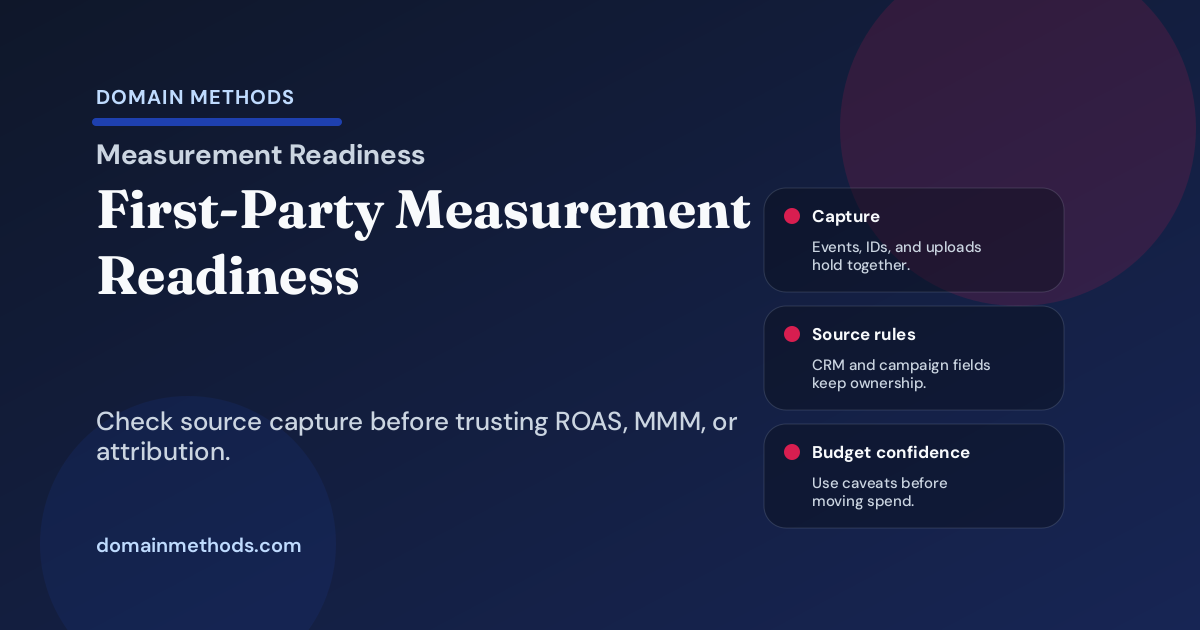
The First-Party Measurement Readiness Checklist: Before You Trust Attribution, MMM, or Platform ROAS
- Jason B. Hart
- Marketing Analytics
- July 8, 2026
Table of Contents
What is first-party measurement readiness?
First-party measurement readiness is the point where your own conversion, source, customer, and revenue data are clean enough to support a marketing decision.
It is not the same as having a better attribution model. It is the layer underneath the model: form capture, UTMs, lead-source rules, server-side events, offline conversion uploads, ecommerce orders, CRM stages, warehouse joins, finance outcomes, and the caveats that travel with each number.
Most teams start the debate too late. They ask whether they need attribution, MMM, incrementality, or platform ROAS. Those methods matter, but they all inherit the same input problem. If the source trail breaks before the model sees it, the model mostly turns missing context into confident-looking output.
The practical question is simpler: are the inputs strong enough for the decision you are about to make?
A weekly campaign-tuning decision can survive some caveats. A seven-figure budget move cannot. A board explanation cannot rest on a platform screenshot when the CRM, warehouse, and finance records disagree.
Use this checklist before the next attribution rebuild, MMM scoping call, platform-budget defense, or spend review.
Why this comes before attribution, MMM, or platform ROAS
Attribution, MMM, incrementality, and platform reporting each answer different questions. The Attribution vs MMM vs Incrementality guide covers that decision layer.
First-party readiness sits one level earlier.
If paid search conversions are double-counted, if HubSpot source fields get overwritten by sales workflows, if offline conversions are uploaded two weeks late, or if Shopify revenue is not reconciled to returns and contribution margin, the method debate is premature. You do not have a measurement-method problem yet. You have an input-contract problem.
This matters because measurement work usually enters the room with urgency attached:
- a growth leader needs to defend paid media spend
- finance wants to know whether platform ROAS is real
- RevOps sees source fields changing after handoff
- the data team is asked to make MMM work with incomplete history
- ecommerce leaders see revenue growth but margin pressure
- an AI or bidding workflow wants cleaner conversion signals than the business can actually certify
The operator tradeoff is uncomfortable. You can move fast with directional evidence, or you can slow down to repair source capture. The mistake is pretending a directional input is decision-grade because the model wrapped it in a cleaner interface.
The seven checks that matter
Do not turn this into a 90-field audit. Start with the seven places where budget confidence usually breaks.
| Readiness check | What to inspect | What breaks in real teams | Decision risk |
|---|---|---|---|
| Server-side and event capture | Browser events, server-side events, form submits, ecommerce orders, identity keys, dedupe rules | Browser-only tracking drops conversions; duplicate events inflate performance; IDs do not survive from session to customer | Platform ROAS looks precise while the observed conversion base is incomplete |
| CRM source ownership | Lead source, original source, latest source, campaign fields, lifecycle stage timing, owner rules | Sales, automation, imports, or enrichment tools overwrite source context after the handoff | Pipeline-source reporting becomes a workflow artifact instead of a buyer-path signal |
| Offline conversion handoffs | Opportunity creation, stage movement, closed-won, renewals, uploads back to ad platforms | Conversions arrive late, lack stable click IDs, or map to the wrong account/opportunity | Bidding and budget decisions optimize to stale or partial outcomes |
| Consent and privacy caveats | Consent mode, cookie banners, region rules, modeled conversions, platform estimates | Teams treat modeled or consent-limited numbers as if they are observed facts | Leadership over-trusts a number that should be labeled directional |
| UTM and campaign taxonomy | Channel taxonomy, campaign naming, source/medium rules, partner and lifecycle tags | Campaign names change mid-quarter; UTMs do not map to finance or channel families | MMM and attribution spend more time cleaning labels than answering the decision |
| Warehouse and revenue joins | Contact/account/order IDs, opportunity joins, billing tables, product events, refunds, margin | The warehouse can join touches to contacts but not to the revenue or margin definition leadership uses | Reporting answers a marketing question but not the business question |
| Finance reconciliation | Spend, invoiced media cost, agency fees, discounts, refunds, returns, COGS, recognized revenue | Marketing defends credited revenue while finance evaluates net economics | A spend decision passes the dashboard test and fails the margin or budget test |
The useful output is not a perfect score. It is a confidence label attached to the decision.
A quick confidence table
Use this table before the team decides what measurement method is allowed to carry the conversation.
| Confidence band | What is true | What it can support | What it should not support |
|---|---|---|---|
| Directional reporting | The team can see enough signal to investigate trends, but source capture or outcome joins still have known gaps | Weekly QA, campaign triage, anomaly investigation, a cleanup backlog | Major budget moves, board-ready channel contribution, automated bidding confidence |
| Ready for budget decisions | Source, conversion, revenue, and caveat rules are documented enough that stakeholders know what the number includes and excludes | Channel-mix choices, attribution cleanup priorities, MMM scoping, spend reallocation with caveats | Claims of causal lift unless the design actually tests causality |
| Source-capture repair first | The input layer is disputed, incomplete, overwritten, or unreconciled across systems | A repair sprint, source-precedence decision, server-side/offline conversion plan, warehouse reconciliation | Buying measurement software, changing attribution weights, asking MMM or platform ROAS to settle the argument |
This is where the meeting gets honest. A directional number can still be useful. It can tell you where to look, what to QA, and which channel story deserves pressure. It just cannot carry every decision.
The failure mode is not uncertainty. The failure mode is unlabeled uncertainty.
What server-side and offline capture actually change
Server-side tracking, conversion APIs, enhanced conversions, and offline conversion uploads are not magic. They do not make platform reporting neutral, and they do not remove the need for business definitions.
They solve a narrower problem: important conversion events are often invisible, duplicated, delayed, or disconnected from the business outcome.
In the DTC ecommerce attribution case study, roughly 25% of conversions had no reliable source data before the measurement rebuild. Server-side tracking recovered about 20% of previously unattributed conversions in that specific case. The useful lesson is not that every team should expect the same recovery number. The lesson is that a large missing-conversion problem can sit quietly underneath a confident ROAS report.
For SaaS teams, the same issue often shows up as lead and opportunity handoff friction. A form submit fires, but the contact merges later. The original source gets overwritten. A demo request becomes an opportunity after a sales touch. Offline conversion uploads arrive too late for the ad platform to learn from the outcome the business actually values.
For ecommerce teams, the issue often shows up as attribution windows and order economics. The platform sees a purchase. Shopify sees an order. Finance sees returns, discounts, shipping, fulfillment cost, and contribution margin. If those layers are not connected, the team can optimize toward a reported ROAS number that gets less profitable as it scales.
When not to let each method carry the decision yet
Use the method only after the input layer is fit for the job.
| Method | Do not ask it to carry the decision when… | Repair first |
|---|---|---|
| Platform ROAS | Conversion counts are modeled, duplicated, missing, or unreconciled to CRM/ecommerce outcomes | Event dedupe, server-side capture, offline conversion mapping, finance reconciliation |
| Multi-touch attribution | Source fields are overwritten, lifecycle stages are unstable, or campaign taxonomy changes midstream | Source precedence, CRM workflow ownership, UTM governance, stage rules |
| MMM | Spend and outcome history is inconsistent, channel labels change, or finance does not trust the revenue definition | Spend taxonomy, outcome definitions, seasonality/promo context, enough clean history |
| Incrementality / holdout | The outcome cannot be measured cleanly or the business has not agreed what action the result will trigger | Outcome trust, test isolation, timing, decision owner, budget threshold |
| AI-assisted bidding or routing | The workflow would act on incomplete or disputed conversion/revenue signals | Certified inputs, owners, exception handling, rollback rules |
This is why the Campaign Taxonomy and UTM Governance Checklist is not just tagging hygiene. Campaign taxonomy is one of the contracts that decides whether later measurement work has a stable input to read.
The holdout-test readiness guide makes the same point from the causal-proof side: a test is useful only when the treatment, outcome, timing, and decision owner are ready.
The meeting version of the checklist
Before a spend review, attribution rebuild, or MMM scoping call, ask seven questions out loud.
- What decision is this number supposed to support? If the answer is vague, the evidence bar will drift during the meeting.
- Which conversion events are observed, modeled, uploaded, or missing? Do not let those categories collapse into one total.
- Who owns source precedence after the lead or order enters the business system? If no one owns the overwrite rules, the attribution model is inheriting politics.
- How late can offline outcomes arrive before they stop being useful for optimization? A perfect conversion upload two weeks late may be too slow for the channel decision.
- Which revenue definition is the decision using? Pipeline, bookings, recognized revenue, net revenue, gross margin, and contribution margin answer different business questions.
- What caveat needs to travel with the number? Consent-limited, modeled, unreconciled, partial-channel, or margin-excluded should be visible in the readout.
- What repair would change the decision fastest? The next move may be smaller than a measurement platform: one source-precedence rule, one conversion API handoff, one warehouse join, or one finance reconciliation.
A strong team does not need every answer to be perfect. It needs enough clarity to avoid overclaiming the answer it has.
Download the First-Party Measurement Readiness Worksheet
Use the worksheet before the team trusts attribution, MMM, platform ROAS, or a budget readout built on source data no one has inspected.
Download the First-Party Measurement Readiness Worksheet
Score the seven input checks, assign a confidence band, and decide whether the next move is measurement, testing, or source-capture repair.
Instant download. No email required.
Want future posts like this in your inbox?
This form signs you up for the newsletter. It does not unlock the download above.
The worksheet is intentionally lightweight: one working checklist for the meeting, not a giant technical audit. It helps you name the decision, score the seven input checks, and write the caveat that should travel with the number.
The practical takeaway
The best measurement method cannot rescue an input layer the business does not trust.
That does not mean every team has to stop and rebuild everything before making decisions. It means the decision needs the right confidence label. Use directional evidence for triage. Use decision-grade evidence for budget movement. Use causal proof when you are claiming lift. Use repair work when the source trail is too broken to carry the argument.
If the immediate problem is spend confidence, attribution disagreement, or platform ROAS that no one fully believes, start with SaaS Marketing Attribution or Where Did the Money Go?. If the blocker is CRM, warehouse, ecommerce, or finance reconciliation, start with Data Foundation.
The goal is not prettier measurement language. It is a cleaner decision: what can we trust, what needs a caveat, and what must be repaired before the next expensive move.
First-Party Measurement Readiness Worksheet
A lightweight checklist for testing whether source capture, conversion handoffs, and revenue joins are ready before the next attribution or spend review.
DownloadWhen spend confidence is the problem
SaaS Marketing Attribution
Use the focused attribution path when source capture, lifecycle rules, campaign taxonomy, and platform credit need to become a trusted operating layer.
See SaaS Marketing AttributionIf the inputs are not ready yet
Data Foundation
Use the foundation path when CRM, warehouse, ecommerce, billing, or finance definitions need source precedence and governed joins before measurement can be trusted.
See Data FoundationSee It in Action
Common questions about first-party measurement readiness
What is first-party measurement readiness?
Do we need server-side tracking before we can trust attribution?
How is this different from an attribution model comparison?
When should the team repair source capture before buying measurement software?

About the author
Jason B. Hart
Founder & Principal Consultant
Helps mid-size SaaS companies turn messy marketing and revenue data into decisions leaders trust.